Digital Workflows in Property Closings: 2026 Guide
Discover the role of digital workflows in property closings. Learn how automation improves efficiency and speeds up transactions in 2026.

Digital workflows in property closings are defined as automated, technology-driven systems that manage document routing, stakeholder notifications, compliance tracking, and task handoffs across the entire closing process. The role of digital workflows in property closings has shifted from optional convenience to industry standard. As of early 2026, roughly 90% of mortgage lenders offer digital closing options. That figure signals a fundamental change in how real estate transactions get done. Federal recognition of electronic signatures under the ESIGN Act, combined with the spread of Remote Online Notarization (RON) laws across most U.S. states, has given digital closings a firm legal foundation. Beesign operates within this framework, supporting ESIGN, eIDAS, and HIPAA compliance for real estate teams that need both speed and legal certainty.
How do digital workflows streamline the property closing process?
A traditional closing moves through a predictable sequence: title search, document preparation, lender approval, signing, notarization, recording, and disbursement. Each step depends on the previous one finishing. When any party is slow, the whole chain stalls.
Digital workflow automation replaces that fragile chain with a system that tracks every milestone and acts on it automatically. Here is how a digitally automated closing typically runs:
- File opened. The workflow triggers a task list and sends welcome communications to all parties simultaneously.
- Title search ordered. The system routes the request and sets a deadline. If the deadline passes without a response, an automated follow-up fires.
- Documents prepared. Templates populate with transaction data pulled from the file. No manual re-keying.
- E-signature packets sent. Buyers, sellers, and lenders receive signing links. Automated signature reminders go out on a schedule until every document is executed.
- Notarization completed. RON platforms connect signers with a notary online, with the session recorded for compliance.
- County e-recording submitted. The workflow pushes the signed deed directly to the county recorder’s system.
- Disbursement triggered. Funds release once all conditions are confirmed.
Lender delays are the top cause of closing delays. Automated follow-ups address this directly by notifying lenders the moment a milestone is ready for their action, rather than waiting for a title officer to make a phone call.
Pro Tip: Set your workflow to send a second automated reminder 24 hours before a deadline, not just when the task is first assigned. Most delays happen because parties forget, not because they refuse to act.
The biggest time loss in title operations is not title examination itself. Coordination tasks like verifying payoffs and HOA demands consume the most hours, often requiring dozens of fragmented calls and emails. A well-built workflow routes those requests automatically and tracks responses in one place.

What are the primary benefits of adopting digital workflows for property closings?
The benefits of automating property closings are measurable, not theoretical. Workflow automation reduces repetitive manual tasks by 60–95% and delivers time savings up to 77% on routine activities. For a title company processing dozens of files per month, that is a significant reduction in labor cost.
The specific advantages for real estate professionals and buyers include:
- Faster closings. Traditional closings take 30–60 days. Digital workflows compress that timeline by removing the bottlenecks caused by manual handoffs and missed communications.
- Fewer errors. Digital workflows reduce errors by 31% and can save over 70 minutes of internal work per loan. Fewer errors mean fewer corrective actions and fewer delayed closings.
- Built-in compliance. Digital workflows automatically create an audit trail that documents every action, timestamp, and approval. That trail is essential when regulators or lenders request proof of process.
- Transparent communication. Every party sees the same status in real time. Buyers stop calling their agent to ask what is happening because the workflow sends them updates automatically.
- Positive ROI. Nearly 60% of business process automation initiatives report positive ROI within 12 months. For real estate teams, that return comes from reduced labor, fewer errors, and faster deal cycles.
The compliance benefit deserves extra attention. An electronic signature with audit trail captures who signed, when, from what device, and under what IP address. That level of documentation satisfies requirements under ESIGN, eIDAS, and state-level RON statutes without any manual logging.
What technological components make digital workflows effective?
Effective digital closing workflows are not built from checklists. True automation requires integration layers connecting email, e-signature platforms, title production software, and county e-recording systems. Without those connections, staff still re-key data between systems, which reintroduces the errors and delays that automation is supposed to eliminate.
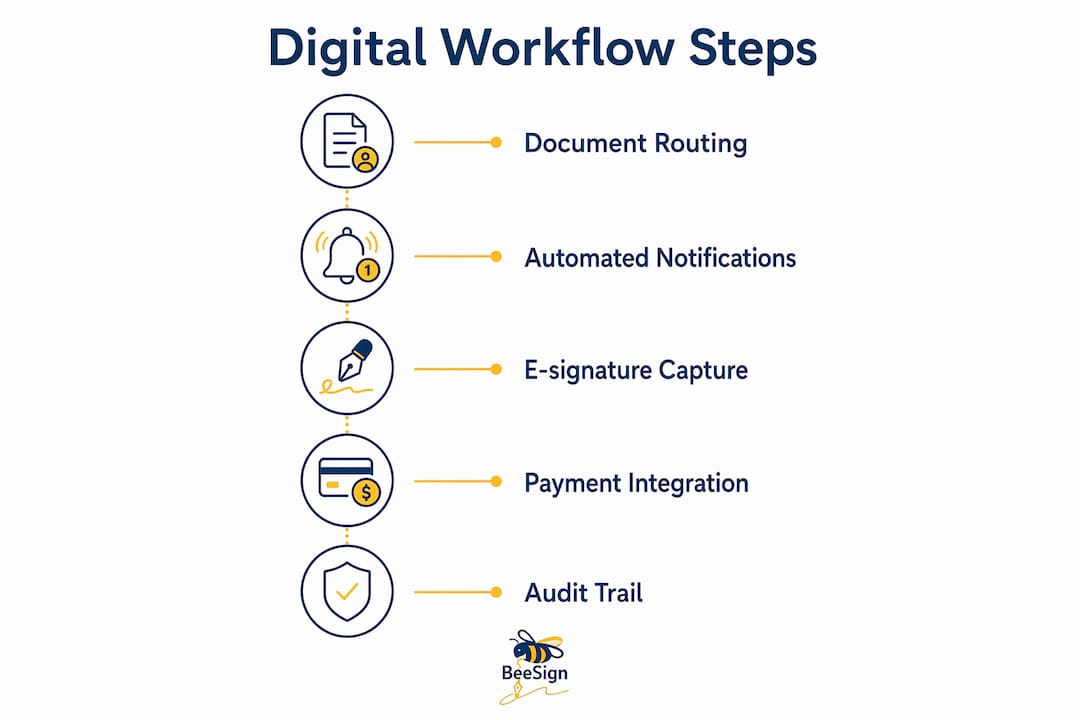
The core components of a working digital closing stack include:
| Component | Function in the closing workflow |
|---|---|
| E-signature platform | Collects legally binding signatures with identity verification and audit trail |
| Title production software | Manages file data, generates documents, and tracks closing conditions |
| County e-recording system | Submits recorded documents electronically, cutting recording time from days to hours |
| RON platform | Enables notarization to happen remotely with a recorded video session |
| Payment processing layer | Handles wire transfers and disbursements within the workflow |
The payment layer is worth noting separately. The movement of money in real estate still often relies on outdated in-person methods, even when every other step has gone digital. That gap is the next major opportunity for real estate technology to close.
Pro Tip: Before selecting any platform, confirm it offers a documented API. An API lets your workflow engine talk directly to title software, e-signature tools, and recording systems without manual exports or imports.
Beesign’s real estate digital solutions address this integration need directly. The platform centralizes contracts, identity verification, and automated workflows in one place, with an API that connects to existing real estate systems. That architecture eliminates the manual re-keying that undermines most partial automation attempts.
What practical strategies help real estate professionals implement digital workflows?
Adoption succeeds or fails based on execution, not technology selection. The right platform with poor onboarding produces the same delays as a paper process.
Follow these strategies to get digital workflows working in your closing operations:
- Map your current process first. Write down every task, who owns it, and how long it typically takes. You cannot automate what you have not documented.
- Start with high-volume, repeatable tasks. Document requests, payoff orders, and signature reminders are the best candidates for early automation. They happen on every file and follow a predictable pattern.
- Train all participants before go-live. Agents, lenders, and buyers all interact with the workflow. If any party does not understand how to respond to automated requests, the workflow stalls at their step.
- Build in human checkpoints. The most effective workflows automate repeatable handoffs while preserving human judgment for critical tasks like title examination and disbursements. Automation handles the routine. People handle the judgment calls.
- Plan for post-closing tasks explicitly. Post-closing tasks often fail due to manual management, a pattern known as the “post-closing cliff,” where attention shifts away from completed deals. Build post-closing steps directly into the workflow so they execute automatically, not when someone remembers.
- Review workflow performance monthly. Track which steps generate the most delays or errors. Adjust triggers, deadlines, and escalation rules based on real data.
The post-closing cliff is a specific and underappreciated risk. Once a deal closes, the file feels done. But recording confirmations, final title policy delivery, and document archiving still need to happen. Automating those steps at the point of closing, not after, prevents them from falling through the cracks.
Key Takeaways
Digital workflows are the most direct path to faster, more accurate property closings, and the technology to support them is now standard across the industry.
| Point | Details |
|---|---|
| Industry adoption is near-universal | Roughly 90% of mortgage lenders now offer digital closing options, making paper-only processes a competitive disadvantage. |
| Automation cuts errors and time | Digital workflows reduce errors by 31% and can save over 70 minutes of internal work per loan. |
| Integration is required for real automation | Connecting e-signature, title software, and e-recording systems eliminates manual re-keying and delivers actual workflow automation. |
| Audit trails protect compliance | Every digital action is logged automatically, satisfying ESIGN, eIDAS, and RON requirements without manual documentation. |
| Post-closing needs its own workflow | The post-closing cliff is a documented failure point. Automating final tasks at closing prevents them from being forgotten. |
What I’ve learned about digital workflows that most guides won’t tell you
The conversation around digital closings tends to focus on speed. Faster signatures, faster recording, faster disbursements. That framing is accurate but incomplete.
What I have seen repeatedly is that the biggest gains from digital workflows are not in the fast parts of the process. They are in the slow, fragmented middle: verifying payoffs, chasing HOA demand letters, confirming lender conditions. Those tasks are invisible in most workflow diagrams, but they consume the most hours. When you automate the coordination layer, not just the signing layer, you find the real efficiency.
The second thing most guides miss is the human judgment question. There is a temptation to automate everything once you see how well automation handles routine tasks. That instinct leads to problems. Title examination, disbursement decisions, and exception handling all require a person who understands the transaction. The best digital closing operations I have observed treat automation as a support system for experienced professionals, not a replacement for them.
The payment infrastructure gap is the most underappreciated issue in the space right now. You can have a fully digital signing and recording process, and then watch the closing stall because a wire transfer requires someone to be physically present at a bank. That friction point will define the next wave of real estate technology investment.
The professionals who will benefit most from digital workflows are not the ones who adopt the most tools. They are the ones who map their process honestly, automate the right steps, and keep humans in control of the decisions that actually matter.
— Mustafa Abusharkh
Beesign brings digital workflows to your closing process
Real estate closings involve too many moving parts for manual coordination to stay reliable at scale. Beesign centralizes the tools that make digital closings work: secure electronic signatures, identity verification, automated document routing, and a full audit trail that satisfies ESIGN, eIDAS, and HIPAA requirements.

Beesign supports remote online notarization workflows and connects to existing real estate systems through its API, so your team does not have to rebuild its process from scratch. The platform’s white-label option lets title companies and brokerages run the service under their own brand, with data stored in their own infrastructure. Real estate professionals who want to close property deals faster without the paper chase can get started with Beesign’s full feature set at beesign.net.
FAQ
What is a digital workflow in a property closing?
A digital workflow in a property closing is an automated system that routes documents, triggers notifications, and tracks task completion across all parties without manual intervention. It replaces phone calls and email chains with rule-based automation tied to closing milestones.
How much time can digital workflows save in a closing?
Workflow automation reduces manual tasks by 60–95% and can save over 70 minutes of internal work per loan. The largest time savings come from automating coordination tasks like payoff requests and HOA demand letters.
Are digital closings legally valid in the United States?
Digital closings are legally valid under the federal ESIGN Act, which recognizes electronic signatures as legally binding. Most U.S. states also permit Remote Online Notarization under state-level RON statutes.
What is the post-closing cliff?
The post-closing cliff is the documented pattern where final tasks like recording confirmations and title policy delivery are forgotten after a deal closes. Automating those steps within the closing workflow prevents them from being missed.
What should real estate professionals look for in a digital closing platform?
Look for a platform that offers e-signature with a full audit trail, identity verification, API integration with title software and county e-recording systems, and compliance with ESIGN and eIDAS. Beesign’s platform features cover all of those requirements in one place.
Recommended
Ready to transform your workflow?
Start using BeeSign today and experience the future of document signing