Electronic Signature vs Wet Signature
Electronic signature vs wet signature: learn the legal, security, speed, and compliance differences so you can choose the right option.
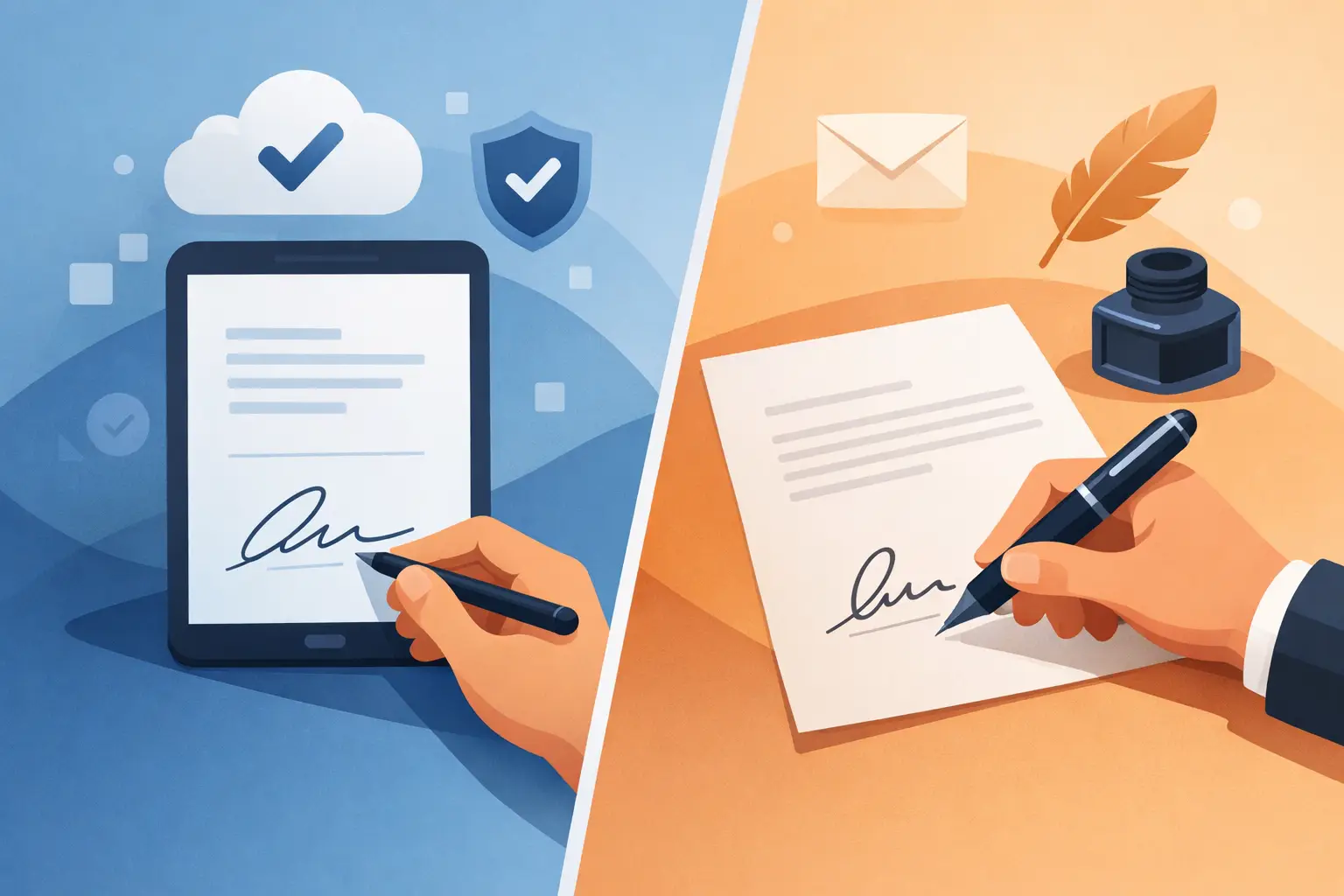
A sales contract is sitting in someone’s inbox, printed but not signed, because the approver is traveling and the final signer is at home. That small delay turns into a missed day, then a missed week. This is where electronic signature vs wet signature stops being a legal theory and becomes an operations problem.
For most business teams, the real question is not which option feels more traditional. It is which one gets documents signed faster, holds up when challenged, and fits the level of risk in the transaction. Sometimes that answer is a wet signature. Often, it is an electronic signature. The smart choice depends on the document, the jurisdiction, and how much identity assurance you need.
Electronic signature vs wet signature: what’s the difference?
A wet signature is the classic handwritten signature made with ink on paper. It usually requires printing, physically signing, scanning, mailing, or storing the original document. People trust it because it is familiar, not because it is always more secure.
An electronic signature is a signature applied digitally to an electronic document. That can be as simple as clicking to sign or drawing a signature on screen, or as advanced as signing with identity verification, tamper-evident sealing, and a full audit trail. In business practice, that range matters. Not every electronic signature workflow offers the same level of proof.
The biggest mistake is treating these as a choice between old-school validity and modern convenience. In many cases, electronic signatures are legally enforceable and operationally stronger because they can capture timestamps, IP addresses, document history, and signer actions automatically. A paper document with a scribbled signature may feel concrete, but if it is scanned, emailed around, or filed badly, it can be surprisingly weak as evidence.
Why businesses are moving away from wet signatures
Wet signatures create friction at every step. Someone has to print the document, sign it, scan it back, send it, and then make sure the final version is stored somewhere people can actually find later. If the signing order matters, or multiple approvals are needed before signature, the process gets slower and messier.
Electronic signatures remove most of that drag. A team can upload a document, place fields, set signing order, request approvals, and send it from a browser. The recipient signs from any device. The sender can track progress instead of chasing email threads. Done right, that turns a process that takes days into one that takes minutes.
This is not just about speed for sales teams trying to close faster. HR teams onboarding new hires, legal teams managing routine agreements, and operations teams collecting forms all benefit when signature workflows are standardized. Less printing. Less scanning. Fewer version-control mistakes. More visibility into who signed what, and when.
Is an electronic signature legally binding?
Usually, yes. In the US, electronic signatures are broadly recognized under laws such as the ESIGN Act and UETA, provided the basic requirements for enforceability are met. That generally includes intent to sign, consent to do business electronically, a clear connection between the signer and the signature, and proper record retention.
That said, legally binding does not mean legally identical in every scenario. Some documents still require wet signatures, notarization, or other formalities depending on state law, federal law, or the type of transaction. Certain estate planning documents, court filings, or highly specific regulated forms may have stricter rules. This is where “it depends” is the honest answer.
If your team handles higher-risk or cross-border agreements, the better question is not only whether electronic signatures are allowed, but what level of evidence you can produce if the signature is challenged. A typed name in a box may be enough for a low-risk internal approval. A high-value contract, healthcare consent, or financial agreement may call for stronger identity verification and a more complete audit record.
Security is where electronic signature vs wet signature gets interesting
Many people assume wet signatures are safer because they are physical. In practice, paper is easy to lose, alter, misfile, or sign without much proof of who actually signed. Once a signed paper document is scanned and emailed, its so-called physical certainty starts to disappear.
Electronic signatures can be more secure when the workflow includes the right controls. A strong platform can encrypt documents in transit and at rest, apply tamper-evident sealing, and generate an audit trail showing every send, open, view, and signature event with timestamps and IP addresses. That gives legal and compliance teams far more context than a scanned PDF with an ink signature and no supporting history.
Security also improves when identity verification is built into the signing flow. For sensitive agreements, it may be appropriate to verify a government ID, match a face with liveness detection, or validate signer details against trusted data sources. At that point, the discussion is no longer just electronic signature vs wet signature. It becomes a question of evidence quality.
A plain wet signature tells you someone wrote something on paper. A well-designed electronic signature workflow can tell you who accessed the document, what they reviewed, when they signed, from where, and whether the document changed afterward.
When a wet signature still makes sense
Wet signatures are not obsolete. They still make sense in a few situations.
First, some laws or institutions still require them. If a court, government agency, title office, or specific form instructions require ink, that requirement wins.
Second, certain ceremonial or relationship-driven moments may call for paper. Board resolutions, commemorative agreements, or high-touch transactions sometimes benefit from the formality of a physical signing. That is more about experience than enforceability, but it can matter.
Third, not every signer is comfortable with digital tools. If the recipient has limited internet access, low technical confidence, or a strong preference for paper, a wet signature may be the practical option.
Even then, it is worth separating preference from necessity. Many teams keep using wet signatures simply because that is how the process was built years ago, not because the documents truly require it.
When electronic signatures are the better choice
For most routine business workflows, electronic signatures win on speed, visibility, and control. Sales agreements, NDAs, employee onboarding packets, vendor contracts, intake forms, and internal approvals are all strong candidates.
They are especially useful when multiple people need to sign in sequence, when teams need a system of record, or when turnaround time affects revenue or service delivery. If your current process involves attaching PDFs to emails, asking people to print and scan, and then manually renaming files, that is a sign the workflow is doing too much work.
Electronic signatures are also better suited to remote and distributed teams. No one has to be in the same office. No apps are required for recipients. Documents can move across departments without turning into a chain of attachments and manual reminders.
Platforms like BeeSign push this further by combining templates, approvals, audit trails, and identity verification in one flow. That matters when the business goal is not simply collecting a signature, but managing the whole agreement lifecycle with fewer tools and less risk.
How to choose the right option for each document
Start with the legal requirement. If the document must be signed in ink, that is your answer.
If electronic signatures are allowed, assess the risk of the transaction. A simple internal acknowledgment does not need the same controls as a high-value customer agreement or a regulated consent form. For low-risk documents, a standard electronic signature may be enough. For higher-risk documents, use stronger authentication, identity verification, and a detailed audit trail.
Then look at workflow complexity. If the document needs approvals before signature, multiple signers, status tracking, or repeatable templates, electronic signature usually offers a much better operational fit. The more steps involved, the more paper breaks down.
Finally, think about what happens after signing. How will the record be stored, retrieved, and defended if questioned later? This is where electronic workflows often outperform paper. Searchable records, access controls, and tamper evidence are hard to match with filing cabinets and scanned attachments.
The practical takeaway on electronic signature vs wet signature
The better option is the one that fits both the legal requirements and the business reality. Wet signatures still have a place, but that place is narrower than many teams assume. For most modern agreements, electronic signatures are not a compromise. They are a faster, more trackable, and often more defensible way to get business done.
If a document carries higher risk, do not fall back on paper by default. Upgrade the digital workflow instead. Add identity verification. Preserve a complete audit trail. Use tamper-evident records. Build a process that is easy for signers and credible for compliance.
The goal is not to make signatures feel modern. It is to make agreements move faster without giving up proof, control, or trust.
Ready to transform your workflow?
Start using BeeSign today and experience the future of document signing