Financial Services Document Verification That Works
Financial services document verification helps teams stop fraud, speed approvals, and create audit-ready agreements without adding friction for clients.
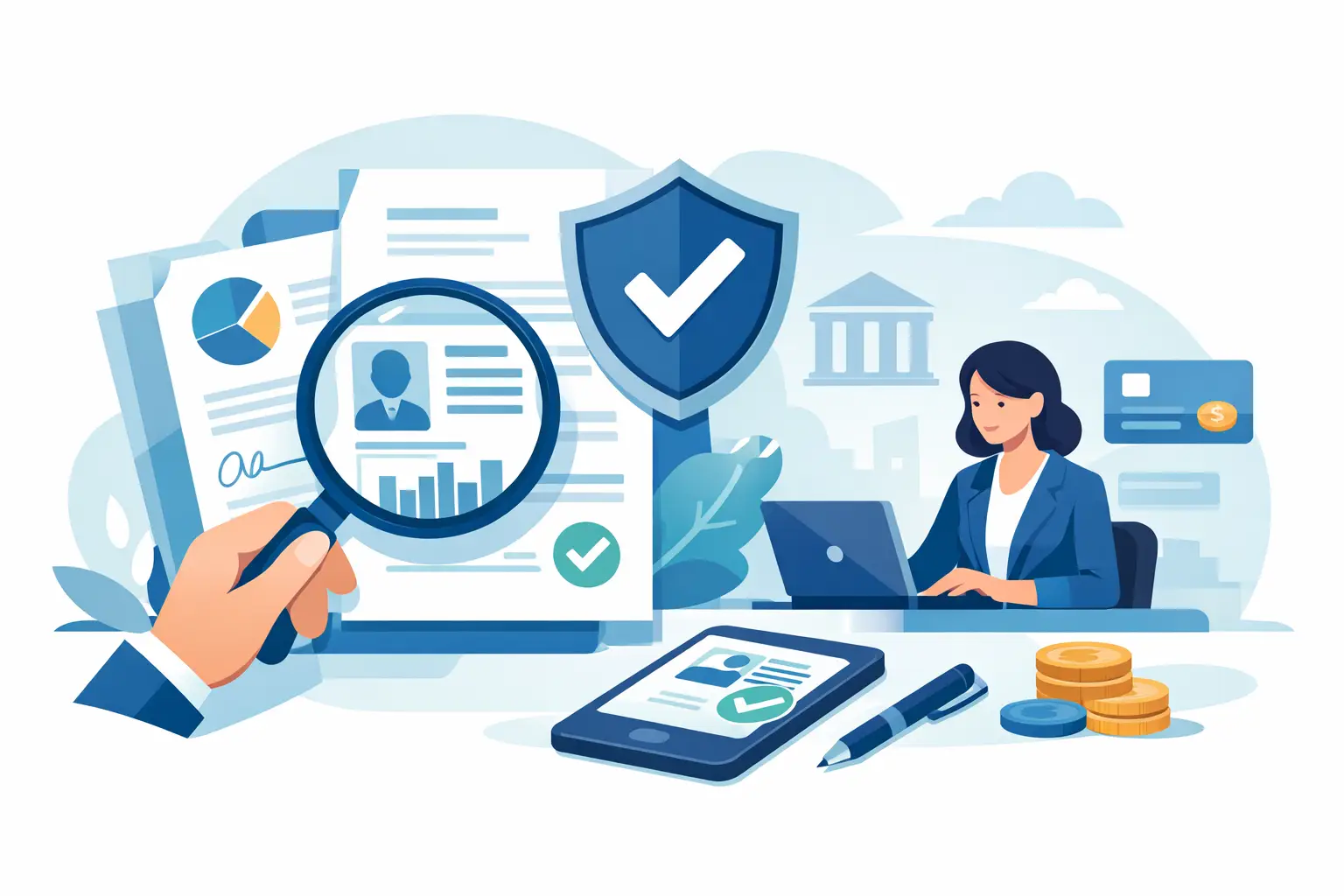
A new account application can look complete and still be risky. A photo ID may be expired, a bank statement may be altered, or the person signing an agreement may not be the person shown on the document. Financial services document verification closes that gap by connecting document checks, identity assurance, approvals, and signed records in one controlled workflow.
For financial teams, the goal is not to create more steps for legitimate customers. It is to collect the right evidence at the right point in the process, then preserve a clear record of what happened. Done well, verification speeds decisions while giving compliance and operations teams the proof they need later.
What financial services document verification should prove
Document verification is often discussed as a single check. In practice, it answers several different questions. Is the document authentic? Is it current and complete? Does it belong to the person submitting it? Does the information match trusted data sources or the details already on file? And, for an agreement, can the business show who approved and signed it?
The answer depends on the workflow. A lender reviewing an income document needs confidence that the document is genuine and that the applicant’s details are consistent. A wealth management firm opening an account may need government ID validation, a face match, and proof that the customer completed the required disclosures. A payments company may need to confirm the identity of both a business representative and the person authorized to sign.
This is why a simple upload field is rarely enough. A strong process combines document capture with identity checks, workflow controls, and evidence that remains attached to the final agreement.
Verification is not the same as a signature
An electronic signature can show intent to sign and create a record of the signing event. It does not automatically prove the signer’s identity to the level required for every financial workflow. For lower-risk agreements, an email-based signing flow and audit trail may be appropriate. For higher-risk transactions, businesses may need government ID capture, biometric face matching with liveness detection, and database validation before allowing the signer to proceed.
That distinction matters when a customer disputes an agreement, a regulator asks how onboarding controls work, or an internal reviewer needs to understand why an exception was approved. The right level of verification should match the transaction’s risk, value, jurisdiction, and regulatory obligations.
Where document verification breaks down
Most financial operations teams do not struggle because they lack a way to collect files. They struggle because evidence is scattered. An applicant uploads an ID through one portal, sends supporting documents by email, receives disclosures from another system, and signs through a separate tool. Someone then copies data between systems and chases missing items manually.
That creates predictable problems: delayed account opening, inconsistent reviews, weak handoffs, and an incomplete audit record. It also increases the chance that sensitive documents sit in inboxes or unsecured folders longer than they should.
Manual review still has a place. A trained reviewer can spot context that automated checks may miss, especially with complex ownership structures, unusual document formats, or legitimate edge cases. But manual review should be an exception path, not the default operating model. Teams need automation for repeatable checks and a clear escalation route for cases that need human judgment.
Build verification into the agreement workflow
The most reliable approach is to treat verification as part of the agreement lifecycle, not as a task bolted on after documents are signed. Start by mapping the decision you need to make: open an account, approve a loan, onboard a merchant, renew a client agreement, or collect an authorized signature.
Then define what evidence is required before the process can move forward. For a higher-assurance flow, that may include a government-issued ID, a selfie with liveness detection, and database validation. For a routine disclosure acknowledgment, it may mean confirming access to a known email address and retaining a detailed signing audit trail.
Next, build the sequence around real operational roles. The customer completes required fields and uploads documents. The verification step runs before signing or before final approval, depending on your policy. A compliance reviewer receives exceptions. An authorized employee approves the package. The customer signs, and the completed agreement, verification result, and audit certificate remain connected.
This order reduces rework. It prevents teams from discovering a failed identity check after everyone has already signed, and it gives reviewers a consistent file instead of a collection of screenshots and email threads.
Keep controls visible, not burdensome
A controlled workflow does not need to feel heavy. Use clear instructions, mobile-friendly capture, and only request documents that are genuinely needed. Tell customers why a document is required and what happens next. When a check fails, provide a practical path forward rather than a vague error message.
The trade-off is real: adding verification can create friction, while reducing checks can increase fraud and compliance exposure. Risk-based design is the answer. Apply stronger identity assurance when the customer relationship, transaction, or product warrants it. Keep lower-risk workflows simple, but never lose the audit trail.
Security and auditability are part of the product
Financial documents contain information that deserves more than basic file storage. Security controls should protect data while it moves, while it is stored, and throughout the approval and signing process. Look for TLS encryption in transit, 256-bit AES encryption at rest, access controls that separate workspaces, expiring links, and tamper-evident sealing for completed documents.
Auditability is equally important. A useful audit trail records each material event: document creation, send time, views, authentication steps, field completion, approvals, signatures, timestamps, and IP addresses. The record should be attached to the completed agreement so it is available when a customer, auditor, or legal team needs it.
For teams working across borders, electronic signature requirements can vary. eIDAS-compliant Advanced Electronic Signatures may be appropriate when identity assurance needs to be stronger than a standard electronic signature. The key is not to select a signature level because it sounds impressive. Select it because it matches the legal context and risk of the transaction.
Questions to ask before choosing a platform
A financial services workflow should be evaluated as a whole. Can the platform collect documents, verify identity, route approvals, and capture signatures without sending customers through disconnected tools? Can compliance teams see the evidence behind an approval? Can the organization set templates and rules so each team follows the same process?
Integration matters, too. High-volume teams should be able to trigger document packages from their CRM, onboarding system, or internal application. An API-first platform lets product and engineering teams create documents, add recipients, manage templates, and track status from the systems employees and customers already use.
Data control can be a deciding factor for regulated organizations. Some businesses need branded experiences under their own domain, emails sent from a verified company domain, or the ability to keep documents and certificates in their own cloud storage. These are not cosmetic preferences. They can support security reviews, customer trust, and internal governance.
BeeSign brings document workflows, identity verification, approvals, and legally binding eSignatures together so teams can move from draft to verified agreement without stitching together separate systems.
Make the exception path as clear as the happy path
No verification process is perfect, and pretending otherwise creates delays. Documents can be blurry, names can differ for legitimate reasons, and databases can return incomplete results. Decide in advance who reviews exceptions, what additional evidence they can request, how decisions are recorded, and when a case must be declined or escalated.
This is where consistency protects both the business and the customer. A documented exception process prevents frontline teams from improvising controls under pressure to close an account or finalize a transaction. It also gives compliance leaders useful data: which checks fail most often, where customers abandon the process, and which document types create the most manual work.
The best financial services document verification workflow is one your team can explain plainly: what was collected, how it was checked, who approved it, and what evidence supports the final agreement. Build that clarity into every transaction, and faster service does not have to come at the expense of trust.
Ready to transform your workflow?
Start using BeeSign today and experience the future of document signing