Why Use Verified Signing Identities for Contracts?
Why use verified signing identities? Confirm who signs, reduce fraud risk, support compliant agreements, and keep high-stakes workflows moving fast now.
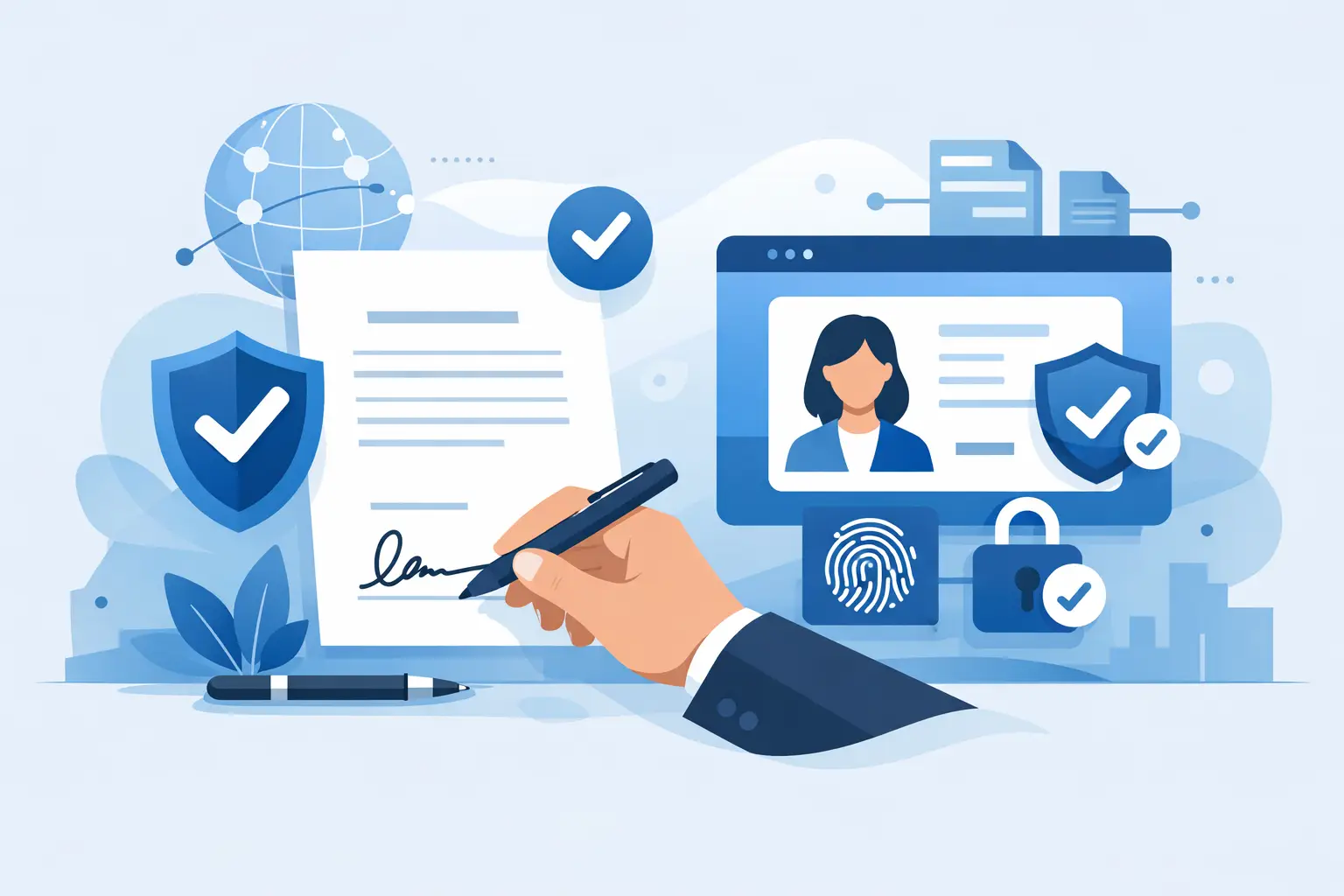
A signed contract is only as reliable as your ability to show who signed it. When a deal, hiring packet, consent form, or financial agreement is challenged, a typed name and email address may not answer the question that matters most: was this really the person authorized to agree?
That is why use verified signing identities is a practical question, not just a compliance one. Identity verification adds confidence at the point of signature, helping teams move documents quickly while collecting stronger evidence for high-stakes agreements.
Why use verified signing identities?
A standard electronic signature workflow can prove a lot. It can record when a document was sent, when it was opened, which email address received it, and when the recipient signed. For many everyday documents, that evidence is appropriate and efficient.
But email access is not always identity proof. Accounts can be shared, compromised, or created under a false name. A recipient can also claim that someone else used their device or inbox. When the agreement involves regulated data, a large financial commitment, cross-border parties, or a meaningful risk of dispute, the gap between an email address and a verified person becomes more significant.
Verified signing identities close that gap. Before signing, the recipient completes checks designed to establish that they are the person they claim to be. Depending on the workflow, that can include government ID capture, database validation, biometric face matching, and liveness detection to help confirm the person is physically present rather than presenting a photo or recording.
The result is not merely another field in a signing flow. It is stronger identity evidence connected to a specific document, event history, and signature.
Reduce impersonation risk without slowing every agreement
Fraud rarely announces itself. It shows up as a last-minute change in banking details, a sender using a lookalike email address, an approval from someone who should not have access, or a signer who later denies involvement.
Identity verification gives teams a useful control when the cost of getting it wrong is high. It makes opportunistic impersonation more difficult and creates a clear checkpoint before a sensitive document is completed. That is especially useful for financial disclosures, property documents, employee agreements, healthcare forms, and legal settlements.
The trade-off is straightforward: additional verification adds a step for the signer. Requiring government ID and a face check for every low-risk NDA or routine internal acknowledgment can create unnecessary friction. The smarter approach is risk-based.
Use a simple eSignature flow when the document and relationship call for speed. Step up to verified identity when the signer is new, the agreement has a higher value, personal or regulated data is involved, or you need better evidence for a possible dispute. This lets your team keep routine work moving while applying more assurance where it earns its place.
Create stronger evidence if an agreement is questioned
A signature image by itself is weak evidence. A complete record is much more persuasive.
For a verified signing workflow, the record should connect the agreement to the signing event and preserve the supporting evidence. That means documenting the document version, the signer’s identity verification result, timestamps, IP addresses, email delivery, views, authentication events, and signature completion. The document should also be sealed against undetected changes after signing.
This does not make every disagreement disappear. Contract enforceability still depends on the governing law, the agreement terms, consent, authority to sign, and the facts of the transaction. A verified identity is not a substitute for good contract process.
It does, however, give your legal, compliance, and operations teams a much clearer story to tell. Instead of searching through inboxes and screenshots, they can produce an audit trail showing what happened, when it happened, and the identity checks completed before the signature.
Identity verification and audit trails work together
These controls solve different problems. Identity verification helps answer who signed. A tamper-evident audit trail helps answer what they signed and how the event unfolded.
You need both for high-assurance agreements. Verifying a signer without preserving the final document and event history leaves an incomplete record. Preserving a document trail without meaningful identity checks may leave room for an impersonation claim. Together, they create a more defensible agreement process.
Support higher-assurance compliance workflows
Many teams first consider identity verification because a customer, regulator, or procurement review asks for it. That is a valid trigger, but the value goes beyond checking a requirement box.
In the European Union, eIDAS defines different levels of electronic signature. An Advanced Electronic Signature must be uniquely linked to and capable of identifying the signatory, created under the signatory’s sole control, and linked to the signed data so later changes can be detected. Identity verification is a key part of meeting the identity-assurance side of that standard.
The right signature level depends on the transaction, jurisdiction, and organizational policy. Not every agreement requires an Advanced Electronic Signature. Some transactions may have their own formal requirements, and certain document types may require a qualified signature or another process entirely. Legal counsel should set the policy for your specific use cases.
For teams handling cross-border agreements, regulated forms, or enterprise contracts, the ability to apply verified identity checks when needed is a major operational advantage. It avoids forcing every department into a single, overly rigid signing process.
Keep the signer experience clear and intentional
More security should not mean a confusing scavenger hunt. A good verification flow tells the signer why the check is required, what they need to provide, and what happens next.
The best time to ask for verification is when the reason is obvious: before a high-value contract is signed, before sensitive information is released, or before a legally significant consent is accepted. A short explanation helps prevent abandonment. For example, explain that identity verification protects both parties and strengthens the agreement record.
The process should also work on the devices people actually use. Mobile-friendly ID capture, clear face-match instructions, and accessible alternatives for signers who cannot complete a standard biometric flow all matter. Security that excludes legitimate signers creates a different kind of business risk.
Set expectations internally as well. Sales should know when to offer identity verification. HR should know which onboarding documents need it. Compliance should be able to review verification policies without manually inspecting every envelope. Consistent rules beat last-minute judgment calls.
Where verified identities deliver the most value
The strongest use cases have one thing in common: a signature creates meaningful obligations, access, or exposure.
For sales teams, verified identities can add confidence to large contracts, partner agreements, and deals where the signer’s authority needs closer review. For HR, they can support onboarding and policy acknowledgments involving sensitive employee information. For healthcare and financial services, they provide a stronger checkpoint around forms that involve protected data, consent, or account-related decisions.
Legal teams benefit when settlement agreements, waivers, board-related documents, or other dispute-prone agreements require better signer evidence. Product teams can use identity verification inside their own customer experience through an API, applying it only at high-risk moments rather than sending users to a separate system.
Build a signing policy your team can actually follow
Start by classifying your documents according to risk. Consider the agreement value, sensitivity of the data, likelihood of fraud, jurisdiction, and consequence of a disputed signature. Then define which documents use basic eSignatures, which require additional authentication, and which require verified identity.
Keep the policy simple enough for busy teams to apply. A three-tier model often works well: routine documents, sensitive documents, and high-assurance documents. Each tier should have a clear signing method, approval requirement, and record-retention rule.
BeeSign brings document preparation, signing order, approvals, identity verification, tamper-evident sealing, and full audit trails into one workflow. Teams can send standard agreements quickly, then add government ID checks, biometric face matching with liveness detection, and database validation when assurance matters more.
The practical goal is not to turn every signature into a compliance exercise. It is to make the right level of trust easy to apply. When a document carries real risk, verify the person behind the signature before the agreement becomes a problem.
Ready to transform your workflow?
Start using BeeSign today and experience the future of document signing