Advanced Signature vs Simple Signature Explained
Compare advanced signature vs simple signature for contracts, HR, and regulated workflows. Choose the right identity proof, audit trail, and speed today.
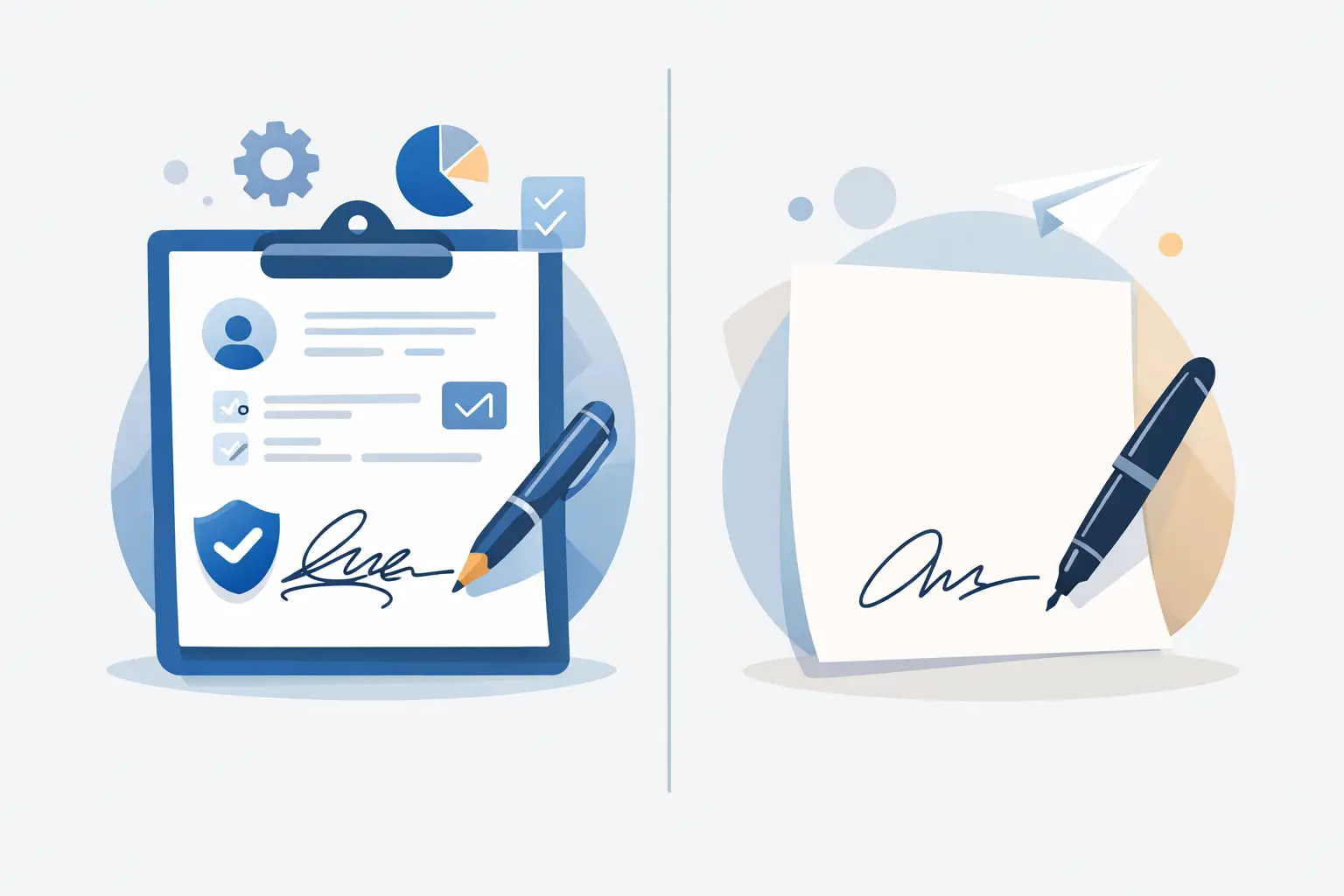
A sales contract can be signed with a typed name in seconds. A healthcare consent or high-value financial agreement may need proof that the person behind that name was actually verified. That is the practical difference behind the advanced signature vs simple signature decision: not which option looks more official, but how much identity assurance and evidence the transaction needs.
The right choice should not slow every agreement down. It should apply the appropriate level of trust to the risk at hand, while keeping contracts, approvals, and onboarding moving.
What is a simple electronic signature?
A simple electronic signature is the broadest category of electronic signing. It can include a signer clicking to accept, drawing a signature, typing a name, checking a consent box, or signing a document through an emailed link.
For many routine business agreements, this is a practical and legally valid way to sign. In the United States, laws such as the Electronic Signatures in Global and National Commerce Act (ESIGN) and the Uniform Electronic Transactions Act (UETA) generally recognize electronic signatures when the parties intend to sign and consent to doing business electronically.
That does not mean every click carries the same weight of evidence. If a signature is challenged, the question becomes whether you can show who signed, what they agreed to, and whether the document remained unchanged. A strong eSignature workflow helps answer those questions through authentication controls, document history, timestamps, IP addresses, and tamper-evident sealing.
Simple signatures work well when the signer relationship is already established and the consequences of a disputed signature are relatively limited. Think standard sales agreements, internal acknowledgments, vendor paperwork, routine HR forms, and low-risk approvals.
What makes an advanced electronic signature different?
An Advanced Electronic Signature, often called an AES, is a specific standard under the European Union's eIDAS regulation. It must meet stricter requirements than a simple electronic signature. It needs to be uniquely linked to the signer, capable of identifying that signer, created under the signer's sole control, and connected to the signed data so later changes can be detected.
In practical terms, an advanced signature starts with stronger identity verification. A business may ask the signer to capture a government-issued ID, complete biometric face matching with liveness detection, and pass database validation before signing. The signing event and verification evidence are then bound to the document.
An AES is not simply a fancier signature image or a longer audit trail. It is a higher-assurance process designed to create a stronger connection between a real person, their verified identity, and a particular agreement.
It is also worth separating Advanced Electronic Signatures from Qualified Electronic Signatures. Under eIDAS, a qualified signature has additional requirements involving qualified certificates and qualified signature creation devices. If a regulation, counterparty, or jurisdiction specifically requires a qualified signature, an advanced signature alone may not be enough.
Advanced signature vs simple signature: the practical comparison
The decision usually comes down to four questions: how certain you need to be about identity, how serious the outcome of a dispute would be, which jurisdictions apply, and how much friction signers will reasonably accept.
A simple signature prioritizes speed and convenience. A recipient receives a secure link, reviews the document, signs from any device, and the sender gets a complete record of the transaction. For a familiar customer signing a routine order form, that may be exactly the right balance.
An advanced signature adds verification steps before signing. That creates more evidence, but it also introduces more work for the signer. A person may need to photograph an ID, allow a face scan, or correct a mismatch. For a low-value agreement, that friction can be unnecessary. For a transaction where identity fraud could create major legal, financial, or regulatory exposure, it is usually a sensible trade-off.
Neither option is automatically better. The best workflow matches the signature method to the transaction rather than treating every document as either casual or high risk.
When a simple signature is usually the right fit
Use a simple signature when the agreement is routine, signer identity is reasonably known, and a detailed audit trail provides enough evidence for the expected risk. This is often the case for sales proposals, service agreements, employee policy acknowledgments, internal approvals, and recurring vendor forms.
For example, an account executive sending a renewal to an existing customer should not need to create an identity-verification obstacle that delays a deal. A secure signing link, clear consent language, signer authentication, timestamps, IP address logging, and a sealed final document can provide a clean, efficient record.
Simple signatures also make sense when volume matters. HR teams collecting hundreds of onboarding acknowledgments or operations teams processing routine forms need a workflow people can complete without training or an app download. The goal is not to lower standards. It is to standardize the right controls and remove the email back-and-forth that creates delays and missing records.
When advanced identity verification is worth it
Choose an advanced signature workflow when you need much stronger evidence of exactly who signed. Common triggers include high-value contracts, cross-border agreements involving eIDAS expectations, documents with sensitive personal or health information, financial transactions, and situations where impersonation risk is high.
It can also be appropriate when a signer is new to your organization and there is no existing relationship to rely on. A remote real estate transaction, a sensitive medical form, a high-risk authorization, or an agreement that could face serious scrutiny later all benefit from a verifiable identity step.
For compliance teams, the value is not just checking a box. It is being able to produce a defensible record when someone asks what happened. That record should show the identity verification outcome, the document version, the signing timestamp, and evidence that the document was not altered afterward.
Build the workflow around risk, not guesswork
A signature policy should be simple enough that sales, HR, legal, and operations teams can follow it without sending every document to compliance. Start by grouping agreements into a few risk tiers. Routine documents can use standard eSignatures. Sensitive or high-value documents can require stronger authentication. High-assurance or cross-border use cases can require identity verification and an advanced signature process.
For each tier, define the evidence your team must retain. At a minimum, a reliable agreement record should include:
- The final signed document and a clear version history
- Consent and intent to sign
- Timestamps for sending, viewing, signing, and completion
- Signer authentication details, IP address data, and audit events
- Tamper-evident sealing that exposes changes after completion
This approach avoids two expensive mistakes. The first is asking every signer for an ID scan, which can hurt completion rates and frustrate customers. The second is using a bare click-to-sign process for a transaction where you may later need to prove identity with confidence.
Keep the evidence connected to the document
A signature is only one part of an enforceable digital agreement. The surrounding workflow matters just as much: the document version the signer saw, the order in which people approved it, the authentication used, and whether anyone altered the file after signing.
That is why disconnected tools create avoidable risk. If identity verification lives in one system, approval emails in another, and the signed PDF in an employee's inbox, reconstructing the transaction later becomes difficult. A central agreement workflow keeps the evidence with the document from draft through completion.
BeeSign supports this model by combining document workflows, audit trails, tamper-evident sealing, and optional identity verification in one place. Documents are encrypted in transit with TLS and at rest with 256-bit AES, while audit records capture the events teams need to track and defend an agreement.
Make signing easy until the risk says otherwise
The strongest signature process is not the one with the most steps. It is the one that gives your business enough proof without making every customer, candidate, or employee jump through unnecessary hoops.
Use simple signatures to keep ordinary agreements moving in minutes. Add advanced identity verification when the transaction, jurisdiction, or risk profile calls for it. That way, your team can move quickly and still know exactly what it can prove when it matters.
Ready to transform your workflow?
Start using BeeSign today and experience the future of document signing