The Role of Digital Signatures in Graduation Documents
Discover the crucial role of digital signatures in graduation. Ensure secure, verifiable diplomas and faster credential verification for students.

Digital signatures are cryptographic tools that verify a graduate’s identity and confirm a diploma has not been altered since it was issued. They are not scanned images of handwritten names. They are mathematical proofs generated by private keys, bound to the document through Public Key Infrastructure (PKI). The role of digital signatures in graduation has grown from a convenience into a legal and institutional standard. Laws like the U.S. ESIGN Act and the European Union’s eIDAS regulation recognize digitally signed diplomas as fully equivalent to paper documents. For students and institutions alike, this shift means faster verification, stronger fraud protection, and credentials that work across borders.
How do digital signatures work in graduation certificates?
Digital signatures secure graduation documents through a process called cryptographic fingerprinting. When a university signs a diploma, its signing system uses a private key to generate a unique mathematical value tied to that exact file. Any change to the document, even a single character, produces a completely different value. That mismatch immediately signals tampering.

The technical backbone is Public Key Infrastructure, or PKI. PKI binds the signer’s identity to a digital certificate issued by a trusted Certificate Authority. Anyone verifying the diploma uses the institution’s public key to confirm the signature is genuine. This is fundamentally different from a scanned signature image, which provides no cryptographic proof and can be copied or forged without detection.
Digitally signed diplomas also carry a complete audit trail. Each signature records the signer’s identity, the timestamp, the device used, and the location. That record is embedded in the file and cannot be removed without breaking the signature.
- Tamper evidence: Any modification to the PDF after signing invalidates the cryptographic signature instantly.
- Audit trail: Signer identity, timestamp, and device data are locked into the document.
- Certificate Authority validation: A trusted third party confirms the institution’s identity before the key is issued.
- Long-term validity: Standards like PAdES-LTA preserve signature validity even after the signing certificate expires.
Pro Tip: Never open a digitally signed diploma in a word processor like Microsoft Word. Editing software rewrites the file structure and breaks the cryptographic signature, which can invalidate the document for employment or admissions verification.
What are the legal standards for digital graduation documents?
The legal foundation for digital diplomas is well established. In the United States, the ESIGN Act and the Uniform Electronic Transactions Act (UETA), adopted by 47 states, prevent institutions from rejecting valid electronic signatures simply because they lack a wet-ink equivalent. In the European Union, eIDAS sets a tiered framework of electronic signature types, with Qualified Electronic Signatures carrying the highest legal weight.
These laws do not just permit digital diplomas. They actively protect them. An employer or graduate school cannot legally dismiss a properly executed digital diploma in a jurisdiction covered by ESIGN or eIDAS. The credential holds the same enforceability as a physical document with a registrar’s seal.
Institutions navigating adoption typically face three categories of challenge:
- Accreditation alignment: Confirm that your institution’s digital credentialing process meets the standards set by your regional accrediting body. Accreditation legitimizes the credential regardless of format.
- Vendor compliance: Choose a signing platform that complies with ESIGN, UETA, and eIDAS. Platforms that meet these standards produce signatures that hold up in legal and administrative review.
- Staff training: Administrative staff who are unfamiliar with digital signature platforms may incorrectly flag valid credentials. Proactive training prevents processing delays for graduates.
- Student communication: Institutions should inform graduates about how to store, share, and verify their digital diplomas before the credential is issued.
Pro Tip: Ask your registrar’s office which digital signature standard your diploma uses before graduation. Knowing whether your credential uses a Qualified Electronic Signature under eIDAS or a standard ESIGN-compliant signature helps you communicate its validity to employers abroad.
What are the benefits of digital signatures for students and institutions?
Digital signatures in education deliver measurable advantages for both graduates and the institutions that issue credentials. The most immediate benefit is speed. Traditional paper verification can take weeks when employers or graduate schools contact a registrar by mail. Instant independent verification through a digital diploma cuts that process to minutes.
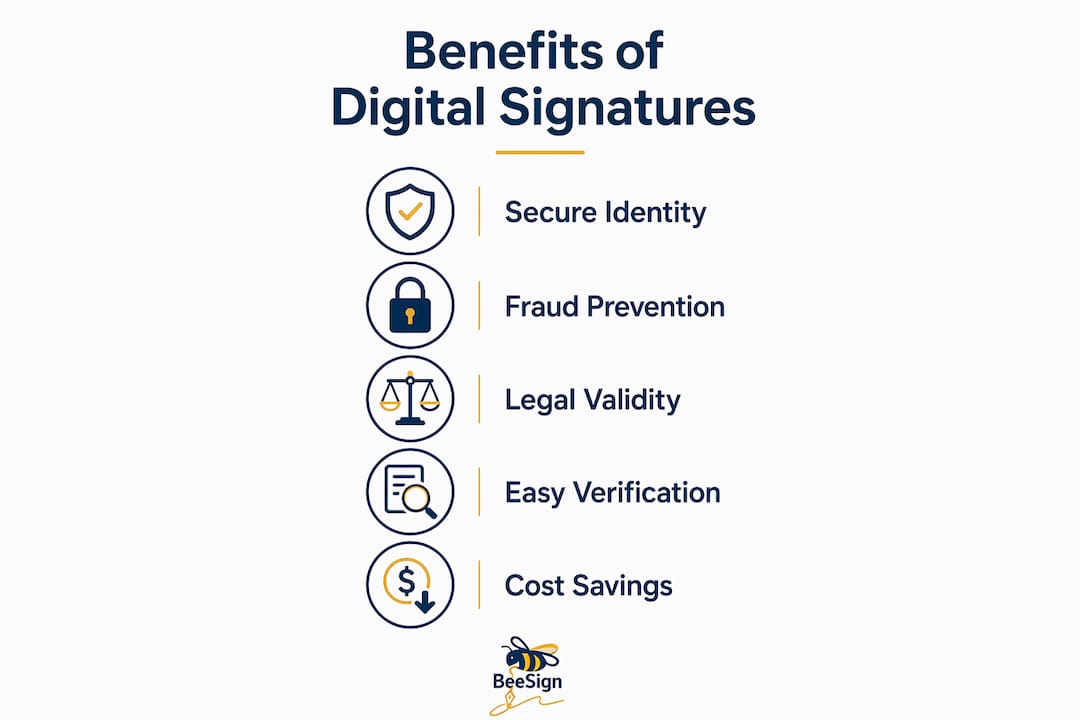
Security is the second major benefit. Institutions transitioning to digital-only diplomas address the forgery problem directly. Digital signatures create immutable, auditable records that cannot be duplicated or altered without detection. A forged paper diploma can circulate for years before discovery. A forged digital diploma fails verification the moment anyone checks it.
Graduates also gain portability. Digital credentials signed with PKI-based signatures can be shared on platforms like LinkedIn, attached to job applications, or submitted to graduate admissions portals without requiring a university to re-verify anything. The signature itself is the proof.
| Benefit | Impact |
|---|---|
| Instant verification | Reduces wait times from weeks to minutes for employers and admissions offices |
| Fraud prevention | Cryptographic signatures make forgery detectable immediately upon verification |
| Audit trail | Signer identity, timestamp, and location are permanently embedded in the file |
| Portability | Graduates share verified credentials digitally without repeated university contact |
| Long-term validity | PAdES-LTA standard preserves verification capability beyond certificate expiration |
- For students: Your diploma works as a portable verified credential on professional networks and application platforms without additional paperwork.
- For institutions: Audit trails provide legal defensibility if a credential is disputed.
- For employers: Verification takes seconds and requires no contact with the issuing university.
What steps should institutions and students take to implement digital signatures?
Effective implementation of digital signatures in graduation processes requires both technical setup and clear communication. Neither works without the other. Institutions that deploy a signing platform without educating staff and students see the same delays they were trying to avoid.
Follow these steps to get the process right:
- Select a compliant signing platform. Choose a platform that explicitly supports ESIGN, UETA, and eIDAS compliance. Confirm it uses PKI-based signatures, not simple electronic markings. Check that it produces an audit trail for each document.
- Store your digital diploma securely. Digital diplomas are often issued as one-time files and not reissued if lost. Save your diploma to at least two secure locations, such as encrypted cloud storage and a local backup drive.
- Never edit the signed file. Opening a digitally signed PDF in editing software breaks the cryptographic signature. Share the original file only. If a recipient needs a different format, direct them to the institution’s verification portal instead.
- Train registrar staff before rollout. Administrative staff who encounter unfamiliar digital signature formats may delay processing for graduates. Institutions should run training sessions and provide written guidance before the first digital diplomas are issued.
- Communicate with graduates proactively. Send clear instructions about how to download, store, and share the digital diploma. Include guidance on what to do if a third party questions the credential’s validity.
Pro Tip: If an employer or admissions office questions your digital diploma’s validity, direct them to your institution’s online verification portal. Most universities that issue digital diplomas provide a public URL where any third party can confirm the credential in seconds.
Adoption rates depend heavily on administrative readiness. Effective implementation requires both technical integration and user education to avoid rejecting valid digital signatures due to unfamiliarity or outdated procedures. Institutions that invest in both sides of that equation see the fastest and smoothest transitions.
Key Takeaways
Digital signatures in graduation documents provide cryptographic proof of identity and document integrity, making them legally equivalent to paper diplomas under ESIGN, UETA, and eIDAS.
| Point | Details |
|---|---|
| Legal equivalency | ESIGN, UETA, and eIDAS recognize digital diplomas as fully valid in the U.S. and EU. |
| Cryptographic security | PKI-based signatures make forgery detectable the moment a credential is verified. |
| Safe file handling | Never open a signed diploma in editing software, as it breaks the cryptographic signature. |
| Instant verification | Digital credentials cut employer and admissions verification from weeks to minutes. |
| Implementation requires training | Staff and student education is as critical as the technical platform for successful adoption. |
Why the shift to digital credentials is bigger than most institutions realize
The move from paper diplomas to cryptographically signed digital credentials is not just an administrative upgrade. It is a structural change in how trust works in academic credentialing.
I have watched institutions treat digital diplomas as a convenience feature, a way to save printing costs or speed up mailing. That framing misses the point entirely. A paper diploma is trusted because of physical security features: embossed seals, special paper, registrar signatures. Those features are easy to replicate with modern printing equipment. A digitally signed diploma is trusted because of mathematics. You cannot fake a valid PKI signature without access to the institution’s private key.
What excites me most is where this goes next. Digital signatures are already becoming verifiable credentials that graduates can share on LinkedIn and professional platforms without any university involvement. The next step is decentralized identity, where a graduate holds their own cryptographic credential in a digital wallet and presents it directly to any verifier. Blockchain-anchored credentials take this further by removing the need for a central verification server entirely.
The institutions that will lead this shift are the ones investing in staff training now, not just platform selection. Technology without education produces the same bottlenecks as paper. The registrar who does not know how to read a PAdES-LTA signature is just as much a barrier as the absence of a signing platform. Get both right, and you give your graduates credentials that work anywhere, instantly, and permanently.
— Mustafa Abusharkh
Beesign supports secure digital graduation workflows
Graduation paperwork involves multiple signers, tight deadlines, and documents that must remain legally valid for decades. Beesign centralizes the entire process in one platform built for exactly that level of compliance and accountability.
Beesign is fully compliant with ESIGN, UETA, and eIDAS, and uses PKI-based identity verification to bind each signer’s identity to every document. Every signed diploma or graduation form carries a complete audit trail with timestamps, signer data, and tamper evidence baked in. Institutions can configure multi-signer routing so department heads, registrars, and deans all sign in the correct sequence without chasing paper. For institutions that need brand consistency, Beesign’s white-label option lets you run the entire signing experience under your own domain. Get started with Beesign and give your graduates credentials that hold up anywhere.
FAQ
What is the role of digital signatures in graduation?
Digital signatures authenticate and secure graduation documents using cryptographic proof, confirming the graduate’s identity and ensuring the diploma has not been altered since it was issued.
Are digital diplomas legally valid in the United States?
Yes. The ESIGN Act and UETA, adopted by 47 states, give properly executed digital diplomas the same legal standing as paper documents with wet-ink signatures.
How do I verify a digitally signed diploma?
Most institutions that issue digital diplomas provide an online verification portal. Enter the diploma’s unique identifier or upload the file to confirm the signature is valid and unaltered.
What happens if I edit my digital diploma PDF?
Editing a digitally signed PDF in any word processor or PDF editor breaks the cryptographic signature. The document will fail verification and may no longer be accepted by employers or admissions offices.
What is PAdES-LTA and why does it matter for graduates?
PAdES-LTA is a digital signature standard that preserves a diploma’s verifiability long after the signing certificate expires. It means your credential remains provable years or decades after your graduation date.
Recommended
Ready to transform your workflow?
Start using BeeSign today and experience the future of document signing