The Role of Metadata in Signed Documents: 2026 Guide
Discover the crucial role of metadata in signed documents. Unlock legal defensibility and compliance insights in our comprehensive 2026 guide.

Metadata in signed documents is defined as the structured contextual data that records who signed, when, how, and under what conditions — making it the foundation of legal defensibility, not a technical afterthought. A digital signature alone proves that a document was not altered after signing. Metadata proves the full story: the signer’s identity, device, IP address, timestamp, and the workflow path the document traveled. Regulatory-compliant document management systems in 2026 require metadata sets including document context identifiers, cryptographic signature details, and identity verification artifacts to support chain-of-custody and auditability. The role of metadata in signed documents is therefore inseparable from compliance, dispute resolution, and efficient records management.
What types of metadata are essential in signed documents?
Signed document metadata falls into four distinct categories, each serving a specific legal or operational function. Missing any one of them creates gaps that auditors and courts will notice.
Document context metadata
Document context metadata identifies the record itself. This includes a universally unique identifier (UUID), the document title, version number, and creation source. These fields answer the basic question: “Which exact document are we talking about?” Without a UUID, two versions of a contract can become indistinguishable in a dispute.
Signature cryptography metadata
Signature cryptography metadata covers the technical proof layer. This includes the hash algorithm used (such as SHA-256), the key type (such as RSA or ECDSA), the certificate chain, and the timestamp of the cryptographic event. Digital signatures provide cryptographic proof of document integrity, but the metadata around that signature tells auditors which algorithm was applied and whether the certificate was valid at signing time.
Identity verification metadata
Identity verification metadata captures who the signer actually was, beyond a name typed into a field. This includes government ID scans, biometric confirmation records, IP addresses, device fingerprints, and geolocation data. Platforms that support eIDAS-compliant identity verification embed this data directly into the signed document package, making it available for independent review years later.

Workflow and event metadata
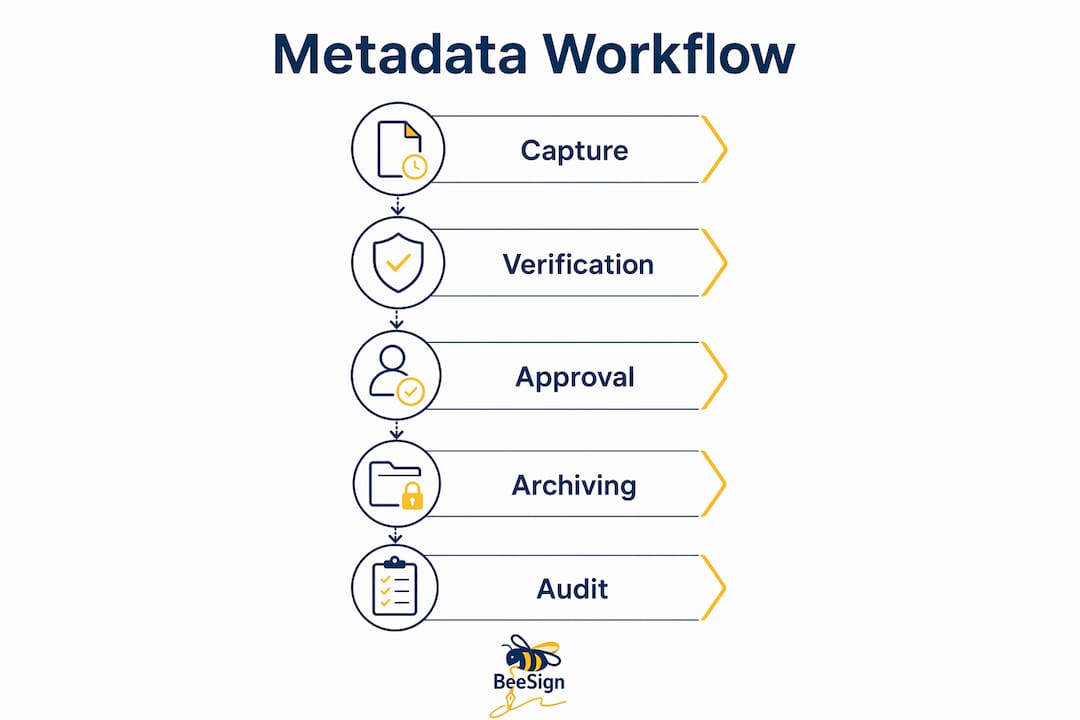
Workflow metadata records the document’s journey: who received it, who approved it, in what order, and at what time. Essential metadata encompasses event timestamps formatted to ISO 8601, actor IDs, correlation IDs, and cryptographic hashes for every signing step. This layer is what compliance teams use to reconstruct the exact sequence of events when a dispute arises.
Pro Tip: Standardize your metadata schema before your first document goes out. Retroactive tagging is error-prone and reduces the reliability of automated compliance checks.
How does metadata enhance legal compliance and auditability?
A signed PDF without its accompanying metadata is a static snapshot. Auditors cannot determine from the file alone whether the right person signed, whether the document was routed correctly, or whether any amendments were acknowledged. Full compliance requires a defensible document package that includes signed files, amendments, workflow history, identity evidence, and chain-of-custody records.
Non-repudiation and chain of custody
Non-repudiation is the legal principle that a signer cannot credibly deny having signed a document. Metadata supports non-repudiation by providing corroborating evidence beyond the cryptographic signature itself. If a signer claims they never received a contract, the workflow metadata shows the delivery timestamp, the IP address of the device that opened it, and the exact moment the signature event was recorded.
Long-term defensibility
Documents often need to be defended years after signing, when software versions have changed and certificate authorities may have expired. Manifest-based evidence bundles that combine signed file hashes, workflow event logs, and identity verification data into one package are the preferred method for long-term defensibility. Auditors treat these bundles as the authoritative record, not the PDF alone.
Reducing operational friction
Organizations that maintain complete metadata packages spend significantly less time reconstructing document histories during audits or litigation. The metadata does the work automatically. Without it, compliance teams must manually gather emails, access logs, and version histories from separate systems, a process that is slow, inconsistent, and legally fragile.
Pro Tip: Store your metadata package alongside the signed file in the same archive location. Separating them creates retrieval risk and weakens your chain-of-custody argument.
The importance of document metadata becomes clearest when something goes wrong. A well-structured metadata package can resolve a dispute in hours. A missing one can extend litigation for months.
What are best practices for capturing metadata in signed documents?
Getting metadata right requires a deliberate process, not a reactive one. The following steps reflect current best practices for organizations that want audit-ready signed documents.
-
Capture metadata at the moment of creation. Set your document management system to record UUID, version, author, and creation timestamp the instant a document is generated. Waiting until signing introduces gaps.
-
Define your metadata schema before deployment. Decide which fields are mandatory across all document types. A consistent schema makes automated classification, retention enforcement, and search reliable. Metadata must be standardized and captured at the exact moment documents are created or signed to enable automatic enforcement of retention policies and routing.
-
Automate metadata capture at every signing event. Each signature event should automatically write a new metadata record: signer ID, timestamp, device data, and IP address. Manual entry at this stage introduces human error and inconsistency.
-
Integrate metadata with your compliance and workflow systems. Metadata that lives only inside a document file is harder to query and report on. Exporting metadata to a compliance database or document management platform lets you run retention reports, flag expiring contracts, and audit signing activity at scale.
-
Avoid retroactive metadata addition. Without metadata, documents remain ambiguous and manual effort intensifies for classification and retrieval. Adding metadata after the fact undermines its legal credibility because it cannot be verified as contemporaneous.
-
Use metadata to drive automated retention and routing. Once metadata is standardized, you can configure rules: contracts above a certain value route to legal review, documents tagged as HIPAA-regulated follow a specific retention schedule, and expired agreements trigger renewal workflows automatically.
Pro Tip: Treat your metadata schema as a living document. Review it quarterly and update field definitions as regulations change, especially if you operate across ESIGN, eIDAS, or HIPAA jurisdictions.
How do digital signatures and metadata complement each other?
Digital signatures and metadata solve different problems. Understanding how they work together is the key to building a genuinely fraud-resistant document process.
What each layer proves
| Layer | What it proves | What it cannot prove |
|---|---|---|
| Digital signature | Document was not altered after signing; signer held the private key | Who physically controlled the device; workflow context |
| Metadata | Who signed, when, from where, and through what process | That the document content is unaltered |
Digital signatures prove document integrity cryptographically but do not reveal event context. Metadata supplements this by providing user IDs, device fingerprints, IP logs, and other details needed for non-repudiation. Neither layer is sufficient alone.
The spoofing risk and how to address it
Metadata can be edited or spoofed if it is not protected. A bad actor could alter a creation timestamp or swap an IP address in an unprotected metadata field. Digital signatures cannot be spoofed without invalidating the cryptographic hash. The solution is to include metadata fields within the signed data scope, so that any alteration to the metadata also invalidates the signature. Cross-referencing metadata with digital signatures enhances investigative context and dispute resolution.
Combining both for fraud detection
Automated platforms that capture metadata and apply cryptographic signatures in the same workflow produce the strongest proof of authenticity. When an auditor or court examines a document, they can verify the signature hash, then cross-reference the metadata to confirm the signing timeline, the signer’s verified identity, and the document’s routing history. The two layers together create a record that is far harder to challenge than either one alone. Understanding what makes an eSignature valid requires recognizing that both layers must be present and intact.
Key takeaways
Metadata in signed documents is not optional infrastructure. It is the evidence layer that makes digital signatures legally defensible, auditable, and operationally useful across the full document lifecycle.
| Point | Details |
|---|---|
| Metadata defines legal defensibility | A signed PDF without metadata cannot prove chain of custody, signer identity, or workflow history. |
| Four metadata categories matter | Document context, cryptographic details, identity verification, and workflow events each serve a distinct compliance function. |
| Capture timing is critical | Metadata captured at creation and signing is legally credible; retroactive additions are not. |
| Signatures and metadata work together | Digital signatures protect content integrity; metadata provides the event context needed for non-repudiation. |
| Evidence bundles are the standard | Manifest-based packages combining signed file hashes, workflow logs, and identity data are the preferred audit format in 2026. |
Why I stopped treating metadata as a technical detail
By Mustafa Abusharkh
The most common mistake I see organizations make is treating metadata as something the IT team handles after the real work is done. That framing costs companies real money and real legal exposure. I have seen compliance audits derailed not because a signature was missing, but because nobody could produce a coherent record of who approved what, in what order, and when.
When metadata is treated as strategic infrastructure, AI document processing can provide explainable business outcomes and proactive governance instead of manual oversight. That is not a future promise. Organizations running metadata-rich workflows today are already automating retention enforcement, flagging anomalies in signing patterns, and generating audit reports in minutes rather than days.
The uncomfortable truth is that most organizations have invested heavily in digital signatures while leaving metadata capture as an afterthought. The signature proves the document was not tampered with. The metadata proves everything else. If you can only defend half the story in court, you have a problem. Treating metadata as a business decision, not a technical one, is the shift that separates organizations that pass audits from those that scramble through them.
— Mustafa Abusharkh
Beesign builds metadata into every signed document

Beesign captures metadata automatically at every stage of the signing workflow, from document creation through identity verification to final signature. Every signed document on the Beesign platform includes cryptographic proof, ISO 8601 timestamps, signer identity artifacts, and full workflow history in a single audit-ready package. For organizations that need to meet ESIGN, eIDAS, or HIPAA requirements, Beesign’s legal and compliance solutions provide the metadata infrastructure to support defensible records without manual effort. You can also explore the full Beesign platform features to see how metadata capture, identity verification, and cryptographic signatures work together in one place.
FAQ
What is the role of metadata in signed documents?
Metadata in signed documents records who signed, when, from what device, and through what workflow process. It provides the contextual evidence that makes a digital signature legally defensible and auditable.
Why isn’t a digital signature alone enough for compliance?
A digital signature proves a document was not altered after signing, but it does not capture workflow history, signer identity details, or chain-of-custody evidence. Full compliance requires both the signature and a complete metadata package.
What metadata standards apply to signed documents in 2026?
Compliant systems use ISO 8601 timestamps, actor IDs, correlation IDs, and cryptographic hashes for each signing event. These fields support chain-of-custody verification and long-term audit defensibility.
How does metadata support dispute resolution?
Metadata provides a timestamped record of every action taken on a document, including who received it, who opened it, and when the signature was applied. This record resolves disputes about whether a party signed knowingly and voluntarily.
Can metadata be tampered with?
Metadata can be altered if it is not protected within the signed data scope. Including metadata fields inside the cryptographic signature hash means any alteration also invalidates the signature, making tampering detectable.
Recommended
Ready to transform your workflow?
Start using BeeSign today and experience the future of document signing