Benefits of Digital Closing Documents for Businesses
Discover the benefits of digital closing documents: faster signings, fewer errors, lower costs, and enhanced compliance for your business.

Switching to digital closing documents delivers faster signings, fewer errors, lower per-transaction costs, stronger compliance, and full brand control — all in one workflow. Here is what that means in practice:
- Speed: signing appointments are significantly shorter with digital closings
- Accuracy: document preview cuts closing-table errors significantly, with one study reporting an 80% reduction in errors surfacing at signing
- Cost savings: hybrid digital closings can save roughly $153 per loan, with full eClosings reaching up to $444
- Compliance: tamper-evident audit trails, cryptographic signatures, and ESIGN/UETA-compliant records protect you in any legal challenge
- Brand control: white-label domains and bring-your-own-cloud storage keep your identity and data inside your infrastructure
If you are evaluating a digital closing solution, start by mapping your current per-close cost and error rate — those two numbers will anchor your ROI case.
Table of Contents
- What are the core business benefits of digital closing documents?
- What measurable gains can you expect from digital closings?
- What security and compliance features should you require?
- How do digital closing documents change your internal workflows?
- Which business use cases get the most value?
- How do you implement digital closing documents step by step?
- How do you measure ROI from digital closing documents?
- Key Takeaways
- Why the compliance-first, white-label approach is the right call
- Beesign gives you a compliant, branded digital closing platform
- Useful sources
What are the core business benefits of digital closing documents?
Digital closing documents touch every layer of your operation: speed, accuracy, cost, customer experience, and brand trust.
Speed and turnaround
Pre-sending documents for review before the signing appointment is the single biggest time-saver. Borrowers or counterparties arrive already familiar with the content, so the live session becomes a confirmation rather than a first read. That is how signing appointments compress to roughly 20 minutes. For high-volume teams, that compression multiplies fast.
Accuracy and version control
A centralized document system eliminates the version chaos that comes with email-based document sharing. Everyone works from the same file, with annotation and approval statuses visible to all reviewers. Missed signatures and stale drafts become far less common when the system enforces completion before a document can advance.

Cost and efficiency
Eliminating printing, scanning, and courier costs is the obvious saving. The less obvious one: staff hours. One lender redirected four funding assistants away from scanning and recycling paper packages after going digital, repurposing them into higher-value roles. That kind of labor reallocation is where the real efficiency gains live.
Customer experience
Borrowers and clients who can preview documents, ask questions in advance, and sign remotely arrive at closing confident rather than anxious. That confidence translates directly into higher net promoter scores. A survey by Arizent Research found that lenders saw significant NPS increases after adopting digital closing technology.
Branding and trust
Pro Tip: If your clients see a generic third-party signing portal, they may hesitate. A white-label domain with your logo and branded email notifications keeps the experience consistent and reinforces trust at the moment it matters most.
White-label options let you run the entire signing experience under your own domain. Combined with identity verification at the point of signing, you create a closing experience that is both recognizable and legally defensible.
What measurable gains can you expect from digital closings?
The numbers that matter most to finance and procurement teams are savings per transaction and time saved per document.
| Metric | Benchmark | Source |
|---|---|---|
| Signing appointment duration | significantly shorter | First American eClosing |
| Template creation time savings | 40–60% faster | NotuDocs |
| Savings per loan (hybrid eClose) | substantial | HousingWire industry study |
| Savings per loan (full eClose) | larger | HousingWire industry study |
| Error rate improvement | — → 80% satisfaction | Arizent/National Mortgage News survey |
Template-driven workflows reduce document creation time by 40–60% compared with freeform manual entry. That saving compounds when your team produces dozens of agreements per week. Pair that with the per-loan savings above, and a business closing 200 transactions per month on a hybrid model could project over $30,000 in monthly savings on closing costs alone, before accounting for staff time.
What security and compliance features should you require?
Procurement and legal teams need a specific checklist, not a general assurance that a platform is “secure.”
Identity verification is the foundation. Require at minimum knowledge-based authentication (KBA), government ID checks, and where your use case demands it, biometric verification. These controls determine whether a signature is legally admissible in a dispute.
Audit trails must be tamper-evident. Every access event, signature action, and document change should be timestamped and cryptographically signed. Digital systems log access and preserve original entries automatically — something paper workflows cannot replicate.
Data protection requirements to confirm before signing any vendor contract:
- Encryption at rest and in transit (AES-256 minimum)
- SOC 2 Type II certification for cloud-hosted solutions
- HIPAA Business Associate Agreement availability for healthcare use cases
- Data residency controls specifying which jurisdiction stores your records
Legal compliance under ESIGN and UETA requires that your platform generates a complete evidence package: the signed document, the audit log, the identity verification record, and the timestamp. Retention policies should be configurable and defensible.
Pro Tip: White-label solutions with bring-your-own-cloud (BYOC) storage keep audit trails and identity records inside your own infrastructure — a decisive advantage when regulators or opposing counsel request evidence.
Role-based access controls and automated retention flags round out the operational layer. Without them, your compliance posture depends on individual staff discipline rather than system enforcement.
How do digital closing documents change your internal workflows?
The shift to digital closing is a process redesign, not a paper-to-PDF swap. The workflow changes start at template governance and extend through every integration point.
Template libraries replace freeform document creation. When closers pull from a governed template, field-level validation catches missing data before the document ever reaches a signer. That single change accounts for a large share of the error-rate improvements cited above.
Common integration points to plan for include your CRM (triggering document generation from a closed-won deal), your HRIS (automating offer letter delivery on hire), and your records system (archiving completed packages with metadata). APIs and webhooks handle the handoffs: a status callback fires when a document is signed, triggering the next step in your workflow without manual intervention.
Automation in document management also turns completed agreements into searchable knowledge, accelerating onboarding and sales enablement beyond the signature event itself.
For change management, plan a sandbox environment before go-live. Run your template library through test signings with internal staff before external partners see the new workflow.
Which business use cases get the most value?
Real estate closings are the clearest case. Hybrid eClosings — where buyers pre-sign the majority of documents electronically before the in-person appointment — deliver immediate ROI and smoother adoption than attempting a full eClose from day one. Lenders closing 70% or more of their volume as hybrid or full eClosings report the largest efficiency gains.
HR onboarding benefits from faster offer acceptance and a complete, auditable record of every document the new hire received and signed. Remote hiring makes this especially practical.
Sales contracts move faster when a prospect can sign from any device without scheduling an in-person meeting. Reduced friction at the final step shortens your sales cycle and improves close rates.
Service businesses with recurring agreements — maintenance contracts, subscription services, field service authorizations — benefit from template automation and on-site mobile signing.
Regulated industries (healthcare, financial services, legal) gain the most from white-label and data residency controls, since their compliance obligations require knowing exactly where signing records live and who can access them.
How do you implement digital closing documents step by step?
A phased rollout consistently outperforms a big-bang launch. Here is a sequenced plan:
- Governance and legal sign-off. Define your retention schedule, confirm ESIGN/UETA compliance requirements for your document types, and document your branding requirements (domain, logo, email templates).
- Choose a bounded pilot use case. Pick one document type or one team. Set success metrics: turnaround time, completion rate, error rate.
- Build your template library. Migrate your highest-volume document types first. Apply field-level validation rules before publishing.
- Configure identity verification and API connections. Set up your identity verification tier, connect your CRM or HRIS, and test webhooks in a sandbox environment.
- Train internal staff first. Run cohort training sessions before external partners see the new workflow. Provide written playbooks for settlement agents, notaries, or other external parties.
- Pilot with a small transaction volume. Measure against your baseline metrics for four to six weeks.
- Expand by use case or volume. Once the pilot metrics confirm ROI, extend to additional document types or business units.
Key risks to mitigate during rollout:
- Low adoption: studies show adoption often stalls below 20% when training is insufficient — build training into your project plan, not as an afterthought
- Template gaps: incomplete template libraries force staff back to freeform documents, erasing accuracy gains
- Integration failures: test every API connection and webhook in staging before production go-live
How do you measure ROI from digital closing documents?
Track these five KPIs from day one of your pilot:
| KPI | What to measure | Target direction |
|---|---|---|
| Turnaround time | Days from document send to fully executed | Decrease |
| Completion rate | % of sent documents completed without follow-up | Increase |
| Error / missed-signature rate | % of closings requiring a redraw or second appointment | Decrease |
| Cost per close | Total closing cost divided by completed transactions | Decrease |
| Staff hours per close | Hours spent on document prep, follow-up, and filing | Decrease |
To build a simple business case: take your current cost per close, subtract the per-transaction savings benchmark relevant to your use case (hybrid eClose: ~$153; full eClose: up to ~$444 for mortgage lenders), and multiply by your monthly transaction volume. That gives you a monthly savings estimate. Divide your implementation cost by that figure to get your payback period.
Report these metrics monthly during the first quarter, then quarterly once the workflow stabilizes. A dashboard that surfaces completion rate and turnaround time in real time lets operations managers catch adoption problems before they compound.
Key Takeaways
Digital closing documents deliver measurable gains in speed, accuracy, cost, and compliance — but only when adoption is treated as a managed process, not a technology switch.
| Point | Details |
|---|---|
| Speed is immediate | Signing appointments compress significantly when documents are pre-sent for review. |
| Templates cut creation time | Template-driven workflows reduce document creation time by 40–60% versus freeform manual entry. |
| Savings scale with volume | Hybrid eClosings save roughly $153 per transaction; full eClosings can reach up to $444 per loan. |
| Compliance requires a checklist | Demand tamper-evident audit trails, identity verification, SOC 2, and data residency controls before selecting a vendor. |
| Beesign fits compliance-first teams | Beesign’s white-label platform with BYOC storage and built-in identity verification maps directly to the procurement checklist above. |
Why the compliance-first, white-label approach is the right call
The conventional wisdom on digital closings focuses almost entirely on speed and cost. Those benefits are real, but they are also the easiest to replicate. Any vendor can shorten a signing appointment. What most generic platforms cannot give you is control over where your signing records live, whose brand your clients see, and how your audit trail holds up under regulatory scrutiny.
The organizations that get the most from digital closings are the ones that treat the infrastructure decision as a compliance decision first. When your cryptographic signatures, identity-verification records, and timestamped logs sit inside your own cloud environment, evidence collection for audits or legal challenges becomes straightforward. When they sit on a shared third-party host, you are dependent on that vendor’s cooperation and retention policies every time a dispute arises.
The adoption data reinforces this point from a different angle. The fact that 90% of lenders offer digital closings yet only 14% achieve high adoption tells you the technology is not the bottleneck. Training, process design, and stakeholder alignment are. A white-label platform that your staff and clients recognize as yours reduces the psychological friction of adoption. People trust a familiar brand. That trust is not a soft benefit — it shows up directly in your completion rate.
Beesign gives you a compliant, branded digital closing platform
Faster closings under your own brand, with your data in your infrastructure — that is the concrete difference Beesign delivers compared with generic hosted signing tools.
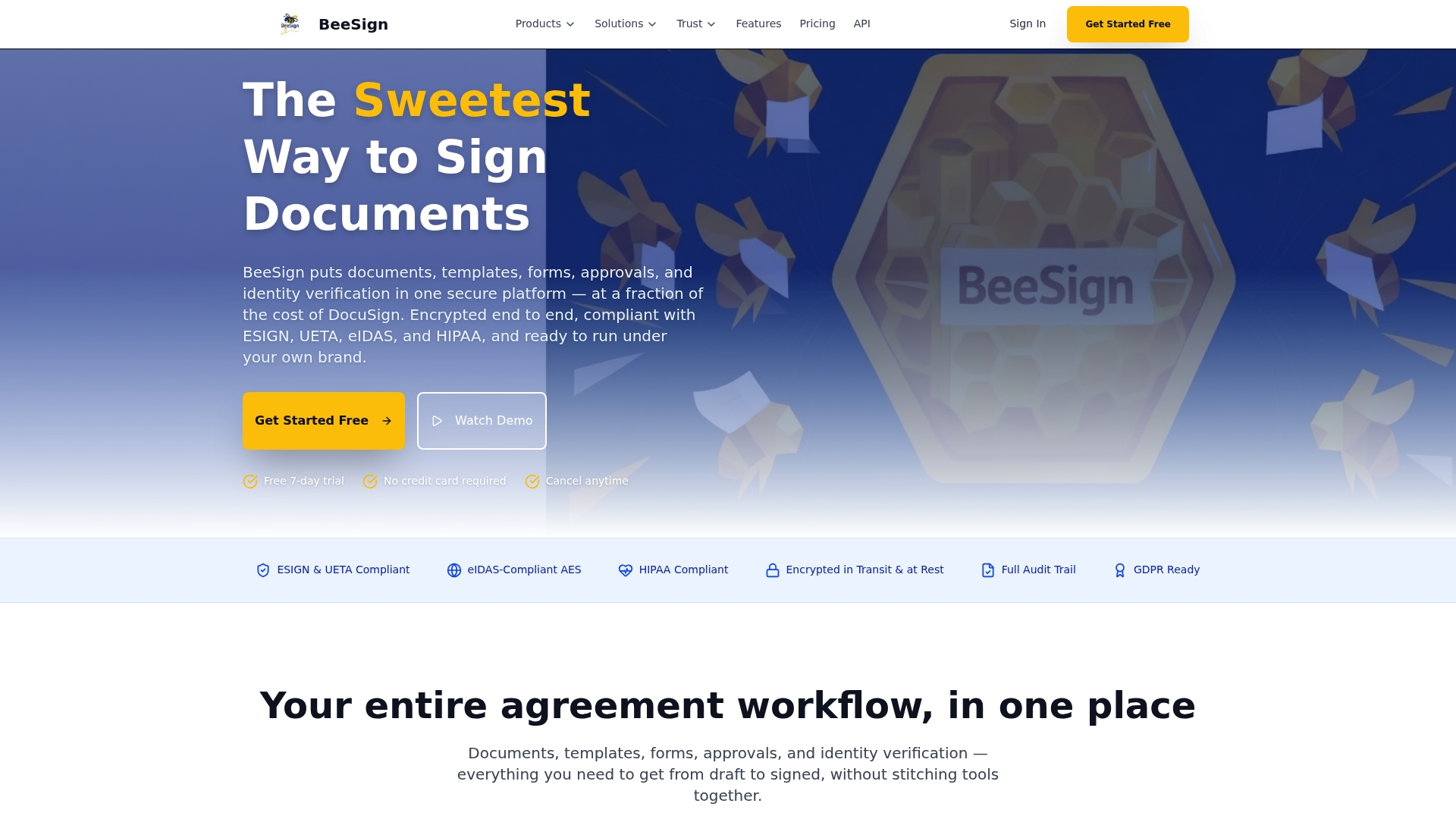
Beesign centralizes contracts, templates, and identity verification in one platform built for compliance and efficiency. The white-label and BYOC option lets you run the entire signing experience under your own domain and store records in your own cloud, satisfying data residency requirements that generic platforms cannot meet. Built-in identity verification, tamper-evident audit trails, and an API for CRM and HRIS integrations map directly to the procurement checklist covered above. Real estate teams, HR departments, sales organizations, and service businesses all use Beesign to close faster without giving up control.
Visit beesign.net to explore the platform and request a walkthrough tailored to your use case.
Useful sources
- First American eClosing — signing appointment duration benchmarks and white-label/BYOC data residency guidance
- HousingWire: Are digital closings really worth it? — per-loan savings figures for hybrid and full eClosings
- NotuDocs: Digital vs. Paper Documentation — template time savings and audit trail compliance data
- Dokmee: 8 DMS Benefits — single source of truth, version control, and collaboration features
- Business Wire: Snapdocs adoption study — adoption rate data and change management findings
- Docsbot: Document management system benefits — automation and AI-driven productivity gains
- Ricoh USA: Benefits of digital document management — security controls, hybrid work, and DMS integration guidance
- Beesign security page — encryption, access controls, and compliance details for procurement review
- Beesign: Legal and compliance solutions — defensible electronic signature controls for regulated industries
- Beesign: Document signing with identity verification — identity check options and admissibility considerations
Recommended
Ready to transform your workflow?
Start using BeeSign today and experience the future of document signing