Why Digital Signatures Reduce Onboarding Time for HR Teams
Discover why digital signatures reduce onboarding time. Streamline HR processes, cut errors, and enhance efficiency today!

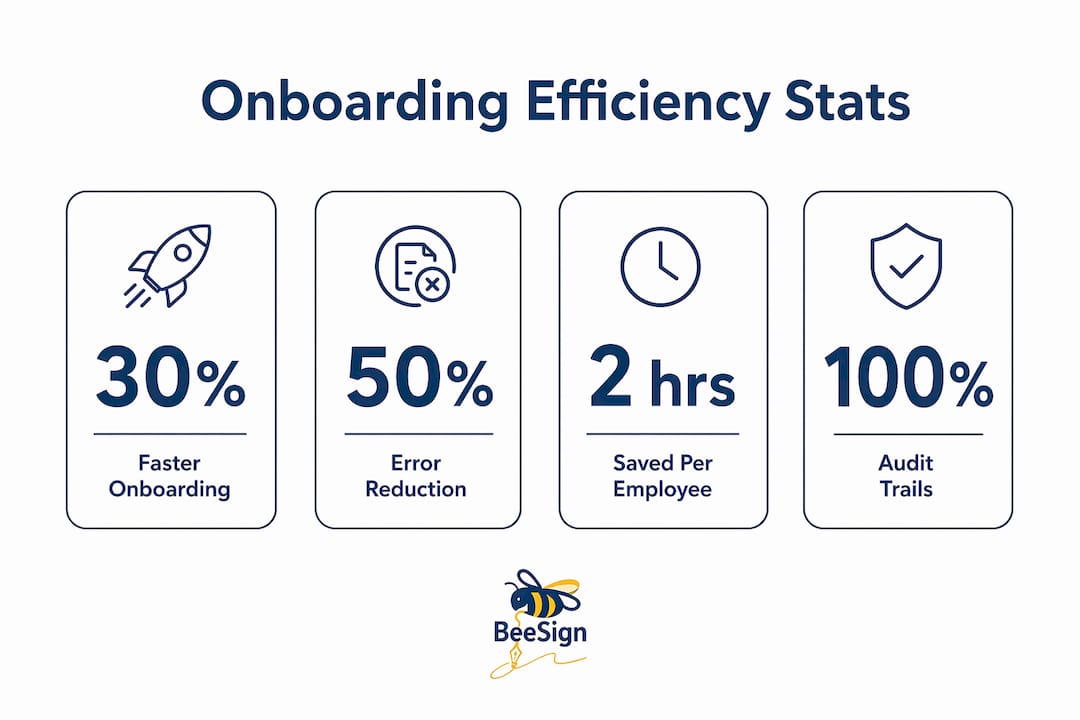
Digital signatures are secure electronic processes that replace handwritten sign-offs by binding a signer’s verified identity to a document using cryptographic technology. They directly answer why digital signatures reduce onboarding time: they eliminate physical paperwork, automate document routing, and compress multi-day approval chains into minutes. Companies using digital signatures report approximately 30% reduction in onboarding time and a 50% drop in document errors. That combination of speed and accuracy is why HR leaders across industries are replacing paper-based processes with electronic signing workflows. Platforms like Beesign centralize contracts, templates, and identity verification in one place, making the shift practical for teams of any size.
Why digital signatures reduce onboarding time through workflow automation
The single biggest reason digital signatures speed up onboarding is that they remove the physical bottleneck entirely. Paper documents require printing, hand-carrying, scanning, and mailing. Each step adds hours or days to a process that new hires experience before they ever log their first productive hour.
Digital routing replaces all of that with a direct send. You upload a document, assign signatories, and the system delivers it instantly. Document signing and processing now happens in minutes rather than days or weeks. That shift alone removes the most common source of onboarding delay: waiting for someone to receive, sign, and return a form.

Automated reminders are the second major accelerator. When a signatory has not acted within a set window, the system sends a follow-up automatically. HR teams no longer spend time tracking down signatures by phone or email. The workflow runs itself, and your team focuses on higher-value tasks like orientation and training.
Here is a typical HR onboarding sequence before and after digital signatures:
- Offer letter sent — delivered by email instantly instead of by courier or postal mail.
- Identity verification completed — the new hire confirms identity through a built-in verification step, no in-person visit required.
- Employment contract signed — the hire signs from any device; the signed copy routes back to HR automatically.
- Benefits enrollment forms completed — pre-built templates populate known fields, reducing manual data entry.
- Compliance documents acknowledged — audit-ready records are created the moment each document is signed.
Pro Tip: Set automated reminders at 24-hour and 48-hour intervals. Most unsigned documents get completed within the first reminder cycle, cutting average completion time significantly.
Integrated systems add another layer of efficiency. When your digital signature platform connects to your HR information system or ERP, signed documents flow directly into employee records. No manual upload, no filing delay, and no risk of a document getting lost between systems.
Which type of digital signature is right for each onboarding document?
Many HR teams conflate electronic signatures and digital signatures, but the distinction matters for both speed and compliance. An ordinary electronic signature is a typed name, a drawn signature, or a checkbox click. A certificate-based digital signature uses public key infrastructure (PKI) to mathematically prove document integrity and signer identity. Both are valid tools. The right choice depends on the document’s risk level.
The table below maps common onboarding documents to the appropriate signature type.
| Document type | Recommended signature | Reason |
|---|---|---|
| Offer letter | Ordinary electronic signature | Low risk, high volume, speed is the priority |
| Employment contract | Ordinary electronic signature | Standard HR transaction, legally recognized |
| Non-disclosure agreement | Ordinary electronic signature | Routine, well-established legal standing |
| Benefits enrollment | Ordinary electronic signature | Internal process, low dispute risk |
| Regulated financial or health forms | Certificate-based digital signature | High value, regulatory scrutiny, audit requirements |
| Executive or board-level agreements | Certificate-based digital signature | High assurance needed, formal legal weight |
Technology governance guidelines recommend treating signature choice as a fit-for-purpose control, applying simpler e-signatures for routine HR documents to maximize speed and reserving high-assurance digital signatures for sensitive cases. That approach keeps your onboarding process fast without sacrificing legal defensibility where it counts.
Pro Tip: Build a document classification matrix for your HR team. Assign each document type a risk tier and a default signature type. This removes guesswork and speeds up every future onboarding cycle.
Laws like the U.S. ESIGN Act and the European eIDAS regulation give electronic signatures the same legal standing as wet-ink signatures for most transaction types. Your HR team can use them confidently for the vast majority of onboarding documents without additional legal review.
What do the numbers say about digital signature onboarding advantages?
The efficiency gains from digital signatures are not theoretical. The data shows consistent, measurable improvements across HR departments that have made the switch.
Companies adopting digital signatures report approximately 30% faster onboarding and a 50% reduction in document errors. Fewer errors mean fewer correction cycles, which is one of the hidden time costs that paper-based onboarding accumulates. Every correction requires re-printing, re-signing, and re-filing.
The economic impact extends beyond HR. When a new hire completes onboarding paperwork faster, they reach productive work sooner. That acceleration has direct revenue implications for sales roles and client-facing positions where every day of delay costs the business real output.
Key operational benefits HR leaders consistently report include:
- Faster time to productivity — new hires complete paperwork before their first day, arriving ready to work rather than spending day one at a desk filling out forms.
- Reduced administrative load — HR staff spend less time chasing signatures and more time supporting new employees.
- Lower error rates — digital signatures prevent document loss or damage, and required-field validation catches missing information before submission.
- Audit-ready records — every signed document carries a timestamp, user ID, and system metadata, making compliance reviews straightforward.
- Geographic flexibility — remote and international hires complete onboarding without mailing documents across borders.
Secure electronic signatures include audit trails recording name, user ID, and timestamp for every signing event. That record is defensible in a dispute and satisfies most regulatory compliance requirements without additional documentation.
The impact on HR productivity compounds over time. A team that onboards 50 employees per year and saves two hours per hire reclaims 100 hours annually. For larger organizations onboarding hundreds of employees, the time savings translate directly into headcount capacity or cost reduction.
How to implement digital signatures for maximum onboarding efficiency
Getting the most from digital signatures in onboarding requires more than buying a platform. The implementation choices you make determine whether your team sees a 10% improvement or a 50% one.
Start by auditing your current onboarding document set. Identify every form a new hire touches, who signs it, and in what order. This map reveals where delays actually occur. Most teams discover that two or three documents account for the majority of their wait time.
Best practices for a high-impact rollout:
- Classify documents by risk tier before selecting a signature type. Use the fit-for-purpose framework: simple e-signatures for routine forms, certificate-based signatures for regulated documents.
- Integrate with your existing HR system. Digital signature solutions that connect to ERP and HR platforms reduce governance costs and eliminate manual data transfer between systems.
- Train HR staff on the new workflow before launch. The technology is straightforward, but teams need to understand how to set up templates, assign signatories, and monitor completion status.
- Use pre-built templates for every recurring document. Templates eliminate re-keying, reduce errors, and cut document preparation time to seconds.
- Maintain audit trail access. Confirm that your platform records signing events with sufficient metadata to satisfy your industry’s compliance requirements, whether that is HIPAA, ESIGN, or eIDAS.
Pro Tip: Run a pilot with one department before a full rollout. Use the pilot data to calculate your actual time savings per hire, then present that number to leadership to secure broader adoption.
Beesign supports HR onboarding document workflows with built-in templates, real-time tracking, and identity verification. Its API lets you automate document routing directly from your existing HR platform, removing the manual handoff that slows most onboarding sequences.
The strategic case for digital signatures in onboarding
Mustafa Abusharkh
After working with HR teams across multiple industries, I have noticed a consistent pattern. Organizations that treat digital signatures as a compliance checkbox get modest results. Organizations that treat them as a workflow redesign tool get transformational ones.
The difference is mindset. When you ask “How do we sign documents electronically?” you end up with a digital version of the same slow process. When you ask “How do we get a new hire fully onboarded before their first day?” you redesign the sequence entirely. Digital signatures make that redesign possible because they remove the physical constraint that forced everything to happen in sequence.
The legal trust question comes up often, and I understand the hesitation. But the ESIGN Act has been law since 2000. eIDAS has governed European transactions since 2016. The legal foundation is solid. The risk of not adopting is now greater than the risk of adopting, because your competitors are onboarding faster and your new hires notice the difference.
My honest recommendation: start with your offer letter and employment contract. Those two documents touch every hire and carry the most delay. Get those right, measure the time savings, and let the data make the case for expanding the program.
— Mustafa Abusharkh
Beesign makes faster onboarding practical for your team
HR leaders who want to reduce onboarding time need a platform that handles the full document lifecycle, not just the signature step. Beesign centralizes contracts, templates, and identity verification in one place, so your team manages every onboarding document from a single dashboard.
Beesign complies with ESIGN, eIDAS, and HIPAA, giving your legal and compliance teams confidence without slowing down HR. Its eSignature platform supports real-time tracking, automated reminders, and an API that connects directly to your existing HR systems. White-label options let enterprise teams run the service under their own brand with custom domains and private cloud storage. Whether you are onboarding five employees a month or five hundred, Beesign scales to your volume without adding administrative overhead.
Key takeaways
Digital signatures reduce onboarding time by replacing physical paperwork with automated electronic workflows, cutting completion time from days to minutes while reducing document errors by up to 50%.
| Point | Details |
|---|---|
| Automation removes bottlenecks | Digital routing and automated reminders eliminate the wait time caused by physical document handling. |
| Match signature type to document risk | Use simple e-signatures for routine HR forms and certificate-based signatures for regulated or high-value documents. |
| Measurable time and error savings | Organizations report approximately 30% faster onboarding and 50% fewer document errors after adopting digital signatures. |
| Audit trails support compliance | Every signing event records name, timestamp, and metadata, making records defensible under ESIGN, eIDAS, and HIPAA. |
| Integration multiplies the benefit | Connecting your signature platform to your HR or ERP system eliminates manual data transfer and compounds time savings. |
FAQ
What makes digital signatures faster than paper signatures?
Digital signatures eliminate physical handling, courier delays, and manual filing. Documents route instantly to signatories and return automatically once signed, compressing a multi-day process into minutes.
Are digital signatures legally valid for employee onboarding documents?
Yes. The U.S. ESIGN Act and the European eIDAS regulation give electronic signatures the same legal standing as handwritten signatures for most HR documents, including offer letters, employment contracts, and NDAs.
What is the difference between an electronic signature and a digital signature?
An electronic signature is a typed name or drawn mark. A digital signature uses PKI certificate technology to mathematically verify both the signer’s identity and document integrity, providing a higher level of assurance for regulated or high-value documents.
How do digital signatures support HR compliance?
Secure electronic signatures generate audit trails that record the signer’s name, user ID, timestamp, and system metadata. Those records satisfy most regulatory compliance requirements and are defensible if a signed document is ever challenged.
How do I choose the right platform for onboarding document signing?
Select a platform that integrates with your existing HR system, supports automated reminders and pre-built templates, and maintains audit trails compliant with your industry’s regulations. Beesign covers all of these requirements and adds identity verification for higher-risk documents.
Recommended
Ready to transform your workflow?
Start using BeeSign today and experience the future of document signing