Digital Signature vs Electronic Signature: 2026 Guide
Understand the key differences in our digital signature vs electronic signature guide. Choose wisely to protect your legal interests in 2026.

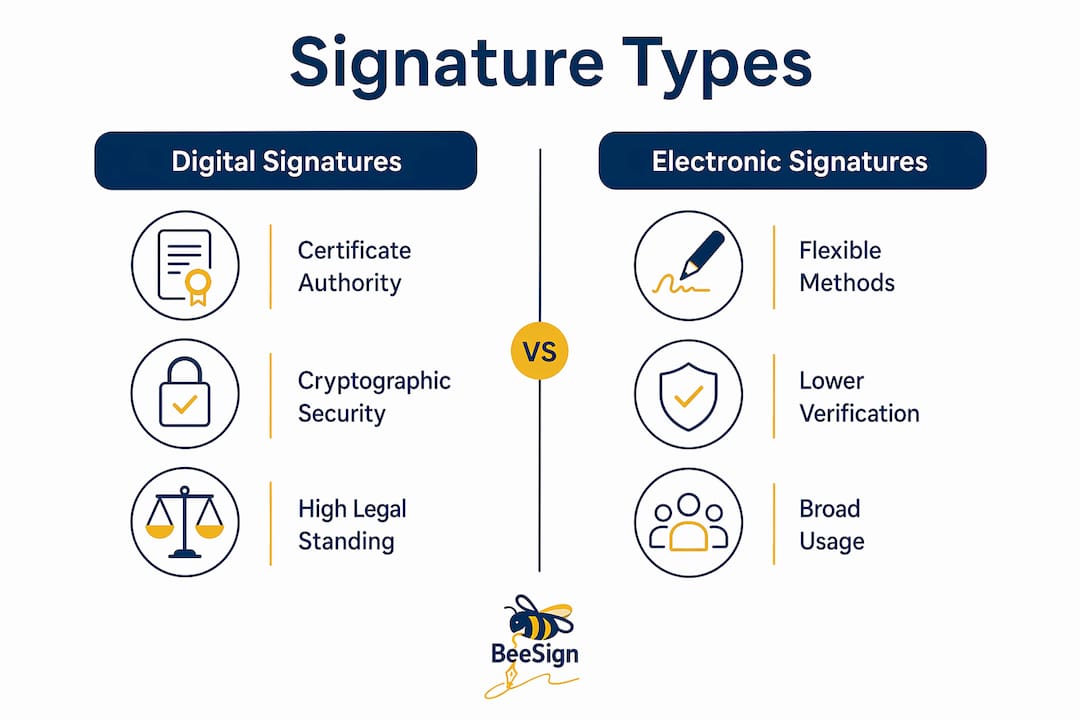
A digital signature is a cryptographic method that uniquely verifies signer identity and ensures document integrity, while an electronic signature is any electronic mark that evidences intent to sign. Most people use these terms interchangeably, but the difference between digital and electronic signatures carries real legal and operational weight. Regulatory frameworks like the EU’s eIDAS regulation and the US E-SIGN Act treat them differently, and choosing the wrong type for a high-stakes transaction can cost you in court. This guide breaks down both concepts, compares their legal standing, and helps you decide which one fits your specific workflow and risk profile.
What is an electronic signature and how is it used?
An electronic signature is a broad legal concept covering any electronic indication of intent to sign a document. Under both eIDAS and the E-SIGN Act, this includes typed names, checkbox clicks, scanned handwritten signatures, and even a stylus drawing on a touchscreen. The definition is intentionally wide, because the law prioritizes intent over method.
Electronic signatures work well for everyday, low-risk agreements. Common use cases include:
- NDAs and confidentiality agreements where speed matters more than maximum assurance
- Delivery receipts and purchase orders processed at high volume
- HR onboarding documents like offer letters and policy acknowledgments
- Simple service contracts between parties with an established relationship
The tradeoff is security depth. Electronic signatures provide weaker tamper evidence compared to cryptographic methods, and identity verification often relies on email confirmation alone. If a signatory later disputes their signature, the evidentiary record may be thin. That limitation does not disqualify electronic signatures from most business use, but it does mean you need to match the method to the transaction risk.
Pro Tip: For high-volume, low-risk documents, electronic signatures are the right call. Requiring stronger verification for routine agreements slows down your team and frustrates signers without adding meaningful protection.

What is a digital signature and what security does it offer?
A digital signature is a specific cryptographic method built on Public Key Infrastructure, commonly called PKI. It uses an asymmetric key pair: a private key that the signer holds and a public key that recipients use to verify the signature. When you sign a document, the system generates a cryptographic hash of the file and encrypts it with your private key. Anyone with your public key can decrypt that hash and confirm the document has not changed since signing.
The security guarantees this creates are concrete:
- Tamper evidence: Any change to the document after signing invalidates the signature automatically.
- Non-repudiation: The signer cannot credibly deny signing, because the private key is uniquely theirs.
- Identity binding: A Certificate Authority issues a digital certificate that ties the key pair to a verified identity.
- Audit trail integrity: The cryptographic record is self-contained within the document, not dependent on a third-party server log.
Certificate Authorities conduct identity validations aligned with national standards and protect private keys using hardware security modules and two-factor authentication. That rigor is what separates a true digital signature from a platform-applied seal. One important nuance: most mainstream e-signature platforms apply their own platform-wide digital certificate to seal documents, not a personal certificate tied uniquely to the signer. True personal digital signatures require dedicated identity proofing and certificate issuance.
Digital signatures are the standard for regulated industries, high-value contracts, cross-border transactions, and any agreement where legal defensibility is a priority. Singapore’s government guidelines, for example, reserve the legal presumption of authenticity for cryptographically secured signatures in funding contracts, tenancy agreements, and statutory declarations.
Pro Tip: Ask any e-signature vendor whether they apply a platform certificate or a signer-bound certificate. The answer tells you whether you are getting a true digital signature or an electronically sealed document.
How do digital and electronic signatures compare legally?
All digital signatures are electronic signatures, but not all electronic signatures are digital signatures. That hierarchy matters when you are evaluating legal standing and evidentiary weight.
The eIDAS regulation structures this as a three-tier model:
| Signature tier | Identity verification | Tamper-proofing | Legal standing |
|---|---|---|---|
| Simple electronic signature | Email or checkbox only | None | Basic legal recognition |
| Advanced electronic signature | Identity linked to signer | Cryptographic integrity | Higher evidentiary weight |
| Qualified electronic signature (QES) | Certificate Authority verified | Full PKI protection | Equivalent to handwritten across EU member states |
In the US, the E-SIGN Act grants legal validity to electronic signatures broadly but allows courts to assign higher evidentiary weight to digital signatures in disputes. That distinction becomes critical when a contract is challenged.
Qualified Electronic Signatures enable legal equivalence to handwritten signatures across EU borders, which removes friction from international transactions. A QES signed in Germany carries the same legal weight in France or Spain without additional authentication steps. For businesses operating across EU member states, that cross-border recognition is a concrete operational advantage.
Pro Tip: If your contracts regularly cross EU borders, target Qualified Electronic Signature compliance from the start. Retrofitting your workflow later is significantly more expensive than building it in.
The practical guidance is straightforward. Use simple electronic signatures for routine, low-risk agreements. Use advanced or qualified digital signatures for contracts with financial exposure, regulatory requirements, or cross-border parties. Overspecifying your signature tier for low-risk documents creates user friction and increases abandonment rates without improving your legal position.
What practical challenges come with choosing between the two?
Choosing between electronic and digital signatures is fundamentally a risk management decision that weighs security needs against user friction and transaction efficiency. The right answer depends on three factors: transaction risk, regulatory environment, and the technical capability of your signing platform.
Digital signatures introduce real operational overhead. Certificate issuance requires identity proofing, which adds steps for the signer. In some workflows, signers need to install software, manage tokens, or complete video verification. That friction is justified for a mortgage or a government contract. It is not justified for an NDA between two parties who already know each other.
Key practical considerations include:
- Cost: Digital certificate issuance and Certificate Authority fees add per-transaction cost that compounds at scale.
- User experience: Signers unfamiliar with PKI may abandon the process if it requires too many steps.
- Interoperability: Cross-border recognition depends on whether the Certificate Authority is recognized in the recipient’s jurisdiction.
- Platform capability: Not all signing platforms support certificate-based digital signatures natively. Verify before committing to a vendor.
Organizations that default to digital signatures for every document, regardless of risk, consistently see lower completion rates and higher support costs. Matching the signature type to the transaction risk is not a compromise on security. It is good risk management.
How to implement digital and electronic signatures in your workflows
Effective implementation starts with a risk assessment, not a technology decision. Follow these steps to build a compliant, practical signing workflow:
-
Classify your documents by risk level. Separate high-risk agreements (financial contracts, regulated filings, cross-border deals) from routine documents (internal approvals, delivery confirmations). Each category needs a different signature tier.
-
Identify your regulatory requirements. If you operate under eIDAS, HIPAA, or industry-specific rules, map which document types require qualified or advanced signatures. Check the legal validity requirements for each jurisdiction you operate in.
-
Select a Trust Service Provider for digital certificates. For qualified digital signatures under eIDAS, your Certificate Authority must appear on an EU Trust List. For US workflows, align with Certificate Authorities that meet NIST standards.
-
Integrate your signing platform with existing business tools. API-driven platforms let you embed signature requests directly into your CRM, contract management system, or HR software. This reduces manual steps and keeps audit trails centralized.
-
Configure audit trails and document integrity checks. Every signed document should generate a tamper-evident record that captures the signer’s identity, timestamp, IP address, and the cryptographic hash of the final document.
-
Train your team and communicate with signers. Explain to signers why a particular level of verification is required. Clear communication reduces abandonment. For digital signatures specifically, walk signers through the certificate process before they encounter it live.
Reviewing your platform’s features before committing is worth the time. The right platform supports both simple electronic signatures and certificate-backed digital signatures, so you can apply the correct method to each document type without switching tools.
Key Takeaways
Digital signatures are a cryptographically secured subset of electronic signatures that provide stronger identity assurance, tamper evidence, and legal defensibility, making them the right choice for high-risk or regulated transactions.
| Point | Details |
|---|---|
| Definitions differ legally | Electronic signatures cover any electronic intent to sign; digital signatures use PKI cryptography and verified certificates. |
| eIDAS creates three tiers | Simple, advanced, and qualified signatures carry increasing legal weight and identity assurance under EU law. |
| QES equals handwritten signatures | Qualified Electronic Signatures hold the same legal standing as wet-ink signatures across all EU member states. |
| Risk should drive selection | Applying digital signatures to low-risk documents increases friction and reduces completion rates without improving legal protection. |
| Platform certificates are not personal | Most platforms apply a shared certificate to seal documents; true personal digital signatures require dedicated identity proofing. |
Why I think most businesses are using digital signatures wrong
The most common mistake I see is organizations treating “digital signature” as a synonym for “more secure,” then applying it everywhere. That instinct is understandable but counterproductive. A qualified digital signature on an internal expense approval form does not make that form more legally defensible. It just makes your employees less likely to complete it.
The more useful mental model is fitness for purpose. A digital signature is a fit-for-purpose control, best reserved for workflows where the legal or financial risk justifies the higher operational overhead. For a real estate closing or a cross-border supply agreement, the overhead is worth it. For a routine vendor NDA, it is not.
What I have found actually works is a tiered policy: define two or three document categories, assign a signature tier to each, and build that into your platform configuration so the right method is applied automatically. That approach removes the decision from individual employees and keeps your compliance posture consistent.
The other thing worth saying plainly: identity verification is the foundation of everything. A digital signature with weak identity proofing is not actually more secure than a well-documented electronic signature. The cryptography is only as strong as the process that issued the certificate. Evaluate that process carefully before trusting any platform’s security claims.
— Mustafa Abusharkh
Beesign supports both signature types in one platform
Beesign centralizes electronic and digital signature workflows, identity verification, and document management in a single platform built for compliance with eIDAS, the E-SIGN Act, and HIPAA. You can apply the right signature tier to each document type without switching tools or managing separate vendor relationships.

Beesign’s identity verification supports eIDAS-compliant Advanced Electronic Signatures, with real-time tracking and a full audit trail on every document. For sales teams, the sales and business solution accelerates deal cycles by embedding signature requests directly into existing workflows. Businesses that need branded signing experiences can run the entire platform under their own domain through Beesign’s white-label option. Visit beesign.net to see how the platform handles both signature types across your document categories.
FAQ
What is the main difference between a digital and electronic signature?
An electronic signature is any electronic mark of intent to sign, including typed names or checkboxes. A digital signature is a specific cryptographic method using PKI and a verified digital certificate to confirm identity and protect document integrity.
Are electronic signatures legally binding in the US?
Yes. The E-SIGN Act grants electronic signatures legal validity for most agreements in the US. Digital signatures carry higher evidentiary weight in disputes because of their cryptographic identity verification.
When should you use a digital signature instead of an electronic signature?
Use a digital signature for high-value contracts, regulated filings, cross-border agreements, or any transaction where legal defensibility and tamper evidence are priorities. Electronic signatures are sufficient for routine, low-risk documents.
What is a Qualified Electronic Signature under eIDAS?
A Qualified Electronic Signature is the highest tier under the eIDAS regulation. It uses a certificate issued by a trusted Certificate Authority and carries the same legal standing as a handwritten signature across all EU member states.
Do most e-signature platforms provide true digital signatures?
Most platforms apply a shared platform certificate to seal documents rather than a personal certificate tied to the individual signer. True personal digital signatures require dedicated identity proofing and certificate issuance from a recognized Certificate Authority.
Recommended
Ready to transform your workflow?
Start using BeeSign today and experience the future of document signing