4 Steps U.S. Ecommerce Teams Use to Make Signatures Legally Defensible
Compliance first guide for U.S. legal and ops teams: 4 steps to send, collect, and prove ecommerce signatures with tamper evident audit trails.

Yes, electronic signatures can validly bind e-commerce contracts in the United States when the record shows signer intent, consent to transact electronically, and a reliable audit trail. The ESIGN Act sets the federal baseline, and platforms like BeeSign build the proof layer around it. The one condition to check first: does your workflow capture and store that evidence, or just collect a click?
TL;DR:
- Using electronic signatures for e-commerce contracts is legally valid in the U.S. if signer intent and consent are clearly demonstrated, with a reliable audit trail.
- Courts require proof that the signer intended to sign, consented electronically, and that the signing record is reproducible and tamper-proof with appropriate timestamps and identity verification.
- Digital signatures provide stronger evidence against denial by including cryptographic seals, while electronic signatures rely more heavily on surrounding audit data.
- Integrating e-signatures into checkout processes via API and webhooks ensures signatures are captured and stored alongside order data, reducing disputes over contract validity.
- Balancing ease of signing and verification level based on contract risk is essential; higher-value deals warrant stricter identity checks and possibly notarization or biometric validation.
Table of Contents
- Why E-Commerce Contract E-Signatures Hold Up Under U.S. Law
- What Makes an Electronic Signature Hold Up as Evidence?
- How Do You Send a Contract for E-Signature and Collect It?
- How Do You Integrate E-Signatures Into an E-Commerce Platform?
- How BeeSign Applies These Controls to E-Commerce Contracts
- How Do You Prove a Signed Contract in a Dispute?
- Checklist for Keeping E-Signing Defensible
- Balancing Conversion and Legal Defensibility
- Get Started With BeeSign for E-Commerce Contracts
- Sources
- FAQ
Why E-Commerce Contract E-Signatures Hold Up Under U.S. Law
Federal law treats a properly executed e-commerce contract e-signature the same as ink on paper. The ESIGN Act says a signature or contract “may not be denied legal effect” solely because it’s electronic, and it governs interstate and foreign commerce. UETA, adopted by nearly every state, does similar work at the state level. Together they cover the vast majority of online sales agreements, order confirmations, and terms-of-service acceptances your business will ever send.
The exceptions rarely touch standard e-commerce. Statutory carve-outs mostly involve wills, certain court orders, and some real-estate or family-law documents. If you’re selling products, licensing software, or signing vendor agreements online, you’re almost certainly inside the protected zone.
What courts actually check:
- Did the signer intend to sign, not just click through?
- Did they consent to conduct business electronically?
- Can you reproduce the exact record they saw and signed?
- Is retention reliable enough to survive a discovery request?
Government guidance on the E-SIGN Act confirms that retention and reproducibility matter as much as the signature capture itself. Where the picture gets murkier: some consumer-finance and lending disclosures carry extra requirements under rules referenced in the Code of Federal Regulations. For high-dollar B2B contracts or anything touching regulated finance, pair your e-signature workflow with a compliance review of applicable laws before you launch, and consider a hybrid or notarized process for edge cases.
What Makes an Electronic Signature Hold Up as Evidence?
An electronic signature is broad: a typed name, a checkbox, a click-to-accept. A digital signature is narrower and cryptographic, using a hashed, tamper-evident seal tied to the document. The distinction matters the moment a signer denies signing. Digital signatures give you mathematical proof the document wasn’t altered after signing; a plain electronic signature relies more heavily on surrounding evidence.
That surrounding evidence is your audit trail, and it needs four components to be credible in front of a judge:
- Timestamp showing exactly when each action occurred
- IP address tying the action to a location and device
- Document hash proving the signed file matches the original
- Completion certificate summarizing the full signing sequence
Identity verification should scale with risk. A newsletter opt-in needs almost nothing. A $500 order might warrant email one-time-passcode confirmation. A six-figure supply contract deserves government ID capture or biometric face matching. ISO information-security standards support the practice of layering retention controls and tamper-evident logging, which materially raises the odds a court accepts your record as authentic.
Pro Tip: Encrypt signed documents at rest and in transit, and set retention periods that match your state’s statute of limitations for contract disputes, not just your internal file-cleanup schedule.
How Do You Send a Contract for E-Signature and Collect It?
Getting from “draft” to “enforceable” takes four stages, and skipping the first one is where most disputes start.
- Pre-send. Confirm both parties’ legal capacity to contract, add clear e-consent disclosure language, and pick your identity-verification level based on contract value.
- Document prep. Build from a template, merge order and customer data automatically, and lock required fields so nothing gets signed blank.
- Delivery. Send through an authenticated channel, present a clear signing interface, and confirm receipt by email or web notification, with automatic reminders for stalled signers.
- Post-sign. Issue the signed PDF with its completion certificate, store both in a secure repository, and trigger downstream fulfillment or order workflows the moment signature completes.
This sequence works whether you’re closing a single enterprise deal or running thousands of checkout-linked agreements a month. Teams handling recurring sales volume often formalize this into a repeatable online contract signing workflow rather than reinventing it per deal.
How Do You Integrate E-Signatures Into an E-Commerce Platform?
Two signing patterns dominate e-commerce, and the choice affects both conversion and your evidentiary record. Embedded signing keeps the buyer inside your checkout flow, which cuts drop-off and lets you log a continuous session trail. Redirected signing sends buyers to a separate signing page, which is simpler to build but introduces a context switch that some buyers abandon.
On the technical side, integration usually runs through:
- A REST API that generates documents from templates and merges order or customer data into contract fields automatically
- Webhooks that fire on signature completion, updating order status, releasing inventory holds, or triggering payment capture
- Field mapping that pulls buyer name, SKU details, and pricing directly from your order system into the contract
- Retention logging that links the signed PDF back to the original order record for later discovery requests
One Shopify-based e-signature module illustrates the pattern well: signing events wire directly into order automations, so fulfillment only proceeds once the signature status flips to complete. For platforms outside the standard stack, partners like commercetools integrations show how commerce APIs and signing events can be wired together for custom builds.
How BeeSign Applies These Controls to E-Commerce Contracts
BeeSign was built around the exact evidentiary checklist courts look for, which is why it’s worth understanding as a working example rather than an abstraction. Enable the tamper-evident audit trail on every document, and you automatically capture timestamps, IP data, and a document hash without extra configuration.
For higher-value contracts, BeeSign’s government ID capture and biometric face matching raise identity confidence well beyond a checkbox click. Every completed signature generates a completion certificate you can hand directly to counsel or a court.
Two other features matter for e-commerce specifically:
- White-label branding with custom domains keeps the signing experience inside your brand, which reduces buyer hesitation at the exact moment they’re deciding whether to trust the transaction
- Bring-your-own-cloud storage keeps signed records inside your own infrastructure to support compliance and data-residency requirements
Pro Tip: If you’re integrating signing into checkout, use BeeSign’s REST API and event webhooks to sync signature status straight into your order management system instead of checking manually. It closes the gap where fulfillment ships before a contract is actually complete.
How Do You Prove a Signed Contract in a Dispute?
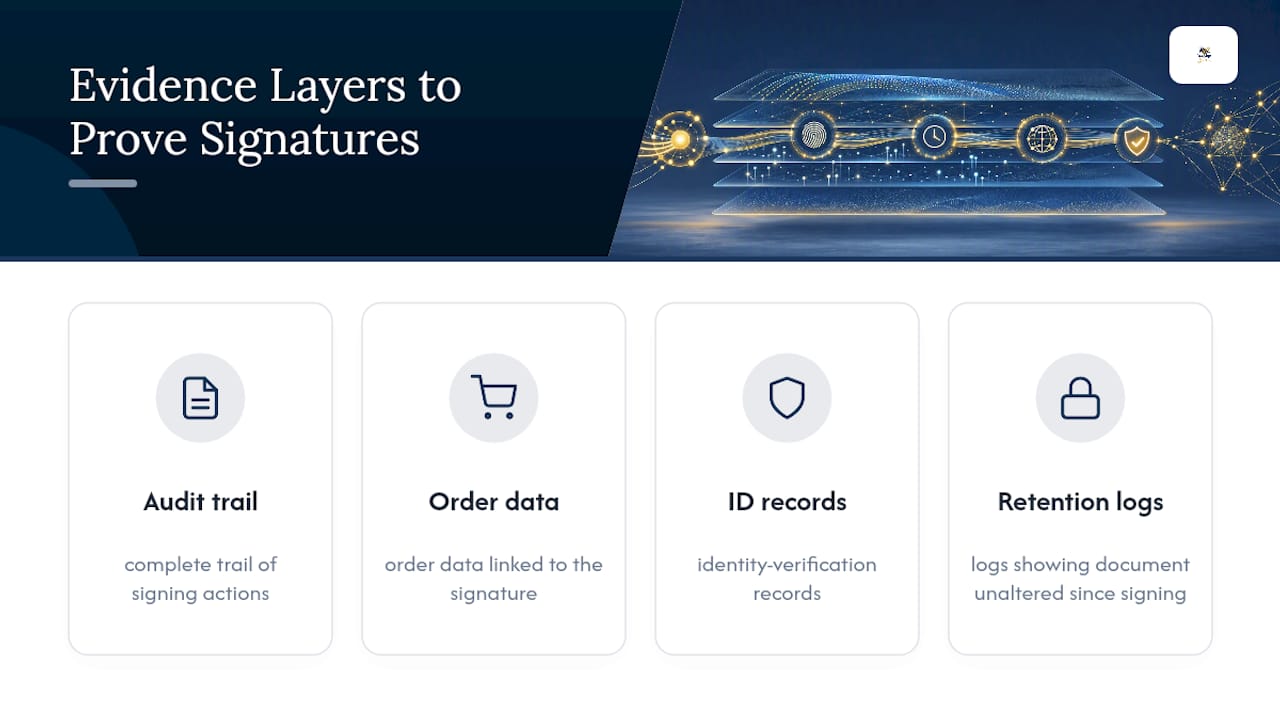
When a signature gets challenged, courts weigh a specific hierarchy of evidence: the complete audit trail, the linked order data, identity-verification records, and retention logs showing the document hasn’t been altered since signing. ISO-aligned retention practices strengthen every one of those layers at once.
The defenses you’ll actually face are predictable: claims of no intent, lack of capacity, forgery, or ambiguous terms. Strong identity verification and clear consent language neutralize most of them before they reach a courtroom. For high-risk contracts, that’s exactly when to add notarization or witnessed execution on top of your standard flow. Consumer disputes involving fraud can also route through federal consumer-assistance channels as an added layer of recourse.
Checklist for Keeping E-Signing Defensible
Run this before you flip on e-signatures for any e-commerce contract flow.
- Place e-consent disclosure language on the signing screen itself, not buried in a separate policy page
- Require at minimum: timestamp, IP capture, document hash, and completion certificate on every signed document
- Match identity-verification level to contract value, not a one-size-fits-all setting
- Set retention rules that satisfy both ESIGN recordkeeping and your state’s limitations period
- Run a test-sign on every new template before it goes live
| Risk Level | Contract Example | Minimum Verification |
|---|---|---|
| Low | Newsletter or free-trial opt-in | Email confirmation only |
| Medium | Standard online purchase agreement | Email one-time passcode |
| High | Enterprise or wholesale supply contract | Government ID plus biometric match |
Balancing Conversion and Legal Defensibility
Ease of signing drives conversions, and stricter identity verification adds friction. Both are true, so calibrate by contract value instead of applying one standard everywhere. Embedding signing directly into checkout cuts drop-off on high-ticket purchases, since buyers never leave the flow they’re already committed to. The trade-off works only when legal and engineering plan the verification tiers together before launch, not after a dispute forces the question.
— Mustafa Abusharkh
Get Started With BeeSign for E-Commerce Contracts
BeeSign gives e-commerce teams the compliance backbone this article just walked through, without forcing legal and engineering to build it from scratch. You get a tamper-evident audit trail on every document, identity verification that scales from email confirmation to government ID capture, and bring-your-own-cloud storage that keeps signed records inside your own infrastructure.

For teams that need buyers to sign inside a branded checkout rather than a generic third-party page, the white-label and BYOC options let you run the entire signing experience under your own domain. That consistency builds buyer trust exactly where it matters most, at the moment of commitment.
Start with a trial, run a real order contract through it, and check whether your current audit trail would hold up if a buyer disputed the sale tomorrow. You can explore BeeSign’s platform and begin that trial today.
Sources
- United States Code (prelim) — Title 15, Chapter 96 (E-Sign Act)
- Electronic Signatures in Global and National Commerce Act (E-Sign Act) — NCUA guidance
- Electronic signature rules referenced in the Code of Federal Regulations
This article is general information, not a substitute for advice from a qualified lawyer. Consult a qualified legal professional about your own circumstances before acting on anything here.
FAQ
Are Electronic Signatures Acceptable on Contracts?
Yes. Under the ESIGN Act and UETA, electronic signatures are legally acceptable on most contracts, including e-commerce sales agreements, as long as the signer intended to sign and consented to electronic transacting.
What Is a Digital Signature in E-Commerce?
A digital signature is a cryptographically sealed version of an electronic signature, using a document hash to prove the file wasn’t altered after signing, which strengthens the record’s evidentiary weight in an e-commerce dispute.
How Do You Send a Contract for E-Signature?
Prepare the document from a template with merged order data, deliver it through an authenticated channel with a clear signing interface, and confirm receipt automatically, a workflow platforms like BeeSign handle end to end.
What Are Electronically Signed Contracts?
They’re agreements executed through digital signature capture instead of ink, backed by an audit trail (timestamp, IP, document hash, completion certificate) that serves as the proof record if the contract is ever challenged.
Recommended
Ready to transform your workflow?
Start using BeeSign today and experience the future of document signing