E-Signature Compliance Laws Explained for U.S. Businesses
Discover essential insights on esignature compliance laws explained. Understand how these laws impact electronic agreements in U.S. business.

Electronic signature compliance laws in the United States establish a clear legal framework: an electronic signature carries the same legal weight as a handwritten one, provided specific requirements are met. Two federal and state laws form the backbone of this framework, the ESIGN Act and the Uniform Electronic Transactions Act (UETA), and together they govern the vast majority of electronic transactions across the country. If you work in real estate, finance, healthcare, or any contract-heavy field, understanding where these laws apply and where they stop is the difference between an enforceable agreement and a disputed one.
Here is what you need to know upfront:
- The ESIGN Act is the primary federal law. It applies to transactions in or affecting interstate or foreign commerce and guarantees that no contract can be denied legal effect solely because it is electronic.
- UETA is a model state law adopted by 49 states plus Washington D.C. and several territories. It covers intrastate transactions where ESIGN does not directly apply.
- New York did not adopt UETA. It operates under its own Electronic Signatures and Records Act (ESRA), which has similar but distinct requirements.
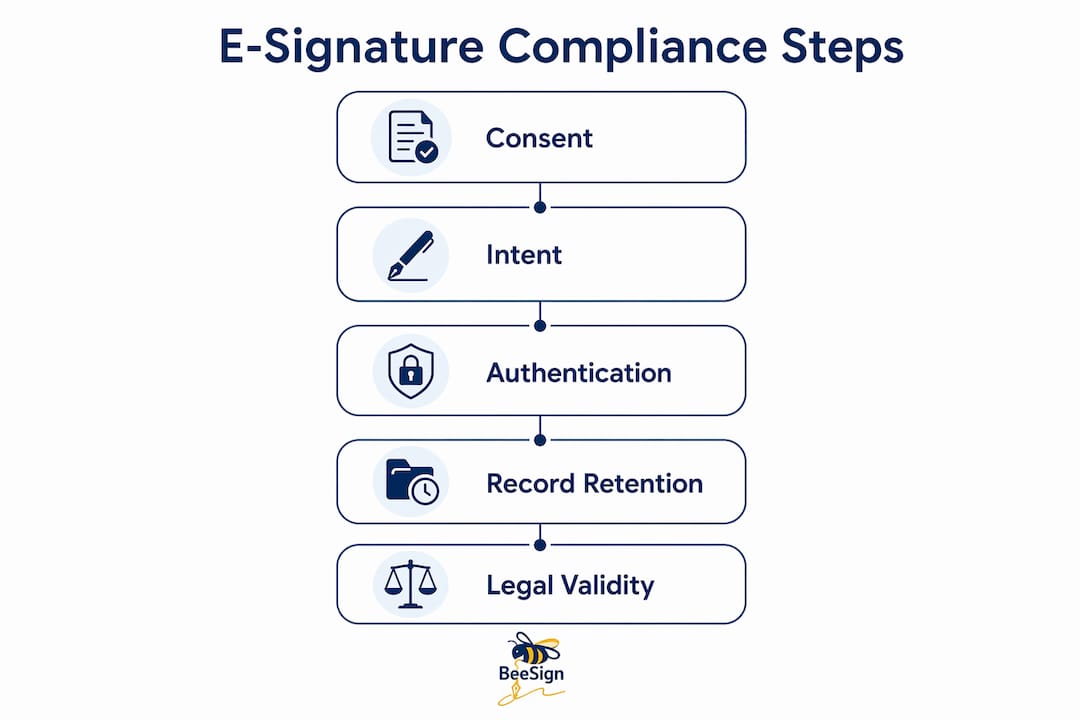
- Both laws require consent, demonstrated intent to sign, authentication, and proper record retention for an electronic signature to be legally valid.
- Certain documents, including wills, trusts, and some family law instruments, are excluded from both ESIGN and UETA and cannot generally be signed electronically.
If you want a deeper look at whether specific document types qualify, Beesign’s guide on legal documents signed electronically covers the full range.
What does the ESIGN Act actually require?
The ESIGN Act, signed into law on june 30, 2000, is the federal anchor for electronic signature legality in the United States. Under Section 7001(a)(1) of Title 15 of the U.S. Code, a signature or contract cannot be denied legal effect, validity, or enforceability solely because it is in electronic form. That is the foundational guarantee.
But the ESIGN Act does more than just validate electronic signatures. It sets out specific compliance obligations, particularly when consumers are involved:
- Affirmative consent: Consumers must actively agree to receive records electronically before you can send them that way.
- Pre-consent disclosure: Before a consumer consents, you must clearly inform them of their right to receive records on paper, their right to withdraw consent, and any fees or consequences tied to withdrawal.
- Hardware and software disclosure: Consumers must receive a statement of the technical requirements needed to access and retain electronic records.
- Electronic confirmation of consent: The consumer must confirm consent in a way that demonstrates they can actually access the electronic format being used.
- Withdrawal rights: A consumer’s withdrawal of consent must be honored within a reasonable time, without imposing fees or conditions that were not previously disclosed.
- Record retention: Electronic records must accurately reflect the original contract and remain accessible to all entitled parties for the legally required period, in a form that can be accurately reproduced.
One point businesses often miss: the ESIGN Act does not override other substantive legal requirements. It removes the barrier of electronic form, but it does not eliminate obligations imposed by other statutes, regulations, or rules of law. If a specific law requires notarization, that requirement still applies; it can just be satisfied electronically if the authorized person’s electronic signature is properly attached or logically associated with the record.
The ESIGN Act also limits state authority over electronic signatures. States cannot mandate a specific technology for creating or validating electronic signatures, provided the technology meets ESIGN’s requirements and does not discriminate against electronic records.

How UETA fills the gaps the ESIGN Act leaves
The Uniform Electronic Transactions Act was drafted by the National Conference of Commissioners on Uniform State Laws in 1999 and has since been adopted by 49 states plus Washington D.C. and U.S. territories. Where the ESIGN Act focuses on interstate and foreign commerce, UETA governs intrastate electronic transactions, making the two laws complementary rather than competing.
UETA’s core validity requirements align closely with ESIGN:
- Intent to sign: The electronic signature must reflect the signer’s intent to authenticate the record.
- Consent: Parties must agree to conduct the transaction electronically, though this agreement can be implied by context.
- Logical association: The signature must be attached to or logically associated with the record being signed.
- Attribution: The signature must be attributable to the person who signed it, typically through authentication methods like access credentials or audit logs.
The practical difference between UETA and ESIGN shows up in scope. A lease agreement between two parties in the same state falls under UETA. A contract between a Texas company and a New York client crosses state lines and falls under ESIGN. In most cases, both laws reach the same legal outcome, but the compliance path and the applicable consumer protections can differ.
States that adopted UETA can modify, limit, or supersede certain ESIGN provisions, but only if their version of UETA is consistent with ESIGN’s requirements and does not favor a specific technology. This creates a layered system where state law governs locally, and federal law steps in for cross-border transactions.
Why New York plays by different rules
New York is the most significant outlier in U.S. electronic signature law. The state declined to adopt UETA and instead enacted its own Electronic Signatures and Records Act, commonly known as ESRA. While ESRA shares some core principles with UETA, including the recognition that electronic signatures can be legally valid, it has its own distinct requirements and scope.
Key differences businesses operating in New York need to understand:
- ESRA applies broadly to transactions involving New York state government agencies and to private transactions where the parties agree to use electronic signatures.
- State agency transactions are subject to specific guidelines issued by the New York State Office of Information Technology Services, which sets standards for acceptable electronic signature methods.
- Record retention rules under ESRA require that electronic records be maintained in a form that preserves their integrity and allows for accurate reproduction.
- Interstate transactions involving New York parties still fall under the federal ESIGN Act, so ESRA’s differences matter most for purely intrastate New York transactions.
For businesses operating across multiple states, New York’s divergence from UETA means you cannot assume a single compliance approach covers every jurisdiction. A contract signed electronically in New York under ESRA may have different evidentiary requirements than the same contract signed under a UETA-adopting state’s rules. Legal counsel familiar with New York’s specific framework is worth consulting if your operations are concentrated there.
Which documents cannot be signed electronically under U.S. law?
Both the ESIGN Act and UETA explicitly exclude certain document categories from their scope. These statutory exclusions exist because the documents involved carry such significant legal or personal consequences that lawmakers determined paper execution with additional formalities was necessary.
Documents generally excluded from electronic signature acceptance under ESIGN and UETA include:
- Wills, codicils, and testamentary trusts: These require wet signatures and, in most states, witnesses and notarization.
- Adoption and divorce documents: Family law instruments governing the legal status of persons are typically excluded.
- Court orders and official court documents: Documents issued by or filed with courts generally require physical signatures or court-specific electronic filing systems.
- Notices of cancellation or termination of utility services: Certain consumer protection notices must be delivered in specific non-electronic formats.
- Notices related to foreclosure, eviction, or repossession: Documents affecting a person’s primary residence carry heightened protections.
- Health insurance cancellation notices and certain benefits documents: Specific consumer health and safety notices are excluded.
- Certain Uniform Commercial Code provisions: Specific UCC articles governing negotiable instruments and documents of title have their own rules that may limit electronic execution.
Some states have carved out exceptions or expanded electronic signature acceptance for certain excluded categories. Remote online notarization laws, for example, now allow notarized documents to be executed electronically in many states, which has opened the door for some documents that previously required in-person wet signatures. Always verify the current rules in the specific state where the document will be executed or enforced.
Key compliance elements that make an electronic signature legally valid
Meeting the legal standard for an electronic signature goes beyond clicking a button. The authentication, intent, and association requirements under both ESIGN and UETA demand that you build a documented, verifiable process around every signature. Here is what that looks like in practice:
- Consent: Obtain clear, affirmative consent from each signer before using electronic records. Document when and how consent was given.
- Intent to sign: Capture evidence that the signer actively chose to sign, such as a checkbox confirmation, a typed name, or a click-to-sign action tied to a specific record.
- Authentication: Use methods that tie the signature to the specific individual. Passwords, two-factor authentication, email verification, and knowledge-based authentication all serve this purpose.
- Audit trails: Maintain a complete log of signing events, including timestamps, IP addresses, and the sequence of actions taken. This log is your primary evidence of attribution if a signature is ever challenged.
- Logical association: The signature must be embedded in or directly linked to the document it authenticates. A signature stored separately from the record it covers creates an evidentiary gap.
- Consumer disclosures: For consumer-facing transactions, provide the required hardware and software disclosures before consent is obtained.
- Record retention: Store signed records in a format that accurately reflects the original, remains accessible to all entitled parties, and can be reproduced for the legally required retention period.
- Security: Protect stored records and signature data against unauthorized access, alteration, or deletion.
Pro Tip: Build your audit trail to answer one question: if this signature were challenged in court tomorrow, could you prove who signed, when they signed, and that they intended to sign? If the answer is yes, your process is on solid ground. Beesign’s compliance checklist for teams walks through each of these elements step by step.
Common compliance challenges and how to address them
Even with a solid understanding of the law, businesses run into recurring problems when implementing electronic signature workflows. The good news is that most of these challenges have practical solutions.

Inconsistent consent management is one of the most common gaps. Teams often collect consent once and assume it covers all future transactions, but ESIGN requires that consent be specific to the categories of records involved. Build a consent management process that tracks what each signer agreed to and when.
Weak authentication creates enforceability risk. A signature captured with only an email address and no additional verification is harder to defend if disputed. Two-factor authentication or knowledge-based verification adds a layer of attribution that courts and opposing counsel take seriously.
State-level variation catches multi-state businesses off guard. A process compliant in California under UETA may not satisfy New York’s ESRA requirements for state agency transactions. Map your transaction types to the states involved and verify compliance requirements for each.
Record retention failures are often discovered too late. Electronic records must remain accessible and reproducible for the full legally required period, which varies by document type and industry. A record stored in a proprietary format that becomes unreadable after a software update fails this requirement. Use open, widely supported formats like PDF/A for long-term storage.
Technological access gaps can invalidate consumer consent. If a consumer cannot actually access the electronic format you are using, their consent is not valid under ESIGN. Test your delivery format across common devices and operating systems before deploying it in consumer-facing workflows.
For financial services teams, the intersection of data security controls and electronic signature compliance adds another layer of complexity. Signature platforms must meet both the legal requirements of ESIGN and UETA and the security standards applicable to your industry.
Where to find authoritative resources on electronic signature law
Getting compliance right means going to primary sources, not just summaries. Here are the most reliable places to build your knowledge:
- 15 U.S.C. Chapter 96: The full text of the ESIGN Act, maintained by the U.S. House of Representatives Office of Law Revision Counsel. This is the authoritative source for federal electronic signature law.
- FDIC Consumer Compliance Examination Manual: The FDIC publishes guidance on ESIGN Act compliance specifically for financial institutions, covering examination procedures and common findings.
- New York State Office of Information Technology Services: The NYS Technology Law and ESRA guidelines are published here, including the state’s standards for acceptable electronic signature methods.
- National Conference of Commissioners on Uniform State Laws: The organization that drafted UETA publishes the official text and commentary, which explains the intent behind each provision.
- Mayer Brown’s electronic signature validity analysis: A detailed legal analysis covering ESIGN, UETA, and state-specific considerations, useful for understanding how courts have interpreted these laws.
- Qualified legal counsel: For transactions with significant legal or financial stakes, an attorney specializing in technology law or commercial contracts can review your specific workflows and identify gaps.
Beesign’s blog post on choosing ESIGN Act compliant software is also a practical starting point for evaluating whether your current platform meets the technical requirements these laws impose.
How Beesign approaches electronic signature compliance and security
Beesign is built around the compliance requirements that ESIGN, UETA, and related regulations impose. The platform centralizes contracts, templates, and identity verification in one place, which directly addresses the audit trail and logical association requirements that make electronic signatures enforceable.
A few things set Beesign’s approach apart:
- White-label infrastructure: Beesign’s white-label solution lets businesses run the platform under their own brand, with custom domains and cloud storage that keeps data within their own infrastructure. This matters for compliance because data sovereignty and retention control stay with the organization, not a third-party vendor.
- Identity verification built in: Authentication is not an add-on. Beesign integrates identity verification directly into the signing workflow, supporting the attribution requirements under both ESIGN and UETA.
- Audit trails by default: Every signing event generates a complete, timestamped audit log. If a signature is ever challenged, the record is there.
- ESIGN, UETA, eIDAS, and HIPAA alignment: Beesign is designed to support compliance across multiple regulatory frameworks, which matters for businesses operating in healthcare, finance, or cross-border contexts.
- API-driven automation: For teams processing high volumes of agreements, Beesign’s API automates the signing workflow while maintaining the consent, authentication, and retention requirements the law demands.
Real estate professionals, in particular, deal with a high volume of time-sensitive agreements where compliance cannot slip. Beesign’s real estate solution is built for exactly that environment, combining speed with the legal safeguards that make every signed document defensible.
What’s changing in electronic signature law in 2026?
The core framework of ESIGN and UETA has been stable for over two decades, but the regulatory environment around electronic signatures continues to evolve. Several developments are worth tracking in 2026.
Remote online notarization (RON) has expanded significantly. Most states now have RON statutes that allow notarized documents to be executed entirely online, using audio-video technology and electronic seals. This opens electronic execution to document categories that were previously excluded, including some real estate instruments and powers of attorney.
Federal agency rulemaking continues to refine how ESIGN applies in specific regulated contexts. Agencies including the Consumer Financial Protection Bureau and the Federal Communications Commission have issued guidance and rules that layer additional requirements on top of ESIGN’s baseline for transactions within their jurisdiction.
State-level updates are ongoing. Several states have amended their UETA-based statutes to address emerging technologies, including blockchain-based signatures and biometric authentication. If your operations span multiple states, monitoring state legislative sessions for electronic signature amendments is a practical necessity.
eIDAS 2.0 in the European Union does not directly affect U.S. law, but businesses operating internationally need to understand that the EU’s updated electronic signature regulation imposes different standards, including qualified electronic signatures with specific certification requirements. Cross-border transactions may need to satisfy both U.S. and EU frameworks simultaneously.
What happens if you don’t comply with electronic signature laws?
Non-compliance with ESIGN and UETA does not automatically mean a signature is void, but it creates serious legal exposure. The consequences range from contract disputes to regulatory penalties, depending on the nature of the violation and the industry involved.
Contract unenforceability is the most direct risk. If a party challenges a signature and you cannot demonstrate proper consent, intent, authentication, or retention, a court may find the agreement unenforceable. That outcome can be costly in any context, but it is particularly damaging in real estate, finance, or healthcare where contracts govern significant assets or obligations.
Regulatory penalties apply in specific industries. Financial institutions subject to FDIC examination can face findings and corrective action requirements if their electronic signature practices do not meet ESIGN’s consumer consent standards. Healthcare organizations that use electronic signatures in patient consent processes must also satisfy HIPAA’s requirements for electronic records, and failures there carry their own penalty structure.
Consumer protection liability arises when the ESIGN Act’s consumer disclosure requirements are not followed. Failing to provide required disclosures before obtaining consent, or failing to honor a consumer’s withdrawal of consent without penalty, can expose a business to consumer protection claims under federal and state law.
Evidentiary problems in litigation are a subtler but equally serious consequence. Without a proper audit trail, proving that a specific person signed a specific document at a specific time becomes difficult. Courts have excluded electronic signatures from evidence when the authentication record was insufficient.
Industry-specific rules that affect electronic signature compliance
Beyond ESIGN and UETA, several industries operate under additional regulations that shape how electronic signatures must be implemented.
Healthcare
The Health Insurance Portability and Accountability Act (HIPAA) governs electronic health records and requires that any system handling protected health information meet specific security standards. Electronic signatures used in patient consent forms, treatment authorizations, or medical records must be implemented within a HIPAA-compliant infrastructure. The HIPAA Security Rule requires access controls, audit controls, integrity controls, and transmission security, all of which directly affect how electronic signature platforms must be configured in healthcare settings.
Financial services
Banks, credit unions, and mortgage lenders operate under a combination of ESIGN, state law, and federal agency rules. The FDIC’s consumer compliance examination procedures specifically address ESIGN Act requirements for consumer disclosures and consent. Mortgage transactions involve additional requirements under the Real Estate Settlement Procedures Act (RESPA) and Truth in Lending Act (TILA), and the Consumer Financial Protection Bureau has issued guidance on electronic delivery of required disclosures in these contexts. For a detailed look at security controls that support compliance in this sector, the data security controls guide for finance firms covers the intersection of regulatory requirements and technical safeguards.
Real estate
Real estate transactions sit at the intersection of ESIGN, state property law, and local recording requirements. Most purchase agreements, lease agreements, and disclosure forms can be signed electronically under ESIGN and UETA. However, deeds and mortgage instruments must often be notarized and recorded with county offices, which introduces the RON framework and local recording office requirements into the compliance picture. The expansion of RON has made fully electronic real estate closings possible in most states, but the specific requirements vary by county and state.
Legal and government
Law firms and government agencies face their own constraints. Courts have their own electronic filing systems with specific authentication requirements that operate separately from commercial electronic signature platforms. Federal agencies can exempt certain record categories from ESIGN’s consent requirements if the exemption is necessary to reduce a substantial burden on electronic commerce and does not materially increase risk to consumers.
Key Takeaways
Electronic signature compliance in the United States requires satisfying ESIGN Act and UETA standards for consent, intent, authentication, and record retention, with state-specific rules like New York’s ESRA adding additional layers for certain transactions.
| Point | Details |
|---|---|
| ESIGN Act is the federal baseline | No contract can be denied legal effect solely because it is electronic, under 15 U.S.C. §7001. |
| UETA covers intrastate transactions | Adopted by 49 states plus D.C., UETA complements ESIGN for transactions within a single state. |
| New York requires separate attention | New York’s ESRA diverges from UETA and imposes distinct rules for state agency and intrastate transactions. |
| Four core compliance elements | Consent, intent, authentication, and audit trails are required for an electronic signature to be legally enforceable. |
| Excluded documents still need paper | Wills, trusts, and certain family law documents cannot generally be signed electronically under ESIGN or UETA. |
Recommended
Ready to transform your workflow?
Start using BeeSign today and experience the future of document signing