eIDAS Signatures vs Seals: Which One Fits?
Compare eIDAS signatures vs seals, understand legal effect and identity, and choose the right workflow for EU agreements, approvals, and records securely.
A procurement team sends a contract to an EU customer. The customer needs a person to accept the commercial terms. Later, the company issues a digitally certified invoice that must prove it came from the business itself. Those are related actions, but they call for different trust tools.
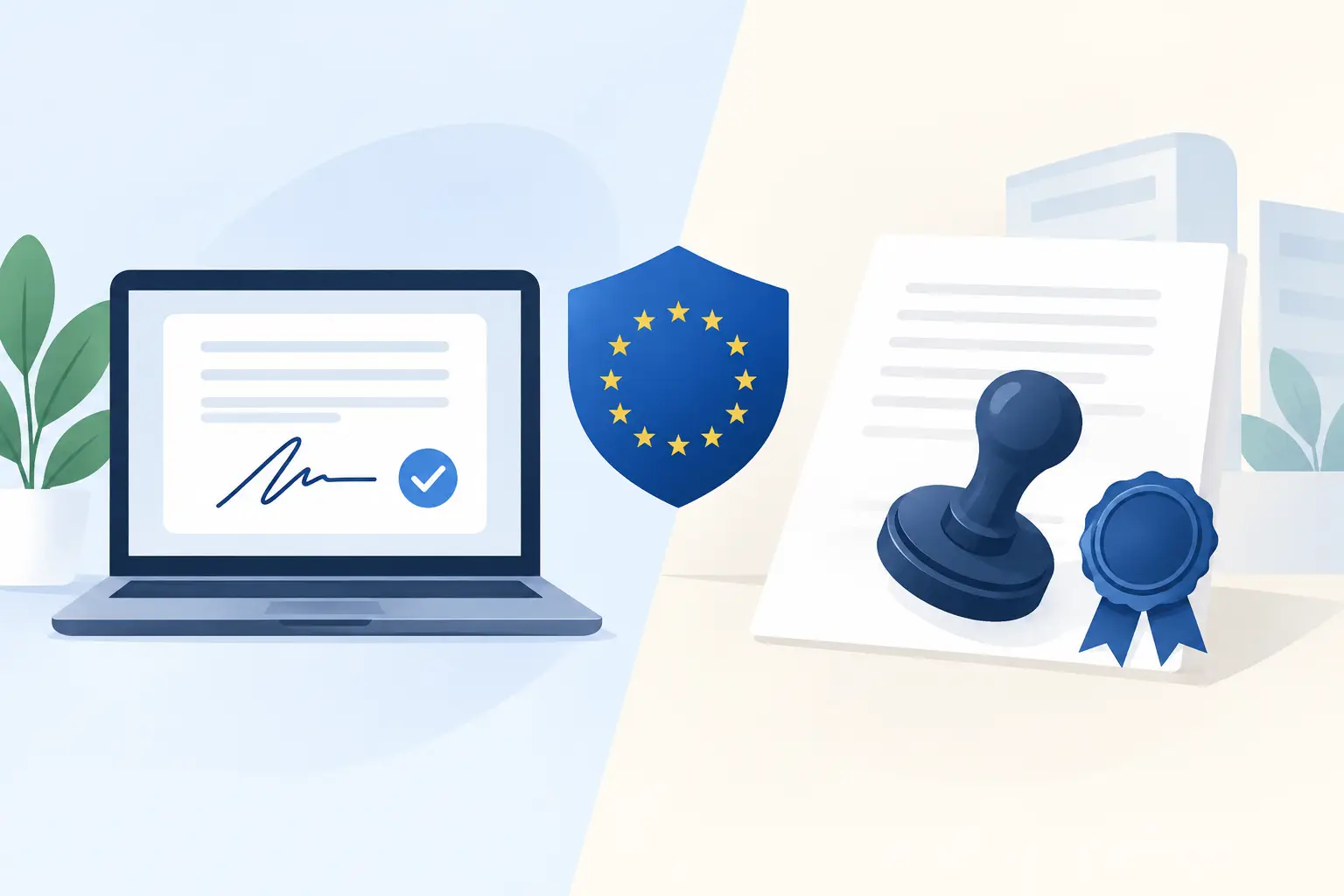
That is the practical difference behind eIDAS signatures vs seals. An electronic signature represents a natural person. An electronic seal represents a legal person, such as a company, public body, or other organization. Choosing the wrong one can create confusion about who approved a document, what it proves, and whether your evidence will satisfy a cross-border process.
eIDAS signatures vs seals: the core difference
The eIDAS framework sets rules for electronic identification and trust services across the European Union. It gives businesses a common vocabulary for assessing electronic signatures, electronic seals, timestamps, and related evidence.
An electronic signature is attached to or logically associated with data and used by an individual to sign. In plain terms, it answers: which person took this action? A sales director signing a customer agreement, an employee accepting an offer letter, or a patient approving a consent form are all signature scenarios.
An electronic seal is attached to or logically associated with data by an organization. It answers: did this document originate from this organization, and has it stayed intact? A seal may be used on certificates, official notices, invoices, automated documents, or high-volume records generated by a company system.
A seal does not turn a company into a human signer. That distinction matters. If a contract requires a person with authority to accept terms on behalf of a business, a company seal alone may not meet the requirement. Conversely, requiring a named employee to personally sign every automatically generated record can be impractical when the real need is to verify organizational origin and document integrity.
What each option proves
Signatures and seals both create evidence, but they create different evidence.
With an electronic signature, the main question is identity and intent. Your workflow should show who the person was, how they were authenticated, what they were shown, and what action they took. A well-designed audit trail records events such as delivery, viewing, authentication, signature completion, timestamps, and relevant technical data.
With an electronic seal, the focus is origin and integrity. The seal ties the document to the organization that created it and helps show whether the document has changed after sealing. This is especially useful where documents are produced automatically or in large volumes and no individual is expected to review and sign each one.
Think of it this way: a signature says, "I, this person, approved this." A seal says, "This came from our organization, and it has not been altered since we issued it."
The eIDAS assurance levels that matter
Not every signature or seal delivers the same level of assurance. eIDAS recognizes basic, advanced, and qualified forms. The right level depends on the document, the risk, and any specific law, regulator, counterparty, or internal policy.
Electronic signatures
A basic electronic signature can be as simple as a signer completing an electronic acceptance step. Depending on the context and evidence available, it may be valid and useful. But it can leave more room for questions about identity, control, or later changes.
An Advanced Electronic Signature, often called an AES, has stricter requirements. It must be uniquely linked to the signer, capable of identifying the signer, created using signature creation data under the signer’s sole control with a high level of confidence, and linked to the signed data so later changes can be detected. It is a strong fit when your team needs more than a click-to-sign record and wants meaningful identity assurance.
A Qualified Electronic Signature, or QES, is an advanced signature created with a qualified signature creation device and supported by a qualified certificate. Under eIDAS, a QES has the equivalent legal effect of a handwritten signature throughout the EU. It is often appropriate where a law or counterparty specifically requires a qualified signature, but it adds friction and cost. Do not default to QES just because a document is valuable. First confirm the actual requirement.
Electronic seals
Electronic seals follow a comparable progression: basic electronic seals, Advanced Electronic Seals, and Qualified Electronic Seals. An advanced seal provides stronger evidence that it is linked to and identifies the creator, remains under appropriate control, and reveals post-sealing changes.
A Qualified Electronic Seal uses a qualified certificate for electronic seals and delivers a legal presumption of the integrity of the data and the correctness of the origin of that data. That is powerful for official organizational documents. It does not, however, create the same handwritten-signature equivalence that applies to a QES made by a natural person.
When a signature is the right choice
Use an electronic signature when the document requires a person to express intent, acceptance, acknowledgment, or approval. Most business agreements fall into this category because contracts are typically formed through actions taken by authorized individuals.
A signature workflow is usually the better fit for customer contracts, employee offer letters, HR policy acknowledgments, vendor agreements, medical consents, settlement documents, and internal approvals. It gives you a clear record of who acted and when.
Authority still matters. A strong signature proves an identified person signed, but it does not automatically prove that person had authority to bind the organization. For higher-risk agreements, build authority checks into your process. That may mean routing to specific job roles, collecting corporate details, requiring an approval before sending, or retaining supporting records in the agreement file.
When a seal is the right choice
Use an electronic seal when the business needs to issue or authenticate a document at the organizational level, especially when documents are generated by a system rather than reviewed one by one.
Common examples include digitally issued certificates, account statements, invoices, insurance documents, official extracts, attestations, product records, and automated notices. A seal can help recipients and relying parties verify that the document came from the stated organization and has not been modified.
Seals are also useful alongside signatures. For example, an authorized person can sign a contract, then the completed agreement can be sealed by the organization as part of long-term preservation or document issuance. The signature captures the person’s intent. The seal supports organizational origin and integrity for the final record.
Build the workflow around the evidence you need
The fastest path is not always the lowest-friction signature option. It is the workflow that collects enough evidence for the risk without making every recipient complete an unnecessary identity hurdle.
Start with four questions:
- Does a natural person need to accept or approve something?
- Does the document need proof that it originated from the company?
- Is there a legal, industry, or counterparty requirement for advanced or qualified assurance?
- What evidence would you need if the document were challenged months or years later?
For routine sales agreements, a clear signing flow, defined recipient roles, tamper-evident document protection, and a complete audit trail may be the practical answer. For regulated onboarding, financial forms, or sensitive healthcare records, identity verification can justify an Advanced Electronic Signature workflow.
BeeSign helps teams collect identity-verified, eIDAS-compliant Advanced Electronic Signatures while keeping the process easy to manage: upload the document, add fields and recipients, set signing order or approvals, then track every event from send to completion. Encryption in transit with TLS, 256-bit AES encryption at rest, and tamper-evident sealing help preserve the agreement record after signing.
Avoid two common mistakes
The first mistake is calling every digital approval a “seal.” A logo, company name, or automated footer is not necessarily an electronic seal with the technical and evidentiary properties your use case requires. Use precise terminology when writing policies, procurement requirements, or customer-facing documentation.
The second is assuming that qualified always means better. Qualified services provide significant legal assurance, but they are not a universal requirement. They can introduce additional identity proofing, certificate, and device requirements. If an Advanced Electronic Signature meets the legal and business need, it may deliver the right balance of speed, security, and signer experience.
Make the decision before the document goes out
Your agreement workflow should identify whether each action needs a person’s intent, an organization’s authenticated issuance, or both. Set that rule in templates and approval policies rather than leaving it to each sender to decide under deadline pressure.
For cross-border EU agreements, confirm the applicable requirements with counsel when the stakes are high. Then make the compliant path the easy path: clear recipient roles, proportionate identity checks, complete audit evidence, and documents that stay verifiable long after everyone has moved on to the next deal.
Ready to transform your workflow?
Start using BeeSign today and experience the future of document signing