Encryption in Vendor Document Sharing: 2026 Guide
Discover the critical role of encryption in vendor document sharing. Ensure sensitive data remains secure with our 2026 guide on best practices.

Encryption is the process of converting documents into secured code to prevent unauthorized access during vendor sharing. The role of encryption in vendor document sharing goes beyond simple file protection. It determines whether sensitive contracts, financial records, and compliance documents stay private as they move between your organization and external vendors. The industry standard for highly sensitive files is AES-256, which governments and financial institutions use because it is computationally infeasible to break with current technology. Encryption alone, however, does not guarantee secure sharing. Without access controls, audit logs, and identity verification working alongside it, even a well-encrypted document can be forwarded, leaked, or misused by an authorized recipient.
What encryption standards are recommended for vendor document sharing?
AES-256 is the recommended standard for financial, medical, and legal documents shared with vendors. AES-128 is sufficient for standard business correspondence and less sensitive files. Both are symmetric encryption algorithms, meaning the same key encrypts and decrypts the file. The key length is the critical difference: AES-256 uses a 256-bit key, which produces a vastly larger number of possible combinations than AES-128’s 128-bit key.
RC4, once common in older PDF encryption, is now deprecated. Security researchers broke RC4 years ago, and any platform still using it puts your vendor documents at serious risk. AES-128 and AES-256 replaced it as the accepted baseline.

Regulatory compliance adds another layer of specificity. FIPS 140-3 replaced FIPS 140-2 as the validation standard for encryption implementations. Regulations like ITAR and HIPAA require encryption that meets FIPS 140-3 validation. For ITAR safe harbor compliance, zero provider key access is mandatory. That means the platform you use cannot hold your decryption keys.
| Feature | AES-128 | AES-256 |
|---|---|---|
| Key length | 128-bit | 256-bit |
| Recommended use | Standard business files | Financial, medical, legal documents |
| Regulatory fit | General business compliance | HIPAA, ITAR, top-secret classified |
| Computational strength | Strong | Computationally infeasible to break |
| RC4 comparison | Far superior | Far superior |
Pro Tip: Always verify that your document sharing platform lists its specific encryption algorithm and key length in its security documentation. “Encrypted” without a named standard is not a meaningful security claim.
How does encryption protect vendor documents, and what are its limits?
Encryption secures files at rest and in transit, which covers two of the most common attack surfaces. At rest means the file stored on a server is unreadable without the decryption key. In transit means the file cannot be intercepted and read as it travels over a network. These protections are real and prevent a large category of external breaches.
The limits are equally real. Encryption does not prevent an authorized vendor from copying, forwarding, or leaking a document once they have legitimate access. Once a vendor opens a decrypted file, the encryption has done its job. What happens next depends entirely on access controls, not the encryption algorithm.
PDF permission flags are a common source of false confidence. Permission flags are advisory only. A flag that says “no printing” or “no editing” is ignored by many PDF readers. Strong encryption tied to a user password is the actual access gatekeeper, not the permission settings.
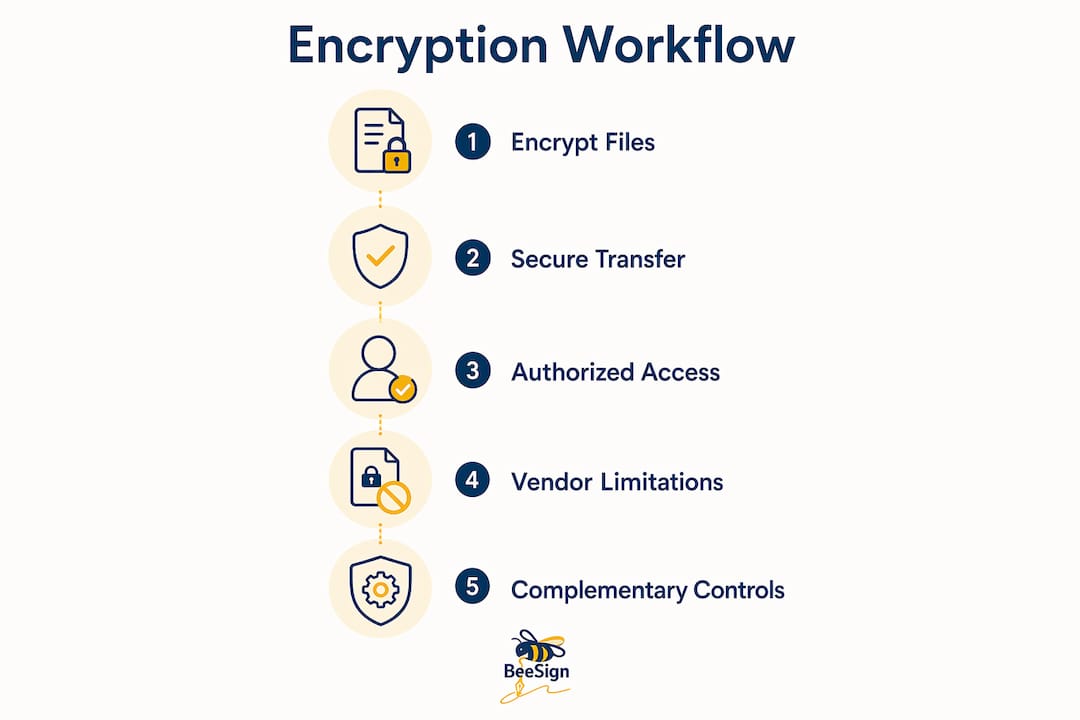
Metadata and attachments create another gap. Many organizations fail to encrypt PDF metadata, embedded attachments, or incremental file saves properly. A document can appear encrypted while its metadata still exposes author names, revision history, or internal file paths.
Key vulnerabilities to address in your vendor document workflow:
- Metadata exposure: Encrypt or strip metadata before sharing any document externally.
- Attachment gaps: Verify that embedded attachments inside a PDF are covered by the same encryption as the main file.
- Weak passwords: A strong encryption algorithm paired with a weak password is still breakable. Use randomly generated passwords or a key management system.
- Incremental saves: PDFs saved incrementally can retain unencrypted earlier versions of the file within the same document.
- Authorized forwarding: Encryption does not stop a vendor from emailing your document to a third party after opening it.
Pro Tip: Test your encrypted documents by opening them in multiple PDF readers. If a “no printing” flag is bypassed in any reader, your security relies on encryption and passwords alone, not permissions.
What additional security measures complement encryption for vendor sharing?
Encryption is the foundation, but a complete vendor document security framework requires several layers working together. Regulated industries demand a framework that combines encryption with tiered access controls, multi-factor authentication, detailed audit trails, and watermarking. Each control addresses a gap that encryption alone cannot close.
Here is how to build that framework in practice:
- Set granular access permissions. Assign each vendor only the access level they need. A vendor reviewing a contract draft does not need download rights. Tiered permissions reduce the blast radius if a vendor account is compromised.
- Require multi-factor authentication. Passwords alone are not sufficient for vendor access to sensitive documents. Multi-factor authentication adds a second verification step that blocks unauthorized logins even when credentials are stolen.
- Enable audit trails. Audit logs track every document view, download, and print event. This creates an evidence record for compliance audits and gives you visibility into how vendors actually use your documents.
- Apply watermarking. Dynamic watermarks that display the vendor’s name and access timestamp deter leaks. A vendor who knows their identity is embedded in every page is less likely to share the document improperly.
- Use expiration timers and remote revocation. Persistent encryption enables real-time revocation and access expiration windows ranging from one hour to seven days. If a vendor relationship ends or a document is superseded, you can revoke access immediately, even after the file has been downloaded.
The combination of these controls with strong encryption is what separates a genuinely secure vendor document workflow from one that only appears secure. Virtual data rooms and enterprise document platforms implement all five layers. Entry-level file sharing tools typically offer only encryption in transit, leaving the other gaps open.
How to implement encryption effectively for secure vendor file exchange
Choosing the right platform is the first decision. Client-side encryption with zero provider key access keeps decryption keys exclusively in your control. Cloud-provider managed keys introduce compliance risk because the provider can technically access your plaintext data. For ITAR, HIPAA, or any regulated industry, client-side encryption is not optional.
Once you have selected a platform, test your encryption coverage thoroughly. PDF encryption must cover metadata, attachments, and incremental saves to eliminate residual unencrypted content. Open test documents in multiple readers and verify that no unintended data is accessible.
Practical steps for a sound implementation:
- Verify the algorithm. Confirm the platform uses AES-256 for sensitive documents and that it meets FIPS 140-3 validation if your industry requires it.
- Use strong, random passwords. Avoid dictionary words or reused passwords. A key management system generates and stores cryptographically random keys without human error.
- Audit vendor access regularly. Review access logs monthly. Remove vendor permissions immediately when a project ends or a relationship changes.
- Integrate signing and identity verification. Document signing with identity verification ties a verified identity to every document interaction. This closes the gap between encryption and accountability.
- Check compliance alignment. Map your encryption setup against the specific regulations your business faces. AES-256 with FIPS 140-3 validation covers HIPAA and ITAR. ESIGN and eIDAS require electronic signature compliance on top of encryption.
Pro Tip: Ask your platform vendor directly: “Who holds the decryption keys?” If the answer is the provider, your data is only as secure as their internal access controls, not yours.
The vendor compliance checklist for 2026 is a useful reference for mapping encryption requirements to specific regulatory frameworks before you finalize your platform choice.
Key Takeaways
Encryption protects vendor documents at rest and in transit, but access controls, audit logs, and identity verification are equally necessary to prevent insider misuse and meet regulatory requirements.
| Point | Details |
|---|---|
| Use AES-256 for sensitive files | AES-256 is the required standard for financial, medical, and legal vendor documents. |
| Encryption has clear limits | Authorized vendors can still forward or leak documents; access controls close this gap. |
| PDF permissions are not security | Permission flags are advisory and bypassed by many readers; passwords and encryption are the real gatekeepers. |
| Client-side encryption is critical | Zero provider key access is mandatory for ITAR and reduces compliance risk for HIPAA. |
| Layer your controls | Combine encryption with MFA, audit logs, watermarking, and expiration timers for full protection. |
The part most businesses get wrong about encryption
Most teams I work with treat encryption as a binary: either a document is encrypted or it is not. That framing misses the most common failure mode entirely.
The real vulnerability is almost never the algorithm. AES-256 is not going to be cracked by a vendor trying to misuse your contract. The actual failures I see repeatedly are weak passwords on encrypted files, metadata left unstripped before sharing, and platforms where the provider holds the keys. Each of these is an implementation mistake, not an encryption weakness.
The second misconception is that encryption equals security. A document encrypted with AES-256 and shared with a vendor who then emails it to a competitor is not a secure outcome. Encryption got the file to the vendor safely. Everything after that required access controls, watermarking, and audit logs to manage.
The trend I find genuinely important in 2026 is persistent encryption. Rather than encrypting a file for transit and then releasing it, persistent encryption keeps the document under your control even after delivery. You can revoke access, set expiration windows, and track every open event. That is a fundamentally different security model, and it is the one businesses sharing sensitive vendor documents should be moving toward.
Choose platforms that show you their encryption documentation, name the algorithm, and let you hold your own keys. Transparency in security architecture is not a marketing claim. It is a verifiable fact you can check before you sign a contract.
— Mustafa Abusharkh
Beesign’s approach to secure vendor document workflows
Beesign centralizes contracts, templates, and identity verification in one platform built for compliance and document security. Every document processed through Beesign is protected with AES-256 encryption, covering both storage and transmission. Audit trails log every view, download, and signature event, giving you a complete record of vendor interactions.
Beesign’s secure eSignature platform combines encryption with granular access controls, multi-factor authentication, and identity verification in a single workflow. For businesses that need to operate under their own branding, Beesign’s white-label option keeps data within your infrastructure while meeting ESIGN, eIDAS, and HIPAA requirements. If you share sensitive documents with vendors and need verifiable security at every step, Beesign gives you the controls to manage it without adding complexity to your team’s daily workflow.
FAQ
What is the strongest encryption standard for vendor documents?
AES-256 is the strongest widely used standard for vendor document sharing. It is approved for top-secret classified information and is computationally infeasible to break with current technology.
Does encryption prevent vendors from forwarding documents?
No. Encryption protects a document during storage and transmission, but it does not stop an authorized vendor from copying or forwarding the file after opening it. Access controls, watermarking, and expiration timers address this risk.
What is FIPS 140-3 and why does it matter?
FIPS 140-3 is the current federal validation standard for encryption implementations. Regulations like HIPAA and ITAR require encryption that meets this standard, making it a baseline requirement for regulated industries.
Are PDF permission flags the same as encryption?
No. PDF permission flags like “no printing” are advisory settings that many PDF readers ignore. Strong encryption tied to a user password is the actual mechanism that controls document access.
What does client-side encryption mean for vendor sharing?
Client-side encryption means the decryption keys are held by you, not the platform provider. This prevents the service provider from accessing your plaintext documents and is required for ITAR safe harbor compliance.
Recommended
Ready to transform your workflow?
Start using BeeSign today and experience the future of document signing