Why Secure Document Storage Matters for Ecommerce
Discover why secure document storage matters for ecommerce. Ensure compliance, protect customer data, and safeguard your business from breaches.

Secure document storage is defined as encrypted, access-controlled, and auditable management of digital files containing sensitive business and customer data. For ecommerce businesses, this practice sits at the center of compliance, customer trust, and financial protection. The average cost of a data breach has surpassed $4.45 million, and the document management system market is projected to grow from $8.85 billion in 2024 to $27.43 billion by 2033. Those numbers reflect how seriously businesses now treat document security as a core operational function, not a background IT task. Regulations like PCI DSS, GDPR Article 32, and CCPA set enforceable standards for how you store, access, and protect customer personally identifiable information (PII), financial records, and contracts.
Why secure document storage matters in ecommerce
Ecommerce operations generate a constant stream of sensitive documents. Every purchase creates payment records. Every vendor relationship produces contracts. Every customer account holds PII. Without proper document security, each of those files is a potential liability.
Cybercriminals target documents because they contain concentrated, high-value information that is often inadequately protected. A single exposed invoice export can reveal customer names, addresses, and partial payment data. A leaked vendor contract can expose pricing strategies and business terms that competitors would pay to see.

The consequences of poor document storage go beyond the breach itself. Regulatory fines under GDPR can reach €20 million or 4% of global annual revenue, whichever is higher. CCPA violations carry penalties per affected consumer. Legal costs, breach notification expenses, and reputational damage compound the financial hit quickly.
What are the biggest risks in ecommerce document storage?
The most common vulnerabilities in ecommerce document storage are not exotic attacks. They are preventable configuration failures.
Security audits show that 90% of mid-range ecommerce brands lack adequate encryption and key management. That means most growing online retailers store sensitive files in databases or cloud buckets without customer-controlled encryption keys. Any breach of the storage environment exposes the data directly.
Misdelivered emails and external sharing without file-level protection are among the leading causes of document breach incidents. When protection does not travel with the file, the moment a document leaves your system, your control ends.
The assets most frequently at risk include:
- Customer PII exports from CRM and order management systems
- Payment records and invoices containing partial card data or bank references
- Vendor and supplier contracts with pricing, terms, and liability clauses
- Employee onboarding documents with identity and tax information
- Signed agreements and eSignature records tied to legal obligations
Each of these document types carries a different risk profile. A mishandled customer export triggers CCPA or GDPR obligations. A leaked signed contract creates legal exposure. Treating all documents identically is itself a security failure.
How do encryption and access control protect sensitive ecommerce documents?
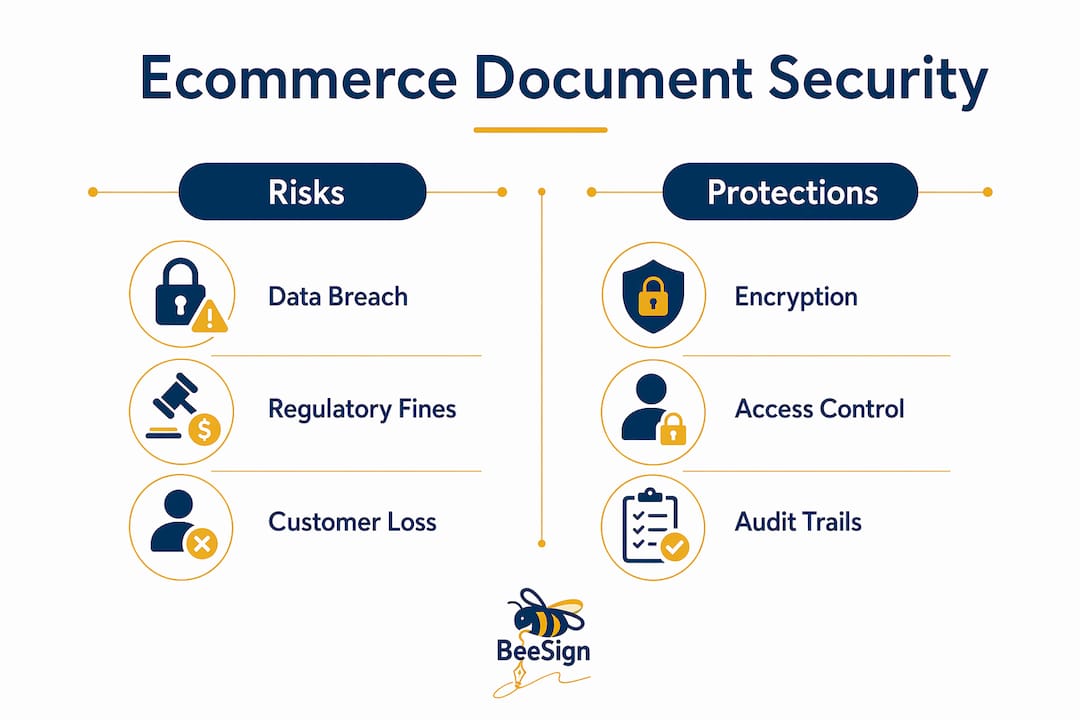
Encryption is the foundation of document security, but the type of encryption matters as much as its presence.
Platform-managed encryption protects data from external attackers but leaves the cloud provider holding the keys. If the provider is compromised, or if a legal order compels disclosure, your data is accessible without your knowledge. Customer Managed Keys (CMKs) solve this by keeping key control with your business. CMKs enable granular audit logging, forced key rotation, and instant revocation. At roughly $1 per month per key, the cost is negligible relative to the compliance benefit.
Zero-knowledge encryption takes this further. Files encrypted on-device before upload mean the storage provider cannot decrypt the data under any circumstances. Your business holds the only keys. This model satisfies the strictest interpretations of GDPR Article 32 and HIPAA’s technical safeguard requirements.
Context-aware access controls add another layer. Rather than granting blanket access by role, you enforce access based on device, identity, and location. A warehouse manager accessing order documents from an approved device on your network gets access. The same credentials used from an unrecognized device in a foreign country do not.
Pro Tip: Enable automatic key rotation on a 90-day cycle for all CMKs tied to customer PII. This limits the exposure window if a key is ever compromised without your knowledge.
Audit trails complete the picture. Every document interaction, including views, edits, downloads, and permission changes, should be logged with a timestamp and user identity. These logs are your primary defense mechanism after a security incident and your primary evidence during a compliance audit.
What are the best practices for implementing secure document storage in ecommerce?
Effective document management starts with segmentation. Not every file needs the same level of protection or the same storage cost.
Classify your documents into three tiers:
- Hot assets are actively accessed files like current contracts, open invoices, and live customer records. Store these with per-file encryption and real-time access controls.
- Warm assets are recent but infrequently accessed files like completed order archives and signed agreements from the past 12 months. Apply encryption at rest with periodic access reviews.
- Cold assets are long-term retention files like tax records and expired contracts. Use encrypted archival storage with strict access logging and defined retention periods.
Segmenting assets by access frequency and risk profile makes storage both more secure and more cost-effective. You apply the highest controls where exposure risk is greatest, and you reduce overhead on files that rarely need to move.
Cloud-based storage now dominates the market. Over 70% of the document management market uses cloud-based solutions, making secure cloud storage the default expectation rather than an advanced option. The key is choosing cloud storage that supports per-file encryption, CMKs, and detailed access logging rather than relying on platform-level protection alone.
API-driven storage integration is the next step. When your ecommerce platform, order management system, and document storage communicate through a secure API, every document generated by a transaction is automatically stored, classified, and protected. Manual uploads introduce human error. Automation removes it.
Pro Tip: Avoid storage configurations where encryption is applied only at the bucket or database level. File-level encryption ensures that even if an attacker accesses the storage environment, individual files remain unreadable without the corresponding key.
| Storage tier | Encryption requirement | Access control | Review frequency |
|---|---|---|---|
| Hot assets | Per-file, CMK | Context-aware, real-time | Continuous |
| Warm assets | At-rest encryption | Role-based, logged | Monthly |
| Cold assets | Archival encryption | Strict, audited | Quarterly |
How does secure document storage support legal compliance and build customer trust?
Compliance is not optional for ecommerce businesses that handle customer data. PCI DSS requires encryption of cardholder data at rest and in transit. GDPR Article 32 mandates appropriate technical measures including encryption and ongoing confidentiality. CCPA gives California consumers the right to know what data you hold and to request its deletion, which requires you to know exactly where every document lives.
Audit trails logging every document interaction satisfy the “accountability” principle under GDPR and the access control requirements under PCI DSS. Without these logs, you cannot demonstrate compliance during an audit. You also cannot identify the scope of a breach, which extends your incident response timeline and increases your regulatory exposure.
The compliance benefits of strong document security include:
- Reduced breach notification obligations because encrypted files are often exempt from notification requirements when the keys are not compromised
- Faster audit responses because access logs and encryption records are already organized and retrievable
- Lower legal costs because a defensible security posture reduces liability in breach litigation
- Stronger vendor relationships because enterprise partners increasingly require documented security practices before signing contracts
Customer trust is the less-discussed benefit. Shoppers who know their data is protected return more often and spend more. A breach, even a minor one, triggers churn that takes years to recover. Investing in secure file storage is also an investment in customer retention.
What practical steps can ecommerce businesses take to improve document storage security?
Improving your document storage security does not require a full infrastructure overhaul. A structured approach produces results quickly.
Start with a security audit focused on encryption and key management. Identify which document types you store, where they live, and whether they are encrypted at the file level or only at the storage level. This audit reveals your actual exposure rather than your assumed exposure.
Then work through this checklist:
- Adopt cloud storage with per-file encryption and zero-knowledge protocols where feasible
- Replace platform-managed keys with Customer Managed Keys for all sensitive document categories
- Implement context-aware access controls tied to device, identity, and location
- Enable detailed audit logging for every document access event
- Define and enforce document retention policies with automated deletion for expired files
- Train your team on safe document handling, including email sharing restrictions and external access policies
- Integrate your document storage with a secure eSignature platform that maintains audit trails through the full document lifecycle
Pro Tip: Run a quarterly access review to identify users who have document permissions they no longer need. Stale access rights are one of the most common and preventable sources of insider risk.
Regulatory requirements will tighten. The vendor compliance checklist for 2026 reflects how quickly obligations are evolving. Building your document security practices now puts you ahead of the next compliance cycle rather than scrambling to catch up.
Key Takeaways
Secure document storage is the single most cost-effective defense ecommerce businesses have against data breaches, regulatory fines, and customer churn.
| Point | Details |
|---|---|
| Encryption type determines real protection | Per-file and zero-knowledge encryption protect data even if the storage environment is breached. |
| Customer Managed Keys are the compliance standard | CMKs enable audit logging, key rotation, and instant revocation that platform-managed keys cannot provide. |
| Segment documents by risk tier | Classify hot, warm, and cold assets separately to apply the right controls at the right cost. |
| Audit trails are non-negotiable | Logs of every document interaction satisfy GDPR, PCI DSS, and CCPA audit requirements. |
| Security and trust are directly linked | Strong document security reduces breach risk and builds the customer confidence that drives repeat purchases. |
The cost of treating document security as an afterthought
I have worked with ecommerce businesses at every stage, from early-stage direct-to-consumer brands to mid-market retailers processing thousands of orders daily. The pattern I see most often is not ignorance of document security. It is deprioritization. Teams know they should address it. They plan to address it. Then a product launch or a hiring push moves it down the list again.
The businesses that pay the highest price are not the ones that made a technical mistake. They are the ones that assumed their cloud storage provider’s default settings were sufficient. They are the ones that never rotated an encryption key or reviewed access permissions. When a breach happens, the question regulators ask is not “did you know about this risk?” The question is “what did you do about it?”
I have seen companies spend more on a single breach response than they would have spent on proper document security over five years. The math is not close. A zero-knowledge encryption setup and a CMK policy cost a fraction of one attorney’s hourly rate during incident response.
The other shift I have noticed is in customer expectations. Shoppers are more aware of data rights than they were three years ago. A breach notification email is no longer just a legal obligation. It is a relationship-ending event for a meaningful share of your customer base. The businesses that treat electronic signatures with audit trails and encrypted storage as core infrastructure are the ones that avoid that conversation entirely.
Document security is not an IT project. It is a business decision with direct revenue implications.
— Mustafa Abusharkh
Beesign brings secure document workflows to ecommerce
Ecommerce businesses that want to close the gap between document security and operational efficiency have a direct path forward with Beesign.
Beesign centralizes contracts, templates, and identity verification in one platform built for compliance with ESIGN, eIDAS, and HIPAA. Every document signed through Beesign carries a full audit trail, capturing each view, signature, and access event in a tamper-evident log. Encryption in transit and at rest protects your files at every stage of the workflow. For businesses that need full data control, Beesign’s white-label and BYOC option keeps your data within your own infrastructure under your own branding. Start protecting your documents and your customers by visiting Beesign’s secure eSignature platform today.
FAQ
What is secure document storage in ecommerce?
Secure document storage is the encrypted, access-controlled, and auditable management of digital files containing customer PII, payment records, contracts, and other sensitive business data. It protects ecommerce businesses from breaches, regulatory penalties, and legal liability.
Why does document protection matter more than general cybersecurity?
Documents concentrate high-value data in single files, making them a primary target for cybercriminals. File-level encryption and access controls ensure protection travels with the document, even when it is shared outside your system.
What regulations require secure document storage for ecommerce?
PCI DSS, GDPR Article 32, and CCPA all impose specific technical requirements for how ecommerce businesses store, encrypt, and control access to customer and payment data. Non-compliance can result in fines, audits, and mandatory breach notifications.
What is the difference between platform-managed and customer-managed encryption keys?
Platform-managed keys are controlled by your cloud provider, which limits your ability to audit or revoke access. Customer Managed Keys give your business full control over key rotation, access logging, and instant revocation, which satisfies stricter compliance requirements.
How do audit trails support ecommerce compliance?
Audit trails log every document interaction, including views, edits, downloads, and permission changes, with timestamps and user identities. These records are the primary evidence during regulatory audits and the first tool used to determine breach scope during incident response.
Recommended
Ready to transform your workflow?
Start using BeeSign today and experience the future of document signing