Signer Biometrics: When Identity Needs More Proof
Signer biometrics add identity assurance to digital agreements. Learn when biometric verification fits, what it proves, and how to deploy it responsibly.
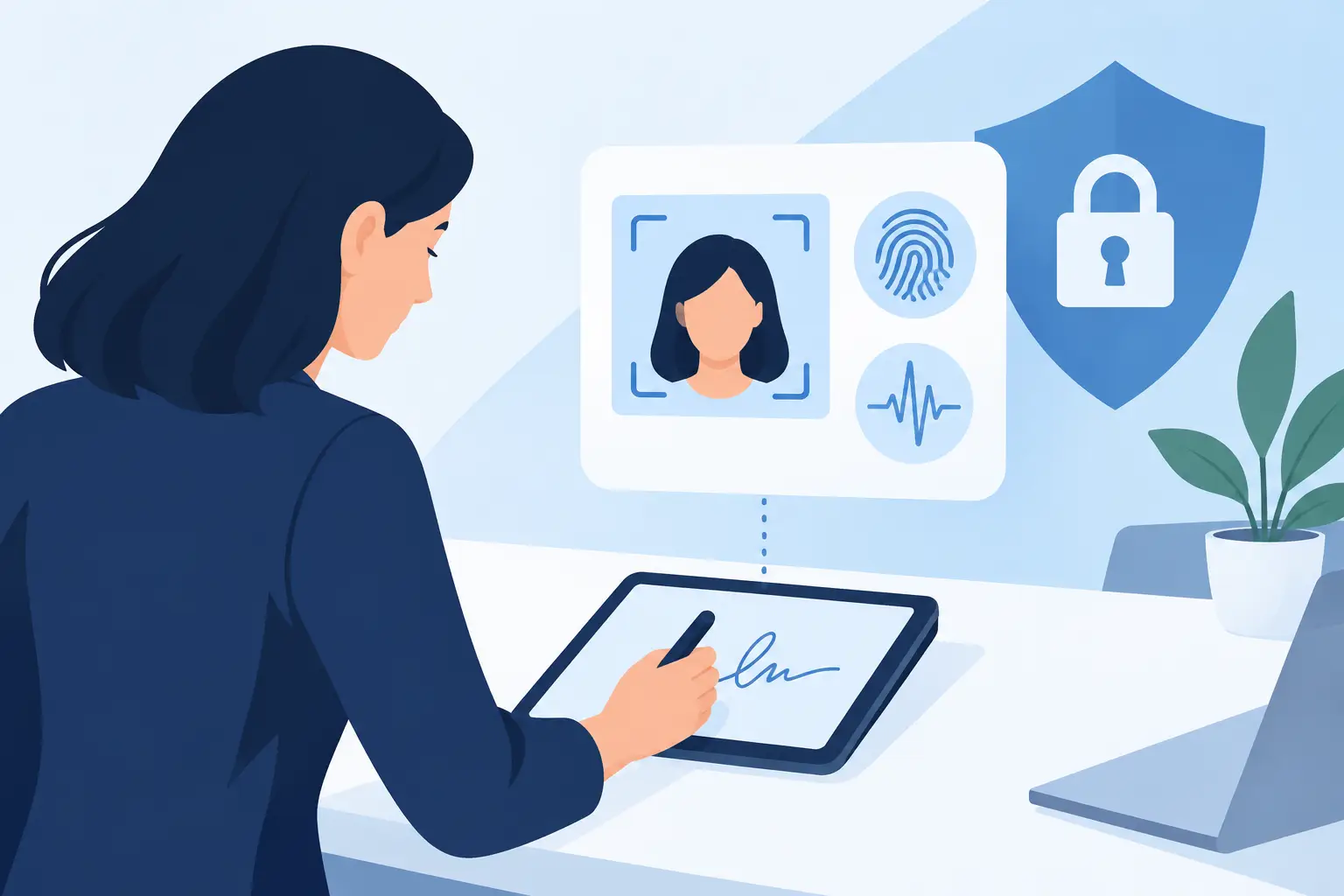
A typed name, a click-to-sign action, and an audit trail can be enough for many agreements. But when the document carries higher financial, legal, or regulatory risk, teams may need more confidence that the person completing the signature is the intended signer. That is where signer biometrics can help.
Used well, biometric verification adds a meaningful identity signal without turning every agreement into a slow, frustrating process. Used poorly, it can create privacy concerns, abandonments, and a false sense of certainty. The right approach starts with understanding what biometrics can prove, what they cannot, and when the extra step is worth it.
What Are Signer Biometrics?
Signer biometrics are biological or behavioral characteristics used to help verify the identity of a person signing an agreement. In digital agreement workflows, this most often means facial biometrics: a signer captures a government-issued ID and takes a live selfie or short video. The system compares the face to the ID photo and uses liveness detection to assess whether a real person is present, rather than a photograph, replayed video, or mask.
The term can also refer to behavioral signature biometrics, such as writing speed, pen pressure, stroke order, and rhythm when someone signs on a screen. These signals may help distinguish a genuine handwritten signing action from a copied image, but they are not the same as government ID verification.
For most business workflows, the practical model is simple: verify the identity of the signer before or during the signing ceremony, then bind that completed verification to the agreement's audit trail. The resulting record can show the steps taken to establish who signed, when they signed, and how the agreement was protected after completion.
What Biometric Verification Actually Proves
Biometrics are an identity assurance tool, not a magic stamp of legal enforceability. A successful face match can support the claim that the person who completed verification resembles the person shown on the submitted ID. Liveness detection can make common spoofing attempts much harder. Database validation, where available, can add another signal that the document or identity data is credible.
That is valuable when a business needs to reduce impersonation risk. Consider a high-value sales contract, a financial authorization, a healthcare consent form, or an employee document involving sensitive access. In each case, knowing that an email recipient clicked a link may not be enough.
Still, biometric verification does not prove every fact surrounding a signature. It does not necessarily prove that the signer read the agreement, understood every clause, had authority to bind a company, or signed without pressure. Those questions require thoughtful contract language, role controls, approval workflows, and, in some cases, additional evidence.
The strongest agreement record combines several layers: signer authentication, identity verification where needed, intent to sign, a clear presentation of the document, tamper-evident sealing, and a detailed audit trail. Biometrics strengthen one part of that chain.
When Signer Biometrics Make Sense
The best use case is not "every document." It is a workflow where the cost of a disputed identity is greater than the added friction of verification.
For example, a sales team closing standard low-risk renewals may prioritize speed and use email access, signing order, and audit logs. A lender approving a significant transaction may require ID capture and face matching because the downside of identity fraud is much higher. HR teams may apply stronger verification only to employment agreements, policy acknowledgments, or documents granting access to sensitive systems.
Biometrics are particularly useful when signers are remote, unknown to the sender, or geographically distributed. They can also help organizations applying a risk-based approach to eIDAS-compliant Advanced Electronic Signatures, where identity verification and a clear link between signer and signature matter.
A practical policy may trigger enhanced verification based on agreement value, document type, signer role, location, or fraud signals. This prevents a simple vendor acknowledgment from getting the same treatment as a major legal authorization.
Face Biometrics vs. Signature Dynamics
These two methods solve different problems, and treating them as interchangeable leads to weak workflow design.
Face biometrics are generally about identity proofing. A signer presents an ID, captures a selfie, and completes liveness checks. This is the better fit when the organization needs evidence tied to a real-world identity.
Signature dynamics are generally about behavioral consistency. They analyze how a person writes rather than who appears in front of the camera. They can be useful in specialized workflows, especially where handwritten signing behavior is familiar and repeatable. But results may vary based on device type, screen size, stylus use, injury, or changes in a person's writing habits.
For a cloud-based agreement platform, face matching with liveness detection is usually easier to explain to business users and easier to connect to a documented identity verification flow. The method should always match the risk you are trying to manage, not the latest feature on a security checklist.
Build the Verification Step Into the Right Place
The cleanest workflow places identity verification exactly where it protects the agreement without surprising the signer. Tell recipients upfront that verification will be required and why. A surprise request for an ID after someone has reviewed a 40-page agreement is a reliable way to create support tickets and drop-off.
A typical high-assurance flow looks like this:
- Upload the agreement, add fields, and assign recipients and signing order.
- Enable identity verification for the signer or only for the specific role that needs it.
- The signer opens the secure invitation, captures their ID, and completes a live face check.
- Once verification passes, the signer reviews and signs the document.
- The completed agreement is sealed, and the audit trail records the verification and signing events.
This sequence gives compliance and legal teams a clearer record while keeping the signer focused on one task at a time. If verification cannot be completed automatically, there should be a defined exception path, such as manual review or an alternative verification method. Do not leave a legitimate customer stranded simply because their camera, lighting, or ID format caused a false rejection.
Privacy Is Part of the Security Model
Biometric data is sensitive. Collecting it without a clear purpose or retaining it indefinitely can introduce more risk than it removes. Before deploying signer biometrics, define why the data is necessary, what data will be captured, who can access it, how long it will be retained, and how requests for deletion or review will be handled.
Use data minimization. If an identity verification result and its associated evidence meet the business requirement, do not collect extra information just because it is available. Keep access limited to authorized personnel, isolate workspaces appropriately, and protect data both in transit and at rest.
Technical safeguards matter here. Encryption with TLS during transmission and 256-bit AES at rest, controlled access, expiring links, and tamper-evident document sealing all help protect an agreement workflow. They do not replace a privacy policy, consent language, or retention schedule, but they are essential operational controls.
Teams should also consider fairness and accessibility. Some signers may not have a current ID, a compatible device, stable connectivity, or the ability to complete a camera-based check. A human-reviewed alternative can preserve security without excluding legitimate signers.
Keep the Evidence, Not Just the Result
A simple status reading "verified" may be helpful operationally, but it is thin evidence in a dispute. Businesses should be able to show the larger story of the agreement: who was invited, which identity check was requested, whether it passed or required review, when the document was viewed, when the signature was applied, and whether the document changed afterward.
This is why identity verification belongs in the same agreement workflow as templates, signing actions, approvals, and completed-document storage. When records live in separate systems, teams spend unnecessary time piecing together screenshots, emails, and vendor exports after a problem occurs.
BeeSign brings document workflow, identity checks, tamper-evident sealing, and a full audit trail into one system of record. That makes it easier to apply stronger identity assurance to the agreements that need it while keeping routine documents moving in minutes.
Choose Assurance That Fits the Agreement
More verification is not always better. It can slow a deal, increase abandonment, and create additional sensitive-data obligations. Too little verification can leave a business exposed when an identity is disputed. The right level depends on the transaction, the jurisdiction, the parties involved, and the consequences of getting it wrong.
Start by identifying the documents where identity is truly central. Add a clear, proportionate verification step. Protect the evidence with the same care you give the agreement itself. Then measure completion rates, exceptions, and fraud signals so the process gets smarter over time.
A signature should move work forward, not create a new pile of uncertainty. When signer biometrics are applied with purpose, they give high-stakes agreements the extra proof they need while letting everyone else sign with a buzz.
Ready to transform your workflow?
Start using BeeSign today and experience the future of document signing