UETA State Variations: Six Steps for Counsel to Avoid Multistate Signature Risk
U.S.-focused primer on UETA state variations for counsel: six practical steps, statutory examples, and a multistate compliance checklist to reduce...

Many jurisdictions have adopted the Uniform Electronic Transactions Act, but New York never joined them, running its own Electronic Signatures and Records Act instead. That single exception drives the most practical rule in this area: UETA state variations rarely stop a signature from being valid, but they can change what happens when a specific transaction type, consent step, or record-retention rule gets challenged in court.
TL;DR:
- Most UETA enacting states adopted similar texts, but key differences include subject-matter exclusions and specific rules on agreement variations.
- New York relies on ESRA, which has a separate administrative framework and does not adhere to UETA, affecting how official electronic records are handled.
- Variations in consent, record retention, attribution, and notarization rules can significantly impact the validity and admissibility of electronic signatures across states.
- Federal ESIGN Act preempts state law unless a state adopts UETA verbatim or enacts a compliant alternative, limiting broad legal divergence.
- Compliance should focus on verifying applicable statutes, capturing explicit consent, and maintaining detailed audit trails rather than trying to master every state variation.
Table of Contents
- UETA State Variations by the Numbers
- Where State UETA Laws Actually Diverge
- How the Federal ESIGN Act Limits State Variation
- Five States Where the Statutory Text Actually Differs
- The Compliance Checklist for Multi-State Electronic Signatures
- Approaches to Multi-State Compliance Controls
- Why UETA Exists and Why States Still Tinker With It
- What Cross-Border Transactions Between States Actually Face
- What Courts Have Said About State-Specific UETA Provisions
- How State Differences Affect Admissibility in Litigation
- Where In-House Counsel Should Actually Spend Their Time
- Sources
UETA State Variations by the Numbers
Here’s the adoption picture as of the current legal landscape: 49 states, the District of Columbia, and several U.S. territories have enacted some version of UETA. Illinois and Washington are the two states that predate the model act with their own electronic-transactions statutes, though both function comparably to UETA in practice. New York stands alone as the state that formally rejected the Uniform Electronic Transactions Act in favor of ESRA, its own statutory framework for electronic signatures and records.
If you need to verify a specific state’s status before finalizing a contract template, two sources carry real authority: the Uniform Law Commission’s official UETA text and commentary, and the NCSL’s UETA adoption list, which tracks state-by-state enactment status and citations.
| Jurisdiction status | Governing framework | Notable detail |
|---|---|---|
| 49 states + D.C. + territories | UETA (state-enacted version) | Adoption dates range from 1999 to the early 2000s |
| New York | ESRA (Electronic Signatures and Records Act) | Never adopted UETA; separate administrative structure |
| Illinois, Washington | Pre-UETA electronic transactions statutes | Functionally similar, drafted before the model act existed |
Where State UETA Laws Actually Diverge
Adoption being nearly universal doesn’t mean the text is identical everywhere. Every state that enacted UETA had the option to modify it, and most did, in ways that matter far more to a compliance officer than the headline adoption count.
Variation by agreement. UETA’s default rule lets parties agree to vary many of its provisions by contract, but not all of them. Connecticut’s statute, for example, spells out specific language for what can and cannot be altered by agreement and how the act applies prospectively to transactions entered into after its effective date, a pattern echoed in Connecticut’s UETA provisions. Counsel drafting multi-state agreements should never assume a variation clause that works in one state transfers cleanly to another.
Subject-matter exclusions. Nearly every enacting state carves out wills, codicils, and testamentary trusts from UETA’s coverage. Beyond that baseline, states diverge: some exclude family-law instruments (divorce decrees, adoption papers), others add negotiable instruments or real-property conveyances to the excluded list. A transaction that’s perfectly valid electronically in one state may require wet-ink signatures in another simply because of what category it falls into.
Consent and notice. UETA generally permits consent to be inferred from conduct, but state court interpretations vary on how much conduct is enough. Practitioners tend to favor explicit, documented consent capture over relying on implied consent, particularly for consumer-facing or real-property transactions where the stakes of a later dispute are higher.
Attribution, notarization, and retention. States differ on how they treat attribution and authenticity for admissibility purposes, on whether and how e-notarization integrates with UETA, and on record-retention or public-access obligations, especially where government agencies are the receiving party.
How the Federal ESIGN Act Limits State Variation
State legislatures don’t have unlimited room to rewrite UETA, because the federal Electronic Signatures in Global and National Commerce Act sits above it. Under 15 U.S.C. §7002’s preemption architecture, a state law affecting electronic signatures or records gets preempted by ESIGN unless the state took one of two approved paths.
- Route one: the state adopts the official 1999 UETA text essentially as written, with only the modifications ESIGN itself permits.
- Route two: the state enacts an alternative procedure or requirement, but only if it’s consistent with ESIGN’s substance and specifically references the federal act.
Most states took route one, which is exactly why UETA state variations tend to be narrow rather than sweeping. New York’s ESRA is the clearest test case for route two: it wasn’t built on the UETA template at all, yet it survives because it doesn’t conflict with ESIGN’s core consumer-protection and record-retention requirements.
Where this matters most in practice is consumer consent and retention. If a state’s carve-out on electronic consumer disclosures conflicts with ESIGN’s consumer-consent provisions, ESIGN controls. Businesses selling into multiple states should treat ESIGN as the floor, not a formality to check off once.
Five States Where the Statutory Text Actually Differs
Reading UETA’s model text tells you what the drafters intended. Reading the state statutes tells you what a court in that state will actually apply.
- New York never adopted UETA. Instead, ESRA created an administrative framework built around an “electronic facilitator,” a role responsible for coordinating electronic signature acceptance across state agencies. If your business deals with New York state government filings, ESRA’s rules for government acceptance of electronic records govern, not UETA’s.
- Delaware enacted an earlier, somewhat non-uniform version of the statute, and Delaware practitioners have flagged specific points where the state’s text and its interaction with ESIGN require closer reading than a plain UETA jurisdiction would.
- Connecticut offers some of the clearest statutory language on variation by agreement and prospective application, spelling out which sections parties can contract around and which effective-date rules apply to transactions predating enactment.
- California and Illinois both built in state-specific language addressing record retention obligations and how UETA applies to automated transactions, meaning contracts formed entirely by automated systems (no human review on one or both sides) get explicit statutory treatment rather than relying on general UETA principles.
- Vermont, Arizona, and Illinois have gone a step further with evidentiary provisions that recognize blockchain-anchored records as admissible business records under state rules, a detail that matters if your audit trail relies on blockchain timestamping.
The Compliance Checklist for Multi-State Electronic Signatures
Before you rely on an electronic signature for a transaction touching more than one state, run through this sequence.
- Confirm the governing statute. Pull the actual state code citation, not a secondary summary, especially for New York (ESRA) and any state with a non-uniform enactment history.
- Check subject-matter exclusions. Wills, certain family-law documents, and in some states real-property or negotiable instruments may fall outside electronic execution entirely.
- Verify your consent-capture method. A checkbox with a timestamp and explicit acknowledgment language holds up better than inferred consent from conduct alone.
- Confirm retention and access procedures. Government-facing transactions in particular may carry state-specific retention windows.
- Check e-notary and transferable-record rules if the document requires notarization or represents a negotiable instrument.
- Flag automated transactions. If either party is a system acting without real-time human review, confirm the state has specific automated-transaction language and that your disclosures account for it.
A defensible two-line consent clause reads something like: “By clicking ‘I Agree,’ you consent to conduct this transaction electronically and confirm you can access and retain electronic records in PDF format.” Preserve the audit trail fields alongside it: timestamp, IP address, document hash, and identity verification events.
Pro Tip: Treat any transaction touching real property, wills, or family law as a red flag requiring manual legal review before you route it through an automated e-signature workflow, regardless of which state it originates in.
Approaches to Multi-State Compliance Controls
Building a signature workflow that holds up across UETA state variations comes down to what you capture and where you store it. Beesign logs explicit consent events with timestamps rather than relying on inferred consent, and it retains the audit-trail fields courts find persuasive: document hashes, IP and device metadata, and identity verification events tied to each signature.
For businesses with state-specific data-location or retention requirements, bring-your-own-cloud options keep records inside the user’s own infrastructure rather than a shared third-party environment. White-label deployment adds a layer of control for organizations that need consistent branding across jurisdictions.
None of this replaces confirming statutory exclusions with counsel for your specific transaction type and state.
Why UETA Exists and Why States Still Tinker With It
The Uniform Law Commission drafted UETA in 1999 to solve a specific problem: contract law assumed paper and ink, and courts had no consistent framework for treating an electronic record or signature as legally equivalent. Before UETA, businesses operating across state lines faced a patchwork of inconsistent common-law rulings on whether an email exchange or a clicked checkbox could form a binding contract.
The drafters built UETA to be technology-neutral on purpose. It doesn’t require a specific type of electronic signature (no mandate for digital certificates or biometric verification), it simply says an electronic signature or record can’t be denied legal effect solely because it’s electronic. That neutrality is why the statute has aged well through decades of shifting signature technology, from early PDF signatures to today’s identity-verified, blockchain-timestamped platforms.
Congress followed a year later with ESIGN in 2000, largely to make sure states wouldn’t undercut electronic commerce with inconsistent local rules. The two-track system, model state law plus a federal preemption backstop, is unusual in American commercial law, and it’s precisely why UETA state variations exist within fairly narrow guardrails rather than as wildly divergent state-by-state regimes. States got room to adapt to local legal traditions (excluding wills, tailoring notarization rules) but not room to reject the underlying principle that electronic records count.
What Cross-Border Transactions Between States Actually Face
A contract signed electronically by a buyer in Texas and a seller in Connecticut sits at the intersection of at least two state statutes, plus the federal ESIGN backstop. In most cases, that intersection is a non-event because both states enacted the official UETA text.
The friction shows up in specific scenarios. If the buyer’s state excludes a transaction category the seller’s state permits (family-law settlements are a common example), the more restrictive rule tends to govern that specific document, even if the rest of the agreement proceeds electronically without issue. Choice-of-law clauses in the contract can help, but they don’t automatically override a state’s mandatory exclusions for categories like wills or certain real-property transfers.
New York transactions require particular attention here. Because ESRA isn’t UETA, a business assuming uniform treatment across all 50 states will misjudge how New York handles government-facing electronic records or the specific procedural role of its electronic facilitator. A multi-state vendor contract that references “compliance with UETA” without separately addressing ESRA has a gap the moment a New York counterparty or a New York state agency enters the picture.
The practical fix isn’t complicated: build your consent and retention workflow to the strictest applicable state standard rather than the most permissive one, and flag any transaction category (wills, real property, negotiable instruments) for manual review before assuming electronic execution is automatically valid everywhere the parties happen to be located.
What Courts Have Said About State-Specific UETA Provisions
Litigation interpreting UETA tends to cluster around a narrow set of recurring questions: was there sufficient attribution to the signer, did the parties actually consent to conduct business electronically, and does the record satisfy retention requirements for the underlying transaction type. Courts applying state UETA statutes generally look for a coherent chain connecting a signature event to a specific individual, which is exactly why attribution and audit-trail quality carry outsized weight in disputes.
Disputes over the “variation by agreement” provisions have also surfaced, particularly where a contract’s boilerplate purported to waive consent requirements that a state statute treats as non-waivable. Courts interpreting these clauses tend to read exclusions and mandatory-consent language narrowly against the drafter, reinforcing why explicit rather than boilerplate consent language holds up better under scrutiny.
The pattern across these cases points to a consistent lesson: the strength of an electronic signature in litigation rarely comes down to which state’s statute applied in the abstract. It comes down to whether the party relying on the signature can produce a clear, contemporaneous record proving who signed, when, and under what disclosed terms. That’s a documentation problem as much as a legal one, and it’s the reason audit-trail design deserves as much attention as statutory research.
How State Differences Affect Admissibility in Litigation
When an electronic record ends up as evidence, the question isn’t just whether the underlying state adopted UETA. It’s whether the record satisfies that state’s evidentiary rules for authentication, which vary in emphasis even among states that enacted nearly identical UETA text.
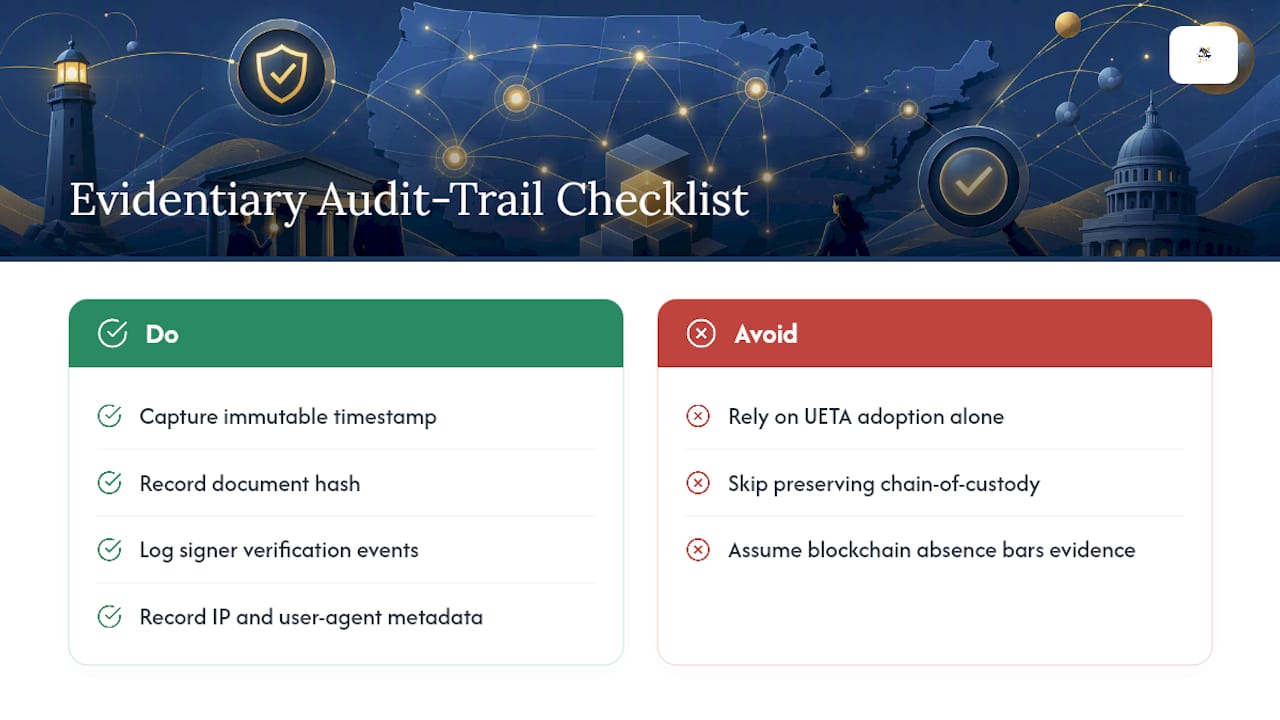
Courts most consistently find a handful of audit-trail elements persuasive: an immutable timestamp, a document hash, signer identity verification events, IP and user-agent metadata, and a clear chain-of-custody log. States with blockchain-specific evidentiary provisions, including Vermont, Arizona, and Illinois, give parties an additional statutory hook for authenticating records anchored to a blockchain timestamp, but the absence of that provision elsewhere doesn’t make blockchain-anchored evidence inadmissible. It just means the proponent relies on general business-records rules instead of a dedicated statute.
The practical risk shows up when a business assumes a signature is “litigation ready” simply because the state adopted UETA. Adoption establishes that an electronic signature can carry legal weight. It says nothing about whether your specific implementation captured the attribution and consent evidence a judge in that state will actually want to see. That gap between statutory validity and evidentiary strength is where most disputes over electronic signatures actually get decided, and it’s a gap that a well-designed audit trail closes far more reliably than statutory research alone.
Where In-House Counsel Should Actually Spend Their Time
Chasing every UETA state variation across 50 jurisdictions is a poor use of a compliance budget. Focus first on the transaction types your business actually relies on that commonly fall into carve-out territory: real estate, family law, negotiable instruments, anything touching wills or trusts. That’s where a signature can fail regardless of how solid your platform is.
For everything else, default to explicit consent capture rather than relying on inferred consent, even in states where implied consent would technically hold up. It costs you one extra click and saves a much harder argument later. And if you operate across multiple states, keep a manual fallback process ready. No electronic workflow should be your only path to closing a transaction.
— Mustafa Abusharkh
Businesses building or scaling electronic signature workflows across state lines can review Beesign’s platform for consent capture, identity verification, and bring-your-own-cloud storage options designed to support jurisdiction-aware compliance, or explore white-label deployment for organizations that need branded, self-hosted control over their signing infrastructure.
This article is general information, not a substitute for advice from a qualified lawyer. Consult a qualified legal professional about your own circumstances before acting on anything here.
Sources
- ueta.rs — Uniform Electronic Transactions Act summary
- ESIGN & UETA — Chaindoc Docs
- Connecticut UETA statutory provisions (chapters 1-266 to 1-286)
- New York State Technology Law: Electronic Signatures and Records Act (ESRA) — NY State Archives
Recommended
Ready to transform your workflow?
Start using BeeSign today and experience the future of document signing