Prove Vendor Agreements: 7 Point E Signature Checklist for Procurement
Make vendor e signatures enforceable with templates, bulk send, API sync, and audit certificates. For procurement and legal ops.

Yes, vendor agreements can be signed electronically, and courts across the United States treat them as binding under federal and state law. Enforceability hinges on evidence, not intent alone: you need signer authentication, a documented consent to sign electronically, and a tamper-evident audit trail tied to the record. The practical next step is choosing a workflow-native platform that supports templates, bulk-send, and audit-grade documentation from the first signature onward.
TL;DR:
- Electronic signatures are legally enforceable for most vendor agreements in the US, provided they include signer authentication and tamper-evident records.
- High-stakes vendor relationships should incorporate identity verification and notarization to strengthen legal protection.
- Using a platform that provides certificates with detailed logs, cryptographic seals, and audit trails is essential for defending signing validity.
- Bulk-send and API integrations shorten onboarding times to 24-48 hours and minimize manual data entry errors across large vendor rosters.
- Choosing a platform with clear retention policies, compliance credentials, and secure data handling reduces operational and legal risks.
Table of Contents
- Vendor Agreements E-Signature Legality: What the Law Actually Requires
- How E-Signature Platforms Turn a Template Into a Signed, Defensible Contract
- Running Vendor Onboarding Without the Email Chase
- Choosing a Vendor Agreement E-Signature Platform: A Working Checklist
- How BeeSign Handles Vendor Agreement Signing and Compliance
- When a Platform Beats Ad Hoc Signing
- Put Your Vendor Agreements on a System Built for Proof, Not Paperwork
- Sources
Vendor Agreements E-Signature Legality: What the Law Actually Requires
The federal ESIGN Act, passed in 2000, and the Uniform Electronic Transactions Act (UETA), adopted by nearly every state, together establish that an electronic signature carries the same legal weight as ink on paper. Vendor and supplier agreements are explicitly the kind of commercial contract these laws were built to cover, and electronic execution is legally binding for this category of document in the United States.
That does not mean every document tied to a vendor relationship qualifies. A handful of categories still require a wet signature, sometimes with a notary present:
- Wills, codicils, and testamentary trusts
- Certain court orders and filings
- Documents governing divorce, adoption, or other family law matters
- Some real estate transfers, depending on state recording requirements
- Notices of foreclosure, eviction, or utility service cancellation in specific states
For the vast majority of vendor paperwork, master service agreements, statements of work, purchase terms, and confidentiality agreements, none of these exceptions apply.
Courts generally apply a four-part test when a signature’s validity gets challenged: did the signer intend to sign, did both parties consent to conduct business electronically, is the signature clearly associated with the specific record, and can the business reliably retain and reproduce that record on demand? Miss any one of those four elements and you have a document that looks signed but may not hold up in a dispute. Legal guidance on e-contract validity consistently points back to these same enforceability elements as the deciding factors.
Pro Tip: If a vendor relationship involves six-figure spend, recurring payments, or sensitive data access, add identity verification or notarization even when the law doesn’t strictly require it. The extra step costs you minutes and buys you a much stronger position if the vendor later disputes the terms.
Where the relationship carries higher stakes, a simple email confirmation of intent to sign electronically is worth adding to your agreement’s boilerplate. Some contract templates now include a dedicated electronic signatures clause that spells out, in the vendor’s own contract language, that “signature” and “execution” include electronic form. That single paragraph removes ambiguity before it becomes a dispute.
How E-Signature Platforms Turn a Template Into a Signed, Defensible Contract
A vendor agreement e-signature workflow follows a predictable sequence, and understanding each step helps you spot where enforceability actually gets built into the document.
- Upload the template. Your standard vendor agreement gets loaded once, then reused for every new supplier.
- Place signature and data fields. You mark where signatures, initials, dates, and tax ID fields belong so signers can’t skip or misplace them.
- Assign signers and signing order. You designate who signs first, whether that’s the vendor’s authorized officer or your own procurement lead.
- Send and notify. The platform emails a secure signing link and tracks whether it’s been opened.
- Signer completes and authenticates. The vendor reviews, signs, and (depending on assurance level) verifies identity.
- Countersign and finalize. Your team executes its side, locking the document.
- Archive with certificate. The platform generates a certificate of completion and stores the final record.
That certificate of completion is the piece most procurement teams underappreciate until they need it. A properly built certificate logs the signer’s email address, IP address, precise timestamps for every action, and a cryptographic hash of the document, essentially a fingerprint that proves the file hasn’t been altered since execution. This evidence package is treated as the primary exhibit in any contractual dispute, because it answers the “who, when, and was it altered” questions a judge or auditor will ask.
Identity verification adds another layer when the vendor relationship warrants it. Options range from a simple email link (low assurance, fine for routine renewals) up to government ID capture and biometric face matching (high assurance, appropriate for new vendors with banking access or regulated data). Version control and field locking round out the picture: once a field is signed, it’s frozen, and any later edit attempt breaks the tamper-evident cryptographic seal rather than silently modifying the record.
Running Vendor Onboarding Without the Email Chase
Procurement and accounts payable teams that still juggle PDF attachments and reply-all threads are losing time they don’t need to lose. The fix starts with the template itself: build a master vendor agreement with locked, validated fields for tax ID, banking details, and insurance certificate numbers, so a vendor can’t submit a malformed W-9 number or leave a required field blank.
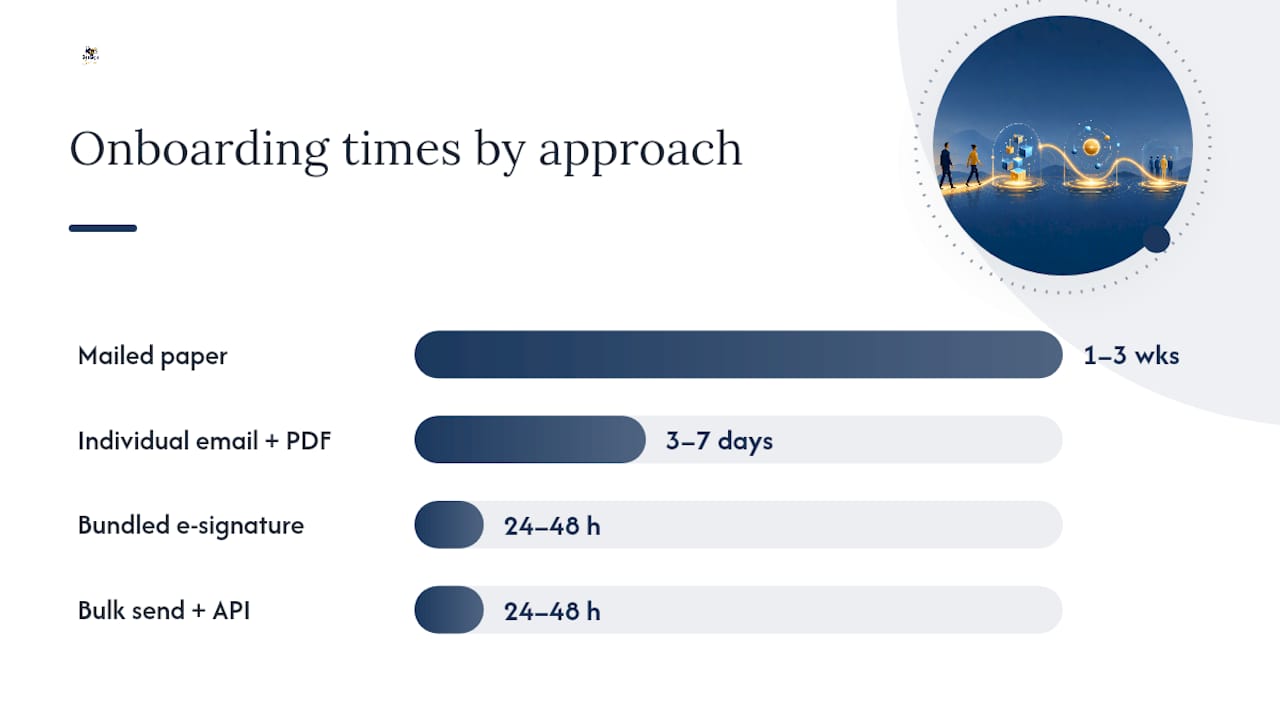
Bundle documents instead of chasing them one at a time. A single send that combines the vendor agreement, W-9 request, and insurance certificate cuts the back-and-forth from three separate email threads to one signing session. Vendor onboarding data backs this up directly: electronic sends typically get signed within 24 to 48 hours, compared to a process that can otherwise stretch across weeks of mailed paperwork and follow-up calls.
Bulk-send and API integration matter most once your vendor roster grows past a handful of names. Sending fifty onboarding packages one at a time is a full day of administrative work; a roster-based bulk-send turns it into a single upload. An API connection to your ERP or CRM keeps vendor records synced automatically, which shortens procurement cycles and cuts manual data-entry errors that otherwise creep in when someone retypes a tax ID by hand.
| Onboarding approach | Time to signed agreement | Manual data entry | Audit trail quality |
|---|---|---|---|
| Mailed paper contract | 1 to 3 weeks | High (rekeyed into systems) | Weak (paper trail only) |
| Individual email + PDF | 3 to 7 days | Moderate | Inconsistent |
| Bundled e-signature package | 24 to 48 hours | Low | Strong (certificate + hash) |
| Bulk-send with API sync | 24 to 48 hours across full roster | Minimal | Strong, consistent across all vendors |
Set retention and access-control policy before volume forces the issue. Decide who can pull an executed agreement, how long it’s retained, and whether your audit team needs export access, then bake those rules into the platform configuration rather than handling them ad hoc after your first compliance review.
Choosing a Vendor Agreement E-Signature Platform: A Working Checklist
Not every e-signature tool is built for procurement volume or audit scrutiny. Before you commit, run the platform against a short list tied directly to enforceability and operational risk.
- Does it generate a certificate of completion with timestamps, IP addresses, and signer email logged automatically?
- Does every executed document carry a cryptographic integrity seal that flags any post-signature tampering?
- Does it offer tiered identity verification, from email confirmation up to government ID and biometric matching?
- Can it bulk-send to a vendor roster and integrate through an API with your ERP or CRM?
- Can you export the full record, agreement plus certificate, in a format your auditors and legal team can actually use?
- Does it document retention policy and access controls clearly enough to satisfy an internal compliance review?
- Does it carry relevant compliance credentials (SOC 2, HIPAA where applicable) for your industry?
When you’re evaluating vendors, ask directly: what does your certificate of completion include, where is data hosted, is encryption applied at rest and in transit, and what’s your incident response process if a breach occurs? A partner resource on security and data handling practices is worth reviewing if your team needs a primer on what “encryption at rest” should actually mean in a vendor contract.
Watch for a few red flags that tend to predict trouble later: no certificate of completion offered by default, authentication limited to a single low-assurance option, vague or missing answers about data export, and no API path for teams that will eventually need automation.
How BeeSign Handles Vendor Agreement Signing and Compliance
BeeSign centralizes the pieces this article has walked through: reusable templates for vendor agreements, tiered identity verification including government ID capture and biometric face matching, and a tamper-evident audit trail generated automatically for every executed document.
For teams handling volume, BeeSign supports:
- Bulk-send to a full vendor roster from a single template
- A developer REST API for syncing signed agreements directly into ERP and CRM systems
- White-label deployment, so signing runs under your own domain and branding rather than a third-party interface
- Bring-your-own-cloud storage, keeping executed records inside your own infrastructure for ESIGN, UETA, eIDAS, and HIPAA compliance
That combination matters most for procurement and legal ops teams managing dozens or hundreds of vendor relationships at once, where a single missing audit certificate can turn a routine renewal into a drawn-out dispute.
When a Platform Beats Ad Hoc Signing
Ad hoc signing, a PDF attachment and a scanned signature, works fine for a one-off vendor with low spend and no recurring renewal. The risk shows up at scale: no consistent audit trail, no bulk-send, and no way to prove authentication if a vendor later claims they never agreed to a term buried on page four.
I’d draw the line at volume and consequence, not company size. A five-person startup onboarding twenty vendors a year with banking access needs the same audit rigor as a large enterprise. Set policy before volume forces your hand: define minimum authentication tiers by contract value, require a certificate of completion on every executed agreement, and put retention rules in writing rather than leaving them to individual judgment calls.
— Mustafa Abusharkh
Put Your Vendor Agreements on a System Built for Proof, Not Paperwork
If you’ve been chasing signatures through email threads and hoping the PDF attachment holds up in a dispute, the checklist above just told you what to fix. BeeSign gives procurement and legal ops teams every item on that list in one workspace: templates for recurring vendor paperwork, bulk-send for full vendor rosters, tiered identity verification, and an audit trail with a cryptographic seal on every executed document.
Teams managing high vendor volume get more value from the API for automating signed-document sync into ERP and CRM systems, cutting the manual rekeying that creates errors in the first place. If your procurement or sales team is ready to stop losing days to signature chasing, BeeSign’s sales and business workflows are built to close vendor agreements faster, with the audit-grade evidence to back every one of them. Start a trial and run your next vendor onboarding batch through it before your current contract renewal cycle hits.
Sources
Recommended
Ready to transform your workflow?
Start using BeeSign today and experience the future of document signing