Dropshipping Vendor Contracts: What to Include and How to Sign
Learn how to draft a dropshipping vendor contract that covers key aspects like pricing, fulfillment, and returns to protect your business.

A dropshipping vendor contract is a written agreement between you (the retailer) and your supplier that defines exactly who stores, packs, ships, and handles returns for products you sell but never physically hold. According to LegalClarity, a well-drafted agreement covers pricing, fulfillment, returns, intellectual property, liability, and termination — the six areas where disputes most commonly arise when things go wrong.
Before you sign anything, confirm the agreement addresses these elements:
- Fulfillment SLAs: processing windows, shipment deadlines, and tracking delivery
- Returns and refunds: who initiates the return authorization, who pays return shipping, and refund timing
- Pricing and payment triggers: wholesale price lists, MAP rules, price-change notice periods, and invoicing frequency
- IP and marketing permissions: licensed use of product images, descriptions, and brand assets
- Liability and indemnity: insurance minimums, mutual indemnities for product claims
- Termination mechanics: notice periods, handling of pending orders, and final accounting
- Dispute resolution: governing law, chosen state, and mediation or arbitration clause
Pro Tip: Never sign a supplier’s boilerplate unchanged. At minimum, fix the MAP clause, the returns policy, and the termination notice period before you countersign — those three terms drive most of the financial disputes in dropshipping relationships.
Key Takeaways
A dropshipping vendor contract protects your margins, your customer relationships, and your platform standing by converting every ambiguous “who pays?” question into a written, enforceable answer before the first order ships.
| Point | Details |
|---|---|
| Define SLA and service credits | Specify processing time, shipment windows, and a credit formula for every breach. |
| Lock MAP and price-change notice | Require 30 days’ written notice before any wholesale price change takes effect. |
| Assign returns and chargeback responsibility | Write the RA process, return shipping costs, and refund timeline into the agreement. |
| Require insurance and mutual indemnity | Ask for a certificate of insurance before the first order and include mutual indemnity for product claims. |
| Use Beesign for execution and storage | Beesign’s templates, approval workflows, and audit-trail e-signatures keep every supplier agreement compliant and retrievable. |
Table of Contents
- What does a dropshipping vendor contract actually do for your business?
- What clauses should every dropshipping agreement include?
- Sample clauses and a template structure you can use today
- How to create and negotiate your dropshipping agreement step by step
- How platform rules affect your contract terms
- How to execute and manage supplier contracts efficiently
- Your pre-signing checklist for supplier agreements
- What most small sellers get wrong — and how to fix it
- Beesign makes signing and managing supplier contracts faster and more secure
- Sources
What does a dropshipping vendor contract actually do for your business?
Most entrepreneurs treat their supplier relationship like a handshake deal until something breaks. A customer files a chargeback on Amazon. A supplier quietly raises wholesale prices mid-campaign. A shipment goes missing and nobody agrees on who eats the loss. A written dropshipping supplier agreement is what converts those ambiguous moments into clear, enforceable answers.
The contract you sign with a supplier is separate from your store’s terms of service. Your terms govern the relationship between you and your customers. The supplier agreement governs the relationship between you and the vendor who fulfills those orders. Both documents need to exist, and they need to be consistent with each other.
Spocket’s supplier agreement guide identifies four areas the agreement must address: how orders are shared, expected shipping times, who handles returns and chargebacks, and what happens to pending orders and unpaid invoices when the relationship ends. Miss any one of those and you are operating on assumptions.
A written agreement becomes especially critical in four situations:
- Onboarding a new supplier you have not worked with before
- Selling high-ticket items where a single return or chargeback is material
- Selling on Amazon, eBay, or Shopify where platform policies impose their own fulfillment and returns standards
- Running a holiday or high-volume campaign where order volume spikes and errors multiply
The contract controls who refunds the customer, who pays return shipping, who owns the product images, and who is liable when a product injures someone. Without it, you are negotiating those questions after the fact, under pressure, with a supplier who has no written obligation to cooperate.
What clauses should every dropshipping agreement include?
A solid vendor contract for dropshipping covers fifteen distinct areas. Each one closes a specific gap that informal arrangements leave open.
Identity of parties and defined terms
Name both entities exactly as they appear in their business registrations. Define “Retailer,” “Supplier,” “Customer,” “SKU,” and “Order” at the top of the document. Defined terms prevent arguments about scope later.
Scope, exclusivity, and sales channels
Specify which SKUs are covered, whether the arrangement is exclusive to your store or open to other retailers, which sales channels are permitted (your own site, Amazon, eBay, Walmart Marketplace), and whether blind or white-label dropshipping is required. Blind dropshipping means no supplier branding on packing slips or packaging — Ecommerce Paradise’s supplier agreement template identifies this as a clause that frequently gets skipped and later causes brand-control disputes.
Order process and acknowledgment
Define how orders are transmitted (EDI, API, portal, or email), the supplier’s acknowledgment window, and the process for cancellations. If the supplier uses a portal, name it and specify what constitutes a valid order confirmation.
Fulfillment SLAs and performance standards
This is the clause that separates a useful contract from a decorative one. Doba’s step-by-step guide makes the point plainly: many sellers run on informal arrangements and suffer fulfillment and refund disputes as a result. Specify processing time (e.g., orders confirmed by 2:00 PM ET ship same day), carrier and service level, tracking number delivery window, and KPIs such as on-time shipment rate. Attach service credits or cure periods to SLA breaches to incentivize supplier performance.
Shipping and risk of loss
State who pays outbound shipping, which carriers are approved, whether the supplier carries shipping insurance, and — critically — the title transfer point. Title transfer at the supplier’s dock means the risk of loss shifts to you the moment the carrier picks up. Title transfer at the customer’s door keeps the supplier responsible for lost shipments. Sprintlaw’s dropshipping agreement overview highlights risk-of-loss and title transfer as two of the highest-impact terms retailers routinely leave vague.
Pricing, MAP, and payment terms
List wholesale prices in an attached Exhibit (more on that structure below). Specify the Minimum Advertised Price (MAP) policy, the notice period required before the supplier can change wholesale prices (30 days is a reasonable standard), invoicing frequency, payment triggers (ship date vs. invoice date), and late-payment fees. Duoplane’s vendor contract guide recommends keeping mutable data like price lists and SKU catalogs in exhibits so you can update them without renegotiating the core agreement.
Returns, refunds, replacements, and chargebacks
Define the Return Authorization (RA) process, the window in which a customer can initiate a return, who pays return shipping for defective items versus buyer’s-remorse returns, restocking fees (if any), and the supplier’s refund timeline. Specify how chargebacks are handled: who provides documentation, who bears the financial loss, and the escalation path when a chargeback is disputed.
Product quality, warranties, and recalls
Require the supplier to warrant that products comply with applicable U.S. safety standards (CPSC regulations for consumer products, for example). Define who manages RMAs, who pays for product recalls, and the notification timeline when a safety issue is identified.
Intellectual property and marketing permissions
Thomson Reuters’ Practical Law drop ship agreement resource identifies branding, marketing permissions, and confidentiality of customer information as standard clauses in drop-ship agreements. Your contract should grant you a limited license to use the supplier’s product images and descriptions for marketing, restrict the supplier from scraping or reselling your customer data, and specify any co-branding or white-label packaging requirements.
Data sharing and privacy
Specify the minimum customer data the supplier needs to fulfill an order (name, shipping address, order ID), prohibit the supplier from using that data for any other purpose, and assign PCI and PII responsibilities clearly. If you sell in California, note CCPA applicability.
Liability, indemnity, and insurance
Cap each party’s liability at a defined multiple of fees paid in the prior 12 months. Include mutual indemnities: the supplier indemnifies you for product liability and IP infringement claims; you indemnify the supplier for claims arising from your marketing. Require the supplier to carry general liability insurance with a minimum policy limit of $1 million per occurrence and name you as an additional insured. Require a certificate of insurance before the first order ships.
Term, termination, and exit mechanics
Set the initial term (one year is typical), auto-renewal conditions, and notice periods for termination for convenience (30–90 days). Define immediate termination triggers: material breach, insolvency, platform removal. Specify what happens to pending orders, in-transit shipments, and outstanding invoices when the agreement ends.
Dispute resolution and governing law
Choose a U.S. state for governing law — typically the state where your business is registered. Specify whether disputes go to mediation first, then binding arbitration, or straight to litigation. Name the arbitration body (AAA or JAMS are common choices) and the venue.
Performance remedies and cure periods
Give the supplier a defined cure period (10–15 business days is standard) to fix an SLA breach before you can invoke service credits or terminate. Specify the service credit formula (e.g., 5% of the affected order value per day of delay) and the right to suspend new orders if the breach is not cured.
Pro Tip: Attach a short Exhibit C as a “Performance Standards Addendum” that lists your KPIs and credit formula separately from the main agreement. That way you can update thresholds as your volume grows without reopening the core contract.
The table below maps each clause to the primary risk it controls.
| Clause | Primary risk controlled |
|---|---|
| Fulfillment SLA + service credits | Late shipments, platform penalties |
| Returns and RA process | Chargeback losses, refund disputes |
| MAP and price-change notice | Margin erosion mid-campaign |
| Title transfer and risk of loss | Lost-shipment liability |
| IP license for images | Copyright claims from supplier |
| Mutual indemnity + insurance | Product liability exposure |
| Termination + pending orders | Stranded inventory, unpaid invoices |
| Governing law and arbitration | Costly multi-state litigation |
Sample clauses and a template structure you can use today
You do not need to start from scratch. The following clause snippets cover the highest-impact areas and are written to be dropped into a working draft or used to redline a supplier’s boilerplate.
Order processing and acknowledgment
Fulfillment SLA
Returns and refunds
Pricing and price-change notice
IP license for product images
Indemnity for product claims
For the overall template structure, Duoplane recommends organizing the agreement with exhibits that hold mutable data:
- Exhibit A: Wholesale price list and payment terms
- Exhibit B: Approved SKU catalog and sales channels
- Exhibit C: MAP policy and enforcement procedure
- Exhibit D: Returns and exchanges policy
- Exhibit E: Performance standards and service credit formula
When you present the template to a supplier, send it as a tracked-changes Word document or a PDF with a redline cover email. State your three non-negotiables upfront (MAP, returns, and termination notice) so the negotiation focuses on those first.
How to create and negotiate your dropshipping agreement step by step
Preparation before you open negotiations
Gather these documents before you contact the supplier’s legal or sales team:
- Your sales forecast and projected order volume by SKU
- A complete SKU list with product descriptions and retail price points
- Platform requirements for each channel you sell on (Amazon’s seller agreement, eBay’s dropshipping policy, Shopify’s terms)
- Proof of your business entity (LLC or corporation) and EIN
- A sample certificate of insurance showing the coverage you will require from the supplier
Negotiation sequence
Work through terms in this order, because each layer depends on the one before it:
- Pricing, MAP, and payment terms — lock the economics first
- Fulfillment SLA and shipment responsibilities — define what “on time” means and what happens when it is not
- Returns, refunds, and chargebacks — agree on the RA process and who pays for what
- IP license and marketing permissions — confirm you can use their images and descriptions legally
- Warranty, product quality, and recall procedures — assign responsibility before a safety issue arises
- Liability, indemnity, and insurance — set minimums and confirm the supplier can actually meet them
- Termination and exit mechanics — agree on notice periods and pending-order handling before you need them
Red flags that should stop you from signing
ContractsCounsel’s drop-shipping agreement resource is direct: if a supplier refuses to put pricing, MAP, return policy, or shipping terms in writing, that is a legitimate reason to pause the relationship. Watch for these specific signals:
- Supplier refuses to commit MAP in writing or insists on unlimited unilateral price changes with no notice
- No written returns policy, or restocking fees above 25% with no exceptions for defective items
- Refusal to sign mutual indemnity or provide a certificate of insurance
- No defined process for handling pending orders on termination
- Boilerplate that caps the supplier’s liability at $0 or “the value of the disputed order” while leaving your liability uncapped
Practical negotiation tips
- Identify your three non-negotiables before the first call and do not trade them away for minor concessions
- Use a short interim letter of intent or addendum to capture agreed terms while lawyers finalize the full agreement — this protects you during the gap
- Ask for a 90-day trial period with defined KPIs before committing to a long-term exclusive arrangement
- Request sample orders before the first live campaign and use them to verify SLA compliance
How platform rules affect your contract terms
Your dropshipping agreement does not exist in isolation. Amazon, eBay, and Shopify each impose requirements that flow directly into the terms you need from your supplier.
Amazon requires sellers to be the seller of record on all documentation. That means your supplier’s packing slips, invoices, and return labels must show your business name, not theirs. Build this into the blind dropshipping clause. Amazon also enforces strict returns windows (typically 30 days for most categories), so your supplier’s RA process must fit inside that window, not outside it.
eBay prohibits purchasing items from another retailer and having that retailer ship directly to the buyer. Selling through a wholesale supplier is permitted, but the supplier must be a genuine wholesaler, not a retail intermediary. Your contract should confirm the supplier’s wholesale status and prohibit them from listing the same products on eBay themselves if exclusivity matters to you.
Shopify does not impose fulfillment SLAs directly, but its payment dispute process means chargebacks land on you as the merchant of record. Your supplier agreement needs to specify who provides chargeback documentation and within what timeframe.
Pro Tip: Before signing any supplier agreement, run your highest-revenue SKUs against the relevant marketplace’s restricted categories list. Some product categories (electronics, supplements, toys) carry stricter authenticity and warranty requirements that need to be reflected in your supplier’s quality and recall clauses.
U.S. regulatory touchpoints worth noting in your contract:
- CPSC product safety: Require the supplier to warrant compliance with applicable consumer product safety standards and to notify you promptly of any recall or safety notice
- FTC truth-in-advertising: You are responsible for the accuracy of claims in your listings, so the IP license clause should confirm that product descriptions the supplier provides are accurate and compliant
- Data privacy: If you share customer PII with the supplier for fulfillment, a data processing addendum covering reasonable security standards and CCPA applicability (for California customers) is worth including
For a broader view of what platform compliance requires from vendor agreements, the vendor compliance requirements checklist on the Beesign blog maps IP and data policies to specific contract clauses.
How to execute and manage supplier contracts efficiently
Signing the contract is not the finish line. How you execute, store, and monitor the agreement determines whether it actually protects you.
Execution best practices
- Confirm that the person signing on behalf of the supplier has documented authority (officer, LLC manager, or authorized signatory per their operating agreement)
- Use an e-signature solution that generates a full audit trail: timestamp, IP address, signer identity, and document hash
- The U.S. Electronic Signatures in Global and National Commerce (ESIGN) Act and the Uniform Electronic Transactions Act (UETA) give e-signed contracts the same legal standing as wet-ink signatures, provided the parties have consented to electronic signing and the platform captures an adequate audit trail
- For high-value or high-risk supplier relationships, add identity verification (government ID capture and biometric face matching) to confirm the signer is who they claim to be
Storage and recordkeeping
- Store every signed agreement, amendment, and exhibit in a centralized contract repository with searchable metadata: supplier name, SKU list, price attachment, effective date, and renewal date
- Maintain version history so you can retrieve the exact terms in force on any given date if a dispute arises
- Set a retention policy of at least seven years for supplier contracts, consistent with general U.S. business records guidance
- Back up the repository to a secondary location; secure document storage for e-commerce is not optional when contracts contain PII and financial terms
Ongoing contract management
- Build an SLA monitoring dashboard that tracks on-time shipment rate, tracking delivery rate, and RA response time against the KPIs in your agreement
- Set calendar reminders 60 days before auto-renewal dates and 30 days before price-change notice windows expire
- Schedule a formal performance review with each supplier every 90 days during the first year, then annually after that
- Document every dispute and its resolution in writing, referencing the relevant contract clause
Pro Tip: Use reusable contract templates with a required-clauses checklist and an approval workflow that routes agreements above a defined revenue threshold to legal review before signing. Beesign’s template and approval workflow features make this straightforward — every new supplier contract follows the same structure and no clause gets dropped by accident.
Your pre-signing checklist for supplier agreements
Use this checklist during a supplier call or before you countersign any agreement. A “No” on any item is a conversation to have before you proceed.
How to use this checklist on a supplier call: Work through each item in order. For any “No,” ask the supplier’s representative directly: “Can we add that to the agreement?” Document their response. If they refuse to commit any of the top five items in writing, treat that as a red flag per the negotiation guidance above.
One-page negotiation memo you can copy into an email:
What most small sellers get wrong — and how to fix it
The most common failure mode in dropshipping relationships is not a bad supplier. It is a vague contract that leaves both parties guessing until something goes wrong.
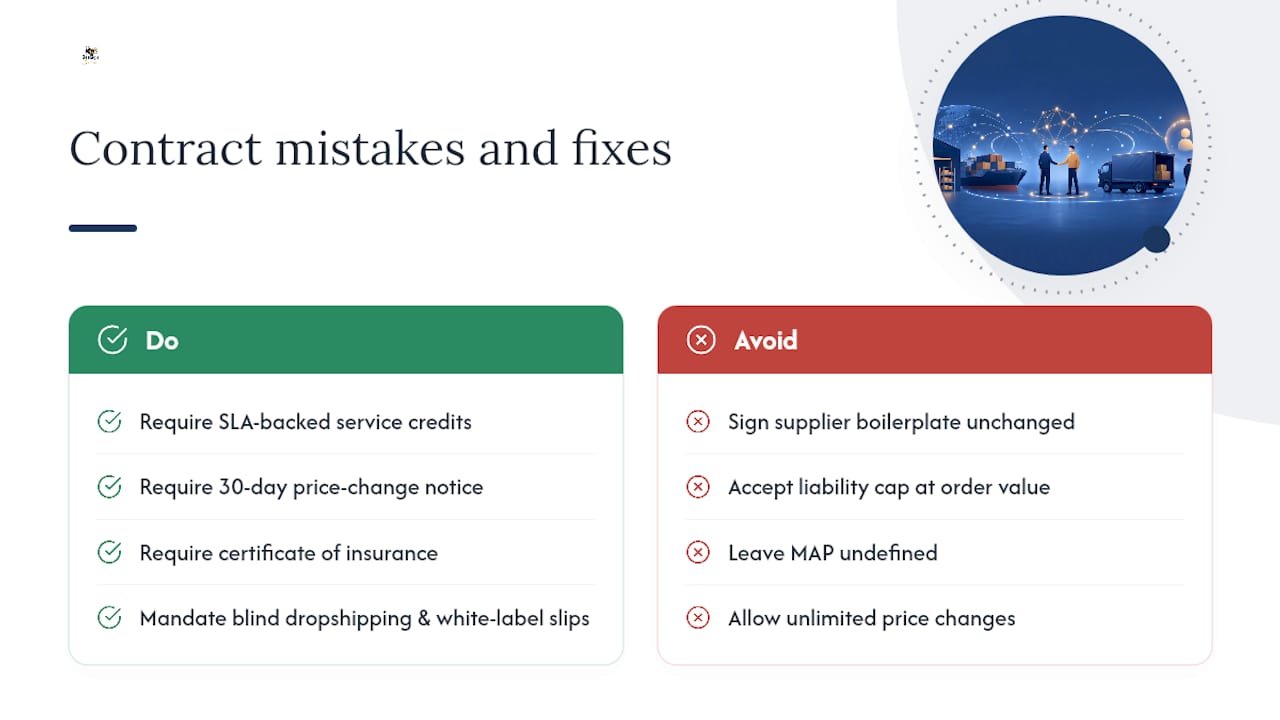
Signing supplier boilerplate unchanged is the single most expensive mistake a small seller makes. Supplier-drafted agreements almost always cap the supplier’s liability at the value of the disputed order, leave MAP undefined, and give the supplier unlimited rights to change prices with no notice. Those three defaults transfer nearly all financial risk to you.
The fix is not complicated. Require SLA-backed service credits so the supplier has a financial incentive to ship on time. Ask for a 30-day price-change notice period and put it in writing. Require a certificate of insurance before the first order ships. If your brand requires consistent packaging, mandate blind dropshipping and white-label packing slips explicitly — do not assume the supplier knows what you expect.
Ignoring data-handling responsibilities is a quieter problem that surfaces later. When you share customer names and addresses with a supplier for fulfillment, you are transferring PII. If the supplier misuses that data or suffers a breach, your customers will hold you responsible. A short data processing addendum costs almost nothing to add and closes that gap entirely.
Monthly supplier audits are worth building into your calendar. Pull your SLA metrics, check on-time shipment rate and RA response time, and compare them against the KPIs in your agreement. Send sample orders quarterly to verify that blind dropshipping and packaging requirements are being followed. Suppliers who know you are tracking performance tend to perform better.
Beesign makes signing and managing supplier contracts faster and more secure
Once you have a solid dropshipping vendor agreement drafted, the execution step matters as much as the drafting. Beesign gives you reusable contract templates, approval workflows, and ESIGN and UETA-compliant e-signatures with full audit trails, so every supplier agreement you sign is legally sound and traceable from day one.
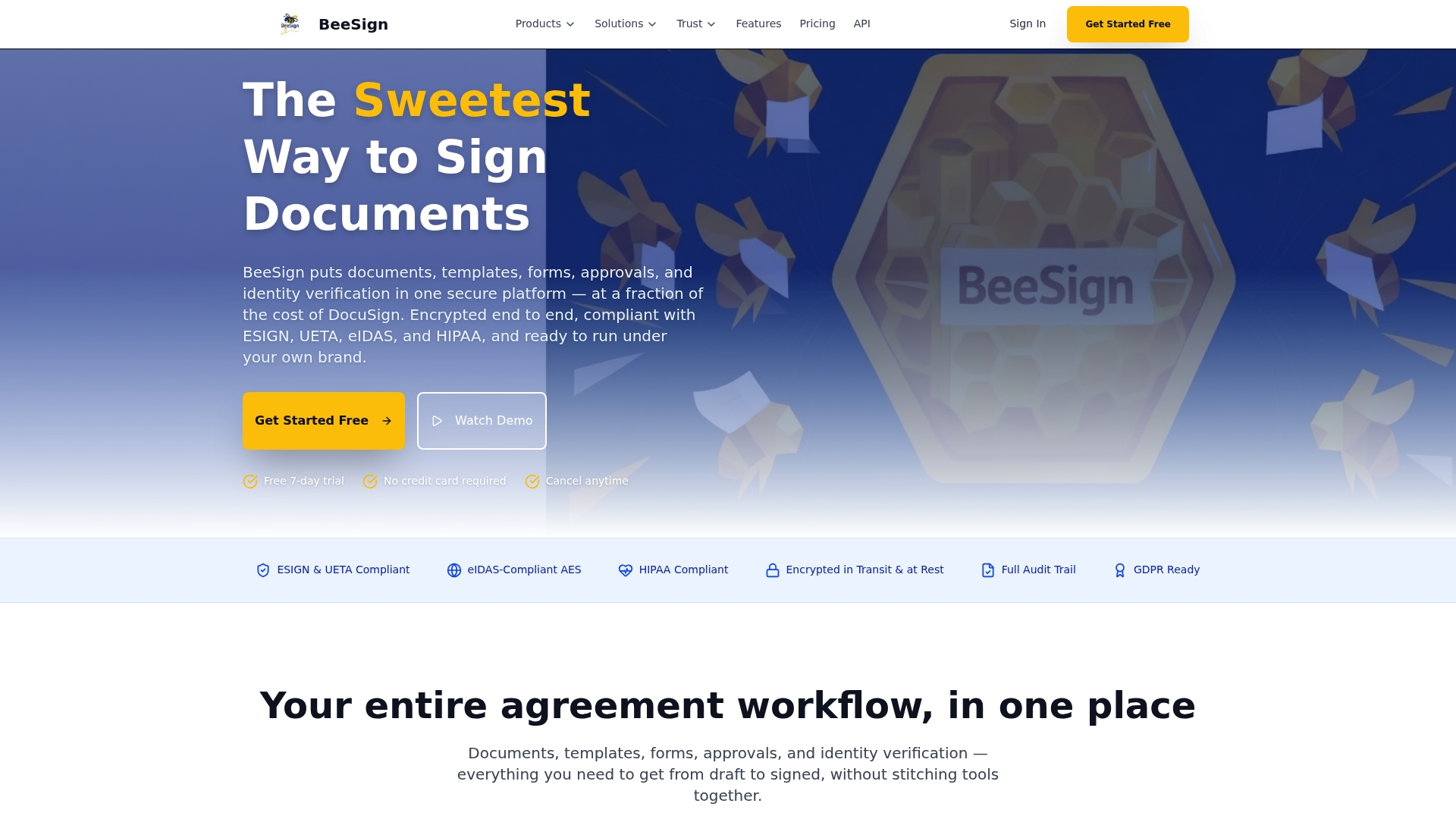
With Beesign, you can build a supplier contract template with required-clause placeholders, route it through an approval workflow before it goes to the supplier, and capture identity-verified signatures with a timestamped audit trail. The contract repository stores every signed agreement, amendment, and exhibit with searchable metadata, and automated reminders flag renewal windows and price-change notice deadlines before they pass. For teams managing multiple suppliers, the REST API connects contract signing directly to your order management workflow.
The e-commerce and retail solution on Beesign is built for exactly this use case. Start a 7-day free trial and have your first supplier contract template ready to send today.
Sources
The following resources were used to build this guide and are worth bookmarking for your own drafting and negotiation work.
- Dropshipping Agreement Contract: What to Include - LegalClarity
- Dropshipping Contracts Guide for Supplier Agreements
- Step-by-Step Guide: Crafting a Dropshipping Agreement Contract That Protects Your Business | Doba
- How to Create a Dropshipping Vendor Contract
- Drop ship agreement | Practical Law - Thomson Reuters
- Dropshipping Supplier Agreement Template: What to Include, What to Negotiate, and How to Use It - Ecommerce Paradise
- Drop shipping agreement — ContractsCounsel
- What Is A Dropshipping Agreement? | Sprintlaw UK
Attorney review: This guide is general information, not legal advice. For a contract that will govern a significant supplier relationship, have a U.S. business attorney review the final draft for enforceability under your state’s law and platform compliance before you sign.
This article is general information, not a substitute for advice from a qualified lawyer. Consult a qualified legal professional about your own circumstances before acting on anything here.
Recommended
Ready to transform your workflow?
Start using BeeSign today and experience the future of document signing