What Is a Fulfillment Center Agreement? A Merchant's Guide
Learn what a fulfillment center agreement is and how to ensure it meets your needs. Discover key steps before signing for success.

A fulfillment center agreement is a legally binding contract between a merchant and a third-party logistics provider (3PL) that governs how the provider will receive, store, pick, pack, and ship your products to customers — it is the operational blueprint for the entire relationship. Before you sign one, take these steps: review the scope of services line by line, request sample SLA reports from the 3PL’s current clients, confirm the full pricing model including minimums, plan a pilot period, and schedule a counsel review of the final draft.
Five things to confirm before you sign:
- Scope of services: Every service you expect (kitting, returns, labeling) is explicitly listed, not implied.
- Inventory ownership: The contract states that title stays with you until the carrier picks up the shipment.
- SLA KPIs: Specific, measurable targets are written in (scan-in time, pick accuracy, on-time dispatch rate).
- Pricing and minimums: All fee categories are itemized, and monthly minimums are capped or clearly defined.
- Termination and transition: Notice periods, cure windows, and data export obligations are spelled out.
Table of Contents
- What clauses does every fulfillment center agreement need?
- What do strong SLAs look like in a fulfillment contract?
- How are fulfillment center fees structured?
- Who owns the inventory, and who bears the risk?
- What tech and data security terms belong in the agreement?
- Sample clauses and a short template you can adapt
- How do you negotiate a fair fulfillment agreement?
- When do you need a fulfillment agreement, and what should you do before signing?
- How to execute and manage your fulfillment agreement efficiently
- Key Takeaways
- The real cost of ambiguous fulfillment contracts
- Beesign makes fulfillment agreement execution faster and auditable
- Useful sources and public templates
What clauses does every fulfillment center agreement need?
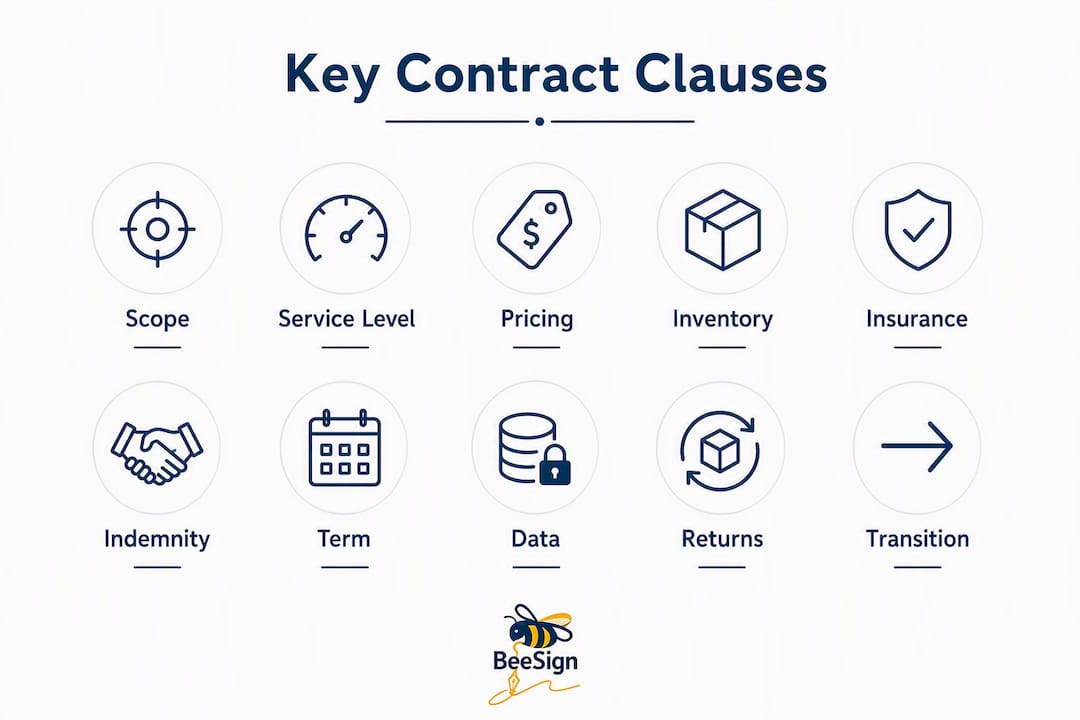
The core of any fulfillment center contract is its clause structure. A missing or vague clause is not a neutral omission — it is a gap that defaults to whatever the 3PL’s standard terms say, which rarely favor the merchant. Legal advisors consistently emphasize that explicitly enumerating every value-added activity in the scope of services is the single most effective way to prevent post-signature billing disputes.
Scope of services
Define inbound receiving, storage, pick and pack, labeling, kitting, returns processing, and any customer-facing support separately. Each service should carry its own pricing reference in the attached fee schedule. If a service is not listed, the 3PL has no contractual obligation to perform it — and may charge a premium when you ask.

Service-level agreement summary
The SLA section should name each performance metric, the measurement period (weekly, monthly), the calculation method, and the remedy for a miss. Linking SLAs to financial credits gives you contractual recourse when service slips. Without defined penalties, you have no enforceable leverage.

Pricing and payment terms
Financial provisions should specify onboarding fees, storage rates (per pallet, per bin, or per cubic foot), pick-and-pack charges, kitting fees, returns processing fees, shipping pass-throughs, and monthly minimums. Billing cadence (weekly, bi-weekly, monthly) and the dispute resolution window for invoices should also appear here.
Inventory ownership and risk of loss
State clearly that title to inventory remains with you at all times during storage and that risk of loss transfers to the carrier upon pickup. This protects you if the 3PL files for bankruptcy or disputes an invoice.
Insurance and liability
Require the 3PL to carry commercial general liability, warehouse legal liability, and cargo insurance. You should be named as an additional insured on each policy. Specify minimum coverage limits and require annual certificates of insurance.
Indemnity and limitation of liability
Negotiate a mutual indemnity clause. Push for carve-outs that remove the liability cap for gross negligence, willful misconduct, and data breaches. A blanket cap that covers all scenarios equally is a red flag.
Term, renewal, and termination
Specify the initial term, auto-renewal conditions, notice periods for non-renewal (typically a pilot period), cure windows for material breaches (usually 15–30 days), and any early-termination fees. A termination-for-convenience right with reasonable notice protects you if the relationship deteriorates.
Data, integrations, and confidentiality
Define API or EDI integration requirements, data ownership (your order and inventory data belongs to you), PII and PCI handling obligations, and the 3PL’s data retention and deletion schedule. Confidentiality obligations should survive termination.
Returns and reverse logistics
Spell out the RMA process, inspection criteria, restocking fees, disposition rules for unsellable units, and turnaround time for crediting returned inventory back to available stock.
Transition assistance and exit obligations
Transition-assistance clauses should require the 3PL to provide inventory manifests, data exports in a specified format, a mutually agreed cutover schedule, and physical access windows for your new provider. Without these, a departing 3PL can slow your migration for weeks.
What do strong SLAs look like in a fulfillment contract?
SLAs are where a fulfillment agreement moves from aspirational to enforceable. Vague language like “best efforts” or “commercially reasonable” gives you nothing to measure against. Standardized SLA language typically requires inventory to be scanned into the warehouse management system within 1–2 business days of arrival and orders received before a defined cut-off time to ship same-day.
Sample SLA KPI table
| Metric | Sample target wording | Typical remedy |
|---|---|---|
| Inbound scan-in time | “All inbound units scanned into WMS within 2 business days of dock receipt” | Service credit of 1% of monthly storage fees per day of delay beyond cure window |
| Same-day ship rate | “Orders received before 2:00 PM local time ship same-day at ≥98% rate, measured monthly” | Service credit equal to 5% of monthly pick-and-pack fees if rate falls below 95% |
| Pick accuracy | “Pick accuracy ≥99.5% per monthly audit of outbound shipments” | Credit per confirmed mispick above the agreed threshold |
| On-time dispatch rate | “≥99% of orders dispatched within the contracted ship window, measured weekly” | Escalation to executive review; credit of 3% of weekly fulfillment fees if rate falls below 95% |
| Returns processing | “Returned units inspected and restocked or quarantined within 3 business days of receipt” | Credit per unit processed beyond the agreed time window |
How SLAs are enforced:
- Service credits: The most common remedy. Credits apply against future invoices, not as cash refunds, so confirm the credit calculation formula and any monthly cap.
- Cure windows: Give the 3PL a defined period (typically 15–30 days) to fix a recurring miss before credits trigger. This prevents disputes over one-off anomalies.
- Step-in rights: For critical failures (e.g., a warehouse shutdown), you may want the right to redirect orders to a backup provider at the 3PL’s cost.
- Audit rights: Require the right to audit WMS data and shipping records quarterly. Without audit rights, you cannot verify the metrics the 3PL reports.
Pro Tip: Require the 3PL to provide a monthly SLA scorecard in a machine-readable format (CSV or JSON export from their WMS). This makes it far easier to spot trends before they become contractual disputes.
How are fulfillment center fees structured?
Pricing is where most merchants get surprised. A fulfillment center contract typically bundles a dozen or more fee categories, and the ones that hurt most are the ones buried in the rate card rather than the headline pitch.
Financial provisions should itemize every charge so you can model your true cost per order before you sign. Here is what to expect:
- Onboarding/setup fee: A one-time charge for system configuration, SKU setup, and integration work. Ranges from a few hundred to several thousand dollars depending on complexity.
- Storage fees: Charged per pallet, per bin, or per cubic foot, billed weekly or monthly. Pallet-based pricing favors merchants with dense, uniform SKUs; cubic-foot pricing can penalize bulky or irregular items.
- Pick-and-pack fee: Charged per order, per item, or per line. Understand whether the base fee covers a single item or a set number of items before per-item add-ons kick in.
- Kitting and assembly fees: Charged per kit built, often with a setup fee per SKU configuration. These are highly negotiable — ask for volume tiers.
- Returns processing fee: Charged per unit received back, with additional fees for inspection, repackaging, or disposal.
- Monthly minimum: A floor charge you owe even if your order volume is low. This is one of the most important figures to negotiate, especially for seasonal businesses.
- Shipping pass-throughs: The carrier rate plus a handling markup. Ask for the markup percentage in writing and request access to carrier invoices for audit purposes.
- Chargebacks and inventory adjustments: Fees for shrinkage, cycle-count discrepancies, or non-compliance with labeling requirements. These can be significant if your inbound packaging is inconsistent.
Negotiation tactics that actually work:
- Request banded pricing with volume tiers so your per-unit cost drops as order volume grows.
- Cap variable fees (storage, returns) at a percentage of total monthly billing to limit exposure in slow months.
- Negotiate a true-up clause that adjusts minimums quarterly based on actual volume, not projections.
- Require itemized invoices with line-level detail, not summary billing. Summary billing makes it nearly impossible to audit pass-throughs.
- Ask for a 90-day pricing lock after onboarding so you are not hit with rate increases before the relationship is stable.
Who owns the inventory, and who bears the risk?
Inventory ownership and risk of loss are two distinct legal concepts, and conflating them is one of the most common mistakes merchants make when reviewing a fulfillment contract.
Title (ownership) determines who has the legal right to the goods. Risk of loss determines who bears the financial consequence if goods are damaged or destroyed. You want to retain title at all times and transfer risk of loss to the carrier the moment the carrier takes custody.
A clean ownership clause reads something like: “All inventory stored at Provider’s facility remains the sole property of Merchant at all times. Provider holds inventory as a bailee and acquires no ownership interest, lien, or security interest in the inventory except as expressly permitted under the Warehouseman’s Lien section below.”
The warehouseman’s lien problem
The warehouseman’s lien permits a 3PL to hold your inventory as collateral for unpaid invoices. Left unchecked, this means a billing dispute over a $500 invoice could give the provider grounds to withhold $50,000 in inventory. Limit this right contractually to undisputed invoices only, and exclude finished goods that are customer-bound from the lien’s scope.
Where title and risk typically move:
- Inbound: You retain title and risk during transit to the warehouse.
- At dock receipt: Title stays with you; risk of loss for warehouse damage shifts to the 3PL (covered by their warehouse legal liability policy).
- Pick and pack: Title stays with you; the 3PL is responsible for mispicks and damage during packing.
- Carrier pickup: Risk of loss transfers to the carrier. Title transfers to the buyer at the point defined in your customer terms (usually FOB shipping point or FOB destination).
Insurance requirements to write into the contract:
- Commercial general liability: minimum $1,000,000 per occurrence / $2,000,000 aggregate
- Warehouse legal liability: covering the full replacement value of your inventory at peak storage levels
- Cargo/transit insurance: if the 3PL arranges carrier pickup
- Cyber and privacy liability: if the 3PL handles any customer PII or payment data
Pro Tip: Request the 3PL’s certificate of insurance before the contract is signed, not after. Verify that your entity is listed as an additional insured and that the policy limits match what the contract requires. A certificate that names the wrong entity is worthless.
What tech and data security terms belong in the agreement?
A 3PL functions as an extension of your brand, and technology integration is core to that relationship — not a peripheral detail. If the integration breaks and there is no contractual SLA for fixing it, your orders stop flowing and you have no recourse.
Integration checklist for the contract:
- API endpoints and authentication method (OAuth 2.0, API key, or EDI X12/EDIFACT)
- Required data fields for order creation, inventory updates, and shipment confirmations
- Webhook or event-notification guarantees (delivery retries, failure alerting)
- Data export formats and frequency (CSV, JSON, EDI) for inventory snapshots and order history
- Test environment availability and acceptance criteria before go-live
- Scheduled downtime windows and advance notice requirements (minimum 72 hours for planned maintenance)
- Support SLA for integration breaks (response time, resolution time, escalation path)
Security requirements to include:
- Encryption in transit (TLS 1.2 or higher) and at rest (AES-256 or equivalent)
- Role-based access controls limiting 3PL staff access to your data
- SOC 2 Type II or ISO 27001 attestation (request the most recent report)
- Incident response and breach notification timeline (typically 48–72 hours after discovery)
- Data retention schedule and deletion obligations upon contract termination
PII and PCI considerations:
If the 3PL processes customer shipping addresses or payment data, the contract must define who is the data controller and who is the data processor under applicable privacy law. Require PCI DSS compliance documentation if the 3PL touches payment card data. Include a data processing addendum (DPA) as an exhibit if you are subject to CCPA or similar state privacy laws.
For guidance on secure document storage and sharing practices that apply to your contract files and integration credentials, your internal policies should mirror the standards you require of your 3PL.
Sample clauses and a short template you can adapt
The clauses below are starting points. Have counsel review and customize them for your specific SKUs, volumes, service windows, and jurisdiction before sending to a 3PL.
Scope of services clause: “Provider shall perform the following services for Merchant: (a) inbound receiving and scanning of inventory within two (2) business days of dock receipt; (b) storage of inventory in a climate-appropriate environment; © pick, pack, and labeling of outbound orders per Merchant’s specifications; (d) kitting and assembly as described in Exhibit A; (e) returns processing per the RMA procedures in Exhibit B; and (f) such additional services as the parties may agree in writing.”
Inventory ownership clause: “All inventory delivered to Provider by or on behalf of Merchant shall remain the sole and exclusive property of Merchant. Provider shall hold such inventory as bailee and shall acquire no ownership interest therein. Provider’s warehouseman’s lien, if any, shall be limited to undisputed amounts owed by Merchant and shall not apply to inventory designated for imminent customer shipment.”
SLA clause excerpt: “Provider shall achieve a same-day ship rate of not less than 98% for orders received before 2:00 PM local warehouse time, measured on a calendar-month basis. For any month in which Provider’s same-day ship rate falls below 95%, Provider shall issue Merchant a service credit equal to 5% of that month’s pick-and-pack fees, applied to the following invoice.”
Termination and transition assistance clause: “Upon expiration or termination of this Agreement for any reason, Provider shall: (a) continue to fulfill outstanding orders for up to 30 days at current rates; (b) provide Merchant with a complete inventory manifest within five (5) business days; © export all order history and inventory data in CSV format within ten (10) business days; and (d) cooperate with Merchant’s designated successor provider to facilitate an orderly transition.”
Customization checklist before sending to your 3PL or counsel:
- Insert your legal entity name and the 3PL’s legal entity name in the preamble.
- Define each SKU or SKU category in Exhibit A with dimensions, weight, and handling notes.
- Fill in the pricing schedule (Exhibit C) with agreed rates for every fee category.
- Set the order cut-off time to match the 3PL’s actual warehouse shift schedule.
- Confirm the governing state law and dispute resolution venue.
- Attach current certificates of insurance from both parties.
- Define the integration endpoints and data schemas in a technical exhibit.
For a downloadable starting template, Rocket Lawyer’s fulfillment services agreement provides a customizable document that covers the core commercial terms. For a real-world example of how large contracts structure attachments and exhibits, the SEC’s EDGAR database includes the Innotrac Fulfillment Services Agreement as a publicly filed exhibit — searching EDGAR for “fulfillment services agreement” surfaces several examples worth reviewing before you draft your own.
How do you negotiate a fair fulfillment agreement?
Negotiation starts before you send a redline. The 3PL’s standard contract is written to protect the 3PL. Your job is to identify the clauses that shift risk to you unfairly and propose balanced alternatives — not to win every point, but to reach a deal both sides can sustain. Overly one-sided contracts that force a 3PL to operate at a loss typically result in degraded service, which ultimately hurts the merchant.
Practical negotiation tactics:
- Start with a pilot. Propose a 60–90 day pilot at reduced or waived minimums before committing to a full-term contract. A 3PL confident in its performance will agree.
- Use time-limited pricing. Lock rates for 12 months with a defined cap on annual increases (e.g., CPI or 3%, whichever is lower).
- Require data portability. Make it explicit that your order history, inventory data, and integration credentials are yours and exportable on demand.
- Limit the lien. Push back on any clause that gives the 3PL a lien over all inventory for any outstanding balance. Limit it to undisputed invoices.
- Require transition assistance. If the 3PL resists including a transition-assistance clause, treat that as a significant warning sign.
- Negotiate phased onboarding discounts. Ask for reduced storage and pick-and-pack rates for the first 90 days while integration and processes stabilize.
Red flags that should pause negotiations:
- Scope described in vague terms like “standard fulfillment services” with no enumerated list of activities
- Liability caps that cover gross negligence and data breaches equally with minor operational errors
- Monthly minimums that are not disclosed until you ask for the full rate card
- No SLA section, or SLAs with no defined remedies
- Transition-assistance obligations that are absent or limited to “reasonable cooperation”
- Billing adjustment line items with no defined calculation method or dispute window
- Obscure “inventory adjustment” fees that allow the 3PL to charge for shrinkage without a cycle-count audit
Pro Tip: When presenting your expected volumes to a 3PL, provide a 12-month order history broken down by SKU, order size, and peak-to-average ratio. This gives the 3PL the data to price accurately and gives you a baseline for SLA targets and minimum negotiations — both sides benefit from specificity.
When do you need a fulfillment agreement, and what should you do before signing?
A formal fulfillment agreement is required any time you hand physical inventory to a third party for storage and outbound shipping. That threshold is lower than most merchants assume.
Scenarios that require a formal contract:
- Onboarding a new 3PL for the first time
- Expanding to a second fulfillment location or cross-border operations
- Adding value-added services (kitting, subscription box assembly, custom packaging)
- Reaching order volumes where a service disruption would materially affect your revenue
- Handling regulated products (food, cosmetics, medical devices) that require documented chain of custody
Pre-sign checklist:
- Prepare an operational data sheet: SKU count, average daily orders, peak order volume, average units per order, and inbound shipment frequency.
- Request and verify the 3PL’s current certificates of insurance.
- Complete a test integration: connect your order management system to the 3PL’s WMS in a sandbox environment and confirm data flows correctly.
- Run pilot shipments: process a representative sample of orders (at least 50–100) before full cutover.
- Check references: speak with at least two current clients in your product category.
- Have counsel review the final draft, particularly the liability, indemnity, lien, and termination clauses.
Typical onboarding timeline:
- Week 1–2: Discovery and data exchange (operational data sheet, SKU specs, integration requirements).
- Week 2–4: Contract negotiation and execution.
- Week 3–5: Integration development and testing in sandbox.
- Week 5–6: Inbound inventory shipment and receiving.
- Week 6–8: Pilot order processing and SLA baseline measurement.
- Week 8+: Full cutover and first billing cycle. Expect the first invoice to include onboarding fees and any setup charges.
For a practical look at how storage facilities handle inventory moves and staging during onboarding and transition, reviewing an operator playbook can help you set realistic expectations for inbound receiving timelines.
How to execute and manage your fulfillment agreement efficiently
Signing the contract is not the end of the process — it is the beginning of a document lifecycle that includes renewals, SLA reviews, insurance certificate collection, and integration change management. Managing that lifecycle manually (email threads, shared drives, calendar reminders) introduces gaps that cost real money when a renewal auto-triggers or an insurance certificate lapses.
Feature-benefit checklist for your e-signature and workflow tool:
- Reusable templates: Build the fulfillment agreement once with required fields locked, so every new 3PL engagement starts from a consistent, pre-approved structure.
- Required fields and conditional logic: Prevent execution of incomplete contracts by making pricing schedule cells and SLA exhibit attachments mandatory before the document can be sent for signature.
- Identity verification: Confirm the signer is who they claim to be using government ID capture and biometric face matching — critical when executing agreements with new providers you have not met in person.
- Complete audit trail: Every view, edit, and signature event is timestamped and logged, giving you a defensible record if a dispute arises over what was agreed.
- Expiration and renewal reminders: Automate alerts 60 and 30 days before the contract auto-renews so you have time to renegotiate or exit.
- Blockchain timestamp proof: Provides tamper-evident evidence of when the agreement was executed, useful if a 3PL later disputes the terms.
Implementation tips for operations teams:
- Embed your SLA exhibit as a required annex in the template so it cannot be detached or overlooked during execution.
- Attach the pricing schedule as a fillable exhibit with locked formula cells to prevent accidental edits after signature.
- Automate certificate-of-insurance collection by triggering a renewal request workflow 45 days before each certificate’s expiration date.
- Log integration endpoints, API credentials, and data schema versions in the contract metadata so your IT team can reference them without hunting through email.
Example workflow:
Draft agreement with SLA and pricing exhibits → internal legal and operations approval → send for e-signature with identity verification → signed agreement stored with full audit trail → automated triggers launch integration setup workstream and insurance certificate collection → renewal reminder fires 60 days before term end.
Pro Tip: Store your signed fulfillment agreement and all exhibits in a centralized, access-controlled repository. When a billing dispute arises six months after signing, you need the exact signed version — not a draft from someone’s desktop. Beesign’s secure contract storage guidance covers the access controls and version management practices that prevent this problem.
Key Takeaways
A well-structured fulfillment center agreement protects your inventory, locks in measurable service standards, and gives you a clear exit path — all three elements must be present for the contract to be genuinely enforceable.
| Point | Details |
|---|---|
| Define scope and SLAs first | List every service explicitly and attach KPI targets with defined remedies before negotiating price. |
| Lock down pricing and transition terms | Itemize all fee categories, cap minimums, and require a transition-assistance clause with specific deliverables. |
| Require insurance and data protections | Name yourself as additional insured, limit the warehouseman’s lien to undisputed invoices, and include a data security exhibit. |
| Run a pilot before full commitment | A 60–90 day pilot at reduced minimums lets you verify SLA performance before the full contract term begins. |
| Beesign for contract execution | Use Beesign’s reusable templates, identity verification, and audit trails to execute and track fulfillment agreements without manual follow-up. |
The real cost of ambiguous fulfillment contracts
Most merchants focus on the headline pick-and-pack rate and treat the contract as a formality. That is the wrong order of operations. The clauses that matter most — the lien language, the transition-assistance obligations, the SLA remedy structure — are the ones that determine what happens when something goes wrong, not when everything is running smoothly.
The practical reality is that a 3PL’s standard contract is drafted by their legal team to minimize the provider’s exposure. That is not bad faith; it is standard practice. Your job as the merchant is to read it as a risk document, not a service description. Every clause that is vague, every remedy that is absent, and every minimum that is undefined is a risk you are accepting by default.
Operations managers can negotiate most commercial terms directly — pricing, minimums, pilot periods, and SLA targets are business decisions. The clauses that warrant counsel are the ones with legal consequences you may not anticipate: indemnity carve-outs, lien language, data breach liability, and governing law. Bringing in a contracts attorney for a two-hour review of the final draft is a fraction of the cost of a single billing dispute or a botched transition.
One thing that consistently surprises merchants: the transition-assistance clause is often the most valuable clause in the entire agreement, and it is the one most frequently absent from a 3PL’s standard form. A 3PL that refuses to include cooperative exit obligations is signaling something about how they expect the relationship to end.
Beesign makes fulfillment agreement execution faster and auditable
Drafting a strong fulfillment center contract is only half the work. Executing it with a verifiable record, tracking renewals, and collecting insurance certificates on schedule is where most operations teams lose time. Beesign gives you a single platform to handle all of it: reusable contract templates with required fields, government ID and biometric identity verification for signers, complete audit trails with blockchain timestamp proof, and automated renewal reminders so nothing auto-renews without your review.
For e-commerce and retail teams managing multiple 3PL relationships, Beesign’s e-commerce contract workflows let you standardize your fulfillment agreement template across all providers, attach SLA and pricing exhibits as mandatory annexes, and store every signed version in a centralized, access-controlled repository. The result: faster execution, fewer gaps, and a defensible record when disputes arise.
Start your 7-day free trial at Beesign and execute your next fulfillment agreement with full identity verification and an audit trail built in.
Useful sources and public templates
These resources give you real contract language, downloadable templates, and legal context to work from:
- Rocket Lawyer — Free Fulfillment Services Agreement: A customizable template covering scope, payment terms, and termination. Useful as a starting draft for straightforward merchant-to-3PL arrangements.
- ContractsCounsel — Fulfillment Center Service Agreement: Explains standard and negotiable terms with attorney commentary. Useful for understanding which clauses are genuinely negotiable and which are typically fixed.
- SEC EDGAR — Innotrac Fulfillment Services Agreement (Exhibit): A publicly filed fulfillment services agreement showing how a large-scale contract structures its exhibits, pricing schedules, and operational attachments. Valuable for seeing real-world contract architecture before you draft your own.
Recommended
Ready to transform your workflow?
Start using BeeSign today and experience the future of document signing