Why Secure Document Sharing Matters for Agents
Discover why secure document sharing matters for agents. Protect client data, ensure compliance, and streamline workflows for faster closings.

Secure document sharing is essential for agents because it protects client data, satisfies legal and fiduciary duties, and creates the auditable workflows that speed closings and reduce disputes. Without it, you are one forwarded email away from a compliance violation, a lost deal, or a client who never comes back.
The bottom line for busy decision-makers:
- Legal duty: ABA Model Rule 1.6© requires agents and attorneys to make reasonable efforts to prevent unauthorized disclosure of client information — unencrypted email does not meet that standard.
- Auditability: Comprehensive audit logs provide non-repudiation — a defensible, timestamped record of who accessed what and when — which is your best protection in a dispute.
- Operational ROI: Controlled, automated sharing cuts manual coordination steps, reduces time-to-close, and gives listing agents real-time visibility into buyer engagement.
TL;DR: Secure sharing is not a nice IT upgrade. It is a compliance requirement, a liability shield, and a deal-velocity tool — all at once.
Table of Contents
- What Happens When Agents Skip Secure Sharing?
- What Security and Workflow Features Should You Require?
- What U.S. Legal and Compliance Requirements Apply?
- How Long Does Implementation Actually Take?
- How to Move to Secure Sharing This Week
- Common Threats Targeting Agent Document Sharing
- Security Policies That Go Beyond the Technology
- Key Takeaways
- Secure Sharing Is a Fiduciary Duty, Not a Feature
- How Beesign Addresses Every Item on This Checklist
- Useful Sources and Further Reading
What Happens When Agents Skip Secure Sharing?
The risks are concrete, not theoretical. Consider three scenarios that play out regularly in U.S. real estate and legal transactions:
- Mis-sent wire instructions. An agent emails wiring details as a plain attachment. A fraudster intercepts or spoofs the thread, substitutes account numbers, and the buyer wires funds to the wrong account. Without a controlled link and identity-verified access, there is no audit trail to prove what the original document said.
- Metadata leaks from PDFs. Standard email attachments carry embedded metadata — author names, revision history, tracked comments — that can expose negotiating positions or internal notes when forwarded to the other side.
- Forwarded disclosures. A buyer forwards a confidential seller disclosure to a third party. Because the file was sent as an attachment with no access controls, the agent has no record of who received it or when.
Many security incidents originate from convenience-driven decisions rather than targeted attacks. An agent who emails a PDF because it is faster than logging into a platform is making exactly that trade-off. Governance and easy-to-use controls close that gap.
The professional cost of inaction: A single leak can trigger a disciplinary complaint under ABA Model Rule 1.6©, expose the brokerage to civil liability, and hand the client a reason to leave — and to tell others why.
Beyond individual incidents, blind document sharing creates negotiation disadvantages. When you cannot see whether a buyer has opened a disclosure or how long they spent on the pricing section, you lose timing intelligence that behavioral telemetry platforms can provide.

What Security and Workflow Features Should You Require?
Not every platform marketed as “secure” delivers the controls agents actually need. Here is a practical checklist split by category.
Security controls
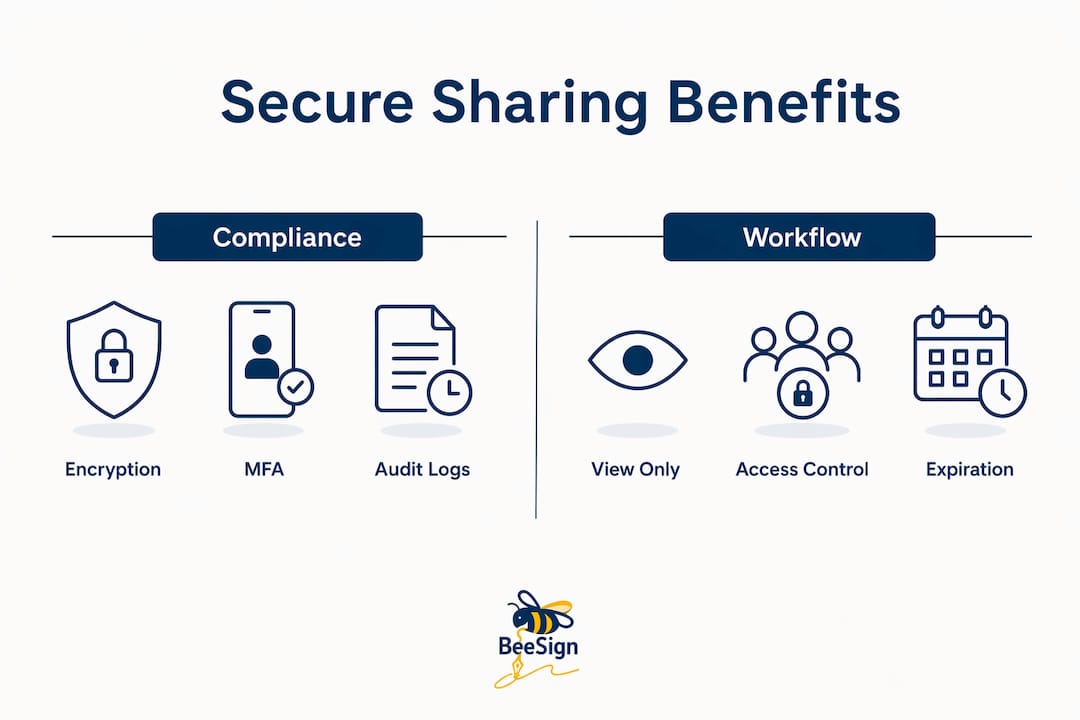
- Encryption: AES-256 at rest and in transit; end-to-end options for the most sensitive documents.
- Identity verification: Signer verification tied to government ID or knowledge-based authentication to strengthen legal defensibility.
- Multi-factor authentication (MFA) and SSO: Required for all internal users; optional but recommended for external signers.
- Role-based access control (RBAC): Least-privilege by default — no one sees more than their role requires.
- Link expiration and revocation: Time-limited access that you can cut off instantly.
- Dynamic watermarking and download controls: Visible deterrents that also create a forensic trail if a document leaks.
- Comprehensive audit logs: Timestamped records of every view, download, and signature event for non-repudiation.
Workflow controls
- Reusable contract templates and automated signing reminders.
- In-app comments and Q&A to keep negotiation inside a controlled environment.
- Behavioral telemetry: page-by-page reading duration and revisit alerts that give listing agents negotiation leverage.
- API integration with CRM and closing systems to eliminate manual re-entry.
| Category | Key Controls | Primary Benefit |
|---|---|---|
| Security | Encryption, MFA, RBAC, audit logs | Compliance and breach prevention |
| Identity | Signer verification, KBA, digital certificates | Legal defensibility of signatures |
| Access management | Link expiration, revocation, watermarking | Leak containment and traceability |
| Workflow | Templates, reminders, behavioral telemetry | Faster closings, fewer disputes |
| Integration | API, CRM connectors, white-label support | Operational efficiency at scale |
Pro Tip: Set “view only” as the default permission for all external links. For wire instructions and government IDs, apply a 7-day expiration; for general transaction documents, 2–4 weeks is a reasonable standard. These two defaults alone eliminate most convenience-driven leaks.
What U.S. Legal and Compliance Requirements Apply?
ABA Model Rule 1.6© is the clearest mandate: lawyers and agents operating under similar professional standards must make reasonable efforts to prevent unauthorized disclosure of client information. In practice, that means encrypted transmission, controlled access, and a log that proves you maintained those controls. Unencrypted email attachments do not satisfy this standard.
The ESIGN Act governs the legal validity of electronic signatures in U.S. commerce. For a signed contract to hold up in a dispute, the platform must capture signer intent, identity, and a timestamped audit record. Platforms that skip identity verification create signatures that are harder to defend. Where transactions involve health data — such as a medical office lease or a healthcare facility sale — HIPAA adds data-handling obligations that require encryption and access logging.
Compliance checklist for vendor evaluation: Confirm the platform provides AES-256 encryption at rest and in transit; maintains immutable, forensic-grade audit logs; supports identity verification at the point of signing; offers data residency controls or a self-hosted option; and includes contract clauses that assign data-processing responsibility clearly. Paste these requirements directly into your RFP.
For legal teams evaluating eSignature platforms, data residency is often the deciding factor. Self-hosted or bring-your-own-cloud deployments let firms keep files and logs inside their own security boundary, which simplifies compliance audits and can reduce per-seat licensing costs in high-volume workflows.
How Long Does Implementation Actually Take?
Realistic timelines prevent stalled rollouts. Here is what a typical brokerage or transaction team should plan for:
- Discovery and policy setup (1–2 weeks): Audit current sharing practices, define permission tiers, and draft an acceptable-use policy.
- Pilot (1–4 weeks): Run one transaction team on the new platform. Measure adoption, identify friction points, and refine default settings.
- Full rollout with training (4–12 weeks): Onboard all agents, run required training sessions, and enforce the new policy in onboarding for new hires.
- API integrations and templates (additional 2–8 weeks): Connect the platform to your CRM, accounting system, or closing software; build reusable contract templates.
Primary cost drivers to budget for:
- Licensing model: per-seat, per-transaction, or white-label flat fee — each suits a different deal volume.
- Integration and data migration from legacy systems.
- Identity verification fees, which vary by verification method and volume.
- Training and change-management support, especially for agents who default to email.
Measuring ROI is straightforward: track time-to-close before and after rollout, count wire fraud incidents, and monitor how often agents bypass the platform. Those three metrics tell you whether adoption is real.
How to Move to Secure Sharing This Week
You do not need a six-month IT project to reduce your exposure on active transactions. Follow these steps in order:
- Choose a platform that enforces identity verification and audit logs. A secure document platform that skips either control is not compliant with ABA Model Rule 1.6© expectations.
- Lock default link permissions to view-only and set expirations. Apply the 7-day rule for wire instructions and IDs immediately — this is a same-day change on most platforms.
- Pilot with one transaction team. Pick a small group, run two or three active deals through the new system, and collect feedback before expanding.
- Create templates and standard operating procedures. Standardized templates cut per-deal setup time and reduce the chance an agent skips a required field.
- Integrate with your CRM and accounting tools where needed. Even a basic API connection eliminates duplicate data entry and keeps the audit trail continuous.
Pro Tip: Train your team to recognize “convenience decisions” — moments when someone emails an attachment because logging in feels like one extra step. The fix is making the secure option faster than email, not lecturing agents about risk.
Pro Tip: For high-risk documents like wire instructions, set expiration to 7 days and require MFA on access. Communicate this policy in writing so clients know what to expect — it also signals professionalism.
Common Threats Targeting Agent Document Sharing
Agents are attractive targets because they handle high-value transactions, time-sensitive wire transfers, and personally identifiable client data — often across multiple parties simultaneously.
Phishing is the most common entry point. A fraudster spoofs a title company or lender email, inserts themselves into an active thread, and substitutes wire instructions. Without a controlled sharing link that requires authenticated access, neither the agent nor the client can verify the document’s origin.
Man-in-the-middle (MITM) attacks intercept unencrypted file transfers in transit. Standard email does not provide end-to-end encryption by default, which means attachments sent over unsecured networks are readable to anyone positioned between sender and recipient.
Insider threats and accidental exposure are underappreciated. According to Mimecast’s 2025 “The State of Human Risk” report, human error surpassed technological flaws as a contributing factor to data breaches in 2024, with 95% of breaches involving human mistakes. An agent who forwards a disclosure to the wrong contact, or leaves a shared folder open after a deal closes, creates the same exposure as a targeted attack.
Platforms that integrate with real estate business software stacks can enforce access controls automatically, reducing the surface area for all three threat types.
Security Policies That Go Beyond the Technology
Technology controls only work when people follow them consistently. A document security framework that covers the full document lifecycle — creation, sharing, storage, and disposal — requires five supporting practices:
Classification: Label every document as public, internal, confidential, or restricted before sharing it. This single habit prevents agents from accidentally applying open-link settings to sensitive disclosures.
Regular access reviews: Role-based permissions are not “set and forget.” When an agent leaves the brokerage or changes teams, their access must be revoked the same day.
Mandatory training: Run security training at onboarding and at least once a year after that. Focus on recognizing phishing attempts, understanding why wire instructions must never travel by plain email, and knowing how to report a suspected breach.
Vendor due diligence: Third-party data breaches are among the most expensive breach types for organizations to recover from, according to the 2024 IBM/Ponemon Cost of a Data Breach Report. Require vendors — title companies, lenders, inspectors — to meet the same sharing standards you enforce internally. A security and compliance review of your tech stack partners is a reasonable annual practice.
Incident response: Define in writing what agents should do if they suspect a document was accessed by the wrong party. A clear, practiced response reduces both damage and liability.
Key Takeaways
Secure document sharing is a legal duty, a liability shield, and a deal-velocity tool that every U.S. agent and brokerage should treat as a core operational requirement, not an optional upgrade.
| Point | Details |
|---|---|
| Legal compliance | ABA Model Rule 1.6© requires reasonable efforts to prevent unauthorized client data disclosure. |
| Non-repudiation | Audit logs create a timestamped, defensible record of every access and signature event. |
| Human error is the top risk | The vast majority of breaches involve human mistakes — training and default controls address the root cause. |
| Implementation is phased | Plan a few weeks for a pilot, several weeks for full rollout, and additional weeks for API integrations. |
| Beesign addresses the checklist | Beesign provides encryption, identity verification, audit logs, link expiration, and white-label deployment in one platform. |
Secure Sharing Is a Fiduciary Duty, Not a Feature
Most articles on this topic treat secure sharing as a technology decision. It is not. It is a professional obligation — and the agents who understand that distinction operate differently from those who treat it as an IT checkbox.
The evidence points in one direction: most breaches in agent workflows come from convenience decisions, not sophisticated attacks. An agent who emails wire instructions because it is faster, or who shares a disclosure via a public link because the client asked for “something easy,” is making a risk trade-off they probably cannot defend to a licensing board or a judge. The technology exists to make the secure path as fast as the insecure one. The remaining variable is whether leadership treats this as policy or as preference.
Auditability deserves more credit than it gets. A comprehensive audit log does not just protect you after something goes wrong — it changes how you negotiate. Knowing a buyer spent 14 minutes on the pricing addendum and returned to it twice the next morning is actionable intelligence. That is the operational upside of secure sharing that most compliance-focused conversations miss entirely.
The platforms that close this gap are the ones worth evaluating. The ones that do not — regardless of price — are a liability.
How Beesign Addresses Every Item on This Checklist
Agents who need encryption, identity verification, audit logs, and workflow automation in one place — without stitching together three separate tools — will find Beesign built for exactly that combination.
Beesign centralizes contract templates, electronic signatures, signer identity verification, and real-time audit logs in a single platform that maps directly to ABA Model Rule 1.6© requirements and ESIGN validity standards. Link expiration, dynamic watermarking, and role-based access control are available out of the box. For brokerages that need brand consistency and data residency, Beesign’s white-label and bring-your-own-cloud options keep files and logs inside your own infrastructure — a meaningful advantage during compliance audits.
Common brokerage workflows — wire instruction protection, disclosure packages with view-only defaults, and signing plus verification sequences — are supported through reusable templates and an API that connects to your existing CRM. The result is faster closings with fewer manual steps and a complete audit trail for every transaction.
Start with a free trial at Beesign to see how the platform handles your active deal types before committing to a full rollout.
Useful Sources and Further Reading
Use these sources to validate claims in procurement reviews, RFPs, or compliance briefings.
- ABA Model Rule 1.6© — practice implications for client confidentiality — explains how encrypted transmission, RBAC, and audit logs satisfy the professional duty to protect client information.
- NHIMG: What Is Secure Sharing? — frames convenience decisions as the primary driver of security incidents and explains how governance controls reduce that risk.
- Alliant National: Stop Risking Your Sensitive Docs — practical defaults for brokers: view-only links, 7-day expirations for IDs and wire instructions, 2–4 weeks for general documents.
- Security Info Watch: Document Security Framework — five-pillar framework (access controls, classification, encryption, monitoring, training) with the IBM/Ponemon and Mimecast data points.
- Coneshare: Secure Real Estate Transactions with Virtual Data Rooms — covers behavioral telemetry, self-hosted VDR deployment, and data-sovereignty considerations for high-volume deal workflows.
- Beesign: Document Signing With Identity Verification — technical and compliance guidance on signer verification methods and how identity checks strengthen signature defensibility.
- Beesign: Security — Encryption in Transit and at Rest — technical detail on Beesign’s encryption, key management, and audit logging architecture.
Recommended
Ready to transform your workflow?
Start using BeeSign today and experience the future of document signing