Enrollment Form Compliance Checklist for Businesses
Ensure your digital processes are compliant with our enrollment form compliance checklist. Capture consent defensibly under major laws today!

Use this enrollment form compliance checklist to make every digital enrollment, consent capture, and e-sign event defensible under ESIGN, TCPA, HIPAA, and major state privacy laws.
Your 10-point checklist:
- Consent checkboxes are unchecked by default with plain-language text
- Granular, separate consent for each seller or communication purpose
- Tamper-evident, timestamped audit trail for every signature event
- Data minimization: every field has a documented business purpose
- Business Associate Agreements (BAAs) executed with all PHI processors
- Encryption in transit (TLS) and at rest (AES-256)
- Role-based access controls (RBAC) and MFA for admin accounts
- Written retention schedule with automated purging triggers
- Identity verification level documented and proportionate to risk
- Enrollment-agreement disclosures formatted conspicuously with pagination
Table of Contents
- What evidence does each checklist item require?
- What does TCPA require for enrollment form consent?
- When does HIPAA apply to enrollment forms, and what controls are required?
- What makes an electronic signature enforceable under the ESIGN Act?
- How should you map data flows and set retention schedules?
- What security controls must every enrollment form system have?
- How do you choose the right identity verification level?
- How do enrollment agreements differ from general applications?
- What is your implementation and testing checklist before launch?
- How do you obtain and document parental consent for minors?
- Key Takeaways
- Why most teams get enrollment form compliance wrong
- Beesign makes the checklist faster to implement
- Useful sources for deeper reading
What evidence does each checklist item require?
Each line above maps to a specific artifact your compliance or QA team must produce and retain.
| Checklist Item | Required Artifact | Minimum Retention |
|---|---|---|
| Consent capture | Timestamped consent text + version ID + checkbox state | 5 years or applicable statute |
| Audit trail | Hashed, append-only log: user ID, IP, device, timestamp | Duration of record + 3 years |
| Data minimization | Field-purpose register with business justification | Lifecycle of form |
| BAAs | Signed BAA copy per processor | 6 years (HIPAA) |
| Encryption | Config screenshots + key rotation logs | Annual review cycle |
| RBAC | Access-control policy + provisioning logs | Duration of employment + 1 year |
| Retention/purging | Retention schedule + deletion confirmation logs | Per schedule |
| Identity verification | Verification method log + evidence stored | Per risk level |
| Enrollment disclosures | Copy of agreement as presented at signing | 5 years minimum |
Best practice form builds log the exact consent text, the form version, and which checkboxes were selected — and those records must be exportable in both human- and machine-readable formats. Automated workflows that generate missing-document alerts are more reliable than manual checklists alone; automated reminders that fire until required documents are uploaded close compliance gaps that manual review misses.
Pro Tip: Version your consent language with a unique ID (e.g., consent_v2.3_2026-03) and store the exact rendered text shown to the user at submission — not just a pointer to the current template. If the language changes after a user signs, you need the version they actually saw.
What does TCPA require for enrollment form consent?
TCPA requires prior express written consent before sending autodialed calls or prerecorded messages to a number collected through a web or mobile enrollment form. Your form must satisfy all four of these conditions:
- Checkbox is unchecked by default
- Consent language is plain, specific, and identifies the seller by name
- A clear statement that consent is not a condition of purchase
- Caller identification is included in the consent text
The FCC’s one-to-one consent rule, effective January 27, 2025, requires that consent name a single seller. You cannot bundle consent for multiple companies or lead buyers into one checkbox. If you distribute leads to third parties, each party needs its own consent checkbox and its own documented consent record.
Document every consent event with: submission timestamp, form version, IP address, checkbox state, and the verbatim consent text rendered at that moment.
Pro Tip: If your enrollment flow routes leads to multiple sellers, redesign the form so each seller has a separate, named checkbox. Bundled consent for lead distribution no longer satisfies TCPA after the January 2025 rule change.
When does HIPAA apply to enrollment forms, and what controls are required?
HIPAA applies the moment your enrollment form collects protected health information (PHI) — a patient’s name paired with a diagnosis, insurance ID, or treatment history qualifies. Three controls must be in place before you launch: data minimization, BAAs with every processor that touches PHI, and role-based access controls.

The HIPAA Privacy Rule requires the minimum-necessary standard: collect only the PHI fields your workflow genuinely requires. Every additional field expands your audit surface. Data minimization is consistently the weakest control in practice — teams add fields “just in case” and never document why.
| Control | Evidence Required for Audit |
|---|---|
| Minimum-necessary data | Field-purpose register |
| BAA execution | Signed BAA per processor, dated |
| Role-based access | Access-control policy + provisioning logs |
| Encryption in transit/at rest | TLS config + AES key management records |
| Immutable audit trail | Hashed, append-only log with user/IP/timestamp |
| Risk analysis | Documented risk assessment, updated annually |
- Assign PHI form access only to roles that need it for their job function.
- Log every view, edit, and download of a PHI record.
- Execute BAAs before any processor receives PHI — not after.
- Store audit logs separately from operational systems.
Pro Tip: Map each enrollment form to the PHI categories it collects and the retention period those categories require. A mental-health intake form has different retention rules than a general wellness enrollment — treat them as separate artifacts in your form inventory.
What makes an electronic signature enforceable under the ESIGN Act?
Three things must be provable: the signer intended to sign, the signature is associated with the specific record, and the record is tamper-evident after signing. Miss any one of these and the signature is vulnerable in discovery.
Capture these fields for every signature event:
- Timestamp (UTC, millisecond precision)
- User ID and authenticated session token
- IP address and device fingerprint
- Signature method (click-to-sign, drawn, typed)
- Document hash (SHA-256 or stronger) at time of signing
- Consent text version shown at signing
- Audit log entry ID (append-only, hashed)
Audit trails for e-signatures must be tamper-evident: hashed, timestamped, and append-only. A log that can be edited after the fact is not audit-trail evidence — it is a liability.
| Audit Field | Legal Purpose |
|---|---|
| Document hash | Proves the record was not altered post-signing |
| Consent text version | Proves what the signer agreed to |
| Timestamp + IP | Establishes time and place of signing |
| Session/user ID | Ties the act to an authenticated identity |
State laws such as New York’s Electronic Signatures and Records Act (ESRA) supplement ESIGN with additional requirements. Your audit trail must be exportable in a format legal counsel can hand to opposing counsel without reformatting. For a deeper look at ESIGN Act compliance, Beesign’s resource library covers the full U.S. legal framework.
How should you map data flows and set retention schedules?
Every enrollment form needs a data map and an automated retention schedule before it goes live. A form without documented data flows is an audit liability from day one.
| Field | Purpose | Processors | Retention Period | Deletion Trigger |
|---|---|---|---|---|
| Name + email | Account creation | CRM, email platform | 7 years | Account closure + — |
| Consent record | TCPA/legal proof | Compliance DB | 5 years | Statutory limit reached |
| Signed document | Contract record | Document storage | 7 years | Contract expiry + 5 years |
| Uploaded ID | Identity proofing | ID verification vendor | — | Verification complete |
| Audit log | Legal evidence | Immutable log store | 7 years | Per retention policy |
Compliance is a lifecycle process: map each form to the data it captures, enforce retention and purging, and maintain evidence of each lifecycle event. For practical guidance on enrollment workflow lifecycle management, Beesign’s 2026 workflow guide covers data-flow documentation in detail.
Pro Tip: Automate deletion with a scheduled job that checks retention triggers nightly. Store deletion confirmation logs — during an audit, you need to prove data was purged, not just that a policy existed.
Cross-platform consistency matters too. If your enrollment form runs on web, mobile, and embedded widgets, the same consent version, data-flow path, and logging hooks must fire on every surface. Spot-check each platform quarterly.
What security controls must every enrollment form system have?
Three baseline controls must be demonstrable before any form goes live: encryption, RBAC, and immutable logging. Each must be evidenced with configuration records, not just policy documents.
- TLS 1.2 or higher on all form endpoints (verify with SSL Labs scan)
- AES-256 encryption at rest, with KMS-managed key rotation
- MFA enforced for all admin and compliance-team accounts
- Least-privilege RBAC: no user has broader access than their role requires
- Session timeouts and re-authentication for sensitive actions
- Vulnerability scans run quarterly; results retained as audit evidence
- Append-only, hashed log storage isolated from the operational database
Pro Tip: Store audit logs in a separate system with append-only write permissions. If your operational database is compromised, logs stored in the same system are suspect. Hashed, off-system log storage is the standard legal teams expect when they ask for tamper evidence.
How do you choose the right identity verification level?
Choose a verification level proportionate to the risk of the transaction, and document the rationale in writing. A low-stakes newsletter enrollment does not need the same identity proofing as a financial services enrollment agreement.
| Risk Level | Recommended Verification | Evidence to Store |
|---|---|---|
| Low | Email confirmation link | Email address + confirmation timestamp |
| Medium | SMS OTP or knowledge-based authentication (KBA) | Phone number, OTP log, KBA question/answer hash |
| High | Government ID check + liveness detection | ID image (encrypted), biometric match score, device fingerprint |
- Low assurance: email link confirmation. Pitfall — shared email accounts undermine uniqueness.
- Medium assurance: SMS OTP or KBA. Pitfall — phone number portability means OTP alone is not sufficient for high-value transactions.
- High assurance: ID document scan plus liveness check. Bind the verification record to the signed document by including the verification event ID in the audit trail.
Link verification evidence directly to the signed record. A signature without a bound identity record is harder to defend in a dispute. For guidance on choosing compliant signature software with built-in identity verification, Beesign’s evaluation guide covers vendor criteria in detail.
Pro Tip: Document why you chose a given verification level for each form type. “We assessed the transaction risk as medium because the form initiates a paid subscription” is the kind of rationale that satisfies a regulator.
How do enrollment agreements differ from general applications?
Treat enrollment agreements as legally distinct documents. They carry greater regulatory scrutiny than general applications and require explicit disclosures, specific formatting, and a signed acknowledgment that the signer understood the terms.
Required elements for a compliant enrollment agreement:
- Total charges stated in underlined capital letters on the same page as the signature line
- Cancellation and refund policy, including the deadline to cancel
- Statement that the agreement is legally binding when signed
- Pagination (e.g., “Page 1 of 4”) on every page
- Delivery of an exact copy to the signer immediately after execution
- Statement of authorization above the signature line
Tennessee’s enrollment agreement rules require pagination and stand-alone disclosure statements — a practical example of how state rules add requirements on top of federal minimums. California’s BPPE checklist similarly requires total charges in underlined capital letters and a conspicuous cancellation notice.
Pro Tip: Present financial data in a summary table near the signature line. Regulators and courts look for whether a signer could have understood their total financial obligation before signing — a buried fee schedule buried in paragraph 14 does not meet that standard.
What is your implementation and testing checklist before launch?
Use a launch checklist that ties every design change to an automated test and a retained evidence artifact.
- Map data flows — document every field, its purpose, and every processor that receives it.
- Place consent checkboxes — unchecked by default, above the submit button, with version-tagged language.
- Enable logging hooks — verify that every form submission writes a timestamped, hashed audit entry.
- Gate BAA execution — block PHI form access until a BAA is on file for each processor.
- Configure retention automation — set deletion triggers and verify with a test purge in staging.
- Run a pre-launch privacy check — verify data minimization, HTTPS, consent defaults, and privacy policy placement.
- Execute end-to-end QA flows — submit test records and confirm audit log entries are complete and exportable.
- Test evidence export — export the audit trail in both PDF and machine-readable format and confirm legal counsel can read it.
- Schedule periodic re-testing — calendar a quarterly spot-check and an annual full audit.
Before sign-off, QA must retain: a completed data-flow map, a sample audit log export, deletion-test confirmation, BAA copies for all PHI processors, and a screenshot of the consent checkbox in its default (unchecked) state.
Pro Tip: Run a pre-launch compliance checklist as a formal ticket in your project tracker, not an informal walkthrough. Each item should have an owner, an acceptance criterion, and a linked artifact. That ticket becomes audit evidence.
For tracking compliance documents across multiple forms and workflows, checklist-based tracking tools with automated reminders reduce the risk of missing artifacts before a deadline.
How do you obtain and document parental consent for minors?
When an enrollment form may be completed by or on behalf of a minor, the Children’s Online Privacy Protection Act (COPPA) applies to users under 13, and many state laws extend similar protections to users under 16 or 18. The process has three steps.
First, verify the user’s age before collecting any data. An age gate at the start of the form — asking for date of birth — is the minimum. If the user is under the applicable threshold, route them to a parental consent flow rather than the standard form.
Second, obtain verifiable parental consent. COPPA’s “verifiable parental consent” standard requires more than a checkbox. Acceptable methods include a signed consent form returned by email or mail, a credit card transaction (as a verification mechanism, not a charge), or a video call with a parent. Store the method used and the evidence collected.
Third, document everything. Retain: the age-gate response, the parental consent method used, the consent artifact (signed form, transaction record, or call log), the date, and the parent’s contact information. If the enrollment agreement requires a parent or guardian signature, that signature line must appear alongside the minor’s, with a clear statement that the guardian is signing on the minor’s behalf. Maryland’s private career school enrollment checklist explicitly requires a parent or guardian signature when the student is a minor.
Key Takeaways
A compliant enrollment form requires documented consent, a tamper-evident audit trail, data minimization across every field, and automated retention — all in place before the form goes live.
| Point | Details |
|---|---|
| Consent must be documented | Store the exact consent text, version ID, checkbox state, and submission timestamp for every user. |
| Audit trails must be tamper-evident | Use hashed, append-only logs that record user ID, IP, device, and document hash at signing. |
| Data minimization reduces audit risk | Every form field needs a documented business purpose; fields without one should be removed. |
| Enrollment agreements need extra controls | Require pagination, conspicuous financial disclosures, and a signed authorization statement above the signature line. |
| Beesign maps directly to these controls | Beesign’s platform provides immutable audit trails, identity verification, BAA support, and retention automation for compliant enrollment workflows. |
Why most teams get enrollment form compliance wrong
The compliance failures I see most often are not about missing checkboxes or wrong encryption settings. They are about treating compliance as a one-time launch task rather than a lifecycle discipline.
Teams build a form, check the obvious boxes — HTTPS, a privacy policy link, a consent checkbox — and ship it. Six months later, the consent language changes, but the version stored in the audit log still points to the old template. A year after that, a regulator asks for the exact text a specific user saw on a specific date. The team cannot produce it. That gap is not a technical failure. It is a process failure.
The second pattern is data accumulation without justification. Forms grow over time. A field added for a campaign never gets removed. Nobody documents why it exists. When an auditor asks for the business purpose of every field, the team scrambles. Data minimization is consistently the weakest control in practice — not because it is technically hard, but because it requires discipline to maintain.
The third pattern is identity verification that is not bound to the signed record. A team implements SMS OTP, stores the verification log in one system, and stores the signed document in another. When a dispute arises, they cannot prove the person who verified their phone number is the same person who signed. Binding verification evidence to the audit trail entry for the signature event is the fix — and it has to be built into the workflow from the start.
The practical lesson: treat your enrollment form inventory as a governed asset. Version it, map its data flows, automate its retention, and test its audit exports on a schedule. Compliance that lives only in a policy document is not compliance.
Beesign makes the checklist faster to implement
Compliance work moves faster when your e-signature platform already handles the infrastructure. Beesign provides the audit trail, identity verification, BAA support, and retention automation that this checklist requires — so your team builds the workflow logic, not the compliance plumbing from scratch.
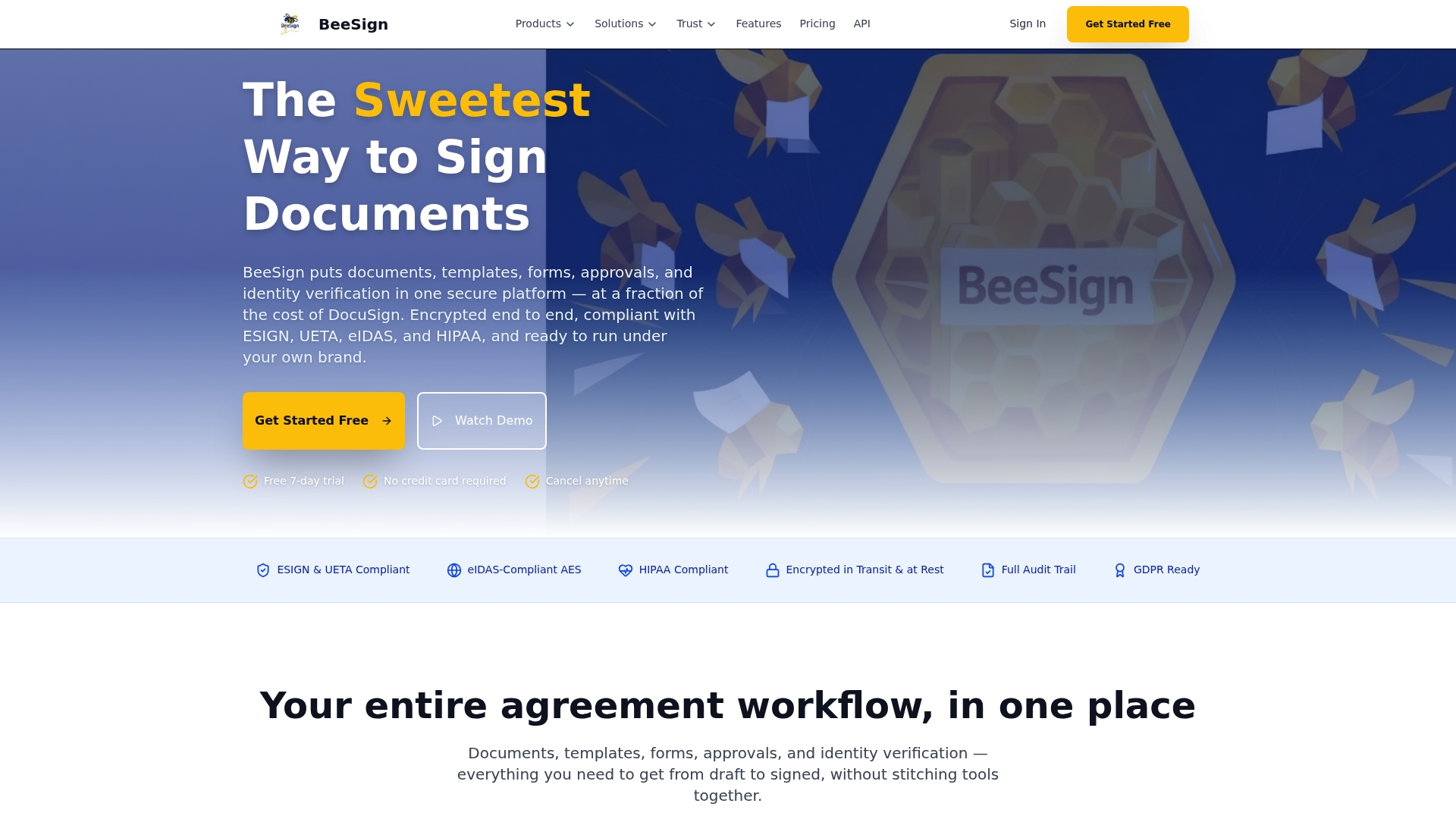
Beesign’s immutable audit trail captures the document hash, consent text version, user ID, IP address, and timestamp for every signature event — the exact fields your legal team needs for discovery. Its identity verification layer lets you configure low-, medium-, or high-assurance proofing per form type, with verification evidence bound directly to the signed record. For PHI workflows, Beesign supports BAA execution as part of onboarding. The white-label and API capabilities let enterprise teams embed compliant signing directly into their own branded enrollment flows without rebuilding the compliance layer.
Ready to run a pilot? Visit Beesign’s platform to see how its features map to your checklist requirements and get your first compliant enrollment workflow live.
Useful sources for deeper reading
These primary references are worth saving with your project artifacts for audit readiness.
- TCPA Lead Form Compliance Review Worksheet — Covers unchecked-by-default requirements, one-to-one consent, and consent recordkeeping for web forms.
- HIPAA Privacy Rule Compliance Checklist for Electronic Forms and E-Signatures — Minimum-necessary standard, BAAs, audit trail requirements, and e-signature enforceability under HIPAA.
- Tennessee Enrollment Agreement Rules (Tenn. Comp. R. & Regs. 1540-01-02-.13) — State-level pagination and disclosure requirements for enrollment agreements.
- California BPPE Enrollment Agreement Checklist — Federal and state minimum requirements for enrollment agreement content, disclosures, and formatting.
- Data Privacy Compliant Forms — Pre-launch checklist covering consent defaults, HTTPS, retention settings, and exportable consent logs.
- GDPR Compliance for Online Forms — Data minimization and field-level justification practices applicable to U.S. privacy frameworks.
Recommended
Ready to transform your workflow?
Start using BeeSign today and experience the future of document signing