Guardian Signature Collection Best Practices in 2026
Master the guardian signature collection best practices for 2026. Ensure compliance, secure signatures, and streamline workflows for success.

Effective guardian signature collection best practices come down to three non-negotiable pillars: legal compliance, technical controls, and documented workflows. Whether you’re managing petition circulation, volunteer agreements, or digital contracts, the same principles apply. Get these right, and your signatures hold up under scrutiny. Miss one, and the entire collection can be invalidated.
Here’s what every organization needs to get right:
- Circulator presence: Every signature must be witnessed in person by the circulator, not just nearby.
- Version-controlled policies: Signing policies must be documented, versioned, and accessible to all staff.
- Identity verification: Confirm each signer’s identity through email, SMS, or secure login before signing.
- Audit trails: Log every access, modification, and signing event with timestamps.
- Compliance alignment: Your workflow must satisfy ESIGN, eIDAS, or HIPAA depending on your industry.
Table of Contents
- What legal requirements actually govern secure signature collection?
- How do you prevent the most common failures in digital signature workflows?
- How to implement a secure and efficient digital contract signing workflow
- How does Guardian Signature Collection integrate with your existing business systems?
- How Beesign puts these best practices into practice
- Key Takeaways
- Why the “technical” and “legal” split is a false divide
What legal requirements actually govern secure signature collection?
The legal foundation for valid signature collection is stricter than most organizations realize. Colorado law requires that every signature be collected in the physical presence of the circulator, who must personally witness each signing. Being in the same room or nearby does not satisfy this requirement. One circulator per petition section is the rule, not a suggestion.
The circulator’s role goes further than simply being present. That role extends to acting as a witness to both signer identity and signing intent, which is why physical presence is legally required to validate authenticity. Circulators must also verify that each signer is eligible, meaning they are a registered elector qualified to vote on the relevant measure.
Affidavit timing is a critical procedural detail that trips up many organizations. Pre-signing an affidavit before collecting the last signature on the sheet invalidates the entire petition. The circulator must sign the affidavit only after the final signature is gathered, because signing early falsely affirms that all signatures were witnessed when they were not.
The consequences of procedural errors are concrete. Failure to properly disclose a circulator in Utah results in rejection of all associated signature packets within three calendar days if the information is not corrected. That enforcement standard reflects how seriously jurisdictions treat circulator accountability.
Key procedural requirements to build into your workflow:
- Circulators must be physically present for every signature, without exception.
- Signer eligibility must be confirmed before collecting the signature.
- Both lines of each signature line must be fully completed.
- Corrections require the signer to cross out the error and initial the change.
- Affidavits must be signed only after the last signature on the attached sheet is collected.
How do you prevent the most common failures in digital signature workflows?
The most frequent failure point in digital signature workflows is inadequate version control and incomplete documentation of signing policies. When policies change but documentation doesn’t keep pace, circulators and staff operate on outdated procedures, and errors follow.
Schema-driven development addresses this directly. Best practices for the Guardian schema cycle include Excel-first design to map parameters and validation rules before importing into the system, incremental development from foundational architecture outward, and testing with default values before deployment. Semantic versioning with backward compatibility and deprecation notices keeps migration paths clear.

Identity verification is the other major control point. Digital signature solutions must integrate robust verification methods such as email confirmation, SMS codes, or secure login credentials to confirm signer identity and establish non-repudiation. Without this, a signature can be challenged on the grounds that the signer’s identity was never confirmed.
Technical controls to implement across your workflow:
- Version control: Use semantic versioning for all signing policy documents, with change history and deprecation notices.
- Schema validation: Test all schema logic with default and edge-case values before publishing.
- Identity verification: Require email or SMS confirmation, or secure login, for every signer. See signer identity verification for technology-specific guidance.
- Audit trails: Log every access and modification event with user ID and timestamp.
- Access controls: Limit stored agreement access to authorized personnel only.
- Encryption: Encrypt agreements both in transit and at rest.
- Backups: Schedule regular backups and test restoration procedures.
How to implement a secure and efficient digital contract signing workflow
Start with a written signing policy before you configure any platform. The policy should define who can act as a circulator, what identity verification is required, how corrections are handled, and when affidavits must be signed. Train every circulator on the policy before they collect a single signature.
Pro Tip: Build your signing policy as a versioned document with a change log. Every time the policy updates, increment the version number and notify all circulators in writing. This creates a defensible record that staff were informed of current requirements.
Choose a platform that enforces your policy technically, not just procedurally. The platform should require identity verification at the point of signing, generate a tamper-evident audit trail automatically, and store agreements on encrypted infrastructure. Compliance with ESIGN and UETA is the baseline for US-based organizations; HIPAA applies if you handle health information, and eIDAS governs cross-border European transactions.
Your eSignature compliance checklist should cover these implementation steps:
- Define and document signing policies with version control.
- Train all circulators and staff before deployment.
- Configure identity verification (email, SMS, or login) as a required step.
- Enable automatic audit trail generation for every signing event.
- Set data retention periods aligned with your legal obligations.
- Schedule quarterly policy reviews and update training accordingly.
- Establish a support channel for staff encountering workflow issues.
Continuous improvement matters as much as the initial setup. Review your audit logs regularly to spot patterns, whether that’s signers abandoning the process at a particular step or circulators skipping verification. Those patterns tell you where the workflow needs adjustment before a compliance issue surfaces.
How does Guardian Signature Collection integrate with your existing business systems?
Integrating your signature collection workflow with existing CRM and document management systems eliminates manual handoffs and reduces the risk of records falling out of sync. The key is choosing a platform with a well-documented API that maps to your current data model.
A CRM integration typically works by triggering a signing request automatically when a deal or record reaches a defined stage. Once the document is signed, the completed agreement and its audit trail write back to the CRM record without manual intervention. This keeps your sales or case management data current and creates a single source of truth for each signed agreement. For teams managing workflow automation, connecting signature events to downstream triggers, such as onboarding tasks or payment processing, compounds the efficiency gain.
Document management integration follows a similar pattern. Signed agreements route to the correct folder or repository automatically, tagged with metadata like signer name, date, and document type. Version control at the document management layer complements the policy versioning described earlier, so you can always retrieve the exact policy version that was in effect when a signature was collected.
For organizations with compliance obligations, a compliance center integration adds another layer: automated checks that flag documents missing required fields or signatures before they are submitted. This is particularly valuable for HIPAA-covered entities, where an incomplete record can trigger an audit finding.
When evaluating integration depth, prioritize these capabilities:
- Bidirectional data sync between your signature platform and CRM or document management system.
- Webhook or API event triggers that fire on signing completion, rejection, or expiration.
- Metadata tagging so every signed document is searchable by signer, date, and document type.
- Role-based access controls that carry over from your existing systems.
- Audit log export in formats your compliance team can review.
How Beesign puts these best practices into practice
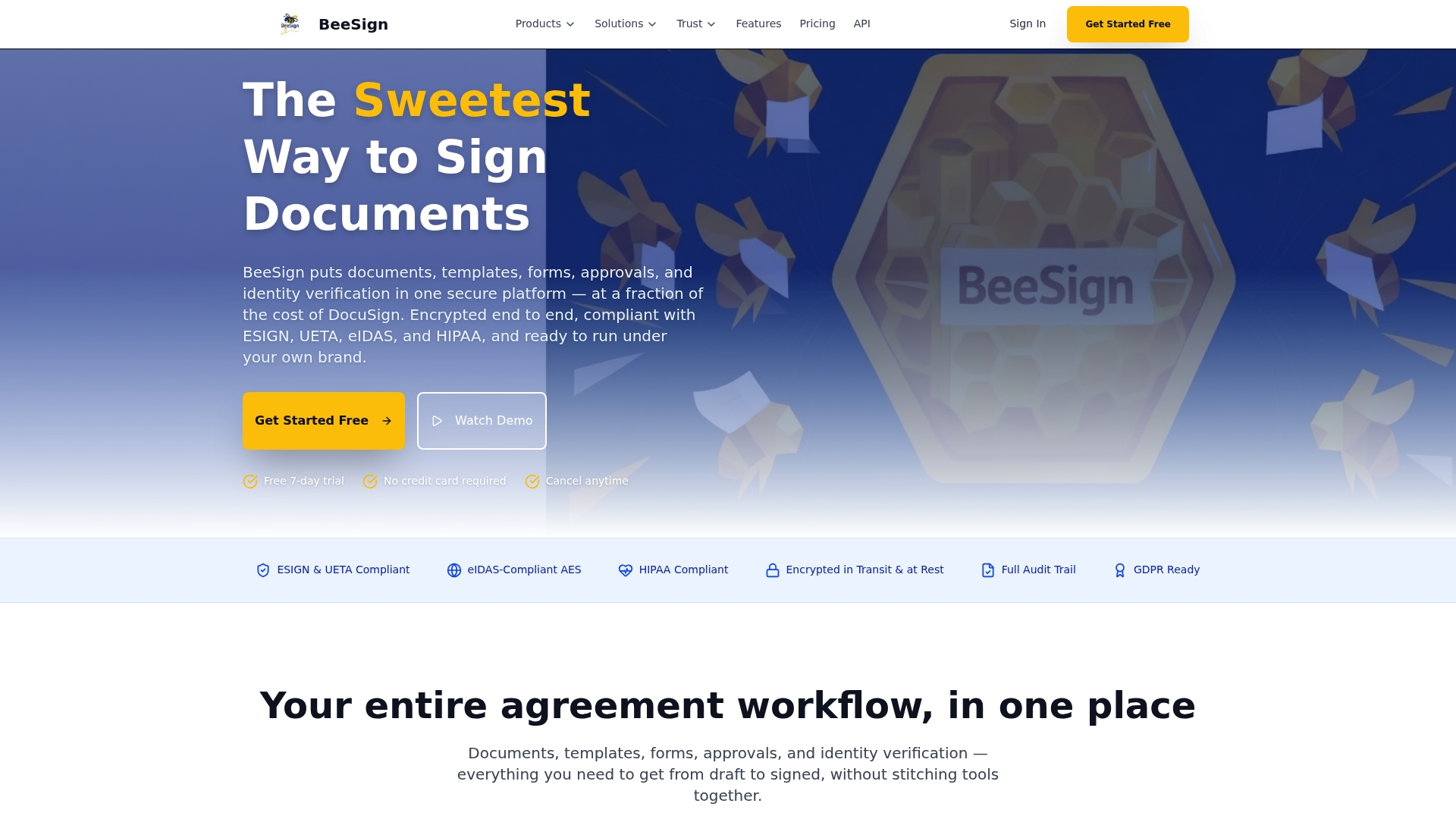
Beesign centralizes contracts, templates, and identity verification in one platform, which means the technical controls described throughout this article are built in rather than bolted on. Every signing event generates a tamper-evident audit trail automatically. Identity verification via email or SMS is configurable as a required step, and all agreements are encrypted in transit and at rest.
Compliance coverage spans ESIGN, eIDAS, and HIPAA, making Beesign a defensible choice for organizations in regulated industries. The electronic signature platform supports real-time tracking so you can see exactly where each document is in the signing process, and the API lets you automate signing requests, status updates, and record-keeping without manual intervention.
For organizations that need to run the service under their own brand, Beesign’s white-label solution supports custom domains and cloud storage within your own infrastructure. That keeps data sovereignty intact and simplifies compliance documentation. Whether you’re a startup closing your first contracts or an enterprise managing thousands of agreements, Beesign gives you the controls to do it correctly from day one.
Key Takeaways
Secure guardian signature collection requires circulator presence, documented policies, identity verification, and a compliant digital platform working together.
| Point | Details |
|---|---|
| Circulator presence is legally required | Physical witnessing of each signature is mandatory; being nearby does not satisfy the legal standard. |
| Affidavit timing determines validity | Sign the affidavit only after the last signature is collected, or the entire petition is invalidated. |
| Version control prevents workflow failures | Inadequate version control and incomplete policy documentation are the most common failure points in digital signing. |
| Identity verification establishes non-repudiation | Email, SMS, or secure login confirmation must be required at the point of signing to prevent fraud. |
| Audit trails support legal defensibility | Logging every access and signing event with timestamps protects organizations in compliance reviews. |
Why the “technical” and “legal” split is a false divide
Most organizations treat legal compliance and technical controls as separate workstreams, assigning one to legal counsel and the other to IT. That split is where problems start. The circulator affidavit timing rule, for example, is a legal requirement, but enforcing it reliably requires a technical control: a system that prevents affidavit submission until the final signature field is completed. Without that technical lock, the legal requirement depends entirely on human memory under pressure.
The same logic applies to version control. Documenting your signing policy is a procedural discipline, but making that documentation accessible, versioned, and tied to staff training is a systems problem. Organizations that treat these as one integrated challenge, rather than two parallel tracks, build workflows that are both legally sound and operationally consistent. The platforms that support this integration, where policy enforcement is built into the signing flow rather than layered on top of it, are the ones worth building your workflow around.
Recommended
Ready to transform your workflow?
Start using BeeSign today and experience the future of document signing