Identity Verification in eSigning: A 2026 Security Guide
Discover the role of identity verification in eSigning for secure transactions. Ensure legally binding signatures and safeguard your business today.

Identity verification in eSigning is defined as the process of confirming a signer’s real-world identity before a digital signature is legally bound to a document. This confirmation is the foundation of every secure electronic signing workflow. Without it, a signature is just a click. The role of identity verification in eSigning extends beyond fraud prevention. It determines whether a signed document holds up in court, satisfies regulators, and protects your business from liability. Frameworks like NIST 800-63-4, eIDAS, and FINRA guidance all treat verified identity as a prerequisite for enforceable digital signatures. The validity of an eSignature depends directly on how well the signer’s identity was established at the time of signing.
What is the role of identity verification in eSigning?
Identity verification in eSigning serves one core function: linking a specific, confirmed person to a specific signature event. That link is what gives the signed document legal weight. A signature without verified identity is legally equivalent to an anonymous mark.

The industry term for this process is “identity assurance,” and it operates on a spectrum. Low-assurance methods, such as email confirmation, work for routine internal documents. High-assurance methods, including biometric checks and government ID validation, are required for financial agreements, healthcare records, and cross-border contracts. The digital economy is projected to reach 30% of global GDP by 2030, which means the volume of regulated digital transactions requiring verified identity will grow substantially. Businesses that treat identity verification as optional today will face compliance gaps tomorrow.
The importance of identity verification also shows up in non-repudiation. Non-repudiation means a signer cannot later deny having signed a document. Achieving non-repudiation requires proof that the signer was who they claimed to be, which only a verified identity chain can provide.
How does identity verification strengthen eSigning security?
Identity verification prevents fraud by making it difficult for bad actors to impersonate a legitimate signer. A single check, such as a password or email link, is no longer sufficient. Layered verification is now recommended to combat synthetic identities and AI-generated deepfakes. That recommendation reflects a real shift in threat sophistication.
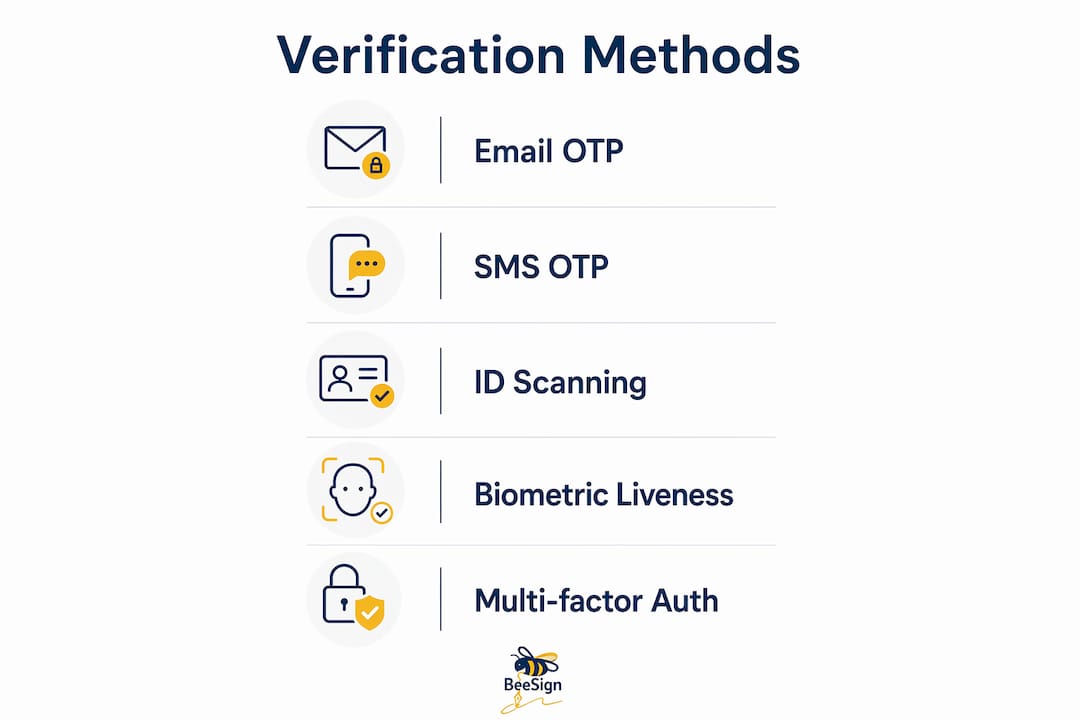
Effective esigning security measures combine multiple signals rather than relying on one method. The most common combination includes:
- Document validation: Optical character recognition (OCR) scans a government-issued ID and checks it against known document templates and security features.
- Biometric liveness detection: A real-time selfie or video confirms the person presenting the ID is physically present, not a photo or deepfake.
- Multifactor authentication (MFA): A one-time password (OTP) sent to a registered phone or email adds a second confirmation layer.
- Contextual signals: Device fingerprint, IP geolocation, and behavioral patterns flag anomalies that documents alone cannot catch.
Synthetic identity fraud, where criminals combine real and fabricated data to create a plausible fake identity, defeats any single-signal check. A system that cross-references document data, a live biometric, and a device fingerprint simultaneously makes synthetic fraud exponentially harder. AI models now detect document anomalies, classify document types, and perform facial matching automatically, which speeds decisions without sacrificing accuracy.
Pro Tip: Match verification strength to document risk. A low-value internal approval needs email confirmation. A high-value financial contract or healthcare consent form requires biometric liveness and government ID validation. Applying maximum friction to every signer creates unnecessary friction and abandonment.
Why does regulatory compliance require identity verification?
Regulatory frameworks treat identity verification as a legal prerequisite, not a best practice. NIST 800-63-4 defines identity assurance levels (IAL) that map directly to the strength of verification required for different transaction types. eIDAS, the European Union’s electronic signature regulation, requires qualified electronic signatures (QES) to be backed by a certificate from an accredited trust service provider. Qualified electronic signatures backed by certificate authorities carry the legal recognition needed for cross-border and regulated workflows.
FINRA, which governs financial industry conduct in the United States, requires high-assurance identity verification for account-level actions. FINRA’s guidance references over 70 nationwide locations for rare cases requiring in-person verification. That detail illustrates how seriously regulated industries treat identity assurance.
The table below maps common regulatory frameworks to their identity verification requirements and typical eSigning use cases.
| Framework | Verification requirement | Typical use case |
|---|---|---|
| NIST 800-63-4 (IAL2) | Remote identity proofing with document and biometric check | Government services, financial onboarding |
| eIDAS (QES) | Certificate-based identity from accredited trust service provider | Cross-border contracts, legal agreements |
| FINRA guidance | MFA plus in-person option for high-risk actions | Brokerage account changes, financial disclosures |
| HIPAA | Identity confirmation tied to access controls and audit logs | Healthcare consent forms, patient records |
| ESIGN Act | Reasonable assurance of signer identity | General commercial agreements |
Audit trails are the compliance mechanism that ties identity verification to the signed document. A proper audit trail records the assurance level used, the document hash, the timestamp, and the sequence of events. Simple timestamps and IP addresses are often insufficient in high-stakes disputes. Courts and regulators expect a complete evidence bundle, not just a log entry.
Best practices for integrating identity verification into eSigning systems
A well-designed identity verification workflow follows a clear sequence. Each step must connect to the next without gaps, because fragmented data between the verification event and the signature event breaks the chain of custody.
- Capture the document. The signer submits a government-issued ID. OCR extracts the data fields and checks them against known document formats.
- Validate the document. The system checks security features, expiration dates, and cross-references the extracted data against authoritative databases where available.
- Perform biometric liveness. The signer completes a real-time selfie or video prompt. The system compares the live image to the ID photo using facial matching algorithms.
- Apply contextual risk scoring. Device fingerprint, IP address, and behavioral signals are scored. High-risk signals trigger additional checks or escalate to manual review.
- Route the outcome. Multi-signal outcomes are approved, rejected, or escalated for human review based on alignment and risk tolerance. Auto-approval only fires when all signals align.
- Bind the verification to the document. The verified identity record, including assurance level and document hash, is attached to the signing event before the signature is applied.
- Preserve the audit trail. A tamper-evident log captures every event in sequence, from identity check initiation through final signature, with cryptographic integrity protection.
Fragmented data between signature and identity verification makes reconstructing the chain of custody nearly impossible. This is the most common failure point in enterprise eSigning deployments. Teams often implement identity verification and document signing as separate systems, then struggle to produce a unified evidence bundle when a dispute arises.
Pro Tip: Design your audit trail as a single, tamper-evident pipeline from identity check to signed document. Every artifact, including the ID image, biometric result, assurance level, and document hash, should live in one linked record. This is what courts and regulators actually examine.
Comparing identity verification methods for eSigning
Different verification methods carry different assurance levels and suit different transaction types. Choosing the right method means balancing security, regulatory requirements, and the signer experience.
Organizations should map verification methods to document risk levels, reserving strong checks for high-value agreements. Applying the same method to every document wastes resources and frustrates signers on low-risk transactions.
| Method | Assurance level | Best for | Key limitation |
|---|---|---|---|
| Email or SMS OTP | Low | Internal approvals, low-risk agreements | Vulnerable to SIM swap and account takeover |
| Knowledge-based authentication (KBA) | Low to medium | Consumer financial onboarding | Data breaches have weakened KBA reliability |
| Government ID scan with OCR | Medium | Commercial contracts, HR documents | Requires quality image capture; no liveness check alone |
| Biometric liveness with facial match | High | Financial agreements, healthcare, legal | Requires camera access; higher friction for signers |
| Certificate-based identity (QES) | Very high | Cross-border contracts, regulated industries | Requires pre-enrollment with a trust service provider |
| MFA combined with document and biometric | High | Regulated financial and healthcare workflows | Most thorough but adds steps to the signing process |
The OTP-verified electronic signature is a practical middle ground for many commercial workflows. It adds a meaningful second factor without requiring biometric hardware. For higher-risk transactions, combining OTP with a document scan and biometric liveness delivers the assurance level that NIST 800-63-4 IAL2 and eIDAS advanced electronic signature (AES) standards require.
Key Takeaways
Identity verification is the legal and technical foundation of every enforceable electronic signature, and the method you choose must match the risk level of the transaction.
| Point | Details |
|---|---|
| Verification anchors legal enforceability | A signature without verified identity cannot achieve non-repudiation in regulated or disputed transactions. |
| Layered signals defeat modern fraud | Combining document, biometric, and contextual checks stops synthetic identity fraud that single-method checks miss. |
| Regulations set the floor, not the ceiling | NIST 800-63-4, eIDAS, FINRA, and HIPAA each define minimum verification requirements for their regulated transaction types. |
| Audit trails must be unified | Fragmented verification and signing records break chain of custody; every artifact must link to one tamper-evident log. |
| Match method to risk level | Low-risk documents need email OTP; high-value contracts require biometric liveness and government ID validation. |
Signing is an identity transaction, not a button click
The biggest mistake I see organizations make is treating the signature event as the main event. It is not. The signature is the output. The identity transaction is what actually matters, and most businesses have not built their workflows to reflect that.
I have reviewed eSigning deployments where the identity check happened in one system, the document signing happened in another, and the audit log lived in a third. When a dispute arose, no one could produce a coherent evidence bundle. The verification data existed, but it was not linked to the specific signing event in a way that held up. That is a solvable problem, but only if you treat document signing with identity verification as a single integrated lifecycle from the start.
The emerging threat I watch most closely is AI-generated deepfakes used to defeat biometric liveness checks. The technology to generate convincing real-time video of a fake person is now accessible to non-specialists. Liveness detection vendors are updating their models continuously, but the arms race is real. Organizations that rely on a single biometric check without contextual risk scoring are already behind.
The practical response is to treat identity verification as a continuous process, not a one-time gate. That means incorporating identity and access management (IAM) signals, monitoring for anomalies after the signature event, and revisiting your verification methods annually as threat patterns evolve. Signing workflows that were adequate in 2024 may not meet the bar in 2026.
— Mustafa Abusharkh
Beesign’s approach to secure, compliant eSigning
Businesses that need identity verification built into their signing workflow, not bolted on afterward, have a direct path forward with Beesign.
Beesign’s eIDAS-compliant identity verification product integrates document scanning, biometric liveness detection, and multifactor authentication into a single signing lifecycle. Every verification event is captured in a tamper-evident audit trail that links directly to the signed document, giving you the evidence bundle regulators and courts expect. Beesign supports ESIGN, eIDAS, and HIPAA compliance requirements, and its white-label option lets your business run the entire workflow under your own brand and infrastructure. If you are ready to build a signing process that holds up under scrutiny, start with Beesign.
FAQ
What is identity verification in eSigning?
Identity verification in eSigning is the process of confirming a signer’s real-world identity before binding a digital signature to a document. It is the mechanism that makes electronic signatures legally enforceable and fraud-resistant.
Is identity verification necessary for e-signing?
Identity verification is legally required for regulated transaction types under frameworks like eIDAS, NIST 800-63-4, FINRA, and HIPAA. For general commercial agreements under the ESIGN Act, it is a best practice that protects enforceability.
What are the most secure identity verification methods for eSigning?
The most secure methods combine government ID scanning with OCR, biometric liveness detection, and multifactor authentication. Certificate-based identity backed by an accredited trust service provider offers the highest assurance level for cross-border and regulated workflows.
How does an audit trail support identity verification in eSigning?
A proper audit trail records the identity assurance level, document hash, biometric result, and event sequence in a tamper-evident log. Simple timestamps and IP addresses are insufficient for high-stakes disputes; courts expect a complete, linked evidence bundle.
How do I choose the right verification method for my documents?
Map your verification method to the risk level of the transaction. Low-risk internal documents need email or OTP confirmation. High-value financial, legal, or healthcare agreements require biometric liveness and government ID validation at a minimum.
Recommended
Ready to transform your workflow?
Start using BeeSign today and experience the future of document signing