Compliance First KYC for eSignature: 3 Team Checklist for U.S. Teams
Engineer friendly, compliance first KYC patterns for eSignature. Learn pre sign verification flows, ESIGN/§7001 impacts, and the three team checklist.

For regulated or high-value transactions, yes: identity-verified eSignatures should be required before you finalize the signature, not after. The reasoning is simple. ESIGN and U.S. Code §7001 make electronic signatures legally valid, but validity isn’t the same as defensibility. A verified identity, tied to a tamper-evident audit trail, is what actually holds up when someone disputes the signature later.
TL;DR:
- Identity verification should occur before signing for high-value or regulated transactions to ensure defensibility and prevent fraud.
- KYC-linked eSignatures combine ID evidence with audit trails, providing stronger attribution and compliance proof in case of disputes.
- Verification methods should be matched to risk levels, using biometric checks and AML screening for high-stakes documents, while lighter methods suffice for low-risk agreements.
- Proper placement of KYC checks involves classifying risk, delaying sign enablement during verification, and routing ambiguous cases for manual review.
- A tamper-evident audit trail must log verification results, timestamps, device info, and document hashes to ensure legal integrity in disputes.
Table of Contents
- What Is a KYC-Linked eSignature, and When Do You Need One?
- How Does ESIGN and U.S. Code §7001 Apply to KYC-Backed Signatures?
- Where Should KYC Checks Sit in the Signing Flow?
- Which Identity Verification Methods Pair Best With eSignatures?
- What Belongs in the Audit Trail for a KYC-Verified Signature?
- How Do You Implement KYC-Integrated Signing? A Checklist
- Balancing Defensibility and Signer Experience
- BeeSign: Built for KYC-Linked Signing From the Ground Up
- Sources
What Is a KYC-Linked eSignature, and When Do You Need One?
A KYC-linked eSignature pairs the signed record with identity evidence, a scanned ID, a face-match result, an AML screening outcome, all logged in the same audit trail as the signature event. That combination does two things a plain typed signature can’t: it strengthens attribution (proving who actually signed) and gives you a documented compliance posture if a regulator or opposing counsel ever asks.
You don’t need this for every document. But certain transaction types practically demand it:
- Opening a financial account or credit line
- Signing loan, mortgage, or refinancing documents
- Executing real estate purchase agreements
- Finalizing high-value B2B contracts or vendor agreements
- Onboarding in industries with AML or “know your customer” obligations (finance, insurance, healthcare-adjacent services)
If a signature dispute would cost you real money or trigger a compliance review, the identity behind it needs to be more than a name typed into a box.
How Does ESIGN and U.S. Code §7001 Apply to KYC-Backed Signatures?
The ESIGN Act doesn’t require identity verification. Its legal test is narrower: a signature is valid when it’s executed or adopted with intent to sign and is “logically associated” with the record. That’s the whole bar for legal enforceability.
An electronic signature is legally valid when it’s executed or adopted by a person with the intent to sign, and logically associated with the record it’s attached to.
The compliance gap ESIGN leaves open: intent and association are easy to claim and hard to prove after the fact. That’s exactly where KYC evidence earns its place. It doesn’t change the legal test. It reinforces the who behind the intent.
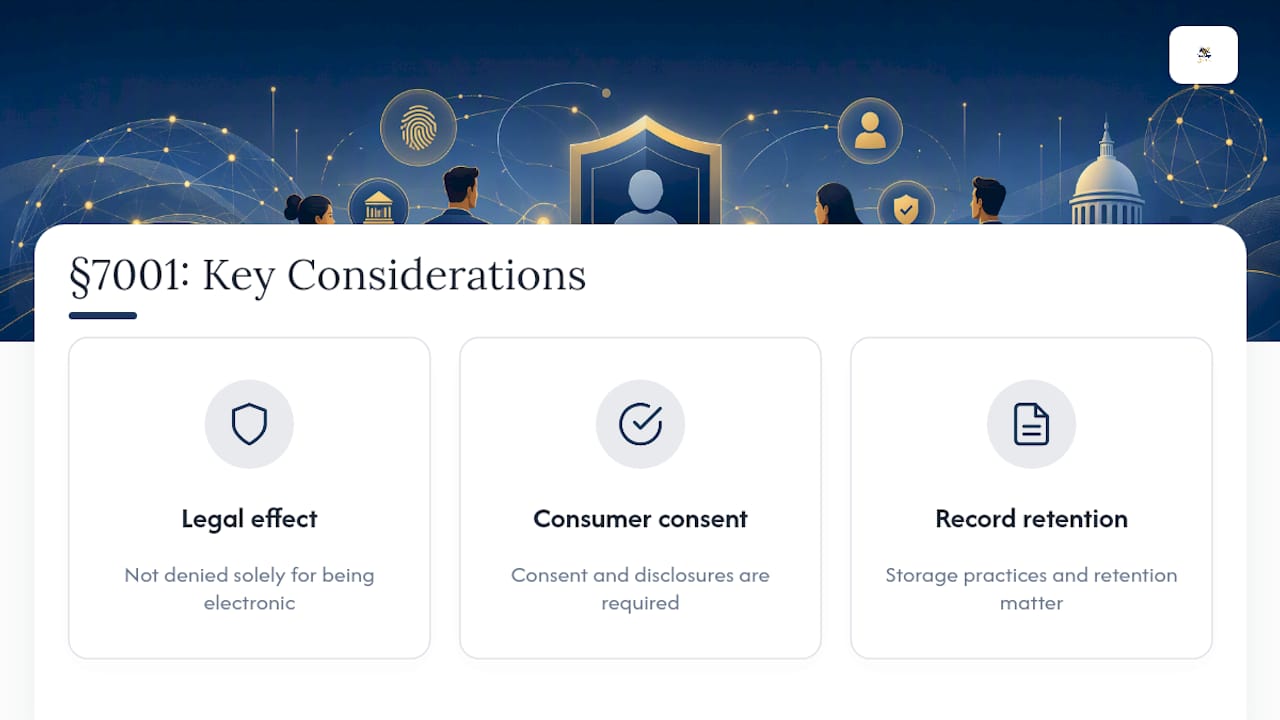
Section 7001 reinforces this from the other direction: electronic signatures and records can’t be denied legal effect solely because they’re electronic. But §7001 also sets conditions around consumer consent and record retention, meaning your disclosures and your storage practices matter as much as the signature capture itself. Build your consent language and retention policy with §7001 in mind from day one, not as a retrofit.
Where Should KYC Checks Sit in the Signing Flow?
Placement is the decision most teams get wrong. Running identity checks after a document is signed treats KYC as an audit function instead of a control. For regulated or high-risk transactions, pre-sign decisioning is the safer pattern, because it stops a bad actor from ever producing a “valid” signature in the first place, rather than flagging one after the fact.
Here’s a practical sequence for building that in:
- Classify the transaction’s risk tier before the signer ever reaches the document.
- Trigger identity verification (ID capture, liveness check, AML screening) as a required step before the sign action becomes available.
- Hold the signature in a pending state while verification runs, rather than exposing a “Sign Now” button immediately.
- Block finalization automatically if verification fails or returns an ambiguous result.
- Route ambiguous cases to manual review rather than auto-approving or auto-rejecting on the spot.
Low-risk documents, an internal policy acknowledgment, a simple NDA, don’t need this weight. Reserve full ID-plus-biometric-plus-AML checks for the transactions where a dispute would actually hurt you.
Pro Tip: Build the pending state into your data model from the start. Retrofitting a “verification in progress” status onto a system that was only ever designed for “signed” or “unsigned” is far more painful than designing it in from day one.
Which Identity Verification Methods Pair Best With eSignatures?
Not every transaction needs the same verification depth, and matching the method to the risk is where most of the practical decision-making happens. The standard toolkit includes:
- Government ID image capture with authenticity checks — catches forged or expired documents before they reach the signature step
- Liveness detection and face-match biometrics — confirms the person signing matches the ID they submitted
- Phone or email ownership verification — a lighter-weight check for lower-risk documents
- AML watchlist screening — flags signers against sanctions and politically exposed persons lists
- Two-factor authentication — adds a second proof point without the overhead of full biometric checks
Heavier checks buy you accuracy at the cost of speed and friction; a full ID-plus-biometric-plus-AML flow can take a signer several minutes and occasionally produces false positives on poor lighting or damaged documents. International IDs add another wrinkle, since document formats and security features vary widely by country, and your verification vendor needs to handle that variance without silently rejecting valid signers. Accessibility matters too: a signer without a smartphone camera or with a visual impairment needs a fallback path, not a dead end.
What Belongs in the Audit Trail for a KYC-Verified Signature?
An audit trail that can’t be reproduced by an outside auditor isn’t much of an audit trail. At minimum, log:
- Signed-at timestamp, down to the second
- Verification results (ID authenticity, biometric match score, AML screening outcome)
- Document hash, to prove the file wasn’t altered post-signing
- Signer IP address and, where available, geolocation
- Device metadata (browser, operating system, device type)
- Every signer action, viewed, scrolled, typed, clicked to sign
This is where tamper-evident audit trails do their real work: turning a signature event into a reconstructable sequence rather than a single unverifiable timestamp. Export formats matter just as much as capture. A tamper-evident PDF or CSV export that a lawyer, auditor, or regulator can review independently is worth more than a database record only your engineering team can query. Align your retention window and consumer-consent disclosures with the ESIGN retention conditions so you’re not storing evidence you never disclosed you’d keep.
How Do You Implement KYC-Integrated Signing? A Checklist
Rolling this out cleanly takes coordination across three teams, and skipping any one of them tends to surface as a compliance gap months later.
- Product/compliance: Define your risk model, write consent and disclosure language, set your retention and export policy, and draft test cases for edge cases like expired IDs.
- Engineering: Build pre-sign verification hooks, connect verification webhooks that pass results before the sign action unlocks, implement tamper-evident logging, and build export endpoints for audit and legal review.
- Operations: Set up a manual review queue with defined SLAs for ambiguous verification results, train support staff on escalation, and schedule periodic compliance testing against your own risk model.
Verification providers commonly deliver results through API and webhook callbacks, so your engineering team needs a clear contract for what a passed, failed, or “needs review” result triggers downstream.
Pro Tip: Test your manual review queue with intentionally ambiguous cases before launch, a blurry ID photo, a mismatched name spelling. If your team can’t resolve those quickly in a dry run, your live SLA will slip the first week you go live.

Balancing Defensibility and Signer Experience
Every added verification step buys you legal defensibility and costs you a little signer patience. That trade-off doesn’t disappear with better technology. It just moves, from “how do we verify identity” to “how do we verify identity without losing the signer halfway through.”
The teams that get this right don’t apply the same verification weight to every document. They tier it, light checks for low-stakes agreements, full identity evidence for anything that could end up in a dispute or an audit. That discipline matters more than which specific verification vendor you pick.

For teams building this out, BeeSign’s identity verification guide and 2026 security guide go deeper into the specific integration patterns discussed here.
— Mustafa Abusharkh
BeeSign: Built for KYC-Linked Signing From the Ground Up
BeeSign centralizes exactly what this article has been describing: identity verification, tamper-evident audit trails, and signing workflows in one platform, instead of stitching together a verification vendor, a signing tool, and a separate logging system.
Government ID capture and biometric face matching run alongside document execution, with results recorded in the same audit trail as the signature event, avoiding the need to reconcile two disconnected systems when a dispute arises. A developer REST API lets your engineering team wire pre-sign verification hooks directly into your existing product, and white-label options with bring-your-own-cloud storage help keep data within your own infrastructure rather than a third-party vendor’s. That matters if your compliance team needs to answer “where does this data live” with a specific address, not a vendor’s privacy policy.
If you’re evaluating a platform for sales contracts or business agreements that need this level of defensibility, BeeSign’s sales and business solution is a practical starting point. Start a trial at BeeSign and see how identity verification fits into your existing signing flow before your next high-value contract goes out.
This article is general information, not a substitute for advice from a qualified lawyer. Consult a qualified legal professional about your own circumstances before acting on anything here.
Sources
- Electronic signature — Legal Information Institute (Cornell Law School)
- 15 USC Ch. 96: Electronic signatures in global and national commerce (U.S. Code)
Recommended
Ready to transform your workflow?
Start using BeeSign today and experience the future of document signing