Presentation Topics for Managers: Win E-Signature Buy-In
Discover effective presentation topics to gain e-signature buy-in. Boost ROI, ensure compliance, and enhance customer experiences in your pitch.

The key presentation topics that effectively encourage decision-makers to approve an e-signature and workflow automation pilot focus on cycle-time ROI (reducing contract-to-close time), compliance and risk mitigation (covering ESIGN, UETA, HIPAA concerns), and improving customer experience (enhancing conversion rates and reducing drop-offs). Pick one as your lead, build every slide around it, and close by proposing a short-term pilot rather than an immediate budget commitment.
Ready-to-use topic headlines to open with:
- “We’re losing X days per contract — here’s what that costs us annually”
- “Our current process creates three HIPAA/ESIGN audit gaps — this closes them”
- “Customers abandon agreements at the wet-signature step — here’s the conversion data”
- “Our ops team spends Y hours per week on manual routing — automation fixes that”
- “A 7-day pilot with zero IT lift will tell us if this works”
In the first 30 seconds, ask your audience for permission: “I’d like to show you a 4-minute demo at the end — can I have that time?” That single ask shifts the room from passive listeners to active evaluators.
Pro Tip: Presentations win when the presenter owns the “why” — topic energy beats slide design every time. Choose the topic you can defend with conviction, not the one that looks best on paper.

Table of Contents
- What presentation topics work best for each stakeholder group?
- How do you structure a persuasive data-story presentation?
- What should you show in a 3–5 minute e-signature demo?
- Two copy-pasteable slide templates and speaker scripts
- How do you handle the most common stakeholder objections?
- What does a strong next-steps slide look like?
- Beesign makes the pilot easy to start
- Key Takeaways
- What actually matters when you rehearse this deck
- Useful sources for your slides and follow-up emails
What presentation topics work best for each stakeholder group?
Match your topic to the room. A CFO wants payback period; a General Counsel wants audit defensibility; a VP of Sales wants cycle time. The table below maps topics for presentations to the audience most likely to approve the pilot.
| Stakeholder | Topic Headline | Core Persuasion Point | Expected Outcome |
|---|---|---|---|
| Finance / CFO | “Contract cycle time costs us $X per deal” | Hard dollar cost of delay and manual labor | Payback period under 12 weeks |
| Finance / CFO | “Paper-based errors create rework — here’s the cost” | Error rate and rework hours quantified | Reduced cost per agreement |
| Legal / Compliance | “Three ESIGN/UETA gaps in our current workflow” | Audit trail gaps and regulatory exposure | Full ESIGN, UETA, HIPAA compliance |
| Legal / Compliance | “How a blockchain-timestamped audit trail protects us” | Tamper-evident records, identity verification | Defensible agreements in disputes |
| Sales / CX | “Customers drop off at the signature step” | Conversion loss at the final agreement stage | Higher close rate, faster time-to-revenue |
| Sales / CX | “Mobile signing cuts our time-to-close by days” | Friction reduction for the buyer | Shorter sales cycles |
| Ops / IT | “Manual routing consumes X hours per week” | Quantified labor waste in approval workflows | Automated routing, fewer errors |
| Ops / IT | “API-first e-signature fits our existing stack” | Low integration lift, REST API, no rip-and-replace | Faster deployment, lower IT cost |
How do you structure a persuasive data-story presentation?
Data storytelling centered on a single key metric tends to be more effective than dense, multi-point decks for executive audiences. The structure below uses reverse chronology: open with the result, then work backward through the evidence and the plan.
Keep the deck concise to maintain focus on the key metric for a 10–12 minute brief, as too many slides can dilute the narrative.
| Slide | Purpose | Key Visual | Speaker Line |
|---|---|---|---|
| 1. Headline | State the single metric | Large KPI callout | “Today I’m asking for one decision based on one number.” |
| 2. Cost of inaction | Show what the current process costs | Bar chart: time or dollars lost per month | “This is what we’re spending to stay where we are.” |
| 3. Root cause | Identify the workflow gap | Process flow with bottleneck highlighted | “The delay lives right here — manual routing and wet signatures.” |
| 4. Solution path | Show how automation closes the gap | Before/after workflow diagram | “Automated routing and e-signature remove both steps.” |
| 5. Compliance proof | Address legal and security concerns | ESIGN, UETA, HIPAA badge + audit trail screenshot | “Every signed document carries a tamper-evident audit trail.” |
| 6. Demo moment | Live or recorded walkthrough | Screen recording or live tool | “Let me show you the full cycle in under 4 minutes.” |
| 7. Pilot ask | Specific, low-risk next step | Timeline: 7 days, 3 metrics, 2 teams | “I’m asking for a 7-day pilot, not a budget line.” |
Pro Tip: Apply the 15-word test to your deck headline before you present. If you can’t state your thesis in 15 words or fewer, narrow the topic. A scattered headline signals a scattered argument.
What should you show in a 3–5 minute e-signature demo?
Timeboxed demos with a clear success metric reduce stakeholder friction and cut the number of follow-up objections. Show the critical path first; save integrations for the Q&A.
- Authenticate (0:00–0:20). Log in and open the dashboard. Validates: security and access control.
- Open a reusable template (0:20–0:50). Select a pre-built contract template. Validates: time saved vs. drafting from scratch.
- Auto-fill fields (0:50–1:30). Populate signer name, date, and custom fields automatically. Validates: error-rate reduction.
- Route for approvals (1:30–2:15). Assign sequential or parallel approvers with one click. Validates: manual routing eliminated.
- Sign with identity verification (2:15–3:00). Complete signing with government ID capture and biometric face matching. Validates: ESIGN/UETA compliance and identity assurance.
- Show the audit trail (3:00–3:45). Open the completed document’s audit log: timestamps, IP addresses, blockchain proof. Validates: legal defensibility.
- Mention integrations and API (3:45–4:30). Briefly show one integration or reference the REST API. Validates: low IT lift for deployment.
Compliance callout: Name ESIGN and UETA for domestic agreements. Add HIPAA when healthcare data is involved. For multinational contexts, note eIDAS coverage. Identity verification (government ID + biometric matching) addresses the most common legal objection about signer authenticity.
Short, single-concept demos improve audience retention — keep the walkthrough under 5 minutes and let the audit trail close the compliance argument for you.
Two copy-pasteable slide templates and speaker scripts
Slide template 1: ROI narrative
Slide headline: “Manual contract routing costs us [X hours/week] — automation pays back in [Y weeks].”
- Current process: [number] steps, [number] handoffs, average [X] days to close
- Automation removes: manual routing, wet-signature collection, error rework
- Projected savings: [hours/week] × [hourly rate] = $[annual figure]
Speaker script: “Right now, every agreement touches [X] people before it’s signed. That’s [Y] days of cycle time we can’t get back. With automated routing and e-signature, we cut that to [Z] days — and the math on labor alone justifies the subscription cost in under [N] weeks. I want to show you exactly how that works in the demo.”
Slide template 2: Compliance and risk mitigation
Slide headline: “Our current workflow has [N] audit gaps — here’s how we close them before they become liability.”
- Gap 1: No tamper-evident record of who signed and when
- Gap 2: No identity verification at the signature step
- Gap 3: Manual version control creates disputed-document risk
Speaker script: “ESIGN and UETA require a clear, auditable record of consent. Right now, we can’t produce that in under 48 hours if we’re challenged. A platform with blockchain-timestamped audit trails and biometric identity verification closes all three gaps — and gives legal a defensible record on demand.”
Beesign pilot ask example
“I’d like to run a 7-day pilot using Beesign on our [highest-volume contract type]. We’ll measure time-to-sign, error rate, and signer completion rate. No IT integration required in week one — we use the web interface and existing templates. At the end of 7 days, we’ll have real data to make the budget decision.”
Pro Tip: Frame the pilot ask as a data-collection exercise, not a purchase decision. Stakeholders who resist a budget commitment almost always agree to a bounded test with defined success metrics.
How do you handle the most common stakeholder objections?
- “Our data can’t leave our servers.” Beesign’s bring-your-own-cloud storage keeps documents in your own infrastructure. No data leaves your environment. (Address on the compliance slide; follow up with the white-label and BYOC page.)
- “Integration will take months.” The REST API connects to existing CRMs and document systems; the web interface works on day one with zero IT work. (Address during the demo’s integration step.)
- “We already have a process — change management is too costly.” Reusable templates and auto-fill mean most users are productive in under an hour. (Requires a follow-up: share a 3-week onboarding timeline.)
- “How do we know signatures are legally valid?” ESIGN and UETA make electronic signatures legally equivalent to wet signatures for the vast majority of U.S. commercial agreements. (Address on the compliance slide; cite the audit trail demo.)
- “What if a signer disputes the document?” The blockchain-timestamped audit trail records every action: IP address, timestamp, identity verification result. (Immediate reassurance; show the audit log in the demo.)
- “Security is a concern — who has access?” Role-based access controls, encrypted storage, and identity verification limit access to authorized parties only. (Requires follow-up: share a security one-pager or the API docs.)
- “The cost isn’t justified for our volume.” Calculate cost per agreement: labor hours × hourly rate ÷ monthly volume. For most teams, the break-even is fewer than 10 agreements per month. (Requires follow-up: provide a cost-per-agreement worksheet.)
What does a strong next-steps slide look like?
Close every deck with a concrete ask. Stakeholders need to know exactly what they’re approving.
Three ask templates to drop into your final slide:
- Pilot approval: “Approve a 7-day pilot on [contract type] with [team]. Success metrics: time-to-sign, error rate, completion rate. No budget commitment required.”
- Budget approval: “Approve a monthly subscription for [team size]. Projected payback: [N] weeks based on [X hours/week] of labor savings.”
- Technical evaluation: “Assign [IT contact] to review the REST API and integration requirements. Estimated evaluation time: 3 business days.”
Minimal pilot scope:
- Duration: 7 days
- Participants: 2–3 team members, one contract type
- Success metrics: time-to-sign (baseline vs. pilot), error rate, signer completion rate
Pilot kickoff checklist:
- IT contact name and availability confirmed
- One sample contract template loaded and tested
- 3-week implementation timeline drafted
- Stakeholder check-in scheduled for day 7
For contract approval workflow guidance, Beesign’s blog covers tool selection and scoping in detail.
Beesign makes the pilot easy to start
Faster agreements start with a platform built for the whole workflow, not just the signature step. Beesign centralizes templates, identity verification, audit trails, and approval routing in one place, with a REST API that connects to your existing tools and a white-label option that keeps everything under your brand.
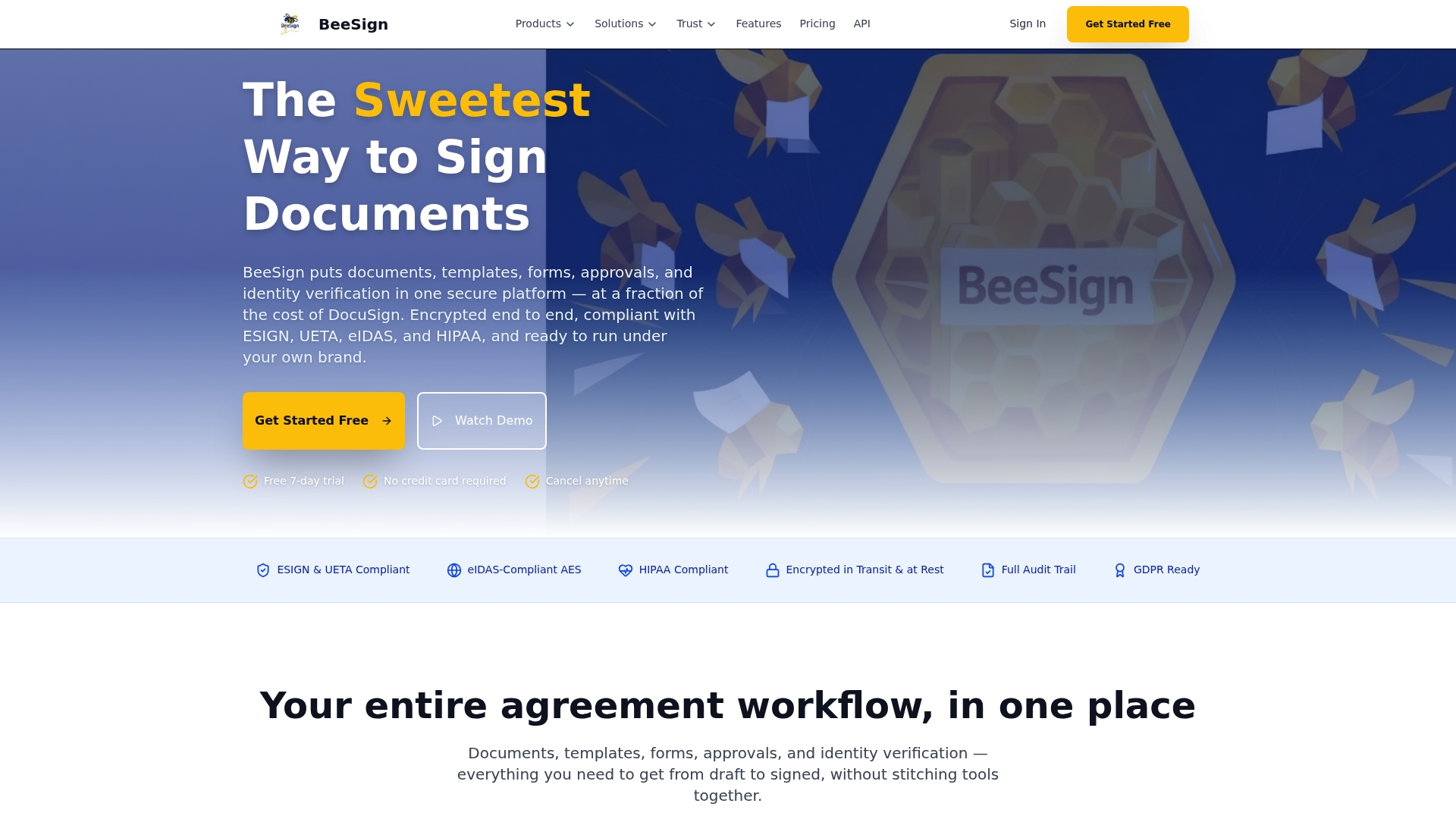
The 7-day free trial is designed exactly for the pilot ask in this deck: load one contract type, run it through the full workflow, and measure time-to-sign and completion rate against your current baseline. No IT integration is required in week one. For sales and business teams, the Beesign sales solution page maps every feature to the deal-cycle outcomes your stakeholders care about. When you’re ready to scope a pilot or discuss enterprise pricing, contact the Beesign team directly.
Key Takeaways
Lead with one metric, build every slide to support it, and close with a focused pilot proposal — that structure tends to win more approvals than multi-topic decks.
| Point | Details |
|---|---|
| Lead with one metric | Pick cycle-time ROI, compliance gaps, or conversion uplift — never all three at once. |
| Use reverse chronology | Open with the result (the KPI), then explain the evidence and the plan behind it. |
| Timebox the demo | A 3–5 minute walkthrough covering template, routing, signing, and audit trail closes most objections live. |
| Frame the ask as a pilot | A 7-day, 3-metric, no-IT-integration pilot reduces perceived risk and gets faster approvals. |
| Beesign for the pilot | Beesign’s 7-day free trial, BYOC storage, and REST API map directly to the stakeholder priorities in this deck. |
What actually matters when you rehearse this deck
Most presenters over-rehearse the slides and under-rehearse the objections. The questions that derail a buy-in meeting almost never come from the content on screen. They come from the compliance slide, the integration step, and the cost-per-agreement math. Rehearse those three moments out loud, with the person who will handle legal questions in the room.
A practical rehearsal structure: run the full deck once solo, then once with a colleague playing the CFO. Assign roles before the real meeting: one person runs the demo, one person owns the legal and compliance questions, one person owns the pilot metrics and timeline. If the meeting runs long and you lose the demo slot, skip slides 3 and 4 and go straight to the pilot ask. A stakeholder who agrees to a 7-day pilot without seeing the demo is still a win.
One more thing: bring the mobile signature considerations brief if your audience includes field teams or remote signers. It answers the “what about our reps in the field?” question before it’s asked.
Useful sources for your slides and follow-up emails
Cite these on your appendix slide or in your follow-up email to reinforce credibility:
- Presentation structure and data storytelling: 120+ Creative Presentation Ideas That Actually Work — supports the single-metric narrative and reverse-chronology structure.
- Topic selection by audience: 120 Best Presentation Topics for Any Occasion — use the 15-word test and the problem-solution frame for internal change pitches.
- Demo best practices: What 500+ B2B Sales Demos Taught Us — timeboxing and outcome-focused demo paths that reduce stalls.
- Demo structure examples: Product Demonstration Examples That Actually Close B2B Deals — concrete demo moments and closing techniques for B2B stakeholders.
- Presenter energy and topic choice: 100+ Presentation Ideas That Will Wow Your Audience — why the presenter’s conviction in the topic matters more than slide design.
- Audience retention and short formats: 200+ Presentation Ideas & Topics — research-backed guidance on single-concept talks for executive briefings.
- Beesign platform overview: Beesign — Secure eSignatures, Workflows & Identity Verification — link in follow-up emails as the primary product reference.
- Beesign agreement workflow guide: Guide to agreement workflow automation — cite for implementation timeline and workflow design questions.
- Beesign sales solution page: Sales & Business — BeeSign — share with sales stakeholders after the meeting.
Where to place citations on slides: Put source URLs in the slide footer (8pt font, gray) on any slide that carries a statistic or compliance claim. Add a full reference list as the last appendix slide so stakeholders can verify claims independently.
Recommended
Ready to transform your workflow?
Start using BeeSign today and experience the future of document signing