Digital Identity in Property Transfers: A 2026 Guide
Discover the role of digital identity in property transfers. Enhance security, speed up transactions, and ensure compliance in 2026.

How digital identity transforms property transfers
The role of digital identity in property transfers is straightforward: it replaces slow, fraud-prone paper checks with verified, technology-backed authentication that protects every party at every stage. Real estate fraud is a significant issue driven by wire fraud, deed fraud, and identity theft. Digital identity is the direct answer to that exposure.
Here is what digital identity delivers in property transactions:
- Fraud prevention: Biometric checks and AI-powered document verification catch impersonation and forged credentials that manual review misses.
- Speed: Modern platforms reduce identity authentication from hours or days to very fast times, significantly improving real estate transaction efficiencies.
- Regulatory compliance: Digital identity platforms are built to satisfy AML (Anti-Money Laundering) and KYC (Know Your Customer) requirements under frameworks like the Bank Secrecy Act and the USA PATRIOT Act.
- Tamper-evident audit trails: Every verification step is logged and time-stamped, creating a defensible record for conveyancers, title companies, and lenders.
- Stakeholder trust: Buyers, sellers, agents, lenders, and title officers all operate from a shared, verified identity record rather than a patchwork of paper documents.
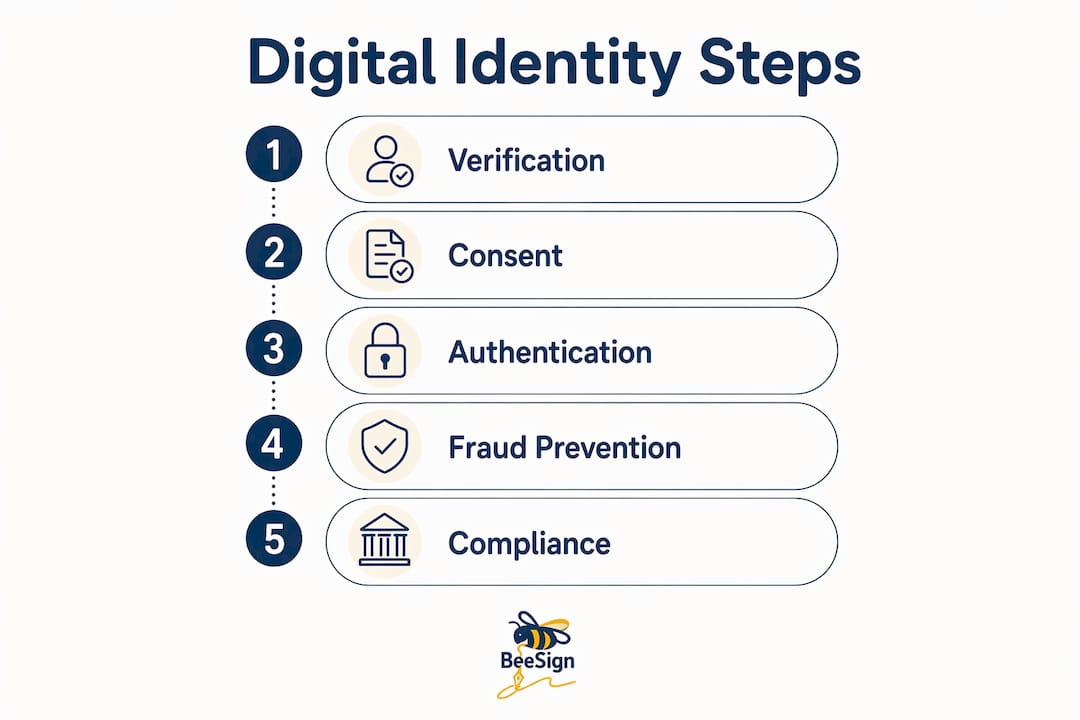
The core technologies enabling these benefits include multi-factor authentication (MFA), facial recognition, iris scanning, AI-based optical character recognition (OCR), digital signatures, and blockchain-based credential verification. Together, they form a verification layer that paper simply cannot replicate.
What digital identity actually means in a real estate transaction
Digital identity in real estate is the verified, electronic representation of a person’s or entity’s credentials, confirmed through technology rather than in-person document review. It goes well beyond scanning a driver’s license. A complete digital identity check combines several layers of verification before any transaction proceeds.
The key technologies involved include:
- Multi-factor authentication (MFA): Requires at least two independent proofs of identity, such as a one-time code plus a biometric scan.
- Biometric verification: Facial recognition and iris scanning confirm that the person presenting credentials is physically present and matches the document photo.
- AI-powered OCR: Reads and validates government-issued ID documents, cross-referencing data against authoritative databases in real time.
- Cryptographic digital signatures: Bind a signer’s verified identity to a document, making post-signing alterations detectable.
- Blockchain-based credentials: Store verified identity records on a distributed ledger, making them independently auditable without relying on a single central authority.
Traditional paper-based methods depend on a notary or agent visually comparing a face to a photo ID. That process is slow, inconsistent, and vulnerable to sophisticated forgeries. Digital identity verification runs the same check in seconds, with AI detecting document tampering that the human eye cannot catch.
Buyers, sellers, lenders, title companies, conveyancers, and agents all rely on digital identity to establish trust before money or ownership changes hands. When each party’s identity is verified through the same standard, the entire transaction rests on a much firmer foundation.
How digital identity prevents fraud in property transfers
Real estate fraud losses remain a major concern in recent years. The three most common attack vectors are wire fraud (redirecting closing funds to a criminal’s account), deed fraud (forging ownership documents), and impersonation (posing as a legitimate seller or buyer). Digital identity verification directly addresses all three.
Key security improvements digital identity delivers:
- Biometric liveness detection confirms the person on screen is physically present, not a photo or video replay used to spoof a remote verification session.
- AI-driven document analysis detects altered fonts, mismatched holograms, and inconsistent metadata on government-issued IDs, catching forgeries that pass visual inspection.
- Tamper-evident audit trails log every identity check, document access, and signature event with a time stamp, creating a chain of evidence that holds up in court and with regulators.
- Continuous transaction monitoring flags anomalies mid-transaction, such as a sudden change in wire instructions, before funds move.
- Cryptographic binding ties each signed document to the verified identity of the signer, making unauthorized alterations immediately detectable.
Pro Tip: When a wire transfer instruction changes during a transaction, treat it as a red flag and re-verify the requesting party’s identity through your digital identity platform before acting. Most wire fraud succeeds because this step is skipped.
Digital identity platforms use AI-driven verification that detects sophisticated frauds missed by humans, and they generate tamper-evident audit trails that provide continuous transaction monitoring. That combination shifts the liability calculus significantly. A conveyancer who follows a recognized digital identity standard, such as the HM Land Registry digital identity standard built on biometric and cryptographic checks, reaches what UK regulators call “Safe Harbour,” meaning the registry will not pursue recourse claims if a fraudulent transaction slips through despite proper process.

The practical takeaway: digital identity does not just reduce fraud risk. It creates documented proof that due diligence was performed, which protects professionals as much as it protects clients.
Where digital identity gets applied across a property transaction
Digital identity verification is not a single checkpoint. It runs through the entire lifecycle of a property transfer, from the first client meeting to final title registration.
| Transaction Stage | Digital Identity Application |
|---|---|
| Client onboarding | KYC checks verify buyer and seller identities before any documents are drafted |
| Title verification | Ownership records are cross-referenced against verified digital credentials |
| Contract signing | Cryptographic e-signatures bind verified identities to purchase agreements |
| Remote closing | Biometric video verification confirms signer identity without in-person attendance |
| AML compliance | Ongoing monitoring flags politically exposed persons and sanctions list matches |
| Title registration | Verified digital ID submitted to land registry in place of paper ID forms |
Key application points across the workflow:
- Conveyancing and title verification: Conveyancers use digital identity platforms to confirm that the person transferring title is the same person registered as the owner, satisfying requirements like Requirement 4 under the HM Land Registry digital identity standard.
- Electronic signatures: Document signing with identity verification ties each signature to a biometrically confirmed identity, making the signed contract legally defensible under ESIGN and eIDAS.
- Remote closing: Buyers and sellers in different states or countries complete closings via video-based biometric verification, eliminating the need for in-person notarization in many jurisdictions.
- KYC and AML onboarding: Platforms screen clients against sanctions lists, politically exposed persons (PEP) databases, and adverse media sources at onboarding, then flag changes throughout the transaction.
- Re-verification: Because property transactions can span weeks or months, platforms perform periodic re-verification to maintain compliance with evolving AML and KYC rules throughout the lifecycle.
A practical example: a buyer in California purchasing a property from a seller in Florida can complete identity verification, review title documents, and sign the purchase agreement entirely online. The platform logs every step, the title company receives a verified credential, and the closing attorney gets a tamper-evident record. No one boards a plane.
For legal teams managing high volumes of property transactions, eSignature platforms built for legal workflows integrate identity verification directly into the signing sequence, so compliance is built into the process rather than bolted on afterward.
How digital identity speeds up transactions and improves transparency
Speed is one of the clearest, most measurable benefits of digital identity in real estate. Traditional identity verification, which involves collecting paper documents, mailing certified copies, and waiting for manual review, can take days. Modern digital identity platforms reduce that authentication time to very fast times, significantly improving real estate transaction efficiencies.

| Verification Method | Typical Time | Fraud Detection Capability |
|---|---|---|
| Manual paper-based review | Hours to days | Limited to visual inspection |
| Digital identity platform | Seconds | AI-powered, biometric, and cryptographic |
| Blockchain credential verification | Near-instant | Decentralized, tamper-evident |
The efficiency gains go beyond speed alone:
- Centralized digital records give all authorized parties, buyers, sellers, agents, lenders, and title officers, access to the same verified information simultaneously, eliminating the back-and-forth of document requests.
- Automated identity checks remove manual bottlenecks from the workflow. When a platform handles KYC screening automatically, your team focuses on the transaction rather than chasing paperwork.
- Real-time audit trails mean any party can see exactly what was verified, when, and by whom. That transparency reduces disputes and speeds up resolution when questions arise.
- Reduced re-work: When identity is verified once through a mutually accepted digital standard, integration friction from repeated re-verification across parties drops significantly.
The transparency benefit is often underestimated. When a lender, a title company, and a buyer’s agent all see the same verified identity record in real time, the transaction moves forward with confidence rather than waiting for each party to independently confirm what the others already know.
Why regulatory compliance now depends on digital identity
Regulatory pressure is the single biggest driver pushing digital identity from optional to required in U.S. real estate. The Bank Secrecy Act and the USA PATRIOT Act impose AML and KYC obligations on financial institutions involved in property transactions. FinCEN’s Geographic Targeting Orders (GTOs) require title insurance companies in specific markets to identify the beneficial owners behind shell company purchases. Non-compliance carries penalties and reputational damage that no firm can afford.
Regulatory bodies increasingly require digital identity adoption for AML and KYC compliance, with failure risking penalties and reputation damage for real estate firms. The shift is not gradual. Regulators are moving from guidance to enforcement, and firms that rely on manual, paper-based processes are exposed.
What digital identity platforms do to satisfy compliance requirements:
- Automated sanctions screening: Cross-reference every party against OFAC, PEP, and adverse media databases at onboarding and throughout the transaction.
- Ongoing re-verification: Because transactions can span months, platforms perform periodic re-KYC checks to catch changes in a party’s risk profile before closing.
- Audit-ready records: Every verification event is logged with a time stamp, creating the documentation regulators expect during an examination.
- Third-party KYC reliance: Digital platforms allow firms to rely on verified credentials from trusted third parties, reducing duplication while maintaining compliance standards.
- Beneficial ownership verification: AI-powered platforms trace ownership structures through corporate layers, satisfying FinCEN’s beneficial ownership requirements for shell company transactions.
The compliance case is also a business case. Firms that build digital identity into their workflows avoid the cost of manual compliance reviews, reduce the risk of regulatory penalties, and close transactions faster because their documentation is already in order.
For property management companies, audit trail best practices show how digital identity records integrate directly into compliance documentation, making regulatory examinations far less disruptive.
Advanced challenges, consent architecture, and what comes next
Digital identity adoption in U.S. real estate is accelerating, but it is not without friction. Understanding where the real obstacles lie helps you build a more resilient implementation.
Cultural resistance is the primary barrier. Many real estate professionals worry that if a digital verification platform misses a sophisticated fraud, they will bear the liability. The evidence runs the other way: digital identity provides tamper-evident audit trails stronger than paper, and documented compliance with a recognized standard shifts liability away from the professional. The fear is understandable, but it is not supported by how regulators actually treat firms that follow proper digital identity protocols.
Consent architecture is not optional. Explicit, step-by-step digital consent at each stage of a property transfer is the mechanism that prevents unauthorized transactions. Bhutan’s national model, which links digital IDs to land ownership verification with explicit consent at each step, demonstrates how consent frameworks prevent unauthorized transfers at scale. U.S. platforms that build consent checkpoints into every signature and verification event give all parties a clear, auditable record of authorization.
Integration friction remains a real operational challenge. When a buyer’s lender, the title company, and the seller’s attorney each use different identity platforms, parties face repeated re-verification because their systems do not share a common credential standard. Authentication tokens and digital IDs verified via API must be mutually accepted across all transaction parties to avoid duplication and inefficiencies. Ecosystem interoperability is the unsolved problem that slows adoption most in complex, multi-party transactions.
Self-sovereign identity (SSI) is promising but carries its own risks. SSI systems shift private key management to the individual, which creates a recovery problem if that key is lost during a transaction sign-off. For high-value property transfers, the consequences of lost access can be severe. SSI frameworks need robust key recovery mechanisms before they are suitable for mainstream real estate use.
Pro Tip: Before selecting a digital identity platform for your firm, confirm that it supports API-based credential sharing with the platforms your transaction partners use. A platform that cannot share verified credentials across the ecosystem forces repeated re-verification and defeats much of the efficiency gain.
Looking ahead, three trends will shape digital identity in U.S. property transfers through 2026 and beyond. First, blockchain-based verified credentials, using smart contracts to automate ownership transfer only when all identity conditions are met, will reduce the role of intermediaries in routine transactions. Second, SSI frameworks will mature as key recovery solutions improve, giving property owners direct control over their verified credentials without depending on a central authority. Third, regulatory pressure will continue to tighten, particularly around beneficial ownership disclosure and AML enforcement, making digital identity platforms a compliance necessity rather than a competitive advantage.
Key Takeaways
Digital identity is now the foundational layer of secure, compliant, and efficient property transfers, combining biometrics, AI verification, and cryptographic audit trails to replace fraud-prone paper processes.
| Point | Details |
|---|---|
| Fraud prevention at scale | Real estate fraud is a serious problem; digital identity’s biometric and AI checks directly counter wire fraud, deed fraud, and impersonation. |
| Speed of verification | Digital platforms reduce identity authentication from hours or days to very fast times, significantly improving real estate transaction efficiencies. |
| Compliance is now mandatory | The Bank Secrecy Act, USA PATRIOT Act, and FinCEN GTOs make AML/KYC digital identity checks a legal requirement, not a best practice. |
| Consent architecture matters | Explicit digital consent at each transaction step prevents unauthorized transfers and creates a defensible audit record. |
| Integration friction is the key obstacle | Platforms must support API-based credential sharing across all transaction parties to avoid repeated re-verification and workflow delays. |
Why real estate professionals cannot afford to wait on digital identity
The professionals I see hesitating on digital identity adoption are usually waiting for the technology to become more universal before committing. That logic is backward. The firms that build digital identity into their workflows now are the ones setting the standard their clients, regulators, and transaction partners will expect from everyone else by 2027.
The regulatory trajectory is clear. AML and KYC requirements are tightening, FinCEN is expanding its beneficial ownership rules, and the cost of a compliance failure, whether a penalty, a fraud loss, or a reputational hit, far exceeds the cost of implementing a proper digital identity platform today. Paper-based verification is not a safe fallback. It is a liability.
What often gets overlooked is the consent architecture piece. Most discussions about digital identity focus on the verification technology itself, biometrics, AI, blockchain credentials. But the consent layer, the explicit, step-by-step authorization that ties a verified identity to a specific transaction action, is what actually prevents unauthorized transfers. A platform that verifies identity without capturing granular consent at each stage is only solving half the problem.
The efficiency argument is also stronger than most professionals realize. When identity is verified once through a mutually accepted digital standard, and that credential is shared across the transaction ecosystem via API, the entire workflow accelerates. Buyers do not re-verify with the lender, then the title company, then the closing attorney. They verify once, and the credential travels with the transaction. That is the model the market is moving toward, and the firms building toward it now will close faster, comply more easily, and lose fewer deals to friction.
Digital identity is not a technology project. It is a practice decision, and the time to make it is before your next transaction, not after your next compliance review.
See how Beesign handles digital identity in property transactions

Beesign brings identity verification, consent management, and tamper-evident audit trails into a single platform built for real estate professionals and legal teams. Whether you are managing a single closing or a high-volume portfolio of transactions, Beesign’s real estate signing solution handles KYC checks, biometric verification, and cryptographic e-signatures in one place, so your team stays compliant without slowing down.
Every signature on Beesign is backed by a full electronic audit trail, giving you the documented proof of identity and consent that regulators and courts expect. You can also explore Beesign’s full platform to see how identity verification integrates across your entire document workflow.
Recommended
Ready to transform your workflow?
Start using BeeSign today and experience the future of document signing