Identity Verification for School Records: IT & Compliance Guide
Discover the role of identity verification in school records. Ensure compliance and enhance security with effective verification methods today.

Identity verification for school records means confirming, with documented confidence, that the person requesting or signing an education record is exactly who they claim to be. Under FERPA’s reasonable-method standard, that confidence must hold across every access channel, whether a student portal, a mailed transcript request, or a DocuSign-style e-signature workflow. The NIST identity proofing model gives you the three-step architecture to get there: resolution, validation, and verification. Beesign brings all three into a single e-signature platform with government ID capture, biometric face matching, and tamper-evident audit logs.
The bottom line: FERPA does not prescribe a specific technology, but it does require that your chosen method be reasonable, documented, and consistent across channels. A password alone no longer clears that bar for sensitive records.
Key signals your implementation must produce:
- A documented risk assessment tying assurance level to record sensitivity
- NIST-aligned proofing steps with a biometric or behavioral linkage step for high-sensitivity records
- A tamper-evident audit trail with timestamps, device fingerprints, and verification artifacts
- Beesign’s bring-your-own-cloud (BYOC) storage to keep evidence within your own infrastructure
Table of Contents
- Why does identity verification matter for school records?
- What do FERPA, HLC, and HIPAA actually require?
- How does the NIST proofing model map to school records?
- Which verification methods work best for school-record use cases?
- How does identity verification fit into an enterprise e-signature workflow?
- IT manager’s implementation checklist
- What are the known risks and how do you mitigate them?
- How do timelines and costs compare across verification approaches?
- What is the recommended approach for U.S. institutions?
- Key Takeaways
- The part most teams get wrong about identity proofing
- Beesign handles identity-verified e-signing end to end
- Primary sources and further reading
Why does identity verification matter for school records?
Disclosing personally identifiable information (PII) from education records to the wrong party creates immediate legal exposure under FERPA, potential accreditation risk under the Higher Learning Commission (HLC), and reputational damage that is hard to reverse. The threat is not hypothetical. Transcript fraud, credential stuffing attacks on student portals, and social-engineering calls to registrar offices are documented, recurring problems.
HLC requires that institutions delivering distance or correspondence education verify that the student who registers is the same person who participates and receives credit. Acceptable methods include secure logins, proctored exams, or equivalent technologies, and institutions must notify students of any associated fees at enrollment. Failing that requirement puts accreditation status at risk, not just a single record release.
Automated biometric verification reduces administrative overhead and speeds enrollment timelines beyond proctoring use-cases. When manual in-person validation is replaced with automated proofing, institutions see measurable gains in fulfillment speed and staff capacity. That operational upside makes the compliance investment easier to justify to leadership.
What do FERPA, HLC, and HIPAA actually require?
FERPA and PTAC guidance
FERPA requires educational agencies and institutions to use reasonable methods to authenticate the identity of any party requesting or transmitting PII from education records. Authentication must be consistent across channels, and the assurance level must match the data’s sensitivity. The Student Privacy Policy Office cautions that treating authentication as a checkbox is a common compliance pitfall. Stronger digital techniques, specifically government ID capture and biometric matching, better meet the “reasonable” threshold than outdated knowledge-based questions.
HLC distance-education expectations
HLC’s identity verification requirement applies to any institution with distance or correspondence programs. Your policy must cover the full student lifecycle: registration, participation, and credit award. Fee disclosure at enrollment is mandatory, not optional.
When HIPAA applies
If your institution stores student health records within the same system as education records, HIPAA’s privacy and security rules layer on top of FERPA. That intersection typically requires stricter access controls, separate audit logging for protected health information (PHI), and a formal risk analysis under the HIPAA Security Rule.
Pro Tip: Document every method-selection decision in a written risk assessment. During an audit or accreditation review, your written rationale for choosing a specific assurance level is as important as the technical control itself.
How does the NIST proofing model map to school records?
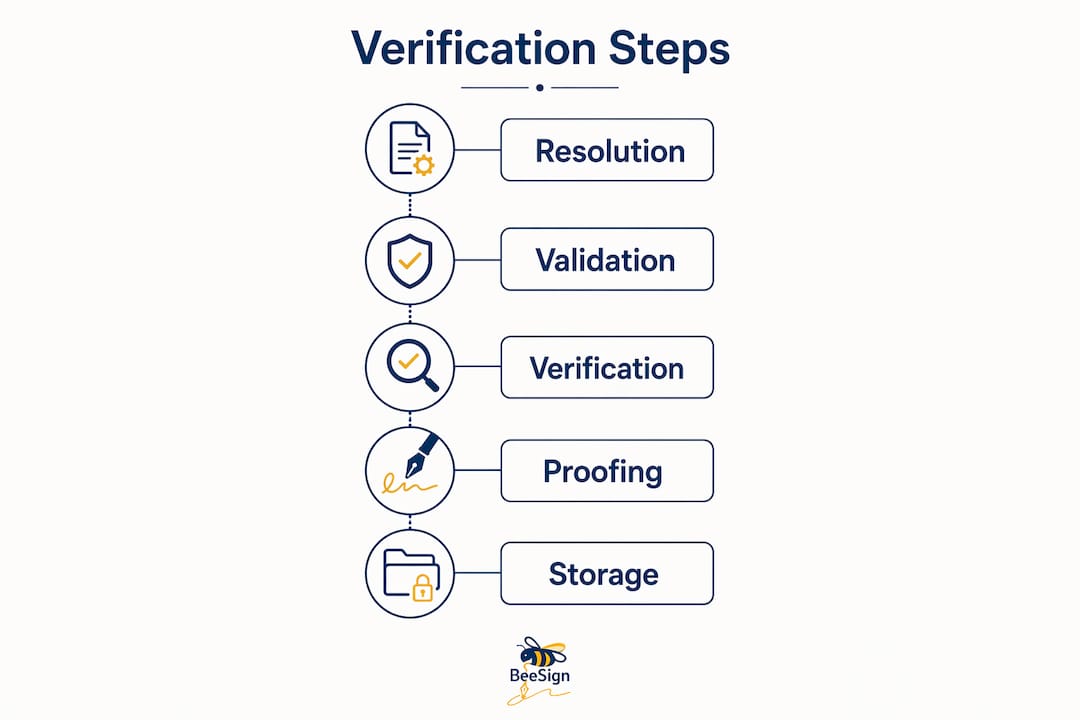
NIST SP 800-63A defines identity proofing as a three-step process. Each step builds on the last, and skipping any one of them weakens the audit chain.
- Resolution — Collect the minimum identity attributes needed to establish a unique individual in your population. For school records, this typically means full legal name, date of birth, and a government ID number.
- Validation — Confirm that the presented credential is authentic, accurate, and unexpired. OCR extraction plus a check against issuing-authority databases satisfies this step for a driver’s license or passport.
- Verification — Establish linkage between the validated identity and the real person in front of you. A biometric face match against the ID photo is the most defensible method for remote workflows and reaches IAL2 assurance.
Many implementations over-index on validation and skip verification entirely. That gap is exactly what auditors and accreditors look for. The linkage step is what converts a document check into a legally defensible proof event.
Map these steps to your workflow touchpoints: resolution and validation at onboarding or enrollment, verification at each subsequent signing event or high-sensitivity record release.
Which verification methods work best for school-record use cases?
The right method depends on the sensitivity of the record and the access channel. Here is a practical breakdown:
- Single-factor login/PIN: Low assurance; acceptable only for public-facing, non-PII pages.
- Two-factor authentication (2FA/OTP): Medium assurance; suitable for general portal access and low-sensitivity record views.
- Document capture + OCR: Medium-high assurance; validates credential authenticity but requires a linkage step to reach IAL2.
- Government ID + biometric face match: High assurance; the recommended baseline for transcript release, enrollment forms, and any record containing PII.
- Proctored exams: High assurance for academic integrity; operationally expensive at scale.
- Knowledge-based authentication (KBA): Low-medium assurance; PTAC guidance explicitly notes this method is weaker than document-based approaches.
| Record Type | Recommended Method | Assurance Level |
|---|---|---|
| Transcript release (online) | Government ID + biometric face match | IAL2 |
| Enrollment form (e-signature) | 2FA + session logging | IAL1–IAL2 |
| Directory information request | Secure login + OTP | IAL1 |
| Student health record access | Government ID + biometric + PHI audit log | IAL2/HIPAA |
| Distance-ed credit award | Proctored exam or biometric login | IAL2 |
For verifying signer identity online, pairing document capture with a live biometric check gives you both the validation and linkage steps in a single workflow pass.
How does identity verification fit into an enterprise e-signature workflow?
The data flow has three stages: proofing, binding, and storage.

Proofing happens before or at the moment of signing. The signer completes ID capture and biometric face match. The platform returns a proof artifact: a structured record of the evidence collected, the match score, and the timestamp.
Binding links that proof artifact to the specific signing event. The signed document’s metadata must reference the proof artifact ID so that any downstream audit can trace the signature back to the verified identity.
Storage must be tamper-evident. Required audit-trail elements include:
- Timestamped signing metadata with IP address and device fingerprint
- Proof artifact (ID image hash, biometric match result, assurance level reached)
- Signer notification records (email/SMS delivery confirmation)
- Retention policy documentation aligned to your FERPA records schedule
For API integration, your checklist should cover:
- Proof initiation endpoint: trigger ID capture and biometric check before the signing session opens.
- Callback evidence ingestion: receive and store the proof artifact from your identity provider.
- Secure storage binding: attach the artifact to the document record in your BYOC environment.
- Webhook for signing completion: fire an event that closes the proof-to-signature chain and triggers retention tagging.
Beesign’s document signing with identity verification covers how to attach verification evidence directly to signed documents, keeping the proof-to-signature chain intact for FERPA audits.
Pro Tip: Store proof artifacts in the same BYOC bucket as the signed document. Separating them across vendors creates a chain-of-custody gap that is difficult to close during an audit.
IT manager’s implementation checklist
Pre-deployment
- Classify all record types by sensitivity (directory info, PII, PHI) and map each to a required assurance level.
- Conduct a written risk assessment documenting the potential impact of unauthorized disclosure for each record class.
- Define your authentication policy: which methods apply to which channels and record types.
Vendor and technical checks
- API security: OAuth 2.0 or equivalent, TLS 1.2+ in transit, AES-256 at rest.
- Data residency: confirm BYOC or in-country storage options to meet FERPA and state data-privacy requirements.
- Biometric matching SLAs: false accept rate (FAR) and false reject rate (FRR) thresholds documented in the vendor contract.
- SOC 2 Type II or ISO 27001 attestation from your identity verification provider.
Operational tasks
- Capture explicit consent before collecting biometric data; several U.S. states (Illinois BIPA, Texas, Washington) require it by law.
- Publish HLC-required fee disclosures for distance-education students before enrollment.
- Train registrar and IT staff on escalation procedures for failed verification attempts.
- Set a documented retention schedule for proof artifacts aligned to your FERPA records policy.
For enrollment-specific automation patterns, onboarding automation examples from HR workflows translate directly to student enrollment pipelines.
Pro Tip: Run a pilot with one record type (e.g., transcript release) before full production. Measure false reject rates and manual review volume in the pilot to calibrate thresholds before scaling.
What are the known risks and how do you mitigate them?
| Risk | Detection | Corrective Action |
|---|---|---|
| High false reject rate | Monitor FRR weekly during pilot | Lower match threshold; add manual review queue |
| Biometric bias (skin tone, lighting) | Audit match rates by demographic segment | Use a vendor with documented bias testing; offer alternate path |
| Identity document fraud | Liveness detection + issuing-authority check | Require NFC chip read or database validation for high-sensitivity records |
| Account takeover post-proofing | Session anomaly detection | Trigger reauthentication on IP/device change |
| Accessibility barriers | User support ticket volume | Provide phone-based or in-person alternate verification path |
Accessibility deserves specific attention. Not every student has a government-issued photo ID or a device with a front-facing camera. Your policy must include an alternate verification path, documented in writing, so that legitimate users are never permanently locked out. Reducing onboarding errors through automation covers how structured exception handling prevents manual-review backlogs from becoming compliance gaps.
How do timelines and costs compare across verification approaches?
Manual in-person verification typically takes two to five business days from request to fulfillment, depending on staff availability and document mailing time. Automated digital proofing compresses that to minutes for straightforward cases, with manual review queues handling edge cases in one to four hours.
Cost trade-offs to weigh:
- Per-transaction fees for automated ID verification typically range from a few cents to a few dollars depending on the assurance level and provider.
- Manual review costs include staff time, which at registrar-office rates can exceed the per-transaction fee by an order of magnitude for high volumes.
- Long-term savings come from reduced admin overhead, faster enrollment completion, and fewer compliance incidents.
Track these ROI metrics from day one: average time-to-fulfill record requests, percentage of transactions requiring manual review, error rate on identity checks, and number of compliance incidents avoided per quarter.
What is the recommended approach for U.S. institutions?
The baseline recommendation is risk-based, documented identity proofing aligned to NIST’s three steps, with biometric linkage for high-sensitivity records and multi-factor authentication for medium-sensitivity access.
Minimum evidence to retain for FERPA compliance:
- Written risk assessment with assurance-level rationale
- Proof artifacts (ID image hash, biometric match result, timestamp) per signing event
- Complete audit log with IP, device, and session data
- Consent records for biometric data collection
- Staff training records for personnel involved in identity proofing
A combined approach, government ID capture plus biometric face match plus a tamper-evident audit trail, shortens fulfillment from days to minutes while producing a defensible record that satisfies both PTAC’s “reasonable method” standard and HLC’s distance-education requirements. For e-signature validity criteria, the proof artifact is what elevates a signature from “electronically signed” to “identity-verified and legally defensible.”
Pro Tip: Reference your written risk assessment and proof-artifact retention policy explicitly in your FERPA compliance documentation. Auditors want to see that your method selection was deliberate, not accidental.
Key Takeaways
Identity verification for school records requires documented, risk-based proofing aligned to NIST’s three steps, with biometric linkage for high-sensitivity records and a tamper-evident audit trail to satisfy FERPA’s reasonable-method standard.
| Point | Details |
|---|---|
| FERPA requires documented methods | Authentication must be consistent across channels and matched to record sensitivity. |
| NIST three-step proofing is the framework | Resolution, validation, and verification together create a legally defensible proof chain. |
| Biometric linkage is the critical step | Most implementations skip verification/linkage, which is exactly what auditors check first. |
| Audit trail elements are non-negotiable | Retain proof artifacts, timestamps, IP/device data, and consent records per your FERPA schedule. |
| Beesign integrates all three proofing steps | ID capture, biometric face match, BYOC storage, and audit logs in one platform for compliant e-signing. |
The part most teams get wrong about identity proofing
The most common mistake is treating identity proofing as a one-time enrollment event. You verify the student at registration, store the result, and assume it covers every subsequent interaction. It does not. FERPA’s “reasonable method” obligation applies each time PII is disclosed or transmitted, not just at account creation. A student who authenticated two years ago with a password is not a verified signer today.
The second mistake is separating the proof artifact from the signed document. When those two pieces of evidence live in different systems, or worse, different vendors, you cannot produce a clean chain of custody during an audit. Beesign’s BYOC storage and white-label capabilities solve this directly: proof artifacts and signed documents stay in your infrastructure, under your domain, with your retention policy applied uniformly.
Training matters more than most IT teams expect. Registrar staff who handle failed verification escalations need a documented procedure, not an informal workaround. Assign a named owner for the escalation queue, set a response-time SLA, and log every manual override with a reason code. That log becomes part of your FERPA audit evidence.
Beesign handles identity-verified e-signing end to end
If you are building a compliant school-records workflow and need identity verification wired directly into your e-signature process, Beesign gives you government ID capture, biometric face matching, blockchain-timestamped audit logs, and BYOC storage in one platform. You get the NIST proofing chain, the FERPA-ready evidence trail, and the API hooks to automate it all, without stitching together three separate vendors.
White-label deployment means the entire workflow runs under your institution’s domain and branding. Your data stays in your cloud. Start with a 7-day free trial at Beesign or explore the white-label and BYOC options to see how data residency requirements map to your infrastructure.
Primary sources and further reading
Use these sources in procurement documentation, accreditation submissions, and technical design reviews:
- PTAC Identity Authentication Best Practices — The U.S. Department of Education’s Student Privacy Policy Office guidance on FERPA-compliant authentication. Cite this in any accreditation or audit submission to demonstrate your “reasonable method” rationale.
- NIST SP 800-63A-4 (Digital Identity Guidelines) — The technical standard defining IAL1–IAL3 proofing requirements. Use this to specify biometric matching and validation requirements in vendor contracts.
- NIST 800-63A Verification Implementation Resources — Practical implementation guidance for the verification/linkage step. Reference this when designing your API integration architecture.
- HLC Verification of Student Identity and Protection of Privacy — The accreditation policy for distance and correspondence education. Required reading for any institution with online programs.
- U.S. State Department: Academic Credentials Authentication — Covers apostille and certification for school records used abroad. Note: this authenticates the issuing authority’s signature, not the individual presenting the document.
- How to Authenticate Anyone Requesting Student Records (DOI) — Scholarly treatment of FERPA assurance levels and practical authentication guidance for school administrators.
This article provides general compliance information, not legal advice. Confirm current FERPA, HLC, HIPAA, and state requirements with qualified legal counsel or your institution’s compliance officer for your specific situation.
Recommended
Ready to transform your workflow?
Start using BeeSign today and experience the future of document signing