Identity Verification Vendor Deals: 2026 AP and Procurement Guide
Discover the crucial role of identity verification vendor deals in safeguarding your systems. Learn how to protect against fraud effectively.

Why identity verification vendors are the gatekeepers of every vendor deal
Identity verification vendors do one thing that no onboarding form can: they confirm a vendor is exactly who they claim to be before that vendor ever touches your systems. That gatekeeping function, validating legal identity, tax status, banking details, and authorized contacts through independent sources, is the core role of identity verification in vendor deals. And right now, it matters more than ever.
Payment fraud hit A significant share of organizations in 2025, according to the AFP Payment Fraud Survey. That figure alone explains why AP and procurement teams are moving away from self-reported forms and toward identity-first onboarding as the new standard.
Here is what identity verification vendors actually do in a vendor deal:
- Confirm the vendor is a registered, legitimate business entity
- Validate tax identity through IRS TIN matching or equivalent authoritative sources
- Verify bank account details independently, not through email or PDFs
- Screen against sanctions lists, PEP databases, and restricted-party registries
- Confirm the person submitting information is authorized to act for that business
- Generate a timestamped, defensible audit trail for every check performed
The shift from form-based to identity-first onboarding is not a technology upgrade. It is a fundamental change in when trust is established. Legacy models collect data first and verify it later, if at all. Identity-first models make verification the entry gate, so only legitimate vendors ever enter your vendor master.
Why vendor identity verification has become a business imperative
Payment fraud rarely involves breaking into a bank. Criminals impersonate legitimate vendors, hijack email threads, or create convincing fake entities, then submit fraudulent banking details through onboarding channels that have no real controls. The fraud entry point is vendor onboarding itself, not the payment system.
The regulatory environment compounds the pressure. Whether it is IRS TIN matching, AML-linked beneficial ownership verification, Nacha account validation rules, or sanctions screening under OFAC, organizations are now expected to prove they know who they are paying. Self-reported vendor data no longer satisfies that standard.
The 2025 AFP Payment Fraud Survey found that A significant share of organizations faced attempted or actual payments fraud. Changed-bank-details schemes and vendor impersonation were among the leading attack vectors.
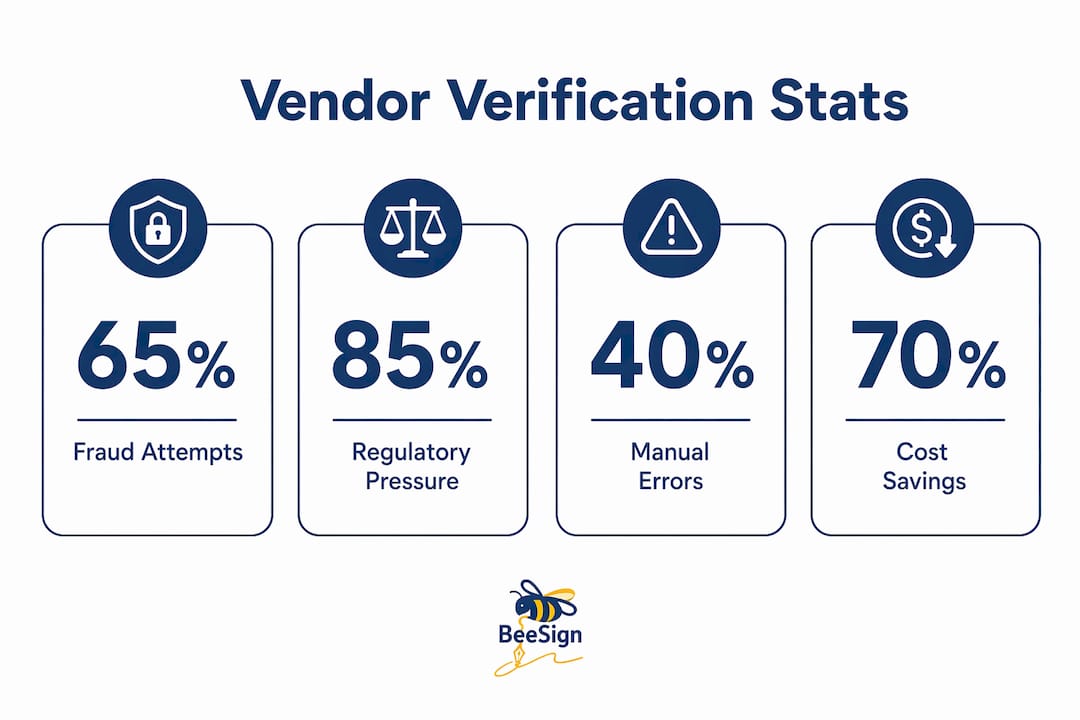
Manual onboarding workflows make the problem worse. When AP teams verify tax forms under invoice deadline pressure, verification gets skipped. When different departments use different intake forms, data inconsistencies accumulate in the vendor master. When there is no audit trail, internal controls cannot be demonstrated to auditors or regulators.
Identity verification vendors solve all three problems at once. They automate the checks, standardize the process across every supplier, and produce documentation that holds up under scrutiny. For AP and procurement teams managing hundreds or thousands of vendors, that combination of automation and defensibility is what makes identity verification a business requirement, not a nice-to-have.
Key business drivers pushing organizations toward formal identity verification partnerships in 2026:
- Business email compromise (BEC) and vendor impersonation attacks are at historic highs
- Beneficial ownership disclosure requirements are expanding under FinCEN and state-level rules
- Nacha’s updated operating rules require risk-based processes for spotting fraudulent ACH entries
- Audit readiness demands documented, timestamped evidence of every vendor check
- AP teams cannot scale manual verification as supplier counts grow
What core features should you look for in an identity verification solution?
The vendor identity verification process covers more ground than most procurement teams expect. A document check is only one layer. Effective solutions validate identity across several dimensions simultaneously, and the architecture behind those checks determines how reliable the results actually are.
Core verification capabilities to evaluate:
- Business identity verification: Confirms legal name, registration status, and business address through authoritative registries, not self-reported fields
- Tax identity validation: IRS TIN matching for domestic vendors, W-8 validation for foreign suppliers
- Bank account verification: Independent confirmation of routing and account numbers through controlled channels, never email
- Sanctions and compliance screening: Real-time checks against OFAC, PEP lists, and adverse media databases
- Authorized user verification: Confirms the person submitting vendor information is genuinely associated with the business
- Ongoing monitoring: Post-onboarding alerts when a vendor’s status, ownership, or sanctions profile changes
Integration with your existing procurement and AP systems is where many vendors fall short. A solution that requires manual data re-entry defeats the purpose. Look for API-first architectures that connect directly to your ERP, whether that is NetSuite, SAP, Oracle, or a mid-market platform like Sage Intacct.
Security measures matter beyond the verification itself. Cryptographic proof of each verification, timestamped audit trails, and evidence retention policies determine whether your documentation holds up in an audit or legal dispute. Compliance certifications to evaluate include NIST SP 800-63 for identity assurance levels, ESIGN and eIDAS for electronic signature validity, HIPAA for healthcare-adjacent workflows, and SOC 2 Type 2 for operational security.

Pricing models vary significantly across the market: per-check fees, monthly platform subscriptions with included credits, and volume-committed contracts each carry different total cost implications. The headline per-check rate is rarely the full picture. Factor in add-on costs for sanctions screening, ongoing monitoring, re-verification, and integration support before comparing vendors on price.
Pro Tip: Model the total cost of ownership at 10x your current verification volume before signing. Per-check pricing that looks attractive at low volume often becomes uncompetitive at scale, while volume-committed contracts can offer meaningful savings for high-throughput AP teams.
How do legacy onboarding methods create fraud and compliance gaps?
Most AP and procurement teams know their onboarding process has problems. The moment of discovery is usually at payment time, when the vendor has already delivered, the invoice is due, and finance is scrambling to verify a W-9 under deadline pressure. That is exactly when verification gets skipped.
Form-based onboarding has four structural weaknesses that identity-first models eliminate:
- Inconsistent data collection: Different departments use different forms, producing vendor master records with gaps, duplicates, and conflicting information
- No authentication: Forms collect what vendors say about themselves. They cannot confirm that a tax ID is real, a bank account belongs to the stated business, or the submitter has authority to act
- Fraud vulnerability: Fraudsters can enter false tax IDs, spoofed contact details, or manipulated banking information. Internal teams rarely have the time or tools to verify every field manually
- Weak audit trails: Paper forms and email chains do not produce the timestamped, defensible documentation that regulators and auditors now expect
Legacy processes also cannot scale. As supplier counts grow and regulatory requirements expand, manual verification becomes a bottleneck. Teams overwhelmed with vendor review cannot keep up, and the backlog creates exactly the conditions where fraud slips through.
Standardization is the fix. When every vendor, domestic or international, passes through the same identity-first workflow, the process becomes repeatable, auditable, and defensible. The vendor master gets cleaner because bad data never enters it. Compliance gaps close because every check is documented. Rework drops because there are no inconsistent records to reconcile at month-end.
The cost savings from reduced rework and fraud loss are real, even if they are hard to quantify before implementation. What is easier to quantify: the cost of a single successful vendor impersonation attack, which typically runs into tens of thousands of dollars per incident in direct losses, plus the remediation and audit costs that follow.
Which identity verification vendors should you consider for US procurement?
Six vendors dominate the US-relevant identity verification market for AP and procurement use cases in 2026. They differ meaningfully on architecture, compliance depth, and the specific problems they solve best.
| Vendor | Key Features | Security Measures | Compliance Support | Integration Capabilities | Pricing Model | Best For |
|---|---|---|---|---|---|---|
| Vouched | AI-powered document and biometric authentication, real-time decisioning | Biometric liveness, document forensics | NIST, ESIGN, AML-compatible | API-first, multiple ERP connectors | Per-check and volume tiers | Enterprises needing fast, scalable identity checks |
| Entrust | End-to-end identity lifecycle, AI fraud monitoring, global coverage | AI-driven anomaly detection, Google Cloud infrastructure | HIPAA, eIDAS, AML, KYC | Google Cloud integration, broad API support | Enterprise contract | Highly regulated industries with stringent compliance needs |
| SEON | Modular fraud risk scoring, multi-source data enrichment | Device intelligence, email and phone graph analysis | AML-compatible, flexible rule engine | REST API, modular architecture | Subscription and per-check | Firms prioritizing customizable fraud risk scoring |
| Veriff | 14,000+ document types, real-time biometric analysis, global coverage | Liveness detection, document forensics | GDPR, AML, KYC, eIDAS | SDK and API, broad platform support | Volume-based tiers | Organizations needing broad geographic and document support |
| Ondato | Full KYC, KYB, and AML lifecycle, agentic compliance automation | End-to-end encrypted workflows, ongoing monitoring | AML, KYC, KYB, multi-jurisdictional | API and white-label options | Modular subscription | Businesses requiring integrated compliance workflows |
| Incode | Privacy-enhanced biometrics, fast onboarding flows | On-device processing, minimal data retention | GDPR, CCPA, HIPAA-compatible | SDK-first, consumer app integration | Volume and enterprise tiers | Consumer-facing applications demanding privacy and speed |

Entrust stands out for highly regulated industries. Its partnership with Google Cloud combines Entrust’s identity verification capabilities with Gemini AI models and Google’s threat intelligence infrastructure. The result is real-time fraud analytics and onboarding efficiency gains that financial services and insurance organizations specifically need. With more than 1 billion identity verifications processed globally, Entrust brings a depth of fraud pattern data that smaller vendors cannot match.
Veriff is the strongest choice when document and geographic coverage are the primary constraints. Its library spans 14,000+ document types across a wide range of countries, with real-time biometric analysis and liveness detection built in. For procurement teams onboarding international suppliers across diverse document formats, Veriff’s coverage depth reduces the manual exception handling that other vendors require.
Ondato takes a different approach: instead of a point solution for identity checks, it covers the full compliance lifecycle. KYC, KYB, AML screening, ongoing monitoring, and case management run on a single platform. For AP teams that need to manage beneficial ownership verification alongside standard vendor onboarding, that consolidation reduces the operational complexity of juggling multiple vendors.
SEON suits procurement teams that want to build their own fraud risk logic. Its modular API architecture lets you combine device intelligence, email graph analysis, phone verification, and sanctions screening in whatever configuration fits your risk model. That flexibility comes with a tradeoff: more configuration work upfront compared to out-of-the-box solutions.
Vouched focuses on AI accuracy and speed, making it a practical fit for enterprises running high volumes of vendor identity checks where turnaround time affects onboarding cycle length. Its compliance support spans NIST and ESIGN standards, which aligns well with US-based procurement requirements.
Incode is purpose-built for consumer-facing applications where user experience and privacy are the primary design constraints. For AP and procurement use cases, it is most relevant when vendor onboarding flows are customer-facing or when the organization operates in privacy-sensitive sectors like healthcare.
Consolidating identity verification into a single platform rather than assembling a multi-vendor stack reduces audit fragmentation, training overhead, and integration complexity. When evaluating these vendors, total cost of ownership across the full stack matters more than the per-check headline rate.
Best practices for choosing and managing an identity verification vendor
Choosing an identity verification vendor is a governance decision, not just a procurement exercise. The vendor you select becomes part of your trust infrastructure, which means their internal controls directly affect your risk posture.
Start by verifying the verifier. Supplier KYB on your identity verification vendor means reviewing their ownership structure, funding sources, sub-processor dependencies, data residency practices, and geopolitical exposure before you integrate them into onboarding workflows. A vendor with opaque ownership or unclear data-path accountability transfers that opacity directly into your compliance posture.
Key practices for durable vendor agreements:
- Negotiate data portability upfront. Exit provisions and data export formats are almost always negotiable before signing and almost never revisited after. Confirm you can retrieve identity evidence, decision logs, and audit records in a usable format if you need to migrate.
- Define breach notification timing in the contract. Standard terms often give vendors 72 hours or more. For AP workflows touching payment data, you need faster notification windows and clear escalation paths.
- Require audit rights. The contract should give you the right to test, inspect, and request evidence of the vendor’s controls, not just rely on their annual SOC 2 report.
- Evaluate in-house versus stacked architecture. Vendors that build their verification stack in-house typically deliver lower latency, more consistent accuracy, and cleaner data-path accountability than those assembling third-party APIs. A stacked architecture distributes responsibility across multiple processors and jurisdictions, which makes it harder to prove data handling and decision accountability.
- Demand published pricing. Opaque, sales-quoted-only pricing transfers procurement risk to you. Vendors with published per-check rates and documented overage terms give you a cleaner basis for TCO modeling and contract negotiation.
Compliance frameworks your vendor should explicitly support include NIST SP 800-63 for identity assurance levels, FATF Recommendations for AML and KYC, NIST CSF 2.0 for supplier governance, and PCI DSS v4.0 if the vendor supports payment-related onboarding flows. For organizations with European supplier relationships, eIDAS 2.0 compatibility is increasingly relevant.
Pro Tip: Run a proof of concept with real vendor data and edge cases before signing. A vendor can perform well on a demo dataset while failing on scanned documents, non-Latin scripts, or suppliers from specific regions. Test with your actual supplier population, including the exceptions, not just the clean cases.
The ID.me and Docusign partnership announced in May 2026 illustrates where the market is heading: identity verification embedded directly into agreement workflows, meeting NIST IAL2 standards without requiring signers to re-enter information. For AP and procurement teams evaluating identity verification partnerships, that kind of embedded, reusable identity is the direction to plan for. You can also explore how document signing with identity verification works in practice as you build out your vendor onboarding architecture.
For teams building out their compliance checklist, the vendor compliance requirements checklist for 2026 covers the key frameworks and documentation standards relevant to US procurement.
Beesign centralizes identity verification and document signing in one place
If the vendors compared above handle identity verification as a standalone service, Beesign takes a different approach: it combines identity verification, contract management, and electronic signatures into a single platform. That matters for AP and procurement teams because vendor onboarding does not end at identity verification. It ends when the vendor agreement is signed, stored, and traceable.
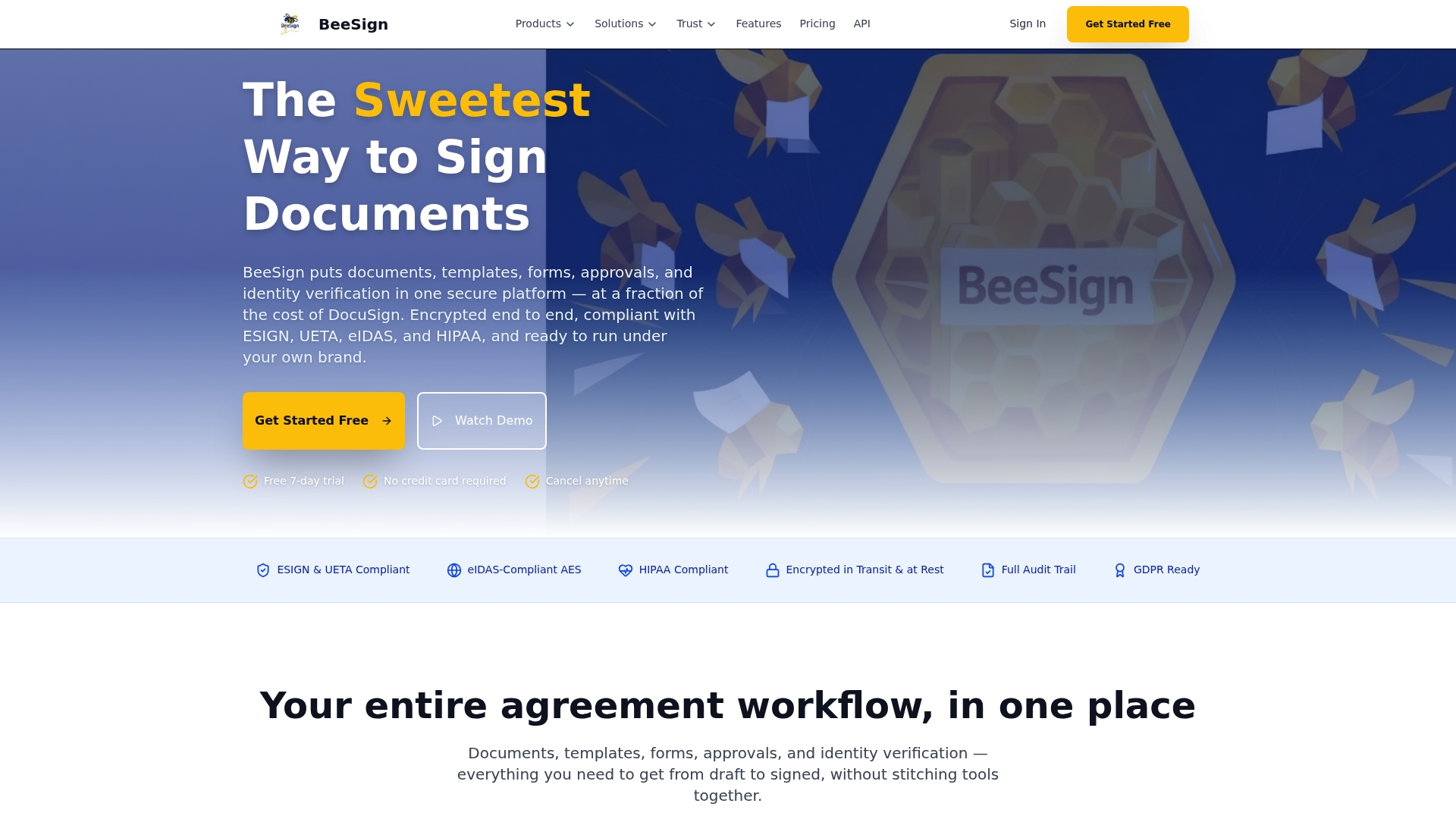
Beesign is built for organizations that want to verify vendor identity and execute vendor agreements without switching between platforms. The platform supports ESIGN, eIDAS, and HIPAA compliance, includes real-time workflow tracking, and offers a white-label option that keeps data within your own infrastructure rather than a shared cloud environment. For teams that have invested in building a specific vendor onboarding process, the API lets you automate the full sequence from identity check to signed contract without manual handoffs.
Where the six vendors above focus on the verification layer, Beesign covers the agreement layer that follows. If your current workflow involves verifying a vendor in one tool and then routing contracts through another, Beesign’s secure eSignature platform consolidates that into one auditable process. That is a practical alternative for teams that want fewer vendor relationships to manage, not more.
Key Takeaways
Identity verification vendor deals establish the gatekeeping function that keeps fraudulent suppliers out of your systems, and the vendors you choose become part of your compliance infrastructure, not just a procurement tool.
| Point | Details |
|---|---|
| Fraud risk is high | 79% of organizations faced attempted or actual payments fraud in 2025, making vendor identity verification a direct fraud control. |
| Identity-first replaces forms | Verifying vendor identity before data entry closes the gap that form-based onboarding leaves open for fraudsters. |
| Verify the verifier | Conduct Supplier KYB on your identity verification vendor, reviewing ownership, sub-processors, and data residency before integrating them into onboarding workflows. |
| Negotiate exit terms upfront | Data portability, breach notification timing, and audit rights are negotiable before signing and rarely revisited after. |
| Beesign covers the full workflow | Beesign combines identity verification with contract management and eSignatures, reducing the number of vendor relationships AP teams need to manage. |
Recommended
Ready to transform your workflow?
Start using BeeSign today and experience the future of document signing