Practical Setup in Beesign: Sequential, Parallel, and Hybrid Signing
Decide when to use sequential, parallel, or hybrid signing. Three practical questions, configuration patterns, and a production ready Beesign setup.

Parallel signing gets documents closed faster because every recipient gets access at once. Sequential signing trades that speed for enforced order, so each signer only sees the document after the person before them acts. Choose sequential when approvals depend on each other or when a document’s value demands a paper trail of who reviewed what first. Choose parallel when signers are peers with no dependency between them.
TL;DR:
- Sequential signing enforces a strict order, making it ideal for documents that require validation, review, or approval based on dependencies between signers.
- Parallel signing allows all signers to access and sign the document simultaneously, significantly reducing turnaround time for peerless or independent approvals.
- Hybrid workflows combine sequential internal approvals with external parallel signing, optimizing control and speed based on specific approval dependencies.
- Setting up effective routing, including conditional rules and grouping, minimizes delays caused by bottlenecks or signers unavailable, especially in complex approval chains.
- Beesign’s platform supports flexible workflows with toggle options for sequential, parallel, and hybrid signing, along with audit trails, identity verification, and API integration for automation.
Table of Contents
- Sequential vs Parallel Signing: What Sequential Actually Means
- Parallel Signing Workflow: Speed Without the Queue
- Hybrid Signing: Combining Sequential and Parallel Steps
- How Beesign Handles Sequential, Parallel, and Hybrid Routing
- Quick Checklist: Picking Sequential, Parallel, or Hybrid
- Get Started With Beesign: Demo, API Docs, and Enterprise Trials
- Sources
- FAQ
Sequential vs Parallel Signing: What Sequential Actually Means
Sequential signing releases a document to one recipient at a time. The second signer has no access, no notification, and often no visibility into the document’s contents until the first signer completes their action. Think of it as a relay race where the baton (the document) physically cannot move to the next runner until the current one crosses their line.
This matters more than it sounds. In a sequential flow, signer #3 cannot even open the document while signer #1 is still reviewing it. That gating is the entire point: it enforces a chain of custody and creates an unambiguous record of who saw the document, in what order, and when.
A typical sequential flow in practice
Picture a vendor contract that needs internal sign off before it goes external. A common chain looks like this:
- Legal reviews the terms and signs first, confirming the language is enforceable.
- Finance signs second, confirming budget approval now that legal has cleared the terms.
- The department head signs third, giving final internal authorization.
- The external vendor signs last, only after every internal check is complete.
Each stage depends on the one before it. If finance signed before legal reviewed the terms, the company could commit to language nobody vetted. That is the risk sequential signing is built to eliminate.
The benefits: control, order, and clean audits
Sequential signing shines wherever a mistake made in the wrong order could not be undone. A loan agreement where a co-signer needs to see the primary borrower’s terms first, a construction change order that needs engineering sign off before it hits the client, an HR termination letter that needs legal review before an employee ever sees it. In each case, order is not a formality. It is the control mechanism.
It also produces a cleaner compliance narrative. Auditors reviewing a sequential envelope can see a linear timestamp trail: signer A completed their action, then signer B received access, then signer B completed their action. That linear record satisfies regulators who care about who saw what, and when under ESIGN Act and eIDAS frameworks, since both expect a demonstrable, non-repudiable sequence for high-stakes agreements.
The drawback: bottlenecks, and how to fight them
The cost is obvious: sequential signing is only as fast as its slowest link. If signer #2 goes on vacation without delegating, the entire envelope stalls, and every signer behind them waits with no way to move forward.
Three mitigations handle most of this:
- Automated reminders. Configure escalating nudges (a gentle one at 24 hours, a firmer one at 72 hours) so a stalled signer doesn’t get forgotten.
- Timeouts with reassignment. Set an expiration window that automatically flags an envelope for reassignment rather than letting it die silently in someone’s inbox.
- Selective parallelizing. Not every step in a “sequential” process actually needs strict order. If finance and the department head are approving independently and neither depends on the other’s input, group them into a parallel sub-step inside the larger sequence rather than forcing them into a single-file line.
Pro Tip: Audit your sequential flows once a quarter. Teams often default an entire contract to sequential out of habit, even when only two of the five signers actually depend on each other. Break those two out, parallelize everyone else, and you can cut days off your average turnaround without giving up any real control.
Most modern eSignature platforms encode this order through recipient numbering: you assign signer #1, signer #2, and so on, and the system gates access based on that list. Some tools go further, letting you set conditional rules (“signer #3 only receives the document if the contract value exceeds $50,000”) so order itself becomes a function of the document’s own data, not just a fixed list.

Parallel Signing Workflow: Speed Without the Queue
Parallel signing sends the document to every recipient simultaneously. Each person gets access the moment the envelope goes out, and each one signs on their own schedule, independent of what anyone else does. There is no queue, no waiting for a notification that never arrives, no bottleneck sitting in someone’s inbox.
The mechanics are simple: instead of a numbered chain, every signer is assigned the same priority. The SignatureAPI documentation shows this literally in code: an envelope’s routing property is set to “parallel,” and every recipient in that group receives the document the instant the API call fires.
Where parallel wins on speed
Parallel signing fits any scenario where signers are equals with no reason to see each other’s actions first. A mutual NDA between two companies is the textbook case: neither party’s signature depends on the other’s, so there is no reason to make one company wait for the other. Routine HR paperwork, like an annual benefits acknowledgment sent to 200 employees, is another. High-volume transactional documents, like standard service agreements sent to a batch of new clients, are a third.
In each case, the turnaround time collapses. A sequential three-signer contract that takes four business days because each person needs a full day to notice, review, and sign can often close in under 24 hours when all three sign in parallel, simply because nobody is waiting on anybody else’s inbox.
The risk: order still matters sometimes, even when it looks like it doesn’t
Parallel signing has one structural weakness: it assumes no signer’s decision should be informed by another’s. That assumption breaks in subtler cases than people expect. If one signer is supposed to add a dollar figure that another signer will rely on, sending both copies out simultaneously invites a mismatch. If one party is supposed to have final review authority before the deal is binding, parallel routing can let a lower-authority signer complete the contract before the reviewer even opens it.
Guard against this with field-level controls rather than reverting to full sequential order for the whole document:
- Read-only fields. Lock any data field that one signer populates so downstream signers can view it but never overwrite it mid-flow.
- Data validation rules. Require certain fields to match a pre-set value or format before the document can be marked complete, catching mismatched entries before they become a signed liability.
- Signer grouping. If you have five parallel signers but two of them are peers who both need to see a third party’s input first, split them into two groups: one small sequential group feeding into a larger parallel group.
Pro Tip: Before defaulting a document type to parallel, ask one question: “Does any signer need information from another signer to make their decision?” If the honest answer is no, parallel is safe. If it is “sometimes,” you need field locks or grouped routing, not a blanket parallel setting. You can find more tactical detail on this in our guide to collecting signatures faster.
Guidance from platforms like EasySend generally recommends mapping the routing method to the document type up front: co-signing and high-volume batch documents lean parallel, while anything with a real approval dependency leans sequential. That mapping exercise, done once per document template, saves most of the guesswork on future sends.
Hybrid Signing: Combining Sequential and Parallel Steps
Most real contracts are not purely sequential or purely parallel. They are hybrid: a sequential internal approval chain that feeds into a parallel external signing group. This is the pattern Ironclad’s guidance on contract signing order points to as the default for anything beyond the simplest two-party document.
Two patterns cover most business cases:
- Internal sequential, external parallel. Legal and finance approve in strict order internally. Once both approvals clear, the document routes to two external counterparties simultaneously, since neither of them needs to see the other’s signature first. This is common in vendor contracts and partnership agreements.
- Grouped parallel inside a sequence. A five-signer employment offer might need the hiring manager to approve first (sequential step one), then HR and the candidate to sign in parallel (a grouped step two), then a final compliance officer to countersign once both prior signatures exist (sequential step three).
Configuring this well comes down to a short list of settings, not a rebuild of your whole process:
- Set group indexes, not just signer order. Most platforms let you assign a numeric index to a group of signers rather than a single person, so “group 2” can contain three parallel signers who all sit after “group 1” and before “group 3.”
- Add conditional routing by document data. Route contracts above a certain dollar value through an extra sequential approval step, and let smaller contracts skip straight to parallel signing. This keeps your low-risk paperwork fast without weakening control on the deals that actually need it.
- Set escalation and decline handling before launch, not after. Decide in advance what happens if someone declines to sign: does the envelope die, route to a backup signer, or notify an administrator? Deciding this after a real envelope stalls always costs more time than deciding it up front.
- Standardize timeout windows by document type. A high-volume HR form might get a 48-hour timeout with an automatic reminder. A six-figure vendor contract might get a seven-day window with a live escalation call at day five.
A short troubleshooting checklist for stuck envelopes:
- Confirm the stalled signer is actually next in the group index, not blocked behind an earlier signer who never completed their step.
- Check whether a declined signature silently halted the chain instead of triggering the escalation rule you configured.
- Verify the signer’s email or access link didn’t bounce, which is the single most common cause of a sequential envelope going quiet.
- Re-check any conditional routing rule tied to document data. A malformed field (a missing dollar amount, for instance) can prevent the system from ever evaluating which path to send the envelope down.
Teams that route contracts through multiple departments before external signing get the most value from mapping this out once, as a template, rather than reconfiguring the routing by hand for every new deal. Our breakdown of routing documents for approval walks through that template approach in more detail.
How Beesign Handles Sequential, Parallel, and Hybrid Routing
Beesign builds workflow toggles directly into envelope creation, so switching a document between sequential, parallel, and hybrid routing takes a setting change, not a rebuilt template. That flexibility matters most for teams running the same contract type at volume, where a rigid one-size routing rule either slows down every send or removes control from the sends that actually need it.
Every envelope, regardless of routing mode, carries a complete audit trail showing timestamps, signer identity checks, and the order in which each action occurred. That trail is what makes hybrid routing defensible to a regulator or an internal compliance officer instead of just convenient. Identity verification, including government ID capture and biometric face matching, adds a second layer: a signature in the audit trail is tied to a verified person, not just an email address that anyone could have accessed.
For businesses that need the document environment to look and feel like their own product rather than a third-party tool, Beesign’s white-label deployment runs the entire signing experience under a custom domain and branding, including branded emails to every signer in the chain. Bring-your-own-cloud storage keeps signed documents inside the business’s own infrastructure, which matters for organizations working under HIPAA, GDPR, or industry-specific data residency rules.
A few capabilities worth knowing before you configure your first workflow:
- Reusable templates encode your routing logic once (which signers are sequential, which are grouped in parallel, which conditions trigger escalation) so every future send starts from a tested structure instead of a blank envelope.
- A developer REST API lets engineering teams set routing programmatically, similar to the routing property model shown in the SignatureAPI documentation, so contract creation can trigger from your own CRM or procurement system without manual setup.
- Real-time tracking shows exactly where an envelope sits in a hybrid chain, which turns the troubleshooting checklist from the previous section into a dashboard view instead of a support ticket.
- Blockchain timestamp proof adds an independently verifiable record of when each signature occurred, on top of the standard audit trail.
Together, these features translate directly into the speed and control trade-offs discussed above: faster turnaround where parallel routing is safe, tighter approval enforcement where sequential routing is required, and a single audit trail that holds up regardless of which mode a given document used.
Quick Checklist: Picking Sequential, Parallel, or Hybrid
Run through three questions before you configure any envelope: Does one signer’s decision depend on information from another signer? If yes, lean sequential. Are all signers approving independently with no shared dependency? If yes, lean parallel. Does the document need both, an internal approval chain feeding an external simultaneous send? That is your hybrid case, and it covers more real contracts than most teams assume.
For risk versus speed, treat high-value or regulated documents (loan agreements, HIPAA-covered records, anything with a compliance officer sign off) as sequential by default. Treat routine, high-volume, peer-level documents (NDAs, standard HR forms, batch service agreements) as parallel by default.
On cadence: a 48 to 72 hour reminder window works for most routine sends, escalating to a direct notification at the 5-day mark for anything sequential and business-critical. Stalled envelopes almost always trace back to one signer, so fix the escalation rule before you fix the template.
— Mustafa Abusharkh
Get Started With Beesign: Demo, API Docs, and Enterprise Trials
Beesign gives you routing flexibility, identity verification, and audit trails in one platform, so you’re not stitching together a signature tool, an ID verification service, and a compliance log separately. The workflow toggle covered above lets your team switch between sequential, parallel, and hybrid routing per document type, without rebuilding your process each time a new contract category comes up.
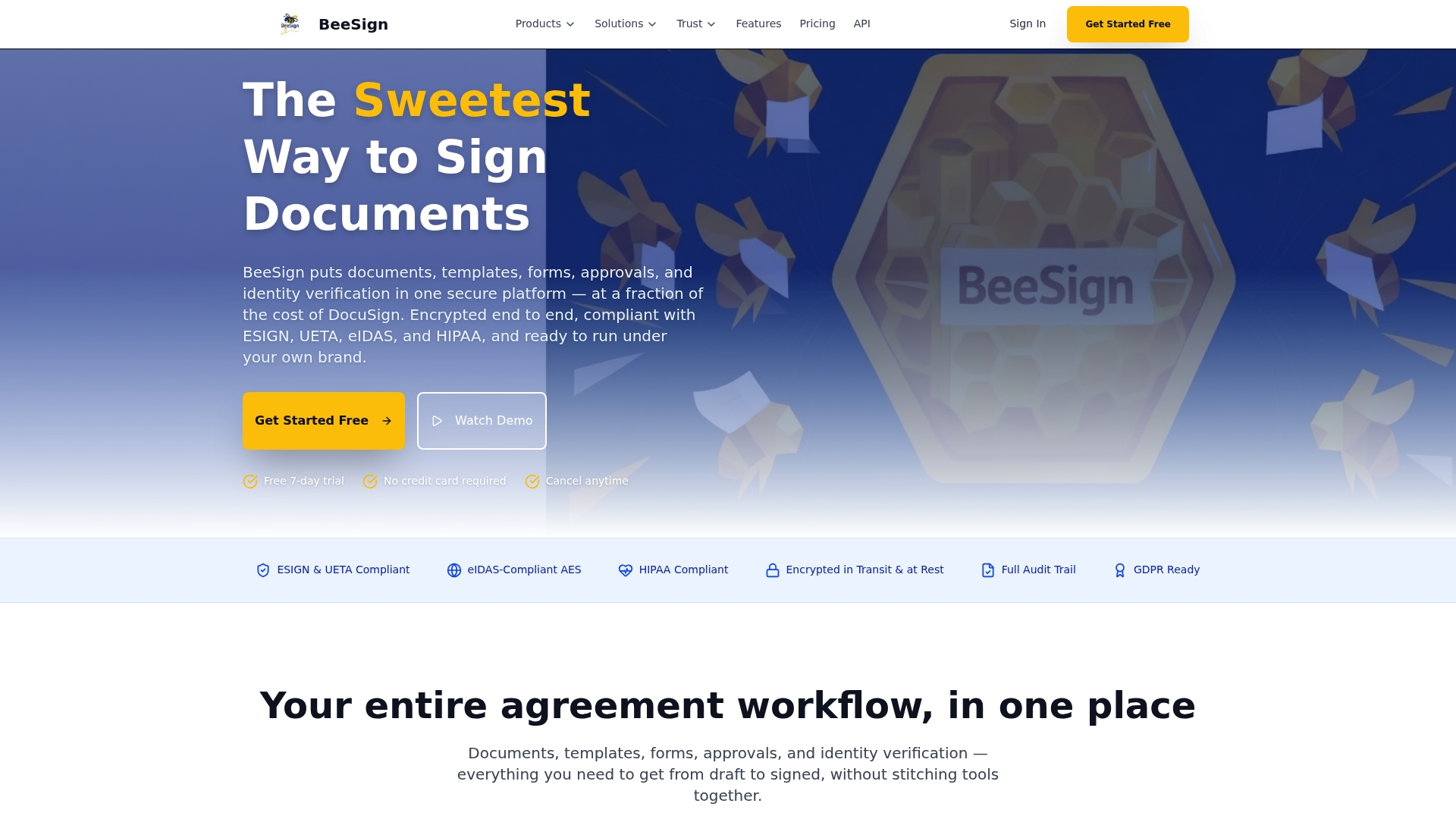
If you want to see the routing controls in action, start with a demo of the Beesign platform. Engineering teams that want to automate envelope creation and set routing programmatically should head straight to the API reference, which documents how to trigger sequential, parallel, and grouped hybrid flows directly from your own systems. Businesses evaluating white-label deployment for their own branded signing experience can request an enterprise trial to test custom domains and bring-your-own-cloud storage against their own compliance checklist. Every new account starts with a 7-day free trial, so you can test a real workflow against your own documents before committing to anything.
FAQ
What is the main difference between sequential and parallel signing?
Sequential signing releases a document to one signer at a time in a set order, while parallel signing sends it to every signer simultaneously so they can sign independently, on their own schedule.
Which is faster, sequential or parallel signing?
Parallel signing is faster in almost every case because no signer waits on another signer’s inbox; sequential signing is only as fast as its slowest link in the chain.
When should I use sequential signing instead of parallel?
Use sequential signing when one signer’s decision genuinely depends on another signer’s prior action, such as a legal review that must clear before finance approves budget.
Can a workflow combine sequential and parallel signing?
Yes. Hybrid or grouped routing is common, typically running an internal sequential approval chain before releasing the document to external parties for parallel signing.
Does Beesign support both sequential and parallel signing workflows?
Beesign includes workflow toggles that let you configure sequential, parallel, or hybrid routing per document, backed by a full audit trail and identity verification on every signer.
How do I prevent order-sensitive errors in a parallel signing flow?
Lock data fields as read-only once one signer populates them, add validation rules for critical fields, and group any signers who share a real dependency into a separate sequential sub-step.
Recommended
Ready to transform your workflow?
Start using BeeSign today and experience the future of document signing