Supply Chain Contracts: A Guide for Procurement and Legal Teams
Learn what a supply chain contract is and how it defines buyer-supplier relationships, ensuring clear terms and risk allocation before signing.

A supply chain contract is a legally binding agreement between a buyer and a supplier that sets the terms for delivering goods or services, covering price, quantity, delivery, quality, and remedies. Three things matter most: it controls what each party must do and when, it allocates risk between buyer and supplier, and you need to know whether a master agreement or a standalone purchase order governs each transaction.
- What it controls: Price and pricing formulas, order quantities, delivery schedules, quality specifications, payment terms, and warranties.
- Practical effect: Allocates inventory risk, cost exposure, and liability before a dispute arises, giving both parties enforceable remedies.
- Action cue: Before signing any PO, confirm whether a master supply agreement already governs the relationship. If it does, the master terms usually prevail over conflicting PO language.
Key Takeaways
A supply chain contract is the enforceable framework that allocates price, quantity, delivery, and liability risk between buyer and supplier before a dispute arises.
| Point | Details |
|---|---|
| Define your contract hierarchy | Confirm whether a master agreement governs before issuing any purchase order, and include an order-of-precedence clause. |
| Insist on explicit price-adjustment formulas | Indexed pricing with caps and floors protects both parties better than fixed prices on long-term agreements. |
| Require clear SLAs with financial consequences | SLAs without defined remedies are unenforceable suggestions; tie each metric to a service credit or cure right. |
| Assign named obligation owners | Every active SLA needs a named owner in operations who measures and reports performance on a defined cadence. |
| Beesign for contract execution | Beesign’s templates, approval workflows, identity verification, and blockchain audit trails reduce cycle time and obligation leakage across your supplier base. |
Table of Contents
- What does a supply chain contract actually cover?
- What are the main types of supply chain contracts?
- Which contract clauses carry the most financial risk?
- How does a supply chain contract move through its lifecycle?
- What are the biggest risks in supply chain contracts and how do you reduce them?
- When should you use a master agreement versus individual purchase orders?
- How does digitizing contracts reduce cycle time and obligation leakage?
- What does it realistically cost and how long does it take?
- The case for cross-functional collaboration in contract management
- Beesign makes supply chain contract execution faster and more reliable
- Sources
What does a supply chain contract actually cover?
A supply agreement is more than a handshake formalized on paper. It is the enforceable framework that controls recurring transactions between buyer and supplier, covering price adjustment mechanisms, termination rights, warranties, force majeure, limitation of liability, insurance, and dispute resolution. When a term is missing, a court does not simply split the difference. It applies a statutory default.
In the U.S., most sales-of-goods contracts fall under UCC Article 2, which provides gap-filling rules the parties may not have intended. If your contract says nothing about delivery terms, UCC Article 2 may place the risk of loss on the buyer the moment the seller hands goods to a carrier, even if the buyer expected delivery to their dock. Deliberate drafting is how you opt out of those defaults.
The core areas a well-drafted supply agreement addresses:
- Price and pricing formulas: Fixed rates, indexed adjustments, volume tiers, and price-review windows.
- Quantity and ordering: Minimum order quantities, forecasting obligations, and flexibility bands.
- Delivery terms and risk of loss: Incoterms or UCC-based delivery points, carrier responsibility, and inspection windows.
- Quality specifications and acceptance: Technical specs, testing protocols, and what constitutes a conforming delivery.
- Warranties: Express warranties on goods, implied warranty disclaimers, and remedies for breach.
- Payment and invoicing: Net terms, late-payment interest, and invoice dispute procedures.
- Term, renewal, and termination: Contract duration, auto-renewal triggers, notice periods, and termination-for-convenience rights.
Businesses use supply chain agreements for a clear reason: they reduce uncertainty, secure continuity of supply, allocate cost and inventory risk ahead of time, and create enforceable remedies when something goes wrong. A well-structured agreement also gives procurement leverage in renegotiation because the baseline terms are already documented. For a practical checklist of what to include in vendor-facing agreements, the vendor compliance requirements checklist is a useful companion.
What are the main types of supply chain contracts?
Supply contract design directly affects supply-chain performance and risk allocation. Choosing the wrong structure can leave one party absorbing demand volatility the other party should share. The taxonomy below covers the most common forms.
Master Supply Agreement (MSA) Sets baseline commercial and legal terms for an ongoing relationship. Individual purchase orders reference the MSA for transaction specifics. Best for high-volume, long-term supplier relationships where renegotiating terms on every PO is impractical.
Purchase Order (PO) A standalone transaction document that becomes a binding contract on acceptance. Appropriate for one-off or low-frequency purchases where no ongoing relationship exists. Risk: if the supplier’s acknowledgment form contains different terms, a “battle of the forms” dispute can arise under UCC Article 2.
Fixed-Price Contract Price is locked for the contract term regardless of input cost changes. The supplier bears commodity and inflation risk. Works well when input costs are stable and the buyer wants budget certainty.
Variable-Price (Indexed) Contract Price adjusts according to a commodity index, CPI, or agreed formula. Demand risk stays with the buyer; price risk is shared. Common in raw-material supply where commodity swings are significant.
Buyback Contract The manufacturer or supplier credits the buyer for unsold inventory returned at the end of a season or period. This shifts demand risk back toward the supplier and encourages the buyer to order more aggressively. MIT supply chain research identifies buyback contracts as a practical tool for reducing the problem of double marginalization in supply chains.
Quantity-Flexibility (Option) Contract The buyer commits to a base quantity and holds options to purchase additional units at a pre-agreed price. Demand risk is shared: the supplier gets a guaranteed floor, the buyer gets upside flexibility. Common in technology component supply where demand forecasts are uncertain.
Revenue-Sharing Contract The supplier charges a lower wholesale price in exchange for a share of the buyer’s revenue. This aligns incentives: both parties benefit when the buyer sells more. Used widely in media, entertainment, and some retail categories.
Consignment Agreement The supplier retains ownership of goods until the buyer sells or uses them. Inventory risk stays with the supplier; the buyer pays only on consumption. Useful for slow-moving or high-value components.
Service-Level Agreement (SLA) / Service Contract Governs ongoing services rather than physical goods, defining performance metrics, uptime, response times, and remedies for non-performance. Often embedded within a broader MSA for logistics, warehousing, or 3PL relationships.
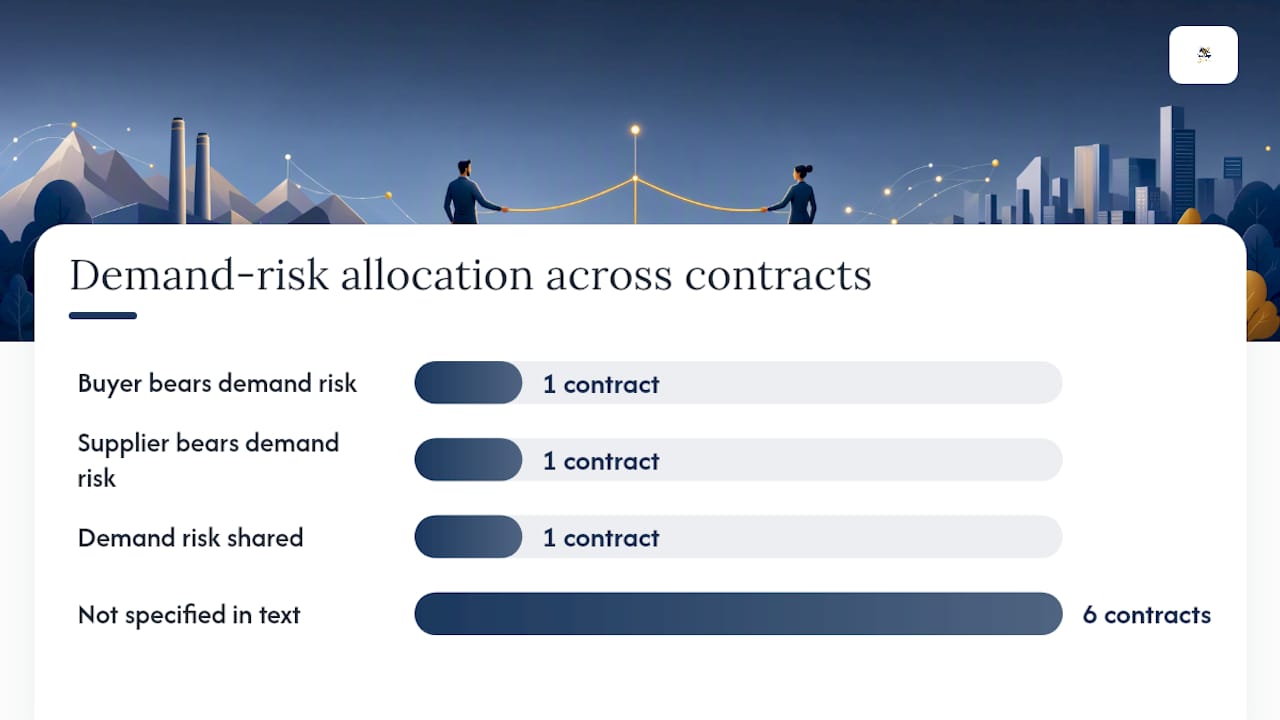
| Contract type | When to use | Who bears demand risk | Pricing shape | Complexity |
|---|---|---|---|---|
| Master Supply Agreement | Long-term, high-volume supplier | Shared via PO terms | Negotiated per PO | Medium |
| Purchase Order only | One-off or infrequent buys | Buyer | Fixed at issuance | Low |
| Fixed-price | Stable inputs, budget certainty needed | Supplier | Flat rate | Low |
| Variable/indexed | Volatile commodities | Shared | Formula-driven | Medium |
| Buyback | Seasonal retail, fashion, publishing | Supplier (unsold return credit) | Wholesale + credit | High |
| Quantity-flexibility | Tech components, uncertain demand | Shared (floor + options) | Base + option premium | High |
| Revenue-sharing | Media, retail, entertainment | Shared | Low wholesale + % revenue | High |
| Consignment | High-value or slow-moving goods | Supplier | Pay-on-consumption | Medium |
Which contract clauses carry the most financial risk?
The clauses below are where money changes hands when things go wrong. Review each one carefully before signing, and push back on language that leaves your exposure open-ended.
Price and price adjustments Fixed pricing without an adjustment mechanism can destroy supplier margins during inflation, leading to quality cuts or supply disruption. Insist on a formula: index reference, review frequency, and a cap on any single adjustment. Avoid language that gives either party unilateral repricing rights.
Quantity, forecasting, and minimums Minimum purchase commitments create hard liability if demand falls short. Tie any minimum to a rolling forecast window and include a true-up mechanism. Buyers should resist binding minimums beyond 90 days without a demand-adjustment clause.
Delivery terms and Incoterms Specify the exact delivery point and which Incoterm applies. “FOB Origin” means the buyer owns the goods the moment they leave the supplier’s dock and bears all transit risk. “FOB Destination” keeps risk with the supplier until delivery. For fulfillment and warehousing relationships, the fulfillment center agreement guide covers delivery and risk-of-loss clauses in detail.

Quality specifications and acceptance testing Define “conforming goods” precisely. Attach technical specifications as an exhibit. Set a clear acceptance window (e.g., 10 business days after delivery) and state what happens to rejected goods. Vague acceptance language is one of the most common sources of payment disputes.
SLAs and performance metrics SLAs without financial consequences are suggestions. Tie each metric to a remedy: service credits, right to cure, or termination trigger. Define measurement methodology so both parties calculate performance the same way.
Force majeure Overly broad force majeure clauses can excuse non-performance for almost any disruption. Narrow the definition to genuinely unforeseeable events, require prompt notice (typically 5–10 business days), and include a time limit after which either party may terminate.
Limitation of liability and consequential-damage waiver Most supply contracts cap liability at the value of the affected purchase order or a multiple of annual contract value. Understand the practical recovery ceiling before signing. A warranty clause that promises full replacement is worth little if the liability cap is low relative to the contract value.
Termination and change control Include termination-for-convenience with adequate notice depending on lead times, termination-for-cause with a cure period, and a change-control process for spec changes. Without change control, informal email approvals can override written contract terms.
Dispute resolution and governing law Specify governing law, jurisdiction, and whether disputes go to arbitration or litigation. For international supply agreements, arbitration under ICC or AAA rules is often faster and more enforceable than cross-border litigation.
Pro Tip: When negotiating limitation-of-liability clauses, check whether the cap applies per-incident or in aggregate over the contract term. An aggregate cap that resets annually gives you far more practical recovery than a single per-incident ceiling.
Sample clause language (concise, practitioner-friendly):
Price adjustment: “The unit price shall be adjusted annually on January 1 by the percentage change in the [Producer Price Index, commodity code X] for the preceding 12-month period, subject to a maximum increase of 5% per adjustment period.”
Force majeure notice: “A party claiming force majeure shall provide written notice within seven (7) business days of the triggering event. If the force majeure event continues for more than sixty (60) days, either party may terminate this Agreement on thirty (30) days’ written notice.”
Acceptance: “Buyer shall have ten (10) business days after delivery to inspect goods and provide written notice of rejection. Goods not rejected within that period are deemed accepted.”
Note the interaction between warranty and liability cap: if your warranty clause promises replacement of defective goods but your liability cap is set at one month’s purchase value, the practical remedy for a large defective shipment may be far smaller than the warranty language implies. Negotiate these two clauses together.
How does a supply chain contract move through its lifecycle?
Contract management is where negotiated intent either survives or gets lost. Cross-functional collaboration between procurement, legal, and operations is the single most important factor in preventing obligation leakage, the gradual erosion of contract terms between signature and day-to-day execution.
The lifecycle in order:
- Request and specification: Procurement defines scope, volume, and technical requirements. Operations provides acceptance criteria. Finance sets payment term parameters.
- Negotiation: Procurement leads on commercial terms (price, volume, delivery). Legal reviews risk allocation, liability, and compliance clauses.
- Legal review and redline: Legal marks up the contract, flags non-standard terms, and escalates material risk issues to leadership.
- Approval workflow: Internal approvals follow a defined authority matrix. Contracts above a threshold value require CFO or legal sign-off before execution.
- Signature and execution: Both parties execute via wet signature or legally compliant e-signature. The executed copy is stored in a central repository with version control.
- Supplier onboarding and SLA activation: Operations confirms acceptance criteria are live. SLA measurement begins from the agreed start date, not from signature.
- Performance monitoring: Procurement and operations track delivery performance, quality metrics, and invoice accuracy against contract terms on a defined cadence.
- Amendment and change control: Any change to scope, price, or specs follows the contract’s change-control process. Informal approvals are documented and formalized.
- Renewal or termination: Renewal notices are triggered before expiry. Termination follows the notice period and wind-down obligations in the contract.
Roles at a glance:
- Procurement: Negotiates commercial terms, manages supplier relationship, tracks performance.
- Legal: Reviews enforceability, flags risk, ensures regulatory compliance.
- Operations: Defines acceptance tests, monitors SLA performance, escalates quality issues.
- Finance: Approves payment terms, tracks invoice accuracy, manages accruals.
Pro Tip: Obligation leakage most often happens between steps 5 and 6. The contract is signed, but SLA thresholds are never formally activated in your CLM or ERP. Fix this by making SLA activation a mandatory checklist item in your supplier onboarding workflow, tied to the contract start date, not the signature date.
For teams building out approval workflows, the legal contract approval workflow guide covers authority matrices and escalation paths in practical detail.
What are the biggest risks in supply chain contracts and how do you reduce them?
Every supply agreement carries a set of risks that are predictable enough to address in the contract itself. The ones below cause the most financial and operational damage when left unmanaged.
- Supply disruption: Mitigate with dual-sourcing clauses, safety-stock obligations on the supplier, and a defined escalation path in the contract when lead times slip beyond a threshold.
- Price spikes: Use indexed pricing formulas with caps and floors rather than fixed prices on long-term agreements. A formula with an annual cap gives the supplier relief without exposing the buyer to uncapped cost increases.
- Quality failures: Require pre-shipment inspection rights, define acceptance testing protocols in a technical exhibit, and specify remedies (replacement, credit, or price reduction) for non-conforming goods.
- Force majeure overreach: Narrow the definition, require prompt written notice, and include a termination right if the event extends beyond 60 days. Broad force majeure language became a significant issue during global supply disruptions and remains a negotiation priority.
- Ambiguous liability: Ensure the limitation-of-liability clause and the warranty clause are drafted together. Mismatched caps and warranty promises create unenforceable remedies.
- Obligation leakage: Tie SLA thresholds to contract activation steps in your CLM system. Assign a named owner for each obligation. Review compliance monthly, not just at renewal.
- Regulatory and compliance risk: Include representations and warranties on regulatory compliance (export controls, sanctions, labor standards), and require the supplier to notify you of any compliance breach within a defined window. The vendor compliance requirements checklist provides a practical starting point for structuring these requirements.
- Unclear remedies: Every material obligation should carry a stated remedy. “Supplier shall use best efforts” is not an enforceable standard. Replace it with a specific metric and a defined consequence.
When should you use a master agreement versus individual purchase orders?
The hierarchy works like this: a master supply agreement sets the baseline commercial and legal terms for the entire relationship, and individual purchase orders reference it for transaction-specific details such as quantity, price, and delivery date. When the two conflict, the master agreement usually governs, but only if the contract says so explicitly.
Use a master agreement when:
- You expect to transact with the same supplier more than three or four times per year.
- The relationship involves variable specs, pricing tiers, or ongoing service obligations.
- You want to avoid renegotiating liability, warranty, and dispute resolution terms on every PO.
- The supplier has significant leverage and you need a signed framework before issuing orders.
- Your legal team flags that the supplier’s standard PO acknowledgment contains terms you cannot accept.
Use standalone POs when:
- The purchase is genuinely one-off with no expectation of repeat business.
- The goods are commodity items with no quality or spec complexity.
- The transaction value is below your internal threshold for full contract review.
Scenario 1: Manufacturing long-term component supply A mid-size electronics manufacturer sources a critical microcontroller from a single supplier. Volume is 50,000 units per quarter, specs change with each product generation, and lead times are 16 weeks. The right structure is an MSA covering price-adjustment formulas, change-control for spec updates, a minimum purchase commitment with a demand-adjustment window, and a buyback or quantity-flexibility option for excess inventory. Individual POs reference the MSA and specify the exact part number, quantity, and delivery date for each order.
Scenario 2: Seasonal retail SKU A retail buyer sources a private-label product for a single holiday season. Volume is fixed, specs are finalized, and there is no expectation of repeat orders. A well-drafted standalone PO with clear delivery terms, acceptance criteria, and a buyback clause for unsold units is sufficient. An MSA would add negotiation time without meaningful benefit.
Pro Tip: Always include a “order of precedence” clause in your MSA stating that MSA terms govern over conflicting PO terms. Without it, a supplier’s PO acknowledgment with different liability language can create a genuine dispute about which document controls.
How does digitizing contracts reduce cycle time and obligation leakage?
Paper-based and email-driven contract processes create version-control failures, missed renewal dates, and SLA obligations that never get tracked. Digitizing supply chain contracts with a CLM platform and e-signature workflow addresses each of those failure points directly.
Key benefits of digitization:
- Faster approval cycles: Automated routing cuts internal approval time by eliminating email chains and manual handoffs. Teams using structured contract approval software report significantly shorter cycle times from draft to execution.
- Centralized version control: A single repository means procurement, legal, and operations always work from the same document. No more “which version did we sign?” disputes.
- Obligation tracking: CLM platforms flag SLA thresholds, renewal dates, and notice deadlines automatically, reducing the obligation leakage that occurs when contracts are stored in email folders.
- Automated renewals and alerts: Set alerts 90–120 days before expiry so renewal negotiations start on your timeline, not the supplier’s.
- Auditable signature trails: Every signature event is timestamped and logged. Blockchain-anchored timestamps provide tamper-evident proof of when a document was signed and by whom.
- Identity verification: Government ID capture and biometric face matching during supplier onboarding reduce the risk of fraud and ensure you are contracting with the correct legal entity.
How Beesign maps to supply chain contract pain points:
- Reusable templates for master supply agreements and standard POs reduce drafting time and enforce clause consistency across the supplier base.
- Approval workflows route contracts to the right internal stakeholders based on contract value and type, with a full audit trail of who approved what and when.
- Identity verification (government ID capture and biometric matching) confirms the contracting party’s identity during vendor onboarding, a step that manual processes routinely skip.
- Blockchain timestamp proof provides a tamper-evident record of every signature event, supporting enforceability under ESIGN, UETA, and eIDAS.
- REST API automation connects Beesign to your ERP or procurement system so PO issuance triggers a signature request automatically, without manual intervention.
Implementation steps for rolling out e-signature and CLM with suppliers:
- Pilot with your top five suppliers by transaction volume. Map their contract types to Beesign templates.
- Configure approval workflows to match your internal authority matrix.
- Set up automated renewal alerts for all active master agreements.
- Integrate the Beesign API with your ERP to automate PO signature requests.
- Run a 30-day compliance check: confirm every active contract has an obligation owner and a monitoring cadence.
Pro Tip: When onboarding suppliers to an e-signature platform, send a brief one-page guide explaining the signing process and the legal validity of e-signatures under ESIGN and UETA. Supplier hesitation is almost always about unfamiliarity, not legal objection. Removing that friction cuts your average signature cycle from days to hours.
For teams evaluating the broader tool landscape, the best contract workflow tools guide covers the key features to look for in a CLM and e-signature platform.
What does it realistically cost and how long does it take?
Negotiation timelines and costs vary significantly by contract complexity. Here are realistic benchmarks to use when planning resources.
Typical timelines:
- Simple purchase order: 1–3 business days from draft to execution, assuming no significant redlines.
- Standard master supply agreement with templates: 2–6 weeks, covering internal drafting, supplier redlines, legal review, and approval workflow.
- Complex manufacturing agreement with technical specs, IP provisions, and acceptance testing protocols: 2–4 months, particularly when the supplier’s legal team is involved and technical exhibits require engineering input.
Primary cost drivers:
- Negotiation bandwidth: Internal procurement and legal FTE hours are the largest cost. A complex MSA can consume many hours of combined internal time.
- Outside counsel: Legal review for high-value or high-risk agreements typically runs several thousand dollars depending on complexity and counsel rates. Not every supply agreement needs outside counsel, but any contract with significant IP, indemnity, or cross-border provisions usually does.
- Technical acceptance testing: Engineering time to define and validate acceptance criteria adds cost that is easy to underestimate at the outset.
- Insurance and escrow: Some agreements require supplier insurance certificates or escrow arrangements, adding both cost and administrative overhead.
- Integration and automation: Initial setup of CLM templates, API integrations, and approval workflows requires upfront investment but reduces per-contract cost significantly at scale.
Pro Tip: When budgeting for a new supplier relationship, estimate internal FTE hours at fully-loaded cost, add outside counsel if the contract value or risk profile warrants it, and factor in recurring monitoring overhead (quarterly reviews, annual renewals). Contracts that look cheap to negotiate often carry hidden costs in ongoing management.
The case for cross-functional collaboration in contract management
The most persistent failure in supply chain contract management is not bad drafting. It is the handoff gap between the team that negotiates the contract and the team that lives with it every day.
Procurement secures favorable terms. Legal ensures they are enforceable. Then the contract goes into a folder, and operations runs the relationship based on habit and email threads rather than the actual agreement. SLA thresholds go unmeasured. Price-adjustment windows pass unexercised. Termination notice deadlines are missed because no one owns the calendar.
A practical weekly rhythm that closes this gap:
- Joint intake meetings: When a new supplier relationship is being scoped, procurement, legal, and operations sit together to define requirements before drafting begins. This prevents the common failure of legal reviewing a contract that operations has already informally agreed to change.
- Standardized templates: A library of pre-approved clause language means legal does not review the same standard warranty clause from scratch on every agreement. Reserve legal review time for genuinely non-standard terms.
- Defined SLA owners: Every SLA in every active contract has a named owner in operations who is responsible for measuring and reporting performance. This is a named person, not a team.
- Monthly contract health checks: A 30-minute monthly review of active contracts against performance data catches obligation drift before it becomes a dispute.
When an issue escalates from a performance miss to a potential warranty or liability dispute, that is the moment to move it from operations to legal. The threshold is not “the supplier is underperforming.” The threshold is “the supplier’s performance may trigger a contractual remedy or expose us to a claim.” Governance suggestion: document that escalation threshold in your contract management policy and review it annually.
Actionable habits to adopt immediately:
- Require written acceptance criteria in every statement of work before legal review begins.
- Maintain a single source of truth for all active contract obligations, whether that is a CLM platform or a structured spreadsheet with named owners.
- Schedule quarterly supplier performance reviews on the calendar at contract execution, not when a problem arises.
- When a supplier requests a change to specs or delivery terms, route it through the contract’s change-control process rather than approving it by email.
Beesign makes supply chain contract execution faster and more reliable
Managing supply chain agreements across dozens of suppliers, each with their own templates and signing preferences, creates real friction. Beesign centralizes the entire execution workflow: reusable master agreement templates, multi-step approval routing, identity verification for vendor onboarding, and blockchain-anchored audit trails that satisfy ESIGN, UETA, and eIDAS requirements. You get a complete record of every signature event without chasing down paper or managing email threads.
The REST API connects Beesign directly to your ERP or procurement system, so a PO issued in your system triggers a signature request automatically. No manual handoff, no version-control risk. For teams with strict data governance requirements, Beesign’s bring-your-own-cloud option keeps contract data within your own infrastructure. Start a 7-day free trial at Beesign and see how much faster your supplier agreements can move from draft to executed.
Sources
The sources below provide authoritative legal and practitioner detail for the topics covered in this guide.
- Supply Agreements: Key Terms for a Reliable Supply Chain
- Supply Chain Contracts: Types, Key Terms, and Clauses - LegalClarity
- MIT Lecture notes — Examples: buyback, option, revenue-sharing contracts
- Supply contract - an overview — ScienceDirect
Recommended
Ready to transform your workflow?
Start using BeeSign today and experience the future of document signing