What Is eSignature Technology? A Clear 2026 Guide
Learn what eSignature technology is and how it streamlines signing documents. Discover its benefits in our clear 2026 guide.

eSignature technology is defined as any electronic method used to capture a person’s intent to sign a document, legally recognized under the U.S. ESIGN Act (15 USC §7001) as “any electronic sound, symbol, or process” attached to a record with signing intent. That definition is deliberately broad. It covers a typed name at the bottom of an email, a checkbox click on a web form, a finger-drawn signature on a tablet, and a cryptographically secured digital signature backed by Public Key Infrastructure (PKI). The industry term you will encounter most often is “electronic signature,” with “digital signature” referring specifically to the cryptographic subset. Understanding where those two terms diverge is the fastest way to choose the right tool for your situation.
What is eSignature technology, and how does it work?
Electronic signature technology captures signing intent through electronic means and attaches evidence of that intent to a document. The simplest form is a typed name or a click on an “I Agree” button. Intent drives legal validity, not the technology used to capture it. That principle sits at the core of both the U.S. ESIGN Act and the European eIDAS regulation.
Digital signatures go further. They use asymmetric encryption, where a signer holds a private key and shares a public key. When you sign a document, the software creates a cryptographic hash of the document’s contents and encrypts it with your private key. Anyone with your public key can decrypt that hash and compare it to a freshly generated hash of the document. If the two hashes match, the document is untampered and the signature is authentic.

Electronic vs. digital signatures: the core distinction
The table below maps the two signature types against the criteria that matter most for real decisions.
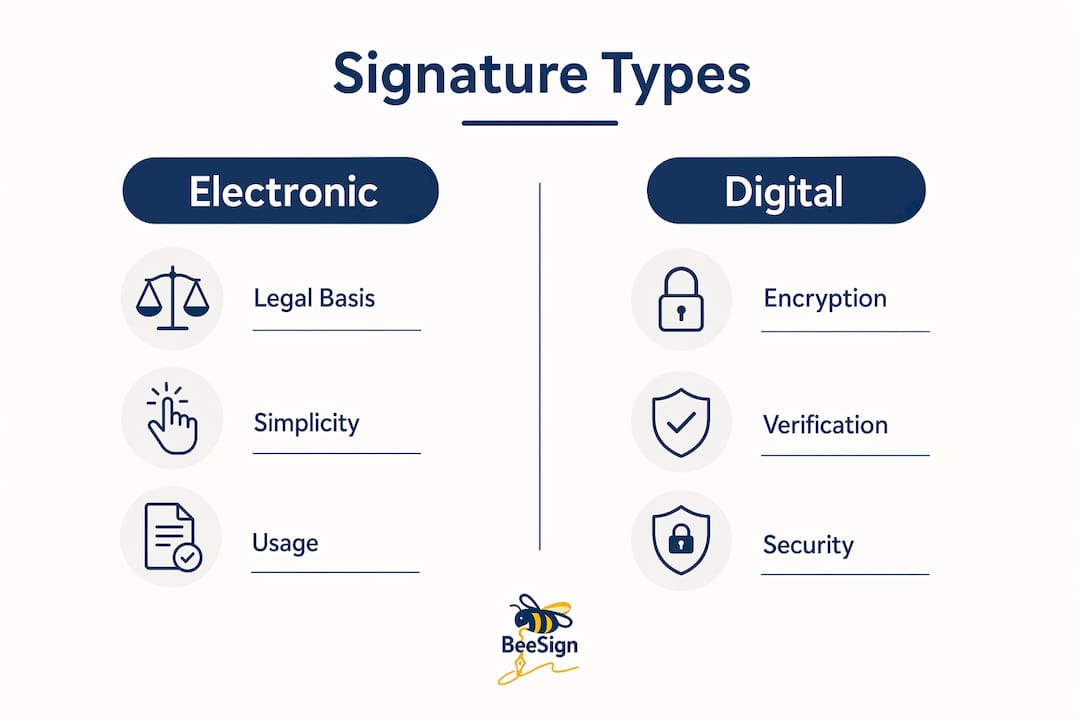
| Criteria | Electronic signature | Digital signature |
|---|---|---|
| Legal basis | U.S. ESIGN Act, eIDAS | U.S. ESIGN Act, eIDAS (advanced/qualified tier) |
| Identity verification | Signer’s assertion | Certificate authority or trust service provider |
| Tamper detection | Audit trail, metadata | Cryptographic hash via PKI |
| Best for | Low-to-medium risk transactions | High-value, regulated, or compliance-driven transactions |
| Device requirement | Any device with a browser | Requires digital certificate |
Certificate authorities and trust service providers issue digital certificates that bind a public key to a verified identity. Without that binding, a public key is just a string of characters with no proven owner.
Pro Tip: If you sign contracts worth more than a few thousand dollars or operate in a regulated industry, ask your vendor whether their platform issues certificates through an accredited trust service provider. That single question separates basic tools from compliant ones.
What are the benefits and real-world applications of eSignatures?
Electronic signature technology improves productivity by letting you sign and send documents from any device, at any time, without printing a single page. That convenience compounds fast across an organization. A sales team that closes agreements in hours instead of days wins deals that slower competitors lose.
The practical applications span nearly every professional context:
- Contracts and sales agreements: Send, sign, and store in one workflow. No courier, no scanner.
- HR documents: Offer letters, NDAs, and benefits enrollment forms reach new hires before their first day.
- Real estate: Purchase agreements and lease documents that once required in-person meetings now close remotely.
- Healthcare: Patient consent forms and HIPAA-compliant authorizations move digitally without compromising privacy.
- Financial services: Loan applications, account openings, and compliance disclosures all support electronic signing under U.S. law.
Beyond speed, eSignatures reduce paper costs, lower the risk of lost documents, and create automatic audit trails. Every signed document carries a timestamp, IP address, and signer email. That metadata becomes your evidence if a signature is ever disputed. You also gain device independence. A client in a different time zone signs on a smartphone. You receive the completed document instantly.
What security risks should you understand before using eSignature tools?
Risks associated with eSignatures include identity impersonation, unauthorized document access, document tampering, and phishing attacks targeting signing links. Knowing these risks does not mean avoiding eSignatures. It means choosing a platform that addresses them directly.
Here is how to protect yourself and your organization:
- Require multi-factor authentication (MFA). A signing link alone is not enough. MFA adds a second verification step, such as a one-time code sent to the signer’s phone, before the document opens.
- Choose platforms using hardware security modules (HSMs). Cloud-based digital certificates secured by HSMs protect private keys from extraction, even if the server is compromised.
- Verify audit trail completeness. A full audit trail logs every action: document opened, viewed, signed, and downloaded. Gaps in that trail weaken your legal position.
- Watch for phishing on signing links. Attackers send fake signing requests that mimic legitimate platforms. Train your team to verify sender domains before clicking.
- Confirm compliance certifications. Platforms compliant with ESIGN, eIDAS, and HIPAA have passed external audits. Compliance is not a marketing claim. Ask for documentation.
“A digitally signed document contains a cryptographic hash encrypted with the signer’s private key. Any change to the document after signing, even a single byte, produces a different hash and immediately invalidates the signature. That mathematical guarantee is what makes digital signatures the gold standard for high-stakes transactions.”
Pro Tip: Never use a free or unbranded signing tool for documents that carry legal, financial, or medical weight. The cost of a compliant platform is a fraction of the cost of a disputed signature in court.
How do you choose the right eSignature solution?
Choosing between basic electronic signatures and advanced digital signatures comes down to three factors: transaction risk, regulatory environment, and the evidentiary standard you need to meet. A low-risk internal approval needs a typed name and an audit trail. A regulated financial contract needs PKI-backed identity verification.
Start by mapping your use cases to a risk level. Then ask these questions when evaluating any platform:
- Does the platform comply with the U.S. ESIGN Act, eIDAS, and any sector-specific law such as HIPAA?
- Does it offer identity verification through certificate authorities or trust service providers for high-risk transactions?
- Does it maintain a complete, tamper-evident audit trail for every document?
- Can it integrate with your existing tools through an API to automate signing workflows?
- Does it support white-label deployment if your brand or data-residency requirements demand it?
The answers to those questions narrow the field quickly. A platform that cannot answer “yes” to compliance and audit trail questions is not suitable for professional use. For most organizations, the right choice is a platform that supports both basic electronic signatures for everyday documents and advanced digital signatures for regulated transactions, all within a single interface.
You can also review a detailed breakdown of ESIGN Act compliant software to understand exactly what legal standards your chosen tool must meet before you commit.
Key Takeaways
eSignature technology is legally valid under the U.S. ESIGN Act and eIDAS when it captures signing intent, and digital signatures add cryptographic proof of identity and document integrity for high-risk transactions.
| Point | Details |
|---|---|
| Legal foundation | The U.S. ESIGN Act and eIDAS recognize electronic signatures when signing intent is clearly captured. |
| Electronic vs. digital | Digital signatures use PKI and cryptographic hashing; basic eSignatures rely on intent and audit trails. |
| Security essentials | MFA, HSMs, and complete audit trails are the minimum for any professional signing platform. |
| Risk-based selection | Match signature type to transaction risk: basic for low-stakes, digital certificates for regulated deals. |
| Compliance check | Confirm ESIGN, eIDAS, and sector-specific compliance before deploying any eSignature solution. |
The distinction most professionals still get wrong
The most common mistake I see professionals make is treating “electronic signature” and “digital signature” as interchangeable. They are not. One is a legal concept. The other is a technical implementation. Conflating them leads to real problems: companies use a basic click-to-sign tool for a high-value contract, then discover their audit trail does not meet the evidentiary standard required in their jurisdiction.
The second mistake is assuming that any eSignature is automatically secure. A typed name on a PDF emailed back and forth has almost no tamper protection. A PKI-backed digital signature, by contrast, makes document alteration mathematically detectable. The technology gap between those two is enormous, even though both qualify as “electronic signatures” under U.S. law.
What I find encouraging is the direction the industry is moving. Cloud-based certificates managed by accredited trust service providers have made high-assurance signing accessible on any device. You no longer need a USB hardware token to sign with a qualified digital certificate. That shift removes the last real friction point for professional adoption.
My advice: treat eSignature selection as a compliance decision, not a convenience decision. Map your document types to risk levels before you choose a platform. And if you are unsure where a transaction falls, default to the higher-assurance option. The cost of over-securing a document is zero. The cost of under-securing one can be significant.
— Mustafa Abusharkh
Beesign makes compliant document signing straightforward
Beesign centralizes contracts, templates, and identity verification in one platform built for both individuals and organizations. It supports compliance with the U.S. ESIGN Act, eIDAS, and HIPAA, and offers full audit trails on every document. For businesses that need data control, Beesign’s white-label solution lets you run the entire signing experience under your own brand and domain, with data staying in your infrastructure.
Whether you handle sales agreements, real estate closings, or HR paperwork, Beesign’s electronic signature platform gives you the tools to sign, track, and store documents securely. The API automates signing workflows so your team spends less time chasing approvals and more time closing deals. Visit Beesign to see how the platform fits your workflow.
FAQ
What is the legal definition of an electronic signature?
Under the U.S. ESIGN Act, an electronic signature is defined as any electronic sound, symbol, or process attached to a record by a person with the intent to sign. Intent is the legal requirement, not the specific technology used.
How is a digital signature different from an electronic signature?
A digital signature is a cryptographic subset of electronic signatures that uses PKI to verify signer identity and detect document tampering. An electronic signature is the broader legal category that includes both simple and cryptographic methods.
Is an eSignature legally binding?
Yes. Electronic signatures are legally binding in the United States under the ESIGN Act and in the European Union under eIDAS, provided the signature captures the signer’s intent and meets applicable evidentiary standards. Learn more about what makes a signature valid under current law.
What security risks come with eSignature tools?
The main risks are identity impersonation, phishing attacks on signing links, unauthorized document access, and document tampering. Platforms that use MFA, HSMs, and complete audit trails mitigate these risks effectively.
When should I use a digital signature instead of a basic eSignature?
Use a digital signature for high-value contracts, regulated transactions, or any document where you need cryptographic proof of identity and tamper detection. Basic electronic signatures are sufficient for low-risk internal approvals and routine agreements.
Recommended
Ready to transform your workflow?
Start using BeeSign today and experience the future of document signing