Blockchain Timestamps vs PKI Signatures: What Each Proves
Blockchain timestamps and PKI signatures prove different things. Learn what each shows about a document, how ESIGN and UETA apply, and how to combine them.

A PKI signature and a blockchain timestamp answer two different questions. A PKI-based digital signature shows that a specific private key processed a document, and a certificate can tie that key to an identity. A blockchain timestamp shows that a specific fingerprint of a document existed at or before a certain moment and has not changed since. Neither one replaces the other. For most U.S. business agreements, the strongest record uses both ideas together with identity verification and a complete audit trail.
This guide explains how each method works, what each one does and does not prove, how ESIGN and UETA treat them, and what to look for in an e-signature platform that uses blockchain timestamp proof.
TL;DR
- PKI signatures answer “who and what.” They bind a key pair to a signer and show whether the content changed after signing.
- Blockchain timestamps answer “when and unchanged.” They anchor a hash of the document, not the document itself, and they do not name a signer.
- U.S. law does not require either one. ESIGN and UETA say a signature cannot be denied effect only because it is electronic. Intent, consent, attribution and record retention carry the weight.
- The practical answer is layering. Identity verification, an audit trail and a timestamp anchor cover gaps that any single method leaves open.
- Some documents are outside ESIGN and UETA altogether, such as wills and certain court documents, so check the document type first.
Table of Contents
- The core difference in one table
- How a PKI signature works
- How a blockchain timestamp works
- Blockchain vs PKI: where each one fits
- What U.S. law says
- Which one do you need?
- What to look for in a blockchain-enabled e-signature platform
- How BeeSign approaches it
- Try it on your own documents
- Our perspective
- FAQ
- Sources
The core difference in one table
| Question | PKI digital signature | Blockchain timestamp proof |
|---|---|---|
| What does it prove? | A specific private key processed this document | A specific hash existed at or before a block time |
| Does it identify a person? | Can, when a certificate authority vouches for the key holder | No, not by itself |
| Does it detect later edits? | Yes, the signature fails to verify if content changes | Yes, the recomputed hash no longer matches the anchor |
| Does it prove the signer’s intent? | No, intent comes from the signing process and records | No |
| What is recorded publicly? | Usually nothing about the document | Only a fingerprint, never the document |
| Who do you trust? | The certificate authority and the key holder | The chain’s ordering and consensus |
| Main weakness | Key theft or a weak identity check before issuance | Says nothing about who anchored the hash or what happened before |
The rest of this article unpacks each row.
How a PKI signature works
Public key infrastructure, or PKI, is a system for binding a public key to the name or identity of a person or organization. Each signer holds a private key and a matching public key. A certificate, issued by a trusted certificate authority, links the public key to an identity.
When a document is signed, software computes a hash of the content and encrypts that hash with the private key. Anyone with the public key can check the result. According to OsloMet’s document forensics course material, a digital signature is cryptographic proof that a specific private key processed the document, and it is verified with the matching public key. A hash on its own is just a fingerprint computed from the content, used to check whether the file has changed.
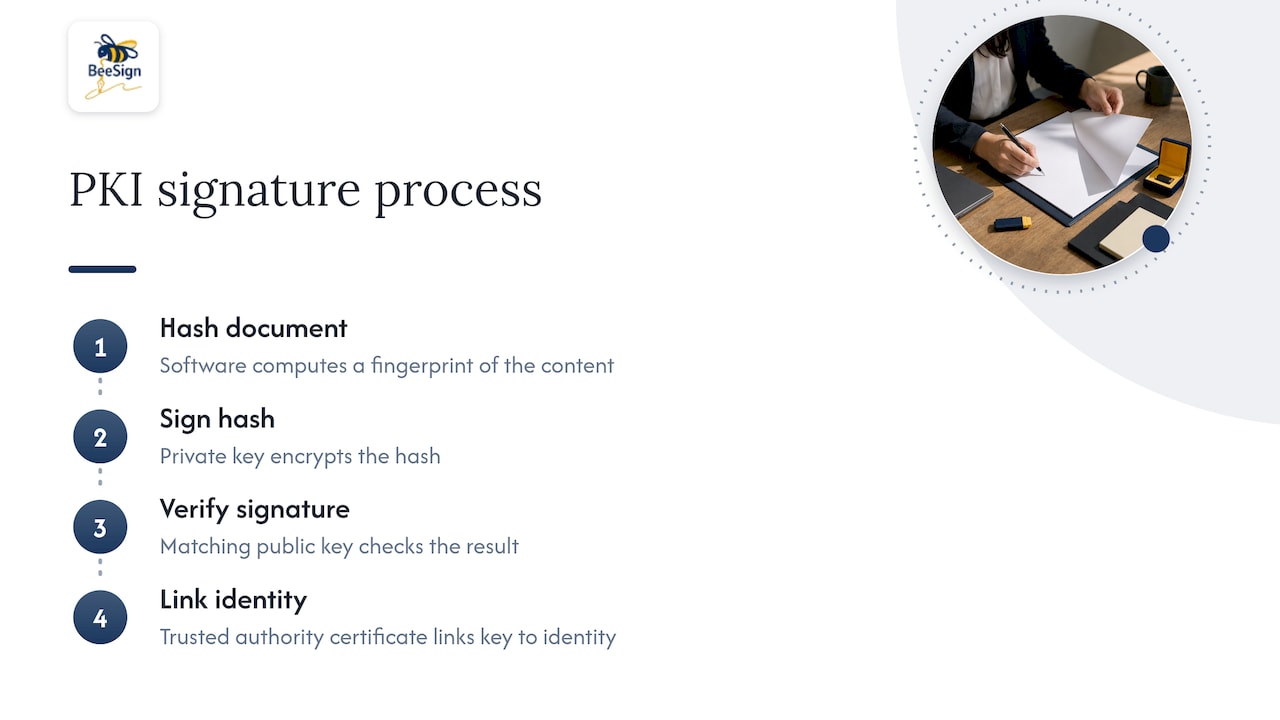
That last point answers a common question: a hash is not a signature. Anyone can compute a hash of a file. Only the holder of a private key can produce a valid signature over it.
What a PKI signature gives you
- Integrity. Change one character after signing and verification fails.
- Authentication, when the certificate is trustworthy. The certificate says whose key it is, and the strength of that claim depends on how carefully the authority checked the person.
- Non-repudiation support. A signer who controlled the key has a hard time claiming the signature is not theirs, though that is a matter of evidence, not magic.
What it does not give you
A signature proves key control. It does not prove the person understood the document, intended to be bound, or was alone at the keyboard. Those facts come from the signing workflow: the consent screen, the identity check, the access log. It also does not, on its own, prove when signing occurred, because a signing time can be set by the signer’s own clock unless a trusted timestamp is added.
How a blockchain timestamp works
A blockchain timestamp starts with a hash function such as SHA-256, which reduces a file of any size to a short, fixed-length fingerprint. That fingerprint, not the file, is written to or committed in a blockchain. The ordering of blocks and the network’s consensus supply the time.
This answers another frequent question: can a blockchain timestamp documents without putting them on the chain? Yes. The document stays where you keep it. Only the fingerprint is anchored. Later, anyone can recompute the hash of the document they hold and check it against the anchored value. If the two match, the document is the same as the one that was anchored. OsloMet’s material describes exactly this: the hash goes to the chain rather than the document, and verification means recomputing the hash and checking its inclusion.
What a blockchain timestamp proves
Per the OsloMet module on digital signatures, timestamps and blockchain, a blockchain timestamp proves that a specific hash was submitted to the chain at or before the block timestamp, and that the document has not been modified since anchoring. That is a strong, narrow claim, and it is useful: it fixes a document in time in a way that nobody, including you, can quietly rewrite later.
What it does not prove
The same source is explicit about the limits. A timestamp alone does not prove who anchored the hash, what the document says, that the document was created at the moment of anchoring, or that it is legally valid. A court-focused article in Frontiers in Blockchain makes a related point: an immutable, tamper-evident record gives confidence about the form of a transaction, but the chain cannot guarantee that the information entered into it was accurate or legitimate.
In plain terms: a timestamp tells you the file existed and is unchanged. It does not tell you who agreed to it.
Blockchain vs PKI: where each one fits
The two methods are not rivals competing for the same job. Think of them as covering different parts of the record.
- Identity. PKI can bind a key to a person through a certificate. A blockchain anchor cannot. In a workflow that needs to show who signed, identity comes from verification steps such as checking a government ID and matching a face to it, plus a log of the signing session.
- Time. A PKI signature carries a signing time only as reliable as the clock behind it. An independent timestamp fixes the time outside the signer’s control. A blockchain anchor is one way to do that.
- Integrity. Both detect changes. A signature breaks if the content changes. An anchor no longer matches the recomputed hash.
- Longevity. Certificates expire and can be revoked, so long-term validation needs planning. An anchored hash stays in the chain’s history, though proving its meaning still needs the surrounding records.
- Privacy. Both can be built so that the document itself is never published. With anchoring, only the fingerprint leaves your systems.
Cost and effort
Cost depends on the design. OsloMet’s material notes that traditional timestamp authority services range from free to commercial, while open blockchain timestamping through OpenTimestamps is free apart from Bitcoin transaction fees, which public calendar servers batch across many users. For a business, the more relevant cost is workflow: who issues certificates, who manages keys, and who keeps the evidence file. A platform that handles these steps removes most of the burden from your team.
What U.S. law says
The legal question in the United States is not “which cryptography did you use?” It is whether the electronic record and signature meet the requirements of the federal ESIGN Act and your state’s version of UETA.
As summarized by the American Bar Association, under ESIGN and UETA a signature or contract cannot be denied legal effect or enforceability solely because it is electronic, an electronic record can satisfy a writing requirement, and an electronic signature can satisfy a signature requirement. Neither law names PKI or blockchain as required. They are technology-neutral.
Two practical consequences follow.
Attribution and intent matter most. You need to be able to show that the signature is attributable to the person and that they meant to sign. A cryptographic method helps, but it is the whole signing record that persuades. Our guide on what makes an eSignature valid walks through those elements, and Are Electronic Signatures Legally Binding? covers the legal baseline.
Record integrity and retention matter too. Attorneys at Lowenstein Sandler note in their article on the recipe for enforceability that ESIGN and UETA call for records that accurately reflect the data and stay accessible, which means archiving securely to prevent unauthorized changes, and that an audit trail supports the integrity and trustworthiness of the record. This is where a hash anchor is a natural fit: it gives you an independent way to show the archived record has not changed.
Blockchain evidence in U.S. courts
Blockchain evidence is not settled federal territory. A Fordham Law Review article observes that the United States has not federally recognized the utility of blockchain evidence, although several states have passed legislation on its reliability and authenticity. So treat a blockchain timestamp as supporting evidence that strengthens your record, not as a legal presumption. Your state’s rules and your attorney’s advice decide how much weight to place on it.
Documents outside ESIGN and UETA
The ABA article also lists categories outside the scope of ESIGN and UETA: documents governed by Article 2 of the Uniform Commercial Code, powers of attorney, wills and codicils, trusts, divorce decrees, official court documents, and court orders and notices. For those, no choice between PKI and blockchain makes an e-signature effective. Confirm the document type with your counsel before you design a workflow around it. If your team works with the EU as well, the difference between signatures and seals under eIDAS is covered in eIDAS Signatures vs Seals.
Which one do you need?
Use the document and the risk to decide.
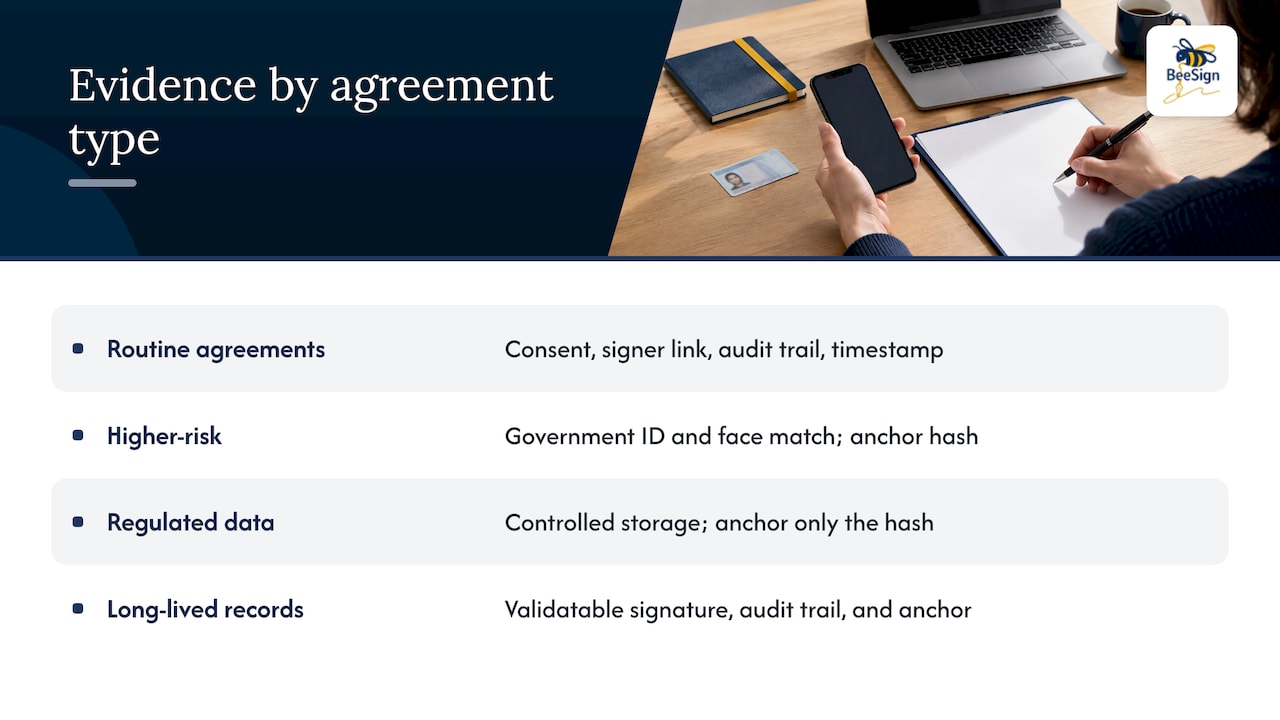
Routine agreements (NDAs, vendor forms, onboarding paperwork, enrollment forms). A well-run e-signature process with consent capture, a signer-specific link and a complete audit trail satisfies ESIGN and UETA for most of these. A timestamp anchor adds cheap, independent proof that the final file is unchanged.
Higher-value or disputed-risk agreements (leases, property transactions, large vendor contracts). Add identity verification: capture a government ID and match the signer’s face to it. Then anchor the final document’s hash. If a dispute arises, you can show who signed, how they were verified, what the session log says, and that the stored file matches the anchored fingerprint.
Regulated data (healthcare, education records). Where the content is sensitive, keep the document in storage you control and anchor only the hash. Our UETA-compliant platform checklist covers what to confirm with any vendor.
Long-lived records you may need to defend years later. Combine a signature that can be validated over time, a preserved audit trail and an anchor. Our guide to tamper-evident audit trails explains how the pieces reinforce each other, and legal holds on e-signature records covers keeping evidence intact when a dispute looms.
What to look for in a blockchain-enabled e-signature platform
When a vendor says “blockchain” or “PKI,” ask what the feature actually does for your record.
- A hash-only anchor. Your document should never be published. Only its fingerprint should be anchored.
- Identity evidence tied to the signer. An anchor says nothing about who signed, so the platform needs its own identity checks, such as government ID capture and biometric face matching.
- A complete audit trail. Timestamps, IP data, consent, and every event from send to completion. See how an audit trail works in eSignatures and electronic signature with audit trail explained.
- Storage you control. Where the finished document lives affects compliance. Bring-your-own-cloud storage keeps files inside your infrastructure.
- Reusable templates and automation. Evidence is only useful if every document goes through the same process. Templates, approvals and an API make that consistent.
- Predictable pricing. Per-envelope fees make teams skip safeguards on small documents. Flat pricing removes the temptation.
- Honest claims. Be wary of any vendor that presents a timestamp as a complete legal guarantee. As the sources above show, it proves existence and integrity, not identity or intent.
How BeeSign approaches it
BeeSign is a workflow-native e-signature platform. Signing, reusable templates, fillable forms and approvals sit alongside identity verification, complete audit trails and blockchain timestamp proof, so the evidence is created as part of the normal workflow instead of being bolted on afterward. We design it with ESIGN, UETA, eIDAS, HIPAA and GDPR requirements in mind.
For teams that want to run the service as their own, White Label & BYOC lets you use a custom domain, your branding and branded emails, and keep storage in your own cloud. If you need to connect signing to your own systems, we build and maintain integrations for you, and our API supports automation.
Try it on your own documents
Start with a document type you sign often: a vendor agreement, an offer letter, a lease addendum. Set up a template, turn on identity verification where the risk justifies it, and review the audit trail and timestamp proof on the completed file. The Individual plan is listed at $9.99 per month on our pricing page, and every subscription starts with a 7-day free trial. Larger teams can contact sales about Enterprise plans and custom integrations.
If identity checks are your priority, see Identity Verification. For the core signing workflow, see Electronic Signatures.
Our perspective
Most of the confusion about blockchain and PKI comes from asking which one is “more secure.” That is the wrong question. They secure different facts. A signature secures the link between a key and a document. A timestamp anchor secures the link between a document and a moment. Neither secures the link between a document and a real person, and that link is what you will be asked about if an agreement is ever challenged.
That is why we build around the workflow rather than around one cryptographic feature. Identity verification, a complete audit trail and blockchain timestamp proof each cover a gap the others leave. Keep the document in your own cloud, anchor only its fingerprint, and you can show integrity and timing without exposing the content.
We also think the evidence should be cheap to produce every time. That is why we price on a flat rate with no per-envelope fees, so your team applies the same safeguards to a routine form as to a major contract. Evidence you create consistently is evidence you can rely on.
Mustafa Abusharkh
FAQ
Is a blockchain timestamp a legally binding signature?
No. A timestamp shows that a hash existed at or before a certain time and has not changed. It does not show who agreed to the document or that they meant to be bound. Under ESIGN and UETA, validity depends on a signature or record that is attributable to a person with intent to sign, so a timestamp works as supporting evidence.
What is the difference between a hash and a digital signature?
A hash is a fixed-length fingerprint computed from a file’s content, and anyone can compute it. A digital signature is made with a private key, so it shows that the key holder processed the document. A signature typically signs the hash, which is why changing the file breaks verification.
Does blockchain store the document itself?
Not in a sound design. The document is hashed on your side, and only the fingerprint is anchored. To verify later, you recompute the hash of the file you hold and compare it with the anchored value. This keeps the content private while still proving it is unchanged.
Is blockchain evidence accepted in U.S. courts?
It is treated as evidence, not as an automatic presumption. Legal commentary notes that the United States has no federal recognition of blockchain evidence, though some states have passed their own laws. Pair a timestamp with identity verification and an audit trail, and ask your attorney how your state treats it.
Which documents can’t be signed electronically under ESIGN and UETA?
The American Bar Association lists wills and codicils, trusts, powers of attorney, divorce decrees, official court documents, court orders and notices, and documents governed by Article 2 of the UCC. Confirm the category of any document with your attorney before you move it into an electronic workflow.
Sources
- Digital Signatures, Timestamps, and Blockchain, OsloMet document forensics module
- Blockchain in the courtroom, Frontiers in Blockchain
- Blockchain Evidence: How Smart Litigators Can Keep It Out, Fordham Law Review
- Electronic Signatures, Agreements & Documents: The Recipe for Enforceability, Lowenstein Sandler
- Electronic Signatures and Legal Opinions, American Bar Association
Recommended
Ready to transform your workflow?
Start using BeeSign today and experience the future of document signing