Co-Branding Agreements in Ecommerce: A Practical Guide
Discover how a co-branding agreement in ecommerce creates opportunities for brands to collaborate, enhance product offerings, and share revenue.

A co-branding agreement in ecommerce is a written contract that lets two brands jointly develop, launch, and sell a co-branded product or bundle while allocating IP rights, revenue, quality control obligations, and termination mechanics between them. Before you brief counsel or approach a partner, confirm your draft covers every item on this checklist:
- IP and trademark licensing (scope, permitted treatments, style guide)
- Revenue mechanics (Net Revenue definition, share formula, payment timing)
- Quality standards (specifications, sample approvals, inspection rights)
- Approval workflow (who approves what, and within how many days)
- Term and territory (duration, renewal, geographic scope)
- Termination mechanics (notice period, cure window, post-termination IP use)
- Inventory handling (run-off period, unsold stock disposition)
- Warranties and indemnities (product liability, IP ownership, insurance)
- Data and privacy (permitted customer-data uses, FTC disclosure obligations)
- Dispute resolution (escalation path, governing law, arbitration vs. litigation)
Resources like the BloombergLaw drafting guide, Practical Law’s mark cross-license templates, and BigCommerce’s ecommerce co-branding explainer are the three most useful starting points when you build out each of these sections.
Key Takeaways
A co-branding agreement in ecommerce is only as strong as its Net Revenue definition, quality-control workflow, and termination mechanics — get those three right and the rest of the contract follows.
| Point | Details |
|---|---|
| Define Net Revenue precisely | Specify every deduction (returns, marketplace fees, chargebacks) before signing to prevent reconciliation disputes. |
| Lock in quality-control approvals | Use specification documents, sample approvals, and a deemed-approval clause to protect both marks and keep launches on schedule. |
| Plan termination and inventory exit | Negotiate a sell-through period (typically 60–90 days) and a buyback option for unsold co-branded stock before the deal is signed. |
| Measure against specific KPIs | Track sales volume, conversion rate, and return rate quarterly; define what shortfall triggers renegotiation or exit. |
| Use Beesign for workflow and signing | Reusable templates, role-based approvals, and a full audit trail reduce drafting time and protect both parties post-launch. |
Table of Contents
- What is a co-branding agreement in ecommerce, and how does it differ from co-marketing?
- When does co-branding make sense for your ecommerce business?
- What formats do co-branding partnerships take in ecommerce?
- What legal clauses must every ecommerce co-branding agreement include?
- How should you structure pricing, revenue share, and payment terms?
- How do trademark licensing and quality control work under U.S. law?
- What compliance and legal risks should you watch for in U.S. ecommerce co-branding?
- How do you go from partner selection to a live co-branded product?
- Sample clause language you can adapt for your agreement
- How to sign, store, and manage your co-branding agreements efficiently
- What experienced operators know that the standard guides miss
- Beesign makes co-branding agreements faster to sign and easier to manage
- Sources
What is a co-branding agreement in ecommerce, and how does it differ from co-marketing?
A co-branding agreement is a contract that governs a partnership where two brands create a single, jointly marketed product or service carrying both identities. According to Shopify’s co-branding guide, co-branding combines two brand identities to create a joint product marketed under both names, which can expand audience reach for online merchants. That joint-product element is the defining feature.
Co-marketing is different. In a co-marketing arrangement, each brand keeps its own product and the two simply promote each other, sharing media spend or audience access. No new product is created, and IP licensing is minimal. Licensing, meanwhile, is a one-way grant: one brand permits another to use its mark on a product the licensee controls, without any joint creation or shared commercial identity.
Understanding the distinction matters when you negotiate scope. If your partner expects a co-marketing deal but you need a co-branded SKU with shared revenue, you are negotiating two different contracts.
| Dimension | Co-branding | Co-marketing | Licensing |
|---|---|---|---|
| New product created | Yes | No | No |
| Both brands on product | Yes | Promotional only | Licensee brand only |
| IP licensing required | Mutual | Minimal | One-way |
| Typical commercial split | Revenue share or margin split | Shared ad spend | Royalty per unit |
| Who owns the product | Defined in agreement | Each party owns theirs | Licensee |
When does co-branding make sense for your ecommerce business?
BigCommerce notes that ecommerce co-branding commonly appears as product bundles, limited collections, and joint listings, making it practical for online stores seeking new audiences. Here are the formats you will encounter most often:
- Limited-edition product collaborations: Two brands co-design a product with both logos on the packaging, sold for a defined window. The Apple Watch Nike edition is a textbook example: Apple’s hardware and software paired with Nike’s running expertise and athlete community to create a product neither brand could have positioned as credibly alone.
- Bundles and marketplace co-listings: Complementary products from two brands sold as a single SKU on Amazon, Shopify, or a brand’s own store. The bundle inherits both brands’ credibility and can command a higher price point.
- Influencer or creator co-brands: A brand and a creator jointly develop a product line under a shared name. This format requires FTC disclosure language in the agreement because the creator’s promotional activity is inseparable from the commercial relationship.
- White-label co-brands for distribution partners: One brand manufactures; a distribution partner sells under a co-branded label. This is common in private-label grocery and supplements, but increasingly appears in ecommerce accessories and apparel.
The Doritos Locos Taco, developed jointly by Frito-Lay and Taco Bell, illustrates the joint-product model at scale: each brand contributed a core competency (chip flavor and seasoning vs. fast-food execution and distribution), and the resulting product was something neither could have launched independently. Smaller ecommerce operations can apply the same logic. HubSpot’s co-branding examples show that smaller brands can partner with micro-influencers or complementary local brands to co-brand successfully, accessing new audiences with lower upfront costs than a traditional product launch.
Choose co-branding when you need complementary capabilities you do not have in-house, access to an audience your brand cannot reach organically, or shared production and fulfillment resources that reduce per-unit cost.
What formats do co-branding partnerships take in ecommerce?
Co-branding is not a single structure. The format you choose shapes the contract you need.
Ingredient co-branding places a supplier’s branded component inside a finished product: think Gore-Tex in a jacket or a named processor in a laptop. The agreement must specify IP attribution on packaging, quality testing standards for the ingredient, and what happens if the ingredient brand changes its formulation.
Joint product lines are the most contract-intensive format. Both brands share design, manufacturing, and marketing decisions, so the agreement needs clear decision-making authority, approval timelines, and a mechanism for resolving creative disagreements before they stall production.
Dual-branded bundles are operationally simpler because each brand retains its own product. The contract focuses on pricing control, how returns are handled when the bundle is split, and which brand owns the customer relationship post-purchase.
Endorsement and influencer co-brands require FTC disclosure language built directly into the agreement. The contract should specify where disclosures appear (product page, social posts, email), the exact language required, and what happens if the creator publishes non-compliant content.
Limited-edition drops are time-boxed by design. The agreement needs a hard end date, a sell-through target, and a clear plan for unsold inventory, because leftover co-branded stock sitting in a warehouse after the partnership ends creates both financial and brand-control problems.
On marketplace listings, co-branding affects who controls the product detail page, which brand’s seller account hosts the listing, and how reviews are attributed. On Amazon, the brand registry holder controls the listing, so the agreement should name which party registers the co-branded ASIN and what happens to that listing at termination.
What legal clauses must every ecommerce co-branding agreement include?
The BloombergLaw drafting guide is clear: a co-branding agreement must facilitate each party’s use of the other’s trademarks and specify rules for a jointly agreed co-brand mark, with clauses covering use, quality control, and termination. Here is what that looks like clause by clause.
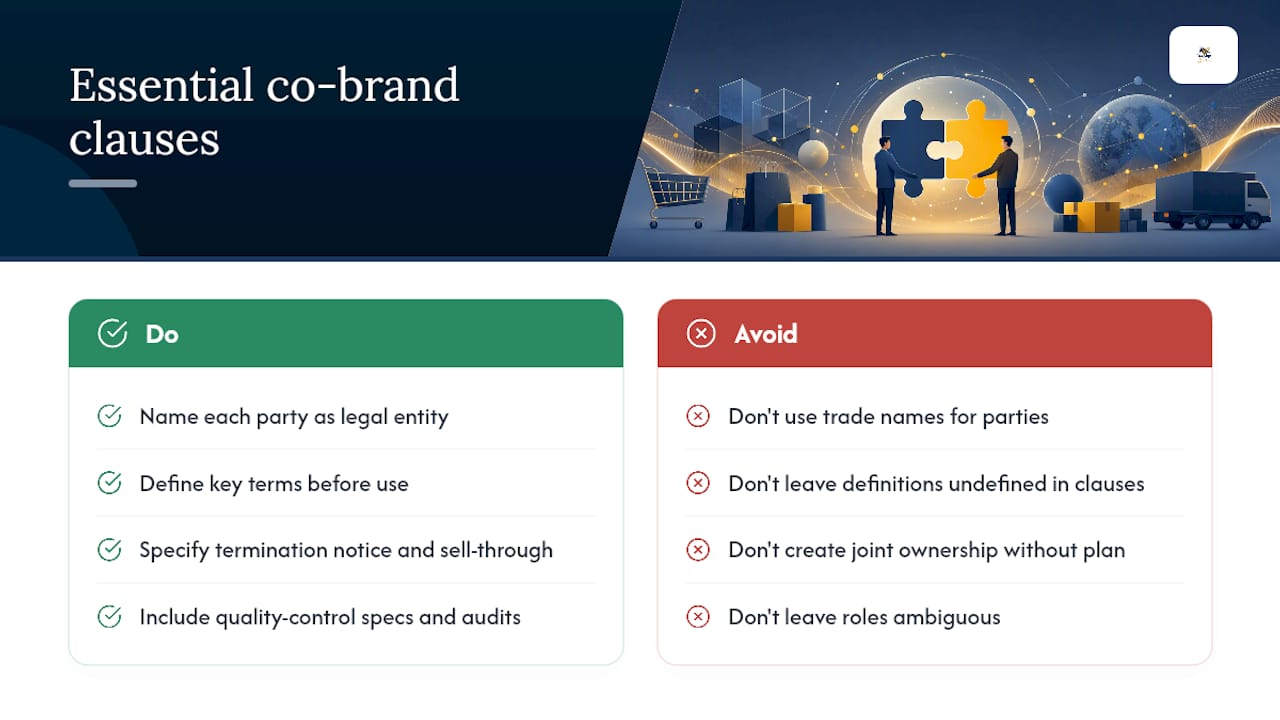
Parties, recitals, and definitions. Name each party precisely (legal entity, not trade name). The recitals state the commercial purpose. Definitions carry the most drafting risk: define “Co-Brand Mark,” “Approved Materials,” “Net Revenue,” “Launch Date,” and “Territory” before any operative clause references them.
IP and trademark licensing. State which marks each party licenses to the other, the scope (non-exclusive is standard), permitted treatments, and what the licensee cannot do (sublicense, modify, use outside the Territory). If a new co-brand mark is created, the agreement must say who owns it. Joint ownership is legally possible but operationally messy; one party owning it with a license back to the other is cleaner and easier to unwind at termination.
Roles and responsibilities. Specify who designs, manufactures, sources, packs, labels, and lists the product. Ambiguity here is the most common cause of launch delays. Attach a responsibility matrix as an exhibit if the product involves multiple handoffs.
Quality control and approvals. Per the BloombergLaw guide, quality-control clauses are non-negotiable in any trademark license. Include specification documents, pre-production sample approvals, periodic audit rights, corrective-action deadlines (typically 30 days), and the licensor’s right to suspend use of its mark if standards are not met.
Commercial terms. Cover revenue share formula, minimum guarantees, pricing authority (who sets the retail price), promotional spend responsibilities, and how refunds and returns reduce the revenue pool.
Warranties, indemnities, and liability. Each party warrants it owns the IP it is licensing. Indemnities should be mutual and cover third-party IP claims. Cap liability at a defined multiple of fees paid in the prior 12 months. Require each party to carry product liability insurance with the other named as an additional insured.
Data and privacy. Define what customer data each party may access, the permitted uses, retention limits, and which privacy laws govern (at minimum, applicable state laws and FTC rules). If the co-brand involves email marketing, specify consent requirements and CAN-SPAM compliance.
Termination and exit. Lawdit’s co-branding guide identifies termination handling for remaining inventory as a key negotiation point. Include notice periods (90 days is common for planned termination), cure windows for breach (30 days is standard), a post-termination sell-through period for existing inventory (typically 60–90 days), and a hard deadline after which all co-branded materials must be destroyed or returned.
Pro Tip: Set approval windows in calendar days, not business days, and include a deemed-approval clause: if the approving party does not respond within the window (e.g., 10 calendar days), the submission is automatically approved. This single clause prevents the most common launch delay in co-brand agreements.
How should you structure pricing, revenue share, and payment terms?
Getting the commercial terms right protects both parties from reconciliation disputes once the product is live. Yotpo’s co-branding overview notes that clear definitions of Net Revenue and cost structures are critical to preventing post-launch disputes.
-
Choose a revenue model. The four common structures are: (a) percentage of Net Revenue, where each party receives a defined share of revenue after deductions; (b) fixed royalty per unit sold, which is simpler to audit; © cost-plus, where one party is reimbursed manufacturing costs plus a margin; and (d) margin-split, where gross margin is divided by a formula after COGS. Hybrid models combine a base royalty with a revenue-share kicker above a sales threshold.
-
Define Net Revenue precisely. A workable definition: “Net Revenue means gross sales revenue actually received from end customers, less returns and refunds processed, promotional discounts applied at checkout, marketplace platform fees (including Amazon referral fees and Shopify transaction fees), applicable sales taxes collected, and chargebacks confirmed by the payment processor.” Attach this as a defined term and cross-reference it in every commercial clause.
-
Set payment timing and audit rights. Monthly or quarterly payment cycles are standard. Each payment should be accompanied by a statement showing gross sales, each deduction category, and the resulting Net Revenue. Either party should have the right to audit the other’s books once per year on 30 days’ notice, with costs borne by the auditing party unless the audit reveals an underpayment above a threshold (typically 5%).
-
Handle chargebacks and returns in shared models. Specify whether chargebacks reduce Net Revenue in the period they are confirmed or the period of the original sale. Returns should reduce Net Revenue in the period the refund is processed. Misalignment on timing creates reconciliation headaches.
-
Include minimum guarantees and co-investment clauses. A minimum annual guarantee protects the brand that licenses its mark. Co-investment clauses specify who funds paid advertising, at what level, and how co-op spend is reconciled against the revenue share.
How do trademark licensing and quality control work under U.S. law?
U.S. trademark law under the Lanham Act requires a licensor to maintain quality control over how its mark is used. A licensor that grants a trademark license without adequate quality-control provisions risks “naked licensing,” which can result in loss of trademark rights entirely. That is not a theoretical risk: courts have found marks abandoned when licensors failed to monitor quality.
Licensing scope. The license grant should specify: the exact marks licensed (by registration number where possible), the permitted field of use (the co-branded product only), the Territory, the term, and whether the license is exclusive or non-exclusive. Exclusivity is a significant commercial concession; if you grant it, attach a minimum sales threshold that triggers reversion to non-exclusive if not met.
Co-brand mark ownership. If the parties create a new combined mark, decide ownership before launch. One-party ownership with a license back is the cleaner structure. Joint ownership requires both parties to consent to any enforcement action, which can paralyze you if the relationship sours.
Quality-control workflow. A practical workflow runs in three stages: (1) specification sign-off before production begins; (2) pre-production sample approval, with a defined rejection remedy (re-submission within 15 days); and (3) periodic production audits, at least annually, with the right to pull samples from live inventory. Document every approval in writing.
Pro Tip: Build an escalation path into your quality-control clause: if a corrective-action notice is not resolved within 30 days, the licensor may suspend the license for the affected product line without triggering a breach of the broader agreement. This gives you leverage without blowing up the entire partnership.
Insurance and recalls. Require each party to carry commercial general liability insurance of at least $1 million per occurrence and $2 million aggregate, with the other party named as an additional insured. The agreement should specify who leads a product recall, who bears recall costs, and how those costs are allocated against the revenue share.
What compliance and legal risks should you watch for in U.S. ecommerce co-branding?
- Lanham Act / false endorsement. Using a partner’s mark in a way that implies a broader endorsement than the agreement covers can expose you to false-endorsement claims. Every marketing asset should be reviewed against the approved materials list before publication.
- FTC endorsement and disclosure rules. When a creator or influencer is a party to the co-brand, their promotional posts are commercial speech. The FTC requires clear and conspicuous disclosure of the material connection. The agreement should specify the exact disclosure language, placement (above the fold on digital content), and a takedown obligation if non-compliant content is published.
- Product safety. If the co-branded product is subject to CPSC regulations (children’s products, electronics, apparel) or FDA oversight (food, supplements, cosmetics), the agreement must name the responsible party for regulatory filings, testing, and any recall. Do not leave this ambiguous.
- Data sharing. Customer purchase data, email lists, and behavioral data are valuable and regulated. The agreement should limit each party’s use of shared customer data to the co-brand program only, prohibit resale or use for unrelated marketing, and require deletion of shared data within a defined period after termination.
- User-generated content. If the co-brand generates UGC (reviews, social posts), the agreement should address who moderates it, who responds to complaints, and how reputationally damaging content is handled.
- Mismatched brand values. A partner’s public controversy can damage your brand overnight. Include a reputational-harm termination right: either party may terminate on 30 days’ notice if the other party’s conduct materially damages the co-brand’s reputation, with no cure period required.
How do you go from partner selection to a live co-branded product?
Partner selection and due diligence. Confirm audience overlap, quality standards, and fulfillment capability before you negotiate. Run a trademark search on the partner’s marks (USPTO database) to verify ownership and check for conflicting registrations. Request proof of product liability insurance and references from prior commercial partners.
Negotiation sequencing. Start with a term sheet covering the commercial structure, IP ownership, and key operational responsibilities. A signed term sheet is not a binding contract, but it surfaces deal-breakers before you spend money on legal drafting. Move to a full agreement once the term sheet is agreed.
Implementation tasks. Artwork approvals, packaging specifications, and listing templates should be finalized before the agreement is signed, not after. Attach approved artwork as an exhibit. Align the marketing calendar with inventory lead times: a product that arrives in the warehouse two weeks after the campaign launches is a common and avoidable problem.
Post-launch governance. Investopedia’s co-branding definition notes that co-branding must be measured against specific KPIs. Schedule quarterly performance reviews covering sales volume, conversion rate, return rate, and customer acquisition cost. Define in the agreement what KPI shortfall triggers a renegotiation or termination right, so neither party is surprised when the conversation happens.

Sample clause language you can adapt for your agreement
These snippets are starting points. Have counsel review and adapt them to your specific deal structure.
-
Co-brand mark license grant: “[Party A] hereby grants to [Party B] a non-exclusive, non-transferable, royalty-free license to use the Co-Brand Mark solely in connection with the Approved Materials and the Co-Branded Product during the Term and within the Territory, subject to [Party A]'s quality-control requirements set forth in Section [X].”
-
Net Revenue definition: “‘Net Revenue’ means gross revenue actually received by the selling party from end-customer sales of the Co-Branded Product, less: (a) returns and refunds; (b) promotional discounts applied at point of sale; © marketplace platform fees; (d) sales taxes collected; and (e) confirmed chargebacks.”
-
Approval workflow and deemed approval: “Each party shall respond to any approval request within ten (10) calendar days of receipt. Failure to respond within that period shall constitute approval of the submitted materials.”
-
Inventory run-off: “Upon termination or expiration, the selling party may continue to sell existing Co-Branded Product inventory for a period not to exceed ninety (90) days (‘Run-Off Period’). All unsold inventory remaining after the Run-Off Period shall be destroyed or returned to the manufacturing party at the selling party’s cost.”
-
Post-termination IP restriction: “Upon expiration of the Run-Off Period, each party shall immediately cease all use of the other party’s marks and the Co-Brand Mark, and shall destroy or return all Approved Materials containing those marks.”
Negotiable vs. non-negotiable language for in-house counsel:
- Non-negotiable: quality-control audit rights, post-termination IP cessation, mutual indemnification for IP ownership warranties, and FTC disclosure obligations.
- Negotiable: exclusivity scope, minimum guarantee amounts, audit cost allocation, and the length of the run-off period.
- Push back on: one-sided indemnification caps, unilateral pricing authority granted to one party, and approval windows longer than 15 business days.
How to sign, store, and manage your co-branding agreements efficiently
A co-branding agreement involves multiple stakeholders: legal, marketing, ops, and often a finance approver. Without a structured workflow, versions multiply, approvals stall, and you cannot prove who signed what and when.
Role-based approval workflows assign each clause or exhibit to the right reviewer before the document reaches the signature stage. Legal reviews IP and indemnity clauses; finance reviews Net Revenue definitions and payment terms; ops reviews the responsibility matrix. A contract approval workflow that routes the document sequentially or in parallel cuts the review cycle significantly compared to email chains.
Versioning and audit trails are not optional in a co-branding context. If a dispute arises over what was approved and when, your audit trail is your evidence. Every version should be timestamped, and every approval action (reviewed, approved, rejected, re-submitted) should be logged with the approver’s identity.
Storage and access controls. Store the executed agreement and all exhibits (approved artwork, specification documents, responsibility matrix) in a single, access-controlled location. Define who can modify templates or brand assets, and restrict that permission to named roles.
Integration with ecommerce platforms. Connecting your contract templates to your fulfillment or product information management system means the approved listing specifications and artwork are available to the ops team the moment the agreement is signed, without a manual handoff.
Pro Tip: Use reusable clause templates for the sections that repeat across co-brand deals (Net Revenue definition, approval workflow, termination mechanics). A template library cuts drafting time on each new agreement and reduces the risk of inconsistent language across your portfolio of partnerships. Platforms like Beesign support template libraries with role-based access, so your legal team controls the master language while commercial teams work from approved starting points.
What experienced operators know that the standard guides miss
The most expensive co-branding mistakes rarely happen in the contract. They happen in the gap between what the contract says and what the teams actually do.
Inventory lockups are the hidden cost most teams underestimate. A 90-day run-off period sounds generous until you realize your partner’s warehouse is holding $80,000 of co-branded stock they have no incentive to move after the relationship ends. Negotiate a sell-through target and a buyback option at cost before you sign, not after the relationship deteriorates.
Approval delays kill launch windows. The most common fix is not a tighter contract clause; it is a shared project calendar with hard approval deadlines mapped to the production schedule. When both teams can see that missing a creative approval by Friday pushes the launch by three weeks, approvals get prioritized. Pair that with a deemed-approval clause in the contract and you have both a practical and legal backstop.
Returns handling in shared revenue models is consistently underspecified. One effective fix: define a “returns reserve” in the accounting definition, where a percentage of gross revenue is held back each quarter and reconciled against actual returns at quarter-end. This prevents the situation where one party has already distributed revenue that later gets clawed back by a return spike.
Marketing calendar misalignment is the other recurring friction point. Co-brand campaigns that launch without coordinated paid media, email, and social schedules underperform and create internal blame cycles. A simple fix is to attach a marketing calendar as an exhibit to the agreement, with each party’s commitments listed by date and channel. It is not legally binding in the same way as the core clauses, but it creates accountability and a shared reference point when timelines slip.
Beesign makes co-branding agreements faster to sign and easier to manage
Co-branding agreements involve more moving parts than a standard vendor contract: multiple approvers, exhibit attachments, version-controlled artwork, and a post-signature workflow that connects to your product launch calendar. Beesign is built for exactly this kind of multi-party, multi-step agreement process.
Reusable clause templates let your legal team lock in approved language for Net Revenue definitions, quality-control workflows, and termination mechanics, so each new co-brand deal starts from a compliant baseline rather than a blank page. Role-based approval routing sends the right sections to the right reviewers automatically, with a complete audit trail and identity verification at every signature step. For ecommerce brands that want a fully branded signing experience, Beesign’s white-label and bring-your-own-cloud options let you run the entire signing flow under your own domain and branding, keeping your data within your own infrastructure for ESIGN and HIPAA compliance. Start your 7-day free trial at Beesign and cut your contract-to-launch cycle from weeks to days.
Sources
- Commercial, Drafting Guide - Co-Branding Agreements
- What is co-branding? How online businesses can work …
- 20 examples of successful co-branding partnerships (and why they’re so effective)
- What is co-branding? How online businesses can work together
- Key Considerations When Entering a Co-Branding Agreement
- Co-Branding Definition
This article is general information, not a substitute for advice from a qualified lawyer. Consult a qualified legal professional about your own circumstances before acting on anything here.
Recommended
Ready to transform your workflow?
Start using BeeSign today and experience the future of document signing