What Is a Commission Agreement? A Practical Guide
Discover what is a commission agreement and why it's essential. Learn how to avoid disputes by defining your commission terms clearly.

A commission agreement is a legally binding contract that defines exactly how a commission is earned, calculated, and paid between a payer (the principal) and an earner (the agent, rep, or broker). Without one, both sides are working from assumptions, and assumptions are where disputes begin. Before any commission-based work starts, get the terms in writing, whether as a standalone agreement or a clearly written clause inside a broader services or employment contract.
The short version: A commission agreement turns a verbal compensation arrangement into an enforceable document. It answers three questions: What triggers a commission? How is the amount calculated? When does payment happen? Get those three answers in writing, signed by both parties, before work begins.
- Immediate action: Sign a written commission agreement, or add a specific commission clause to your existing contract, before the first sale, referral, or transaction occurs.
Table of Contents
- Who uses commission agreements, and when do you need one?
- What clauses must every commission agreement include?
- How are commission payments triggered and calculated?
- What happens to commissions when the agreement ends?
- Employee vs. independent contractor: why classification matters
- How to write a commission agreement: a step-by-step checklist
- Are e-signatures legally valid for commission agreements?
- Annotated sample commission agreement
- Key Takeaways
- The clause that actually protects you
- Beesign makes commission agreements faster to sign and easier to enforce
- Useful sources and references
Who uses commission agreements, and when do you need one?
Commission agreements appear wherever one party earns a percentage or fee based on a transaction they facilitate or close. The two core parties are the principal (the business or individual paying the commission) and the agent (the person earning it). That relationship takes several forms: a W-2 sales employee, a 1099 independent contractor, a real estate broker, a referral partner, or a creative freelancer earning royalties on sales.
The industries where written commission agreements are most common include:
- Real estate: Buyer’s agents, listing agents, and brokers all operate under commission agreements, typically tied to a percentage of the sale price at closing. Beesign’s real estate signing workflow is built specifically for this use case.
A standalone commission agreement makes sense when the compensation arrangement is the primary relationship. A commission clause inside a broader employment or services contract works when commissions are one component of a larger arrangement. Either way, the clause language must be specific enough to stand on its own. As Xactly notes, a commission agreement is the written contract that turns compensation arrangements into enforceable rules. Vague language does not become clearer over time; it becomes a dispute.
What clauses must every commission agreement include?
A well-drafted commission agreement covers more than just the rate. Barnes Walker’s legal glossary emphasizes that clear definitions for core terms, such as “Net Revenue,” “Closed,” and “Payment Received,” prevent most commission disputes before they start. Here is a checklist of the clauses that belong in every agreement:
- Commission rate and calculation method: State the percentage or flat fee explicitly. Specify whether it applies to gross revenue, net revenue, or gross profit, and define each term inline. “10% of net revenue, where net revenue means the invoice amount less any taxes, shipping, and refunds” is enforceable. “10% of sales” is not.
- Payment trigger: Define the exact event that makes a commission earned. Common triggers include a signed customer contract, a paid invoice, or customer acceptance of delivery. The trigger clause is the single most litigated provision in commission disputes.
- Payment timing: State the payment interval (weekly, biweekly, or monthly) and whether payment is contingent on the payer first collecting customer funds. Indeed’s guidance on commission structures notes that timing is often delayed when payers need to collect from customers first, so the agreement must say so explicitly.
- Crediting and split rules: When multiple reps touch a deal, who gets credit? Define split percentages, overlay credit, and multi-touch crediting rules in writing.
- Reporting and audit rights: The earner should have the right to review the records used to calculate their commission. Include a clause requiring the payer to provide monthly or quarterly commission statements and granting the earner audit rights on request.
- Territory and scope: Define the geographic territory, customer segment, or product line the agreement covers. Overlapping territories without clear rules create disputes.
- Exclusivity and non-compete: If the earner cannot represent competing products or solicit the payer’s customers after termination, say so explicitly, with a defined duration and geographic scope.
- Termination and post-termination rights: Specify notice periods, what happens to deals in progress at termination, and whether commissions on closed deals are paid after the relationship ends.
- Clawbacks: Define when a commission can be recovered (customer cancellation, chargeback, or fraud) and the process for doing so.
- Governing law and dispute resolution: Name the state whose law governs the agreement and specify whether disputes go to arbitration, mediation, or litigation.
Pro Tip: Define every term that appears in a calculation clause. If your agreement says “net revenue,” add a parenthetical definition the first time it appears: “(net revenue means the total invoice amount less returns, refunds, and applicable taxes).” That one sentence eliminates the most common source of commission disputes.
How are commission payments triggered and calculated?
The trigger clause and the calculation method work together. Getting one right and leaving the other vague still produces disputes.
Common triggers:
- Signed customer contract (most common in SaaS and services)
- Customer invoice paid in full
- Customer acceptance of delivery or project milestone
- Subscription renewal (for residual commission structures)
A well-written trigger clause might read: “A commission is earned when the customer executes a written order agreement and pays the first invoice in full. No commission is earned on a transaction that is cancelled, reversed, or refunded before full payment is received.”
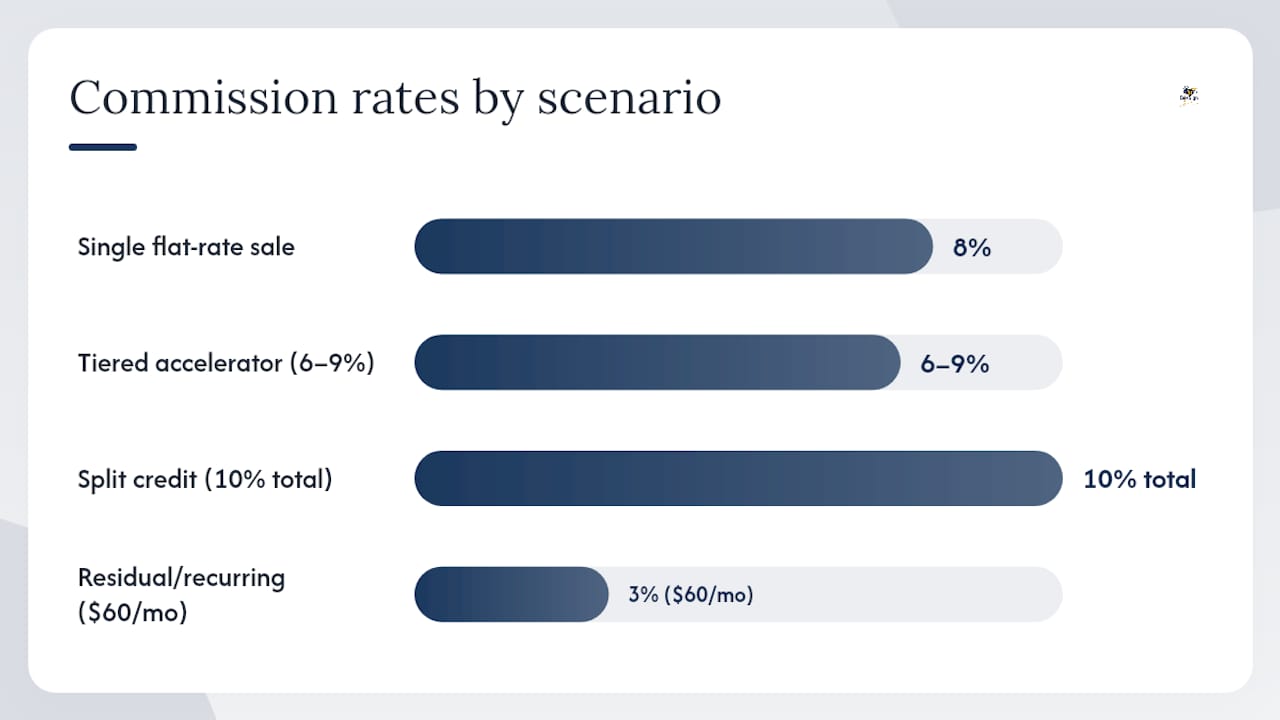
Calculation examples:
| Scenario | Rate | Base | Commission Earned |
|---|---|---|---|
| Single flat-rate sale | 8% of net revenue | — | — |
| Tiered accelerator | 6% up to $100,000, 9% above | — | — |
| Split credit (two reps) | 10% total, 50/50 split | — | — |
| Residual/recurring | 3% of monthly subscription | — | $60/month ongoing |
Handling cancellations and chargebacks: The agreement should state that a commission paid on a transaction that is later cancelled or charged back is subject to offset against future commissions, or repayment within a defined period (commonly 30–60 days). Without this language, recovering an overpaid commission is legally difficult in many U.S. states.
Commissionly’s sales and commission agreement guide recommends specifying whether partial payments trigger partial commissions or whether the full payment must be received first. Both approaches are valid; the agreement just needs to say which one applies.
What happens to commissions when the agreement ends?
Duration and termination provisions are where many commission agreements fall short. A common term is one year with automatic renewal unless either party provides 30 days’ written notice. That language is standard and enforceable, but it leaves the post-termination question open if not addressed separately.
Post-termination commission rights depend entirely on what the agreement says. Courts in most U.S. states will enforce the written terms, so the agreement should answer:
- Are commissions on deals closed before the termination date paid out after termination? (Usually yes, if the trigger was met before termination.)
- Are commissions on deals in progress at termination paid if they close after the termination date? (This is negotiable; define a “tail period” of 30–90 days if the earner should receive credit.)
- Does termination for cause forfeit post-termination commissions? (Many agreements say yes; state this explicitly.)
A sample post-termination clause: “Upon termination of this Agreement for any reason, Company shall pay Agent all commissions earned on transactions where the payment trigger was satisfied prior to the effective date of termination. No commission shall be earned on transactions that close after the termination date, except as provided in the 30-day tail period set forth in Section [X].”
Clawbacks must be written carefully to be enforceable. Several U.S. states, including California, restrict clawback provisions for employees. For independent contractors, clawbacks are generally enforceable if the agreement specifies the triggering event, the amount subject to recovery, and the repayment timeline. The Department of Labor’s guidance on wages is the relevant federal reference for employer obligations around commission payroll timing and deductions.
Employee vs. independent contractor: why classification matters
How you classify the earner affects payroll taxes, benefits obligations, and which labor laws apply. Getting it wrong exposes the payer to back taxes, penalties, and potential wage claims.
- W-2 employee: The payer withholds federal and state income tax, Social Security, and Medicare. Commissions are wages subject to the Fair Labor Standards Act and state wage payment laws. The payer issues a W-2 at year-end.
- 1099 independent contractor: The earner is responsible for self-employment taxes. The payer issues a 1099-NEC for payments of $600 or more in a calendar year. No withholding is required.
The IRS and courts evaluate classification using a multi-factor test focused on behavioral control (does the payer control how the work is done?), financial control (does the earner have independent business risk?), and the type of relationship (is there a written contract, benefits, or permanency?). No single factor is determinative.
Practical indicators that support independent-contractor status:
- The earner sets their own schedule and works for multiple clients.
- The earner uses their own tools and bears their own business expenses.
- The agreement explicitly states the earner is an independent contractor and is responsible for their own taxes.
- The payer does not provide training on how to perform the work.
Pro Tip: Add this language to your agreement: “The parties agree that Agent is an independent contractor and not an employee of Company. Agent is solely responsible for all federal, state, and local taxes on compensation received under this Agreement.” Then operate consistently with that classification. A contract clause alone does not create contractor status if the day-to-day relationship looks like employment.
California applies the ABC test under AB5, which is stricter than the federal standard. If either party is based in California, consult a California employment attorney before finalizing the classification.
For payers: issue 1099-NEC forms by January 31 of the following year for any contractor paid $600 or more. Failure to file carries IRS penalties.
How to write a commission agreement: a step-by-step checklist
Use this checklist whether you are drafting from scratch, reviewing a template, or evaluating an agreement someone else sent you. Contractable’s commission agreement guide identifies three core questions every agreement must answer: What triggers the commission? How is it calculated? When is it paid? Build your checklist around those three anchors.
Pre-draft:
- Identify both parties by full legal name and entity type (individual, LLC, corporation).
- Confirm the classification (employee or independent contractor) and document the basis for that decision.
- Choose the commission structure that fits the business model and sales cycle.
- Identify all payment triggers and define them in plain language before drafting.
Drafting:
- Write the scope of work section: what products, services, or territories are covered.
- State the commission rate and calculation method with inline definitions for every financial term.
- Write the payment trigger clause using specific, observable events.
- Add payment timing: interval, contingency on customer payment, and any holdback period.
- Include crediting and split rules if multiple earners are involved.
- Add reporting obligations: what records the payer provides, how often, and in what format.
- Add audit rights: the earner’s right to request supporting documentation within a defined period.
- Write the termination clause: notice period, for-cause vs. without-cause, and post-termination tail.
- Add the clawback clause with triggering events, recovery amount, and repayment timeline.
- Include governing law (name the state), dispute resolution method, and remedies for nonpayment.
Before signing:
- Confirm both parties’ signatures are captured (wet ink or a legally valid e-signature).
- Verify notice addresses are current and correct.
- Check that the governing law clause names a specific U.S. state.
- Confirm the agreement is stored in a retrievable, tamper-evident format.
Red flags to watch for:
- Commission rate defined without specifying the base (gross vs. net).
- Payment trigger is “upon sale” with no definition of “sale.”
- No audit or reporting rights for the earner.
- Clawback clause with no defined repayment timeline.
- Missing governing law clause.
A legal contract approval workflow that routes the draft through review before signature catches most of these issues before they become problems.
Are e-signatures legally valid for commission agreements?
Yes, in the United States. The Electronic Signatures in Global and National Commerce Act (ESIGN) and the Uniform Electronic Transactions Act (UETA), adopted in 49 states, give electronic signatures the same legal weight as handwritten ones for commercial contracts, including commission agreements. The Statute of Frauds requires certain contracts to be in writing; an e-signed document satisfies that requirement.
What matters legally is not the technology but the audit trail. A valid e-signature process should capture:
- The signer’s identity (email, IP address, and ideally government ID verification or biometric face matching).
- The exact time and date of signature.
- The document version signed (a hash or checksum that proves the document was not altered after signing).
- A complete audit log of every action taken on the document.
Best-practice checklist for signing and storing commission agreements:
- Use a platform that captures a time-stamped audit trail for every signing event.
- Enable identity verification (government ID capture or biometric matching) for high-value agreements.
- Store the signed document and its audit trail together, in a tamper-evident format.
- Use version control so you can prove which version was signed if a dispute arises.
- Set up automatic reminders for renewal dates and post-termination tail periods.
When a commission dispute reaches litigation, the signing record is often the first thing a court examines. A complete audit trail, with timestamps and identity verification, makes breach claims straightforward to prove. Platforms that provide agreement workflow automation handle this automatically, removing the risk of a missing or incomplete record.
Annotated sample commission agreement
The SEC’s public commission sales agreement exhibit is one of the best free templates available. Because it was filed under public disclosure requirements, every clause was written to withstand scrutiny. Use it as a structural reference, then adapt the language to your business model and state law.
Here is a compact annotated sample covering the most important clauses:
COMMISSION AGREEMENT
This Commission Agreement (“Agreement”) is entered into as of [Date] by and between [Company Name], a [State] [entity type] (“Company”), and [Agent Name], a [State] [entity type] (“Agent”).
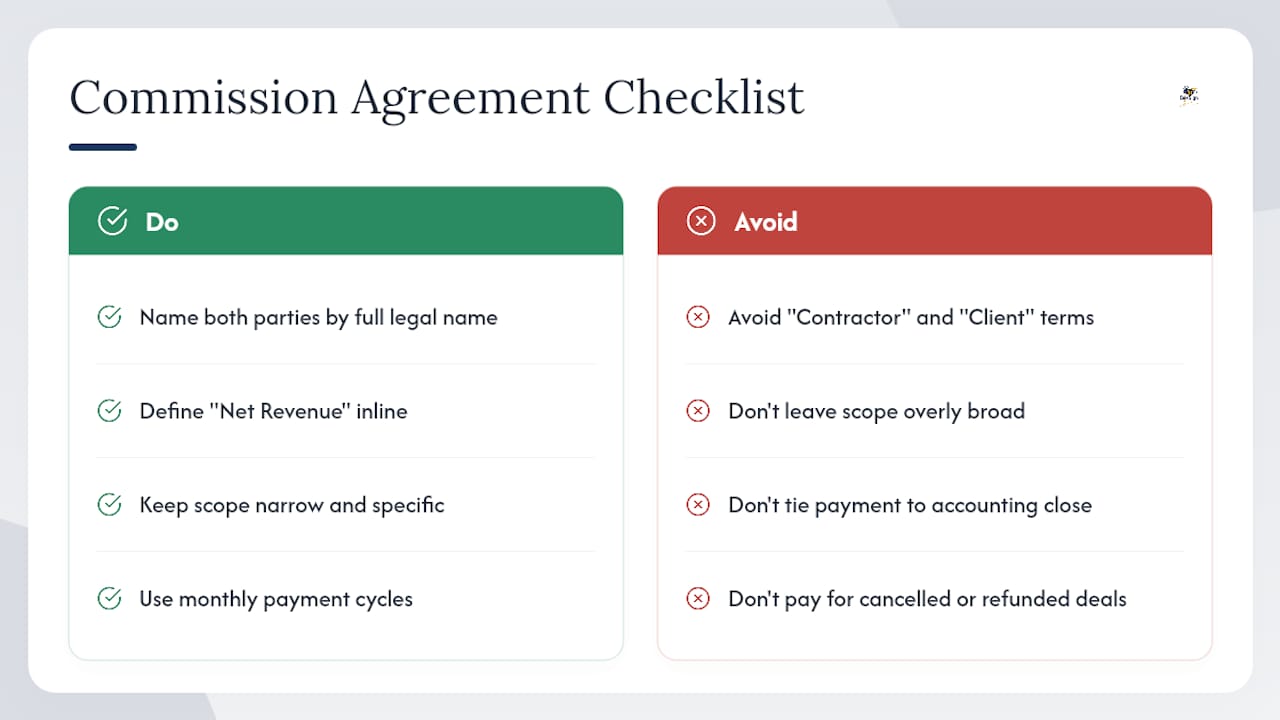
Annotation: Name both parties by full legal name and entity type. “Company” and “Agent” become the defined terms used throughout. Avoid “Contractor” and “Client” if those terms appear elsewhere in a broader services agreement, to prevent ambiguity.
1. Scope of Services. Agent agrees to [describe services, e.g., solicit orders for Company’s products in the Territory defined in Section 4].
Annotation: Keep the scope narrow and specific. A broad scope clause (“all sales activities”) creates disputes about which transactions qualify for commission.
2. Commission Rate. Company shall pay Agent a commission of [X]% of Net Revenue on each Qualifying Transaction. “Net Revenue” means the total invoice amount paid by the customer, less any returns, refunds, and applicable taxes.
Annotation: Define Net Revenue inline. This is the single most important definition in the agreement. Negotiation variant: some payers define net revenue to also exclude shipping and implementation fees; earners should push back on exclusions that are not standard costs of the sale.
3. Payment Trigger. A commission is earned when (a) the customer executes a written order agreement, and (b) Company receives full payment of the customer’s first invoice. No commission is earned on a transaction that is cancelled or refunded before full payment is received.
Annotation: Two-part triggers (signed contract AND paid invoice) protect the payer from paying commissions on deals that fall through. Earners should negotiate for a single trigger (signed contract) or a partial commission on partial payment.
4. Payment Timing. Earned commissions shall be paid within [15/30] days following the end of the calendar month in which the payment trigger is satisfied.
Annotation: Monthly payment cycles are standard. Earners should resist language that ties payment to the payer’s internal accounting close, which can delay payment indefinitely.
5. Term and Termination. This Agreement commences on [Date] and continues for one (1) year, renewing automatically unless either party provides 30 days’ written notice. Either party may terminate for cause upon 10 days’ written notice specifying the breach.
6. Post-Termination Commissions. Commissions on transactions where the payment trigger was satisfied before the termination date shall be paid within 30 days of termination. No commission is earned on transactions closing after the termination date.
7. Audit Rights. Company shall provide Agent with a monthly commission statement. Agent may, upon 10 days’ written notice, audit the records supporting any commission statement, at Agent’s expense, no more than once per calendar year.
8. Governing Law. This Agreement is governed by the laws of the State of [State], without regard to conflict-of-law principles. Disputes shall be resolved by binding arbitration under the rules of the American Arbitration Association in [City, State].
Adapt the bracketed fields to your specific situation. The SEC exhibit linked above shows how a publicly filed version handles crediting, exclusivity, and indemnification, which are worth reviewing before finalizing a complex agreement.
Key Takeaways
A commission agreement is enforceable only when it defines the trigger, the calculation method, and the payment timing with enough precision that both parties can apply the terms without interpretation.
| Point | Details |
|---|---|
| Define the trigger precisely | State the exact observable event (signed contract, paid invoice) that makes a commission earned. |
| Specify net vs. gross inline | Define every financial term used in the rate clause to prevent the most common calculation disputes. |
| Include audit rights | Give the earner the right to review supporting records; this clause alone prevents most post-payment disputes. |
| Match structure to sales cycle | Choose a commission structure (straight percentage, tiered, residual) that aligns with your deal length and payment terms. |
| Use Beesign for signing and storage | Beesign captures a time-stamped audit trail and identity verification, giving every signed commission agreement a court-ready record. |
The clause that actually protects you
Most people treat the commission rate as the most important line in the agreement. After reviewing commission disputes across industries, the trigger clause is where agreements actually succeed or fail.
A rate of 8% is meaningless if the agreement does not define when that 8% is earned. “Upon sale” has been litigated thousands of times in U.S. courts, and the outcomes vary by state, by judge, and by whatever surrounding evidence the parties can produce. A two-part trigger, signed contract plus paid invoice, with a clear definition of each term, removes that ambiguity entirely. It is not a negotiation concession; it is a drafting standard.
The second underappreciated clause is the audit right. Earners often skip it because asking for audit rights feels adversarial. It is not. A payer who is calculating correctly has nothing to fear from a monthly commission statement and an annual audit right. An earner who waives audit rights has no practical way to verify their pay, and no legal standing to challenge a calculation they cannot inspect.
The third thing most agreements get wrong is the post-termination tail. Both parties focus on the rate and the trigger during negotiation, then leave the termination section as boilerplate. Six months later, when a rep leaves with deals in progress, the boilerplate becomes the entire dispute. Write the tail period explicitly: 30, 60, or 90 days, with a clear list of which deals qualify. That specificity takes 10 minutes to draft and saves weeks of litigation.
Beesign makes commission agreements faster to sign and easier to enforce
Getting a commission agreement signed quickly matters, but getting it signed correctly matters more. Beesign gives sales teams, brokers, and business owners a signing workflow that captures everything a court needs to enforce the agreement: a time-stamped audit trail, government ID verification, biometric face matching, and blockchain timestamp proof, all stored in a tamper-evident record.

For commission agreements specifically, Beesign’s platform supports:
- Identity verification — (government ID capture and biometric matching) for high-value agreements.
Beesign complies with ESIGN, UETA, and eIDAS, so every signed agreement carries the same legal weight as a wet-ink signature. Start with a 7-day free trial and sign your first commission agreement today.
Useful sources and references
These sources informed this guide and are worth bookmarking for drafting, reviewing, or researching commission agreements:
- Sales Commission Agreement: What to Include | Xactly
- Commission Sales Agreement
- Wages | U.S. Department of Labor
- 10 Commission Structures & Plans to Motivate and Scale | Rippling
- Commission Agreement | Legal Glossary - Barnes Walker
- Sales and Commission Agreement Guide - Commissionly.io
- Commission structure for sales | Indeed
- Commission Agreement Template: How to Write One (Rates, Clauses & Examples) | Contractable
This article provides general information about commission agreements in the United States and is not legal advice. Consult a qualified attorney to review any agreement before signing, particularly for agreements involving California law, non-compete provisions, or high-value transactions.
Recommended
Ready to transform your workflow?
Start using BeeSign today and experience the future of document signing