What Is a Marketplace Seller Agreement? A Practical Breakdown
Discover the essentials of a marketplace seller agreement and learn how to navigate fees, indemnity clauses, and termination rules effectively.

A marketplace seller agreement is the legally binding contract between you and an e-commerce platform that sets the rules for listing, selling, getting paid, and staying in good standing. It forms the moment you accept the platform’s terms, usually by clicking “agree” during onboarding, and it governs your account for as long as you sell there.
If you read nothing else, do this: audit the fee schedule, the indemnity clause, and the termination triggers before you sign anything. Those three sections cause the most disputes and the most account suspensions. Standards like ESIGN govern how these contracts get signed electronically, and platform terms like Best Buy’s marketplace standard terms show how detailed these documents actually get.
- Check the fee schedule for hidden commission tiers and payment-processing charges.
- Read the indemnity clause. It decides who pays when a customer sues over a defective product.
- Find the termination section. Know exactly what triggers a suspension before it happens to you.
Pro Tip: Marketplace agreements can be long, but the sections that actually decide your risk exposure, fees, indemnities, and termination typically fit within a concise portion.
Key Takeaways
The three clauses that determine most seller disputes are fees, indemnities, and termination triggers, and reviewing them before signing prevents the majority of costly surprises.
| Point | Details |
|---|---|
| Audit fees first | Calculate net margin using the highest fee tier, including reserve holds and payment processing. |
| Indemnity scope matters | Check whether the clause is mutual or one-directional before accepting ongoing liability. |
| Survival clauses outlast termination | Some obligations, especially indemnities, continue after your account closes. |
| Policy updates are usually unilateral | Look for effective-date language and request longer notice periods where you have volume leverage. |
| Sign with a verifiable audit trail | Identity-verified e-signature and secure storage protect you if a dispute reaches arbitration. |
Table of Contents
- What a Marketplace Seller Agreement Covers, Section by Section
- Fees, Commissions, and Payout Terms That Affect Your Margin
- Operational Rules: Listings, Fulfillment, and Performance Metrics
- Liability, Indemnities, and What You’re Giving Up on IP
- Termination, Suspension, and How Disputes Get Resolved
- Policy Changes and Where You Actually Have Leverage
- Your Seller Agreement Checklist: Review, Sign, and Store It Right
- Where to Read the Actual Contract Language
- What Most Sellers Get Wrong About These Contracts
- Sources
What a Marketplace Seller Agreement Covers, Section by Section
Every marketplace contract follows a similar skeleton, even when the wording varies by platform. Knowing the standard sections means you can scan any new agreement and find the parts that matter in minutes instead of hours. A marketplace seller agreement governs onboarding, listing obligations, fee schedules, IP rights, and dispute processes across the life of your account, so treating it as a checklist rather than a wall of legal text is the right instinct.
- Definitions. This section sets the meaning of terms like “listing,” “order,” and “commission event” that get referenced everywhere else in the document.
- Account eligibility. Requirements around business registration, tax ID, and sometimes minimum inventory or sales history.
- Listing rules. What product data you must provide, how categories work, and restrictions on duplicate listings.
- Prohibited items. Categories the platform bans outright, from counterfeit goods to certain regulated products.
- Fees. Commission percentages, listing charges, and payment-processing costs.
- Fulfillment. Shipping timelines, packaging standards, and tracking requirements.
- Returns. Who absorbs the cost of a return and how refund timing works.
- Termination. Conditions under which the platform can suspend or close your account.
- Dispute resolution. How conflicts get resolved, often through arbitration rather than court.
AWS Marketplace’s own agreements overview shows a useful mechanic worth understanding regardless of which platform you sell on: the agreement typically becomes binding the moment you accept an offer, not when a human reviews it. Best Buy’s standard terms use a similarly modular layout, breaking out “Agreement Documents” and “Excluded Products” as separate defined sections rather than burying them in dense paragraphs. That structure is common enough that once you’ve read one platform’s terms carefully, the next one reads much faster.
Fees, Commissions, and Payout Terms That Affect Your Margin
Commercial terms determine whether your listing is actually profitable, and they’re often the section sellers skim fastest. That’s a mistake, because fee structures on major marketplaces frequently combine four separate charges rather than one flat rate.
- Commission fees: a percentage of each sale, often varying by product category.
- Listing fees: flat charges for creating or maintaining a product listing, regardless of whether it sells.
- Fulfillment fees: charges tied to platform-managed storage, packing, and shipping.
- Payment-processing fees: a separate cut taken for handling the transaction itself.
Fee comparison tools like Marketplace Seller Fees can help you see how commission and processing rates stack up across platforms like eBay and Mercari before you commit inventory to one channel.
Payout timing deserves its own scrutiny. Some agreements release funds within a few business days of delivery confirmation; others hold a rolling reserve, often a percentage of your revenue, for weeks to cover potential chargebacks or returns. That reserve language is easy to miss because it’s usually tucked into a “Payments” or “Reserve” subsection rather than the main fee table.
Watch for two clause types that quietly compress margin. Fee-change clauses let the platform adjust commission rates with limited notice, sometimes as little as 30 days. Pricing-parity clauses can require you to keep your marketplace price at or below what you charge anywhere else, which limits your ability to run promotions on your own site without also discounting on the platform. Some agreements go further and require participation in platform-wide sales events as a condition of maintaining good account standing.
Pro Tip: Calculate your true net margin using the platform’s highest advertised fee tier, not the lowest, before you commit to sourcing inventory around that channel.
Operational Rules: Listings, Fulfillment, and Performance Metrics
Operational clauses turn into real compliance work fast, and they’re where most account penalties actually originate. Listing accuracy requirements mean product titles, images, and specifications have to match what ships, with mismatches sometimes triggering automatic listing removal.
- Prohibited-item lists vary by platform and category, so a product allowed on one marketplace may be banned on another.
- Merchant-fulfilled sellers handle their own shipping and are measured on ship time and tracking upload speed; platform-fulfilled sellers hand that off but pay storage and pick-pack fees instead.
- Performance metrics typically include on-time shipping rate, order defect rate, and cancellation rate, each with a threshold that triggers a warning or suspension.
- Return-rate penalties can include reduced search visibility even before an account faces suspension.
Sellers running their own logistics should compare these obligations against their fulfillment center agreement terms, since a mismatch between what the marketplace expects and what your fulfillment partner actually delivers is a common, avoidable cause of performance strikes.
Liability, Indemnities, and What You’re Giving Up on IP
Indemnity clauses shift legal risk onto you, often more than sellers expect when they first sign. A typical clause requires you to cover the platform’s legal costs if a customer sues over a defective product, a copyright claim, or a safety issue tied to something you listed. That obligation frequently survives account termination.
- Indemnification: you agree to defend and cover the platform against claims arising from your products or listings.
- Limitation of liability: the platform typically caps its own liability to you, often at a small multiple of fees paid, while your liability to them stays open-ended.
- Survival clauses: specific obligations, indemnities especially, that continue after your account closes.
- IP licensing: by listing content, you usually grant the platform a broad license to use your images and text for marketing.
- Data access: platforms often retain rights to customer and sales data collected through your storefront, even after you leave.
Practitioners consistently flag broad indemnities and survival clauses as the costliest terms sellers overlook, since they create liability that outlasts the business relationship itself. If you’re licensing branded content or co-selling under a shared identity, review how those terms interact with any co-branding agreement you’ve signed separately.
Pro Tip: Ask specifically whether the indemnity clause is mutual or one-directional. A one-way indemnity favoring the platform is standard, but the scope of what counts as a “claim” is often negotiable for larger sellers.

Termination, Suspension, and How Disputes Get Resolved
Account suspensions rarely come with much warning, and understanding the mechanics ahead of time changes how you respond when one hits.
- Common triggers include performance metric violations, prohibited-item listings, intellectual property complaints, and suspected fraud. Any one of these can result in immediate fund holds and delisting, often before you’re given a chance to explain.
- Appeals processes typically require a written plan of action addressing the root cause. Reinstatement timelines vary widely, from a few days for minor policy violations to several weeks for account-integrity issues.
- Governing law and arbitration clauses usually route disputes to arbitration in a jurisdiction the platform chooses, which limits your ability to file a lawsuit in your own state or seek a jury trial.
Best Buy’s standard terms, like many marketplace agreements, spell out specific remedies the platform can apply short of full termination, including temporary listing removal or payout holds, giving sellers a narrower first response before the relationship ends entirely.
Policy Changes and Where You Actually Have Leverage
Marketplaces routinely reserve the right to update policies without renegotiating your contract. Look for language granting the platform authority to amend terms “at any time” with notice delivered through an email or dashboard alert rather than a signed amendment. Legal analysis of marketplace governance confirms this pattern is standard practice, not an aggressive outlier, and that effective-date language in the update notice is what actually determines when you’re bound to the new terms.
That doesn’t mean you have zero leverage, especially as your sales volume grows.
- Volume commitments: sellers moving significant revenue can often negotiate fee caps or dedicated account support.
- Verified business status: completing enhanced verification sometimes unlocks better payout terms or reduced reserve holds.
- Legal review requests: asking for a 30 day review window before a policy change takes effect is a reasonable, and sometimes successful, ask for established sellers.
A workable negotiation script: “We’d like a 60 day notice period for fee changes affecting our top-selling categories, and we’re requesting the indemnity clause be limited to claims arising from our direct negligence.” Most platforms won’t rewrite standard terms for a new seller, but established accounts with real volume get further than sellers assume.
Your Seller Agreement Checklist: Review, Sign, and Store It Right
Turn everything above into a repeatable workflow instead of a one-time read-through.
- Confirm the fee schedule, including any reserve or hold percentage.
- Locate the indemnity clause and check whether it’s one-directional.
- Find the termination triggers and appeals timeline.
- Check for survival clauses that outlast account closure.
- Note the effective-date language for policy updates.
The workflow itself matters as much as the checklist. Receive the agreement, highlight the risk clauses above, request narrow edits where you have leverage, then sign with identity verification attached so there’s no question later about who agreed to what. Beesign supports this exact process: white-label signing keeps the experience under your own brand, built-in identity verification with government ID capture confirms who’s actually signing, and bring-your-own-cloud storage means the signed agreement and its full audit trail stay inside your own infrastructure rather than a third party’s servers. For teams managing multiple marketplace contracts, the API can automate routing and archiving so nothing gets signed without a paper trail you can produce if a dispute ever lands in arbitration.
Pro Tip: Store every signed version of a marketplace agreement, not just the current one. Platforms update terms often, and having the version you actually agreed to matters if a dispute references an older clause.
Where to Read the Actual Contract Language
- AWS Marketplace agreements overview
- Best Buy marketplace standard terms
- Vendor compliance checklist
- BeeSign for sales and business agreements
What Most Sellers Get Wrong About These Contracts
Most advice on marketplace seller agreements focuses on fees, and fees matter, but they’re not where sellers actually get hurt. The costlier pattern is indemnity and survival language that keeps obligations alive long after an account closes. Sellers read the commission percentage carefully and skim the legal boilerplate, when the boilerplate is usually where the platform shifted the real risk.
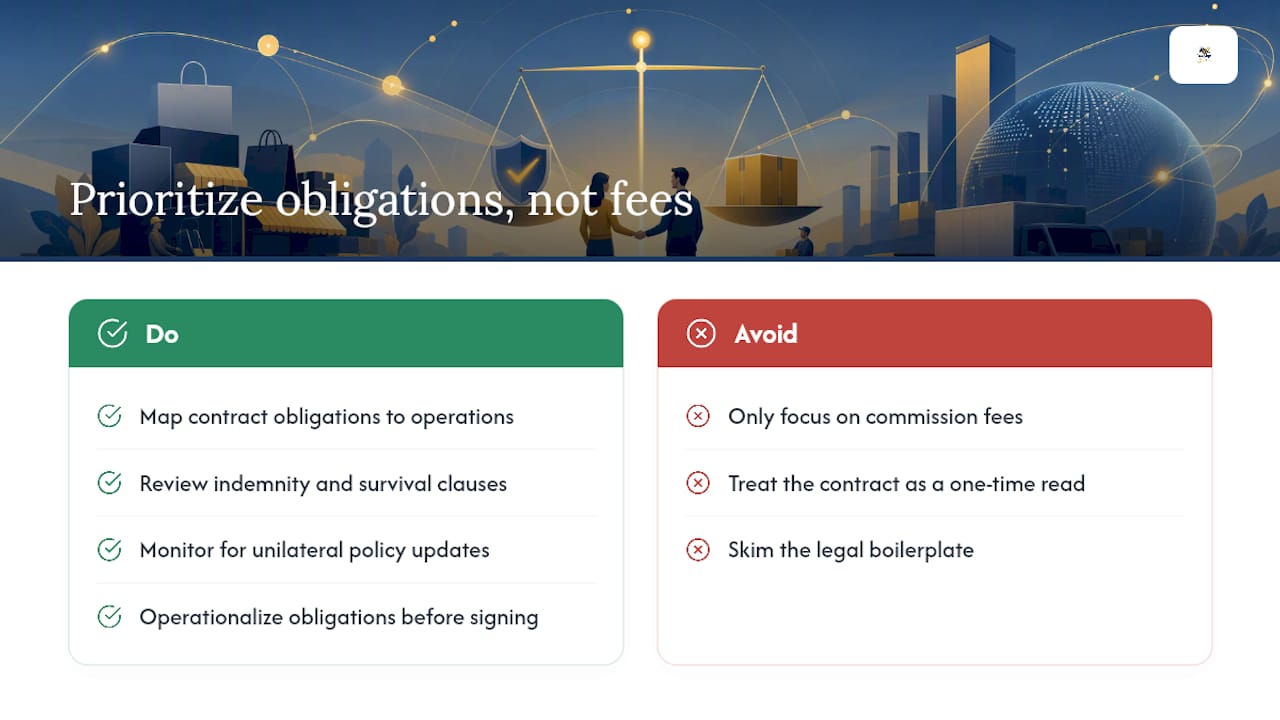
The conventional advice to “read the terms carefully” also undersells how much these documents change without warning. Unilateral policy updates aren’t an edge case; they’re the default structure of nearly every marketplace agreement in circulation. Sellers who treat their contract as a static document they read once are the ones blindsided by a fee change or a new prohibited-items rule six months later.
If you take one thing from this, prioritize operationalizing your obligations, not just reading them. Map what the contract requires against your actual fulfillment capacity and customer-service response times before you sign, not after a performance strike shows up in your dashboard.
— Mustafa Abusharkh
Sources
- AWS Marketplace agreements overview
- Best Buy marketplace standard terms
- What are marketplace seller agreements? — Distrilink
- Indiana Law Journal repository: analysis of marketplace policy changes
Recommended
Ready to transform your workflow?
Start using BeeSign today and experience the future of document signing