What Is an Employee Handbook Acknowledgment Form?
Discover what an employee handbook acknowledgment is and why it’s essential. Learn how it protects your business and supports HR practices.

An employee handbook acknowledgment is a signed confirmation that an employee received the handbook and had a chance to review it. That single document is your primary proof of distribution and one of your strongest legal safeguards if a dispute ever lands in front of an arbitrator or judge.
The form itself is short, but it does heavy lifting:
- It confirms the employee received the handbook on a specific date.
- It creates a paper trail you can point to during performance reviews, discipline, or termination disputes.
- It should be collected during onboarding and again whenever you roll out a significant policy update.
Skip it, and you’re left arguing “we told them” with nothing to back it up.
Key Takeaways
A signed employee handbook acknowledgment proves distribution and notice, and it protects employers only when it pairs at-will and non-contract language with consistent collection and secure storage.
| Point | Details |
|---|---|
| Define the document correctly | It’s proof of receipt and review, not a binding contract between employer and employee. |
| Include three core clauses | At-will status, non-contract disclaimer, and a policy-change reservation belong on every form. |
| Collect at two key moments | Gather signatures at onboarding and again after any material handbook update. |
| Document refusals immediately | Note the refusal, get a witness signature, and keep applying policies consistently. |
| Store digitally with audit trails | Timestamped e-signatures reduce the risk of missing pages and speed up retrieval during disputes. |
Table of Contents
- Understanding Handbook Acknowledgment: Formats HR Actually Uses
- Why a Signed Acknowledgment Matters for Legal Protection
- Essential Elements Every Acknowledgment Form Should Include
- When and How to Collect Handbook Acknowledgments
- What to Do When an Employee Refuses to Sign
- A Copy-Ready Handbook Acknowledgment Template
- Recordkeeping Best Practices for Signed Acknowledgments
- How E-Signature Workflows Strengthen Handbook Compliance
- Frequently Asked Questions
- Sources
Understanding Handbook Acknowledgment: Formats HR Actually Uses
A signed acknowledgment proves notice. It doesn’t create a contract, and that distinction matters more than most first-time HR managers realize. The form says, in effect, “I received this and understand it’s not a promise of continued employment,” not “I agree to be legally bound by every sentence inside.”
You’ll typically see three formats in the field:
- Paper signature page, stapled to the back of a printed handbook, filed physically. Simple, but easy to misplace and slow to retrieve.
- Scanned signed copy, stored as a PDF in a personnel folder. Better than paper alone, but still manual and easy to lose track of across dozens or hundreds of hires.
- E-signature with an audit trail, timestamped and stored digitally. This is the format most compliance-focused HR teams are moving toward because it logs who signed, when, and from where.
Simple wording works best: “I acknowledge that I have received the employee handbook and have had the opportunity to review its contents.” No legalese required.
Why a Signed Acknowledgment Matters for Legal Protection
A signed acknowledgment carries real evidentiary weight. When you’re defending a termination decision or a discipline case, that dated signature shows the employee had notice of the policy they allegedly violated. Without it, you’re relying on memory and assumption, which rarely holds up well in a hearing.
There’s a subtler risk too. A handbook that reads like a binding promise, without disclaimers, can be interpreted by a court as an implied contract. That’s the opposite of what most employers want. Employment in the United States is presumed at-will in every state except Montana, and clear at-will language on the acknowledgment form helps preserve that status by making explicit that the handbook doesn’t override it, according to Cornell Law’s overview of the at-will doctrine.
Model guidance from the Texas Workforce Commission reinforces this: acknowledgment forms should explicitly state at-will status, disclaim contractual intent, and reserve the employer’s right to change policies at any time.
Pro Tip: Put your at-will disclaimer in bold or a separate paragraph on the acknowledgment form itself, not buried in the handbook’s introduction. Courts have scrutinized handbooks where disclaimers were easy to miss.
Essential Elements Every Acknowledgment Form Should Include
A solid acknowledgment form isn’t complicated, but skipping one clause can undercut the whole document’s purpose. Build yours around these core pieces:
- At-will employment statement. Confirms that either party can end employment at any time, for any lawful reason.
- Non-contract disclaimer. States plainly that the handbook is a set of guidelines, not a binding agreement.
- Policy-change reservation. Reserves your right to revise, add, or eliminate policies without prior notice.
- Employee identification fields. Full name, job title, department, and the date the handbook was provided.
- Signature line and witness line. A manager or HR representative signature adds a second layer of documentation.
Beyond the core four, a few additions offer extra protection without adding bulk. An NLRA/Section 7 savings clause is worth including if your handbook touches social media, confidentiality, or conduct policies, since overly broad language there can be read as interfering with employees’ rights to discuss working conditions, per drafting guidance on Lexology. If you’re collecting the form electronically, a short e-sign disclosure confirming the employee consents to sign digitally closes a gap some employers overlook.
One design decision trips people up: how do you handle acceptance of future changes? Two approaches work. You can state that continued employment after a policy update constitutes acceptance, which is common and low-friction. Or you can require a fresh signed re-acknowledgment after material updates, which creates stronger documentation but adds an administrative step. Many HR teams use continued employment for minor edits and a signed re-acknowledgment for major overhauls like a new PTO policy or a revised harassment procedure.
Pro Tip: Keep a version log inside your HR system noting which handbook version each employee acknowledged. If a dispute arises two years later, you need to know exactly which policy language they signed off on.
When and How to Collect Handbook Acknowledgments
Timing follows a simple rule: collect at hiring, and collect again after any material update. A minor typo fix doesn’t need a new signature. A revised leave policy or a new arbitration clause does.
- Present the handbook during onboarding, before or on the employee’s first day, using engaging orientation games to complement handbook distribution.
- Give employees reasonable time to actually read it rather than rushing a signature during a busy first morning.
- Collect the signature and file it immediately, not weeks later when memories and paperwork both go stale.
- After a significant policy change, repeat the process and document the new acknowledgment separately from the original.
Digital collection has a clear edge here. E-signature tools log a precise timestamp, verify the signer’s identity, and make the record instantly searchable, which beats digging through a filing cabinet when an attorney requests documentation five years later, according to HR best practice guidance from Breakroom. If an employee has an accessibility need or can’t sign in the moment, a dated email confirmation or an HR checklist noting the handbook was provided can serve as a backup distribution record.
Pro Tip: If you’re still onboarding with paper, start with just the acknowledgment form as your first digital pilot. It’s the single document HR teams regret losing the most.
What to Do When an Employee Refuses to Sign
Refusals happen. Document them the same day.
- Note the refusal directly on the form, including the date and the employee’s stated reason if given.
- Have a manager or HR witness sign confirming the handbook was presented on that date, per documentation guidance from LegalClarity.
- Keep applying policies to that employee exactly as you would to anyone else. The signature proves distribution; it isn’t what makes the policy binding.
- Loop in legal counsel if the refusal is tied to a broader dispute or if you’re considering disciplinary action over the refusal itself.
A Copy-Ready Handbook Acknowledgment Template
Here’s a template you can adapt directly into your onboarding packet or e-sign flow:
- Header: Company name, “Employee Handbook Acknowledgment of Receipt.”
- Body statement: “I acknowledge that I have received a copy of the [Company Name] Employee Handbook, dated [version/date]. I understand it is a set of guidelines, not a contract of employment, and that my employment is at-will and may be terminated by either party at any time, with or without cause or notice. I understand the company may revise, add, or eliminate policies at its discretion.”
- Optional clause: “Nothing in this handbook is intended to interfere with employees’ rights under Section 7 of the National Labor Relations Act.”
- E-sign disclosure line (if collected digitally): consent to sign electronically under applicable e-signature law.
- Fields: Employee name, job title, department, date, signature line, witness/HR signature line.
Adapt the bracketed language to your state and industry, but treat the at-will and non-contract clauses as non-negotiable. Have counsel review any substantive rewording, especially if you operate across multiple states with different labor requirements.
Recordkeeping Best Practices for Signed Acknowledgments
Store signed forms in the employee’s personnel file, a secure HRIS, or an encrypted document repository with an audit log, echoing the recordkeeping approach SHRM recommends for handbook distribution evidence.
- Timestamp every signature and confirm signer identity at the point of collection.
- Make records searchable by employee name and handbook version, not just by hire date.
- Retain acknowledgments for the duration of employment plus your state’s applicable retention period.
Digital records solve the most common failure point in paper systems: the missing signature page. A scanned folder with one blank page is a liability during an audit or a lawsuit.
How E-Signature Workflows Strengthen Handbook Compliance
Manual acknowledgment tracking breaks down fast once you’re hiring at any volume. A workflow-native e-signature platform closes that gap.
- Audit trails capture who signed, when, and from what device, giving you defensible evidence without manual logging.
- Identity verification, including ID capture and biometric matching, confirms the signer is actually the employee on record.
- Reusable templates mean every new hire gets the current handbook version automatically, with no risk of someone signing an outdated draft.
A typical automated flow looks like this: a handbook template triggers automatically when a new hire is added to onboarding, sends a reminder if unsigned after a set number of days, and archives the completed, timestamped copy the moment it’s signed. Beesign supports exactly this kind of onboarding paperwork automation, and organizations that need acknowledgment forms delivered under their own branding can run the entire workflow through white-label deployment rather than a generic third-party portal.
Pro Tip: Pair your handbook acknowledgment trigger with your onboarding checklist so HR gets a single alert when a new hire has an outstanding signature, instead of manually cross-checking two systems.
A pragmatic recommendation for HR teams
The teams that avoid acknowledgment gaps aren’t the ones with the longest handbooks. They’re the ones who automate the boring part: reminders, storage, and version tracking. Set up a trigger that sends the current handbook version at hire and after every material update, then let the system chase signatures and archive completed copies centrally. Use the template above as a starting point, but have counsel review your at-will and NLRA language before you roll it out company-wide.
Frequently Asked Questions
What is an employee handbook acknowledgment, exactly? It’s a signed statement confirming an employee received the handbook and had the chance to review it. It documents distribution; it doesn’t create binding contractual terms.
Does the acknowledgment form need to be signed every year? No. Collect it at hiring and again only after a material policy change, not on a fixed annual schedule.
Can an employee’s continued employment count as acceptance of handbook updates? Yes, many employers state that continued employment after a policy update constitutes acceptance, though a signed re-acknowledgment offers stronger documentation for major changes.
What happens legally if an employee never signs the acknowledgment? Policies still apply to that employee. The signature is evidence of notice, not the source of the employer’s authority to enforce policy.
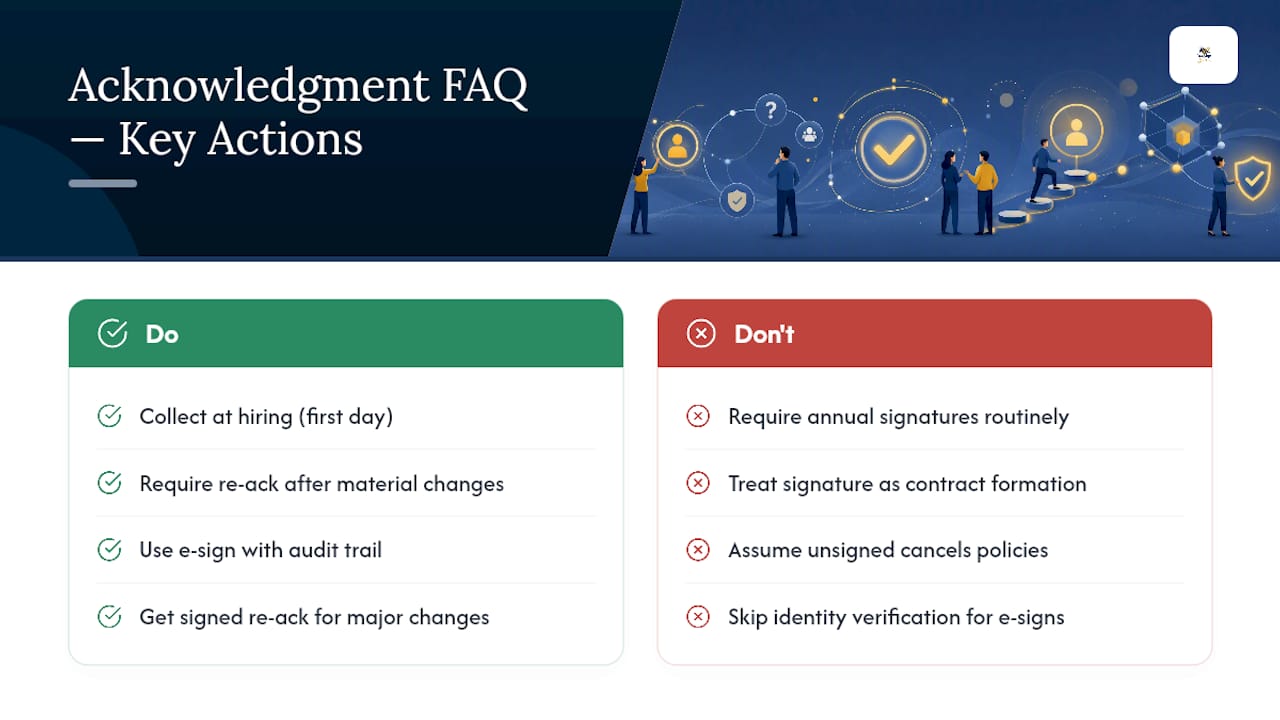
Is an electronic signature valid for a handbook acknowledgment? Yes, an e-signature with a proper audit trail and identity verification is generally accepted and often easier to defend than a paper form, since it timestamps the signing event automatically. Beesign’s electronic signature tools are built for exactly this kind of compliance-sensitive onboarding documentation.
Sources
- Acknowledgment Of Receipt Of Employee Handbook
- Employment at will doctrine — Cornell Law
- Employee handbook receipt acknowledgment — SHRM
- How to draft key provisions of an employee handbook (USA) — Lexology
Recommended
Ready to transform your workflow?
Start using BeeSign today and experience the future of document signing