What Is a Product Licensing Agreement? A Practical Guide
Discover how a product licensing agreement enables businesses to leverage valuable brands and technologies, boosting market reach and revenue.

A product licensing agreement is a contract in which one party, the licensor, grants another party, the licensee, permission to make, sell, or use a specific product, brand, or technology in exchange for payment, usually structured as royalties. The licensor keeps ownership of the underlying intellectual property. The licensee gets legal permission to commercialize it, within limits both sides negotiate up front.
The purpose on each side is different yet complementary. Licensors want revenue and market reach without building factories or sales teams. Licensees want a faster path to market using a product, patent, or brand that already has value, without paying the full cost of developing it from scratch, a tradeoff Investopedia documents consistently across industries.
You’ll see this structure everywhere once you start looking for it:
- A toy company licensing a movie character to put on lunchboxes and backpacks
- A pharmaceutical firm licensing a patented compound to a manufacturer in another country
- A software company licensing its codebase to a hardware maker for embedded use
- A fashion brand licensing its name to a fragrance or eyewear manufacturer
- A university licensing a lab-developed process to a startup for commercial production
Key Takeaways
A product licensing agreement works because it defines exactly what the licensee may do with the licensor’s IP, ties payment to enforceable royalty and audit terms, and assigns ownership of future improvements before disputes can arise.
| Point | Details |
|---|---|
| Check the grant clause first | Confirm the language lists specific permitted activities rather than vague, broad permission. |
| Define the royalty base precisely | Specify gross vs. net sales and list every allowed deduction before signing. |
| Secure real audit rights | Write in reporting frequency, permitted auditors, and consequences for underreporting. |
| Settle improvement ownership early | Choose licensee-owned, licensor-owned, or joint ownership before development starts. |
| Use a workflow tool for execution | Centralize templates, signatures, and audit trails so monitoring clauses get enforced. |
Table of Contents
- What a Product Licensing Agreement Covers
- What Types of Product Licenses Exist?
- Key Elements of a Licensing Agreement You Need to Negotiate
- How Royalties, Advances, and Minimum Guarantees Work
- Weighing the Benefits and Drawbacks on Each Side
- Preparing for Negotiation: Due Diligence and Red Flags
- Sample Clauses and Where to Find Reliable Templates
- Common Drafting Mistakes That Cause Disputes Later
- Running the Deal: Execution, Signatures, and Ongoing Monitoring
- When Should You Bring In a Lawyer?
- A Practical Note on Drafting Speed vs. Legal Protection
- Sources
What a Product Licensing Agreement Covers
At its core, a licensing agreement answers one question: what exactly is the licensee allowed to do, and where are the boundaries? Everything else in the contract exists to define, limit, or enforce that answer.
Start with the vocabulary, because these terms show up in nearly every agreement and their precise wording determines how much freedom the licensee actually has:
- Licensed product — the specific item, technology, or IP covered, defined narrowly enough to avoid scope creep
- Grant — the actual permission being given (make, use, sell, distribute, sublicense)
- Territory — the geographic area where the license applies (a country, a region, worldwide)
- Field of use — the market or application the license is restricted to (medical devices vs. consumer electronics, for example)
- Term — how long the agreement runs before it expires or must be renewed
- Exclusivity — whether the licensor can grant the same rights to others, or keep some for itself
- Sublicensing — whether the licensee can extend rights to a third party
- Improvements — who owns any modifications or new developments made during the license period
The subject matter changes the whole negotiation. A patent license usually centers on technical claims and freedom-to-operate concerns. A trademark license centers on brand consistency and quality control, because a licensor’s name is only as good as the products carrying it. A copyright license (software, media, designs) focuses on reproduction and distribution rights. Know-how licenses, covering trade secrets or unpatented processes, lean heavily on confidentiality because the value disappears the moment the information becomes public.
One distinction trips up a lot of first-time licensees: a license is permission, not ownership. The licensor still owns the underlying IP unless the contract explicitly assigns it. This matters because a nonexclusive patent license is technically a promise not to sue rather than a transfer of rights, a nuance Corporate Finance Institute points out and one that shapes how enforcement and exclusivity clauses get written. Licensing agreements also rarely stand alone. They frequently sit alongside manufacturing, supply, or development agreements, and WIPO’s guidance on related agreements stresses that misaligned timing or pricing between these related contracts is a common source of disputes.
What Types of Product Licenses Exist?
Not every license looks the same, and choosing the wrong structure for your situation creates friction later. Here are the models you’ll encounter most:
- Exclusive license — only the licensee can exploit the rights, even the licensor can’t use them or grant them elsewhere. Higher price, stronger commitment expected in return.
- Nonexclusive license — the licensor can grant the same rights to multiple parties simultaneously. Cheaper for the licensee, but no protection from competition using the identical product.
- Sole license — a middle ground where the licensor keeps the right to use the IP itself but agrees not to license it to anyone else.
- Option agreement — a short-term, low-commitment deal that lets a prospective licensee evaluate the technology or product before signing a full license.
- Technology or manufacturing license — grants rights to produce a patented product or use a proprietary process, common in pharmaceuticals, industrial equipment, and electronics.
- Trademark or merchandising license — grants rights to put a brand or character on a product, common in toys, apparel, and consumer goods.
- Distribution or territory-limited license — grants rights to sell an existing product in a defined geographic market without manufacturing rights.
A startup licensing a patented sensor to a single manufacturer for a defined region typically wants exclusivity to justify the manufacturer’s tooling investment. A brand licensing its logo to ten different apparel makers across ten product categories usually wants nonexclusive rights, because volume across many partners beats depending on one. The right structure follows the business goal, not the other way around, an idea WIPO’s licensing guide frames as a business-first question before any drafting starts: does the deal need broad rights across a product family, or narrow rights to make one specific item?
Key Elements of a Licensing Agreement You Need to Negotiate
Treat this as a checklist. Every clause below is a place where careless wording either costs you money or gives away more than you intended.
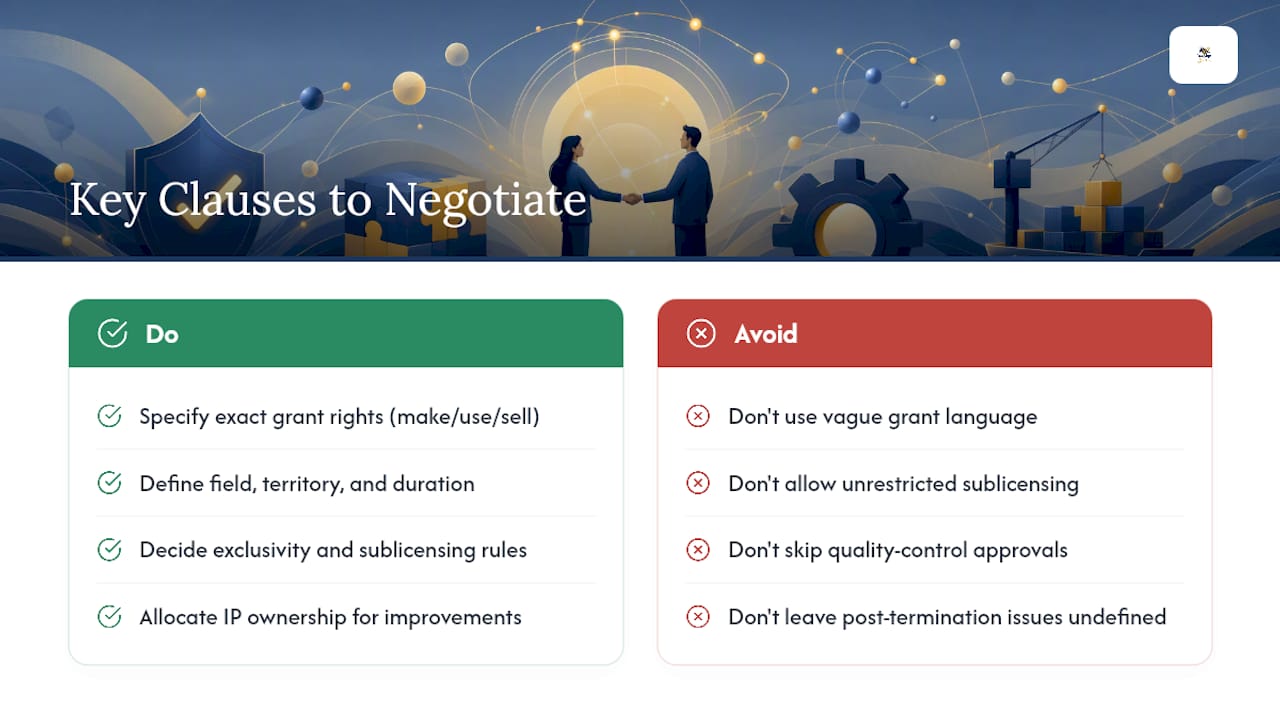
Grant of rights. Read the grant clause twice. Does it say “make, use, and sell” or just “use”? Vague grant language is one of the most common ways a licensor unintentionally hands over broader rights than planned.
Field of use, territory, and duration. These three levers work together. A narrow field of use protects the licensor’s ability to license the same technology into other markets. A broad territory speeds up the licensee’s expansion but limits future deals elsewhere. Duration should match realistic commercialization timelines, not just a round number like five years picked out of habit.
Exclusivity and sublicensing. Decide upfront whether sublicensing is allowed at all, and if so, under what approval process. An unrestricted sublicensing right can put your product in the hands of a company you’ve never vetted.
IP ownership and improvements. This is where deals get messy later if it isn’t addressed early. Practitioners generally use one of three patterns: the licensee owns improvements it makes, the licensor owns them, or ownership is joint with specific carve-outs, according to WIPO’s guidance on structuring these terms. Pick whichever pattern preserves the commercialization rights your business will actually need five years from now.
Quality control and approvals. Especially for trademark and merchandising licenses, the licensor typically retains approval rights over product samples, packaging, and marketing materials. Skipping this clause is how a brand ends up attached to a product it wouldn’t want its name on.
Confidentiality, warranties, indemnities, and liability caps. Confidentiality protects know-how that has no other legal protection once disclosed. Warranties and indemnities allocate risk if the product infringes a third party’s IP or causes harm. Liability caps limit exposure but need to be negotiated against the size of the deal, not accepted as boilerplate. Unclear terms around governing law, dispute resolution, or termination frequently turn into expensive litigation, a pattern licensing guidance from Casrai calls out directly.
Termination and post-termination rights. What happens to unsold inventory when the agreement ends? Can the licensee sell off existing stock for a defined wind-down period? Does trademark use stop immediately or phase out? These questions belong in the contract, not left to a post-termination phone call.
Pro Tip: Before you sign anything, run every draft grant clause through a simple test: read it aloud and ask, “Could this sentence be interpreted more broadly than we intend?” If the answer is yes, rewrite it with a specific list of permitted activities rather than a general description.
How Royalties, Advances, and Minimum Guarantees Work
Money terms are where most negotiations either succeed or stall. Understanding the standard structures before you sit down at the table puts you in a stronger position.
Most product licensing deals use some combination of the following:
| Payment Structure | How It Works |
|---|---|
| Lump-sum fee | A one-time payment, often used for smaller or shorter-term licenses. |
| Royalty (percentage of sales) | Ongoing payments calculated as a percentage of net or gross sales. |
| Per-unit fee | A fixed amount paid for each unit manufactured or sold. |
| Milestone payments | Payments tied to specific development or sales targets being hit. |
| Minimum annual guarantee | A floor payment owed regardless of actual sales performance. |
The royalty base matters as much as the royalty rate. Is the percentage calculated on gross sales or net sales? If it’s net sales, what deductions are allowed, returns, discounts, shipping, taxes? Product licensing guidance consistently flags this as one of the clauses most worth negotiating carefully.
Royalty rates vary widely by industry, and minimum annual guarantees are a common tool licensors use to secure baseline revenue and leverage for renewal negotiations, regardless of how the licensee’s sales actually perform, a practice noted in small-business licensing guidance. A minimum guarantee also signals commitment. A licensee unwilling to accept any floor payment may not be putting real marketing muscle behind the product.
Statistic to watch: Reporting cadence and audit rights directly affect whether a royalty structure actually gets enforced. Without clear inspection provisions, a licensor risks losing both royalty income and quality control, a risk licensing practitioners describe as one of the most common enforcement gaps in real agreements. Vague audit language, no specified frequency, no named permitted auditors, no defined sample size, is often unenforceable when a dispute actually arises.
Currency and price adjustment clauses matter too, particularly for multi-year international deals. Withholding taxes on royalty payments across borders can quietly erode the licensee’s net payment if the contract doesn’t specify who bears that cost.
Weighing the Benefits and Drawbacks on Each Side
Licensing works well for a lot of businesses, but it isn’t automatically the right move for everyone. Here’s the honest tradeoff.
For licensors, the appeal is real:
- Revenue with far lower capital investment than building manufacturing or distribution
- Expanded market reach into regions or channels the licensor couldn’t service alone
- Brand exposure through products the licensor never has to produce
But licensors give something up too:
- Loss of direct control over how the product is made, marketed, or sold
- Reputational risk if the licensee cuts corners on quality
- Revenue dependency on a partner’s execution, not the licensor’s own effort
For licensees, licensing offers a shortcut:
- Faster market entry using an established product or brand instead of building from zero
- Leverage of existing brand equity or proven technology, reducing customer acquisition cost
- Lower research and development spend compared to creating something original
The tradeoffs on the licensee side are just as concrete:
- Ongoing royalty payments that eat into margin for the life of the agreement
- Restrictions on territory, field of use, or product modifications that limit flexibility
- Exposure if the licensor grants competing licenses or lets exclusivity lapse
Licensing generates revenue for the licensor without the cost of manufacturing or distributing, while the licensee gains access to an established product or brand but absorbs the sales risk directly, a dynamic that product licensing overviews frame as the central tradeoff of the whole model. Whether licensing beats building your own product from scratch, or licensing out beats manufacturing in house, depends entirely on your capital position and how fast you need to move.
Is product licensing necessary? Not always. If you have the capital, the manufacturing capacity, and the time to build distribution yourself, licensing may cost you more in royalties over the long run than it saves in speed. Licensing earns its place when time-to-market, brand reach, or specialized capability matters more than owning every part of the value chain.
It’s worth distinguishing licensing from franchising, since the two get confused often. A licensing agreement typically grants rights to a product, technology, or brand mark without dictating how the licensee runs its business. A franchise agreement is far more prescriptive, controlling operations, training, supply chains, and often requiring ongoing fees beyond royalties. If you’re licensing a product formula to an existing manufacturer, that’s a license. If you’re opening a location that must follow a detailed operating manual, that’s a franchise.
Preparing for Negotiation: Due Diligence and Red Flags
Walking into a licensing negotiation without homework is how good deals turn bad. Here’s what real preparation looks like.
Before you discuss a single term, verify the basics: does the licensor actually own the IP being licensed, clear of liens or competing claims? Is there a clean chain of title if the IP changed hands before? Does a freedom-to-operate check show no conflicting third-party rights in the intended territory? For trademark and merchandising deals, ask whether the licensee has functioning quality systems in place, not just promises.

On the commercial side, build a realistic sales forecast before you agree to a minimum guarantee. A licensee who commits to a minimum they can’t hit ends up in breach within the first year. A licensor who sets the minimum too low leaves money on the table and loses renewal leverage.
Negotiation itself is a series of tradeoffs, not a single number to fight over. Aligning business objectives early, before either side gets attached to specific contract language, is what WIPO’s licensing framework identifies as the difference between deals that close smoothly and deals that stall in redlines for months. Anchoring on royalty percentage alone misses the bigger picture. A licensee might accept a higher royalty in exchange for exclusivity, or a lower advance in exchange for a narrower territory that limits future competition from the same licensor.
Pro Tip: Model three scenarios before you negotiate: your realistic sales forecast, an optimistic one, and a pessimistic one. Then check whether the minimum guarantee you’re being asked to accept still makes sense under the pessimistic scenario. If it doesn’t, that’s your opening negotiation point, not a deal breaker.
Watch for these red flags that should slow down or stop a deal entirely:
- Unclear or undocumented IP ownership on the licensor’s side
- No quality control or approval mechanism in a trademark license
- Limited or vague reporting and audit rights on royalty calculations
- Grant language broader or vaguer than the actual business discussion covered
- No defined process for handling improvements or new developments
Sample Clauses and Where to Find Reliable Templates
Seeing real clause language helps more than reading definitions. Here’s roughly how the core clauses tend to read, simplified for illustration:
- Grant clause: “Licensor grants Licensee a nonexclusive, non-transferable license to manufacture and sell the Licensed Product within the Territory during the Term.”
- Royalty clause: “Licensee shall pay Licensor a royalty of [X]% of Net Sales, payable quarterly within thirty (30) days of quarter end.”
- Minimum guarantee clause: “Licensee shall pay Licensor a Minimum Annual Guarantee of [$amount], creditable against royalties earned in that contract year.”
- Termination for breach clause: “Either party may terminate this Agreement upon thirty (30) days’ written notice if the other party materially breaches and fails to cure within the notice period.”
- Improvement ownership clause: “Any improvements to the Licensed Product developed by Licensee during the Term shall be owned by [Licensor/Licensee], subject to a license-back to the other party.”
For real drafting reference rather than illustrative snippets, Harvard’s Office of Technology Development publishes sample licensing agreements that show full clause structure from actual technology transfer deals. For patent- and technology-heavy licenses specifically, AUTM’s Technology Transfer Practice materials contain detailed sample grant and licensed-product language drawn from university licensing offices, which tend to be some of the most heavily negotiated agreements in existence. Real corporate filings offer another angle: some SEC-filed license agreements show exactly how public companies define “Licensed Product” and structure grant language in practice.
Adapting a sample clause to your own deal isn’t a copy-paste job. Replace every placeholder deliberately, check that your definitions section actually matches how terms are used throughout the document, and confirm cross-references still point to the correct section numbers after you edit. Most licensing agreements are heavily negotiated documents, not plug-and-play templates, and treating a sample as a finished contract rather than a starting point is exactly where careful practitioners warn deals go wrong.
Common Drafting Mistakes That Cause Disputes Later
A handful of mistakes show up in dispute after dispute. Each one has a straightforward fix if you catch it before signing.
Vague grant language. Saying “Licensee may use the Licensed Product” without specifying make, sell, distribute, or sublicense invites disagreement about what’s actually permitted. Fix it by listing exact permitted activities and excluding everything else explicitly.
No audit or monitoring rights. A royalty structure with no defined reporting cadence or audit trigger is nearly impossible to enforce. Fix it by specifying reporting frequency, permitted auditors, and consequences for underreporting, ideally with a defined sample size and confidentiality terms around what the audit uncovers.
Undefined royalty base. Failing to define whether royalties calculate on gross or net sales, and what deductions apply, is one of the most common sources of underpayment disputes. Fix it by writing out an explicit list of allowed deductions rather than leaving “net sales” undefined.
Ignoring improvement ownership. Skipping who owns new developments made during the license term sets up a fight the moment something valuable gets invented. Fix it by choosing one of the three standard ownership patterns upfront and writing in carve-outs for background IP that predates the agreement.
Generic templates make all four of these mistakes worse when definitions like “Licensed Product” or “Net Sales” get copied without tailoring them to the actual product SKUs and revenue flows of your specific deal, a pattern that licensing template guidance flags as one of the most preventable sources of future disputes.
Running the Deal: Execution, Signatures, and Ongoing Monitoring
Getting the contract language right is half the job. The other half is executing the deal and keeping it monitored for the life of the agreement, and this is where a lot of well-drafted contracts quietly fail.
A typical execution workflow runs through several stages: a term sheet establishes the broad deal points, negotiation and redlines refine the language, both sides sign off on a final version, and then onboarding and compliance checks confirm the licensee can actually meet quality and reporting obligations from day one. Each stage benefits from a system that tracks changes and approvals rather than an email chain full of attachment versions.
Once the agreement is signed, the operational features that matter most are the ones that connect directly back to the monitoring clauses you negotiated:
- Reusable templates for recurring license types, so each new deal starts from vetted language instead of a blank page
- Role-based approvals that route redlines to the right internal stakeholders before anyone signs
- Identity-verified signatures that create a defensible record of who agreed to what and when
- Complete audit trails that document every change made to the contract during negotiation
- Milestone triggers that flag key dates like royalty reporting deadlines or renewal windows automatically
This is exactly where a workflow-native platform earns its place in the process. A tool like Beesign centralizes contract templates, identity-verified signatures, and audit trails in one system, so the reporting cadence and audit rights you negotiated into the contract actually get enforced operationally instead of falling through the cracks six months later. For businesses running multiple license deals with different partners at once, that centralized record turns a monitoring clause on paper into something you can actually act on when a licensee misses a reporting deadline. Similar principles apply to approval workflows for other complex agreement types, where role-based review speeds up sign-off without sacrificing oversight.
Pro Tip: Set calendar-linked reminders tied to every reporting deadline and renewal window in the contract, not just the signature date. Missed royalty reports are one of the most common reasons audits get triggered later, and most of them come down to a forgotten deadline rather than intentional underreporting.
When Should You Bring In a Lawyer?
Not every licensing deal needs outside counsel, but some situations genuinely shouldn’t be handled without one. Here’s how to draw that line.
Get a lawyer involved when the deal is a high-value exclusive arrangement, when improvement ownership or background IP ownership is complicated, when the deal spans multiple jurisdictions with different IP or tax rules, or when you’re entering a regulatory environment you don’t already understand well. In these situations, the cost of a lawyer is small compared to the cost of a poorly drafted clause discovered years into the deal.
Lawyers typically handle drafting or rewriting the core grant language so it precisely matches business intent, negotiating indemnity and liability provisions that allocate real risk fairly, structuring tax and cross-border transfer provisions, and running IP due diligence to confirm clean title before you sign anything.
For lower-risk deals, you can use counsel more efficiently. Write a prioritized list of specific questions before your first call, use sample templates from sources like Harvard OTD or AUTM to draft a first pass yourself, and reserve billable attorney hours for the clauses that carry the most financial or legal exposure, exclusivity, indemnities, and IP ownership, rather than paying for a full rewrite of routine boilerplate.
This article provides general information about product licensing agreements and is not a substitute for legal advice; confirm your specific contract terms with a qualified attorney before signing.
A Practical Note on Drafting Speed vs. Legal Protection
Most people treat licensing agreements as either a legal problem or a business problem, and that split is where a lot of deals lose momentum. The strongest agreements come from treating both sides as the same conversation from day one, not sequential steps where legal reviews what business already agreed to informally.
The overlooked issue isn’t usually the big clauses like exclusivity or royalty rate. Those get plenty of attention because both sides know they matter. It’s the operational plumbing, reporting cadence, audit triggers, improvement ownership, that gets rushed at the end of a negotiation because everyone’s tired of redlining and wants to sign. That plumbing is exactly what determines whether the deal actually functions three years in, long after the excitement of signing has faded.
My honest view is that speed and protection aren’t actually in tension the way people assume. A well-defined grant clause and a clear royalty base don’t slow a deal down, they prevent the exact disputes that would have slowed it down far worse eighteen months later. The businesses that get licensing right tend to pair careful clause drafting with a system that actually enforces what the contract says, tracking signatures, storing versions, flagging reporting deadlines, rather than trusting that everyone will remember their obligations on a spreadsheet somewhere. Good drafting sets the rules. A reliable workflow is what makes sure those rules get followed after the ink dries.
Sources
A handful of sources are worth going back to as you refine your own agreement, and each serves a different purpose. WIPO’s licensing guides offer high-level guidance on aligning business objectives with contract structure, useful for framing a deal before you write a single clause. Harvard OTD’s sample licensing agreements and AUTM’s technology transfer practice materials give you actual clause language to study or adapt, particularly strong for patent and technology licenses. Investopedia’s licensing agreement explainer works well as a plain-language refresher on core concepts if you need to bring a non-legal stakeholder up to speed quickly.
Use the guidance sources to understand the reasoning behind a clause, and use the template sources to see how that reasoning turns into actual contract language. Neither replaces a lawyer’s review for a high-stakes deal, but both will make your conversation with counsel more efficient because you’ll already understand what’s being negotiated and why.
- Sample Licensing Agreements (Harvard OTD)
- Product licensing
- Licensing Agreement: Definition, Example, Types, and Benefits (Investopedia)
Recommended
Ready to transform your workflow?
Start using BeeSign today and experience the future of document signing